Topic 2.4: The Digestive System
0.0(0)
Studied by 0 people Call Kai
 Learn
Learn Practice Test
 Spaced Repetition
 Match
Match Flashcards
 Knowt Play
Card Sorting
1/53

Earn XP
Description and Tags
Last updated 6:52 PM on 2/6/23
Name | Mastery | Learn | Test | Matching | Spaced | Call with Kai | Chat |
|---|
No analytics yet
Send a link to your students to track their progress
54 Terms
1
New cards
the fate of an apple
* time in the mouth → %%<1 minute%%
* esophagus → %%\~1-2 hours%%
* stomach → small intestine, \~ %%7-8 hours%%
* whatever that hasn’t been absorbed → %%large intestine%%
* large intestine → %%12-14 hours%%
* esophagus → %%\~1-2 hours%%
* stomach → small intestine, \~ %%7-8 hours%%
* whatever that hasn’t been absorbed → %%large intestine%%
* large intestine → %%12-14 hours%%
2
New cards
continuous state of renewal
* bones
* heart
* blood vessels
* nerves
* heart
* blood vessels
* nerves
3
New cards
**Each day _____% of our** %%**body weight**%% **is replaced with new tissue**
5
4
New cards
%%Taste cells%% are replaced every _____ days.
7
5
New cards
%%Intestinal tract lining cells%% are replaced every _____ days
3
6
New cards
Skin cells are replaced every _____.
month
7
New cards
Red blood cells turn over every _____ days.
120
8
New cards
digestion
break food down into its components
9
New cards
aspects of digestion
* mechanical digestion
* chemical digestion
* chemical digestion
10
New cards
mechanical digestion
* chewing
* action of the GI tract %%(gastrointestinal tract)%%
* action of the GI tract %%(gastrointestinal tract)%%
11
New cards
chemical aspects
* gastric juices
12
New cards
digestion is complete when
* carbohydrates (CHO), protein (PRO), and fat are %%reduced%% to substances that can be %%absorbed%%
* when vitamins and minerals are %%released%%
* when vitamins and minerals are %%released%%
13
New cards
Peristalsis
* %%wavelike muscular contractions%% of the GI tract (esophagus to the stomach) that push its contents along
14
New cards
stomach action
* circular, longitudinal and diagonal muscles
* %%chyme%% released %%3 times/min i%%nto intestine
* %%chyme%% released %%3 times/min i%%nto intestine
15
New cards
segmentation
* forward/backward movement to allow for greater contact between food and digestive juices
16
New cards
sphincter contractions
* prevent reflux
17
New cards
absorption
* take it in
* end products of digestion taken up by the %%lymphatic system%% and %%circulatory system%%
* end products of digestion taken up by the %%lymphatic system%% and %%circulatory system%%
18
New cards
circulation
* move it around
* provide all cells with nutrients for %%growth%% and %%regeneration%%
* provide all cells with nutrients for %%growth%% and %%regeneration%%
19
New cards
overview of the digestion system
* %%25-30 ft%% of muscular tube and secretory organs; inner space is called the %%lumen%%
* secreted juices break foods into %%absorbable pieces%%
* carbs → *glucose* and *fructose*, *monosaccharides*
* proteins → *amino acids* (broken down)
* fats → *fatty acids* and *glycerol*
* secreted juices break foods into %%absorbable pieces%%
* carbs → *glucose* and *fructose*, *monosaccharides*
* proteins → *amino acids* (broken down)
* fats → *fatty acids* and *glycerol*
20
New cards
gastric juice
* contains %%water%%, %%enzymes%%, and %%hydrochloric acid%%
* %%pH = 2,%% which is 100 000 times more acidic than water which has pH of 7
* %%epithelial cells%% in the stomach must secrete mucus to protect stomach cell lining
* %%pH = 2,%% which is 100 000 times more acidic than water which has pH of 7
* %%epithelial cells%% in the stomach must secrete mucus to protect stomach cell lining
21
New cards
\
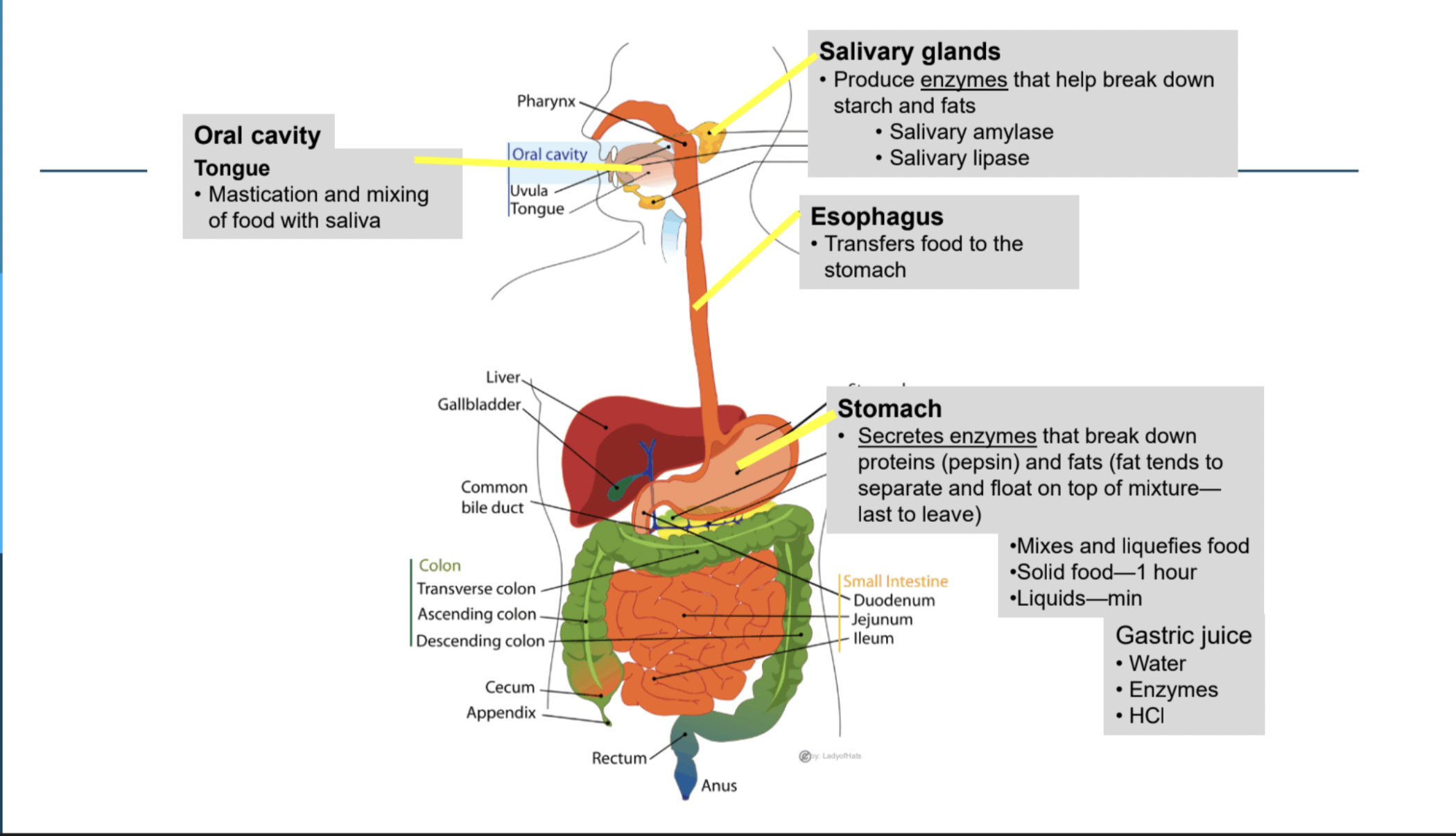
%%oral cavity%% → tongue = mastication and mixing of food with saliva
%%salivary glands%% → produce enzymes that help break down starch and fats (salivary amylase and salivary lipase)
%%esophagus%% → transfers food to the stomach
%%stomach%% → secretes enzymes that break down proteins (pepsin) and fats (fat tends to separate and float on top of mixture— last to leave)
* __mixes and liquefies food__
* solid food—1 hour
* liquids—min
%%salivary glands%% → produce enzymes that help break down starch and fats (salivary amylase and salivary lipase)
%%esophagus%% → transfers food to the stomach
%%stomach%% → secretes enzymes that break down proteins (pepsin) and fats (fat tends to separate and float on top of mixture— last to leave)
* __mixes and liquefies food__
* solid food—1 hour
* liquids—min
22
New cards
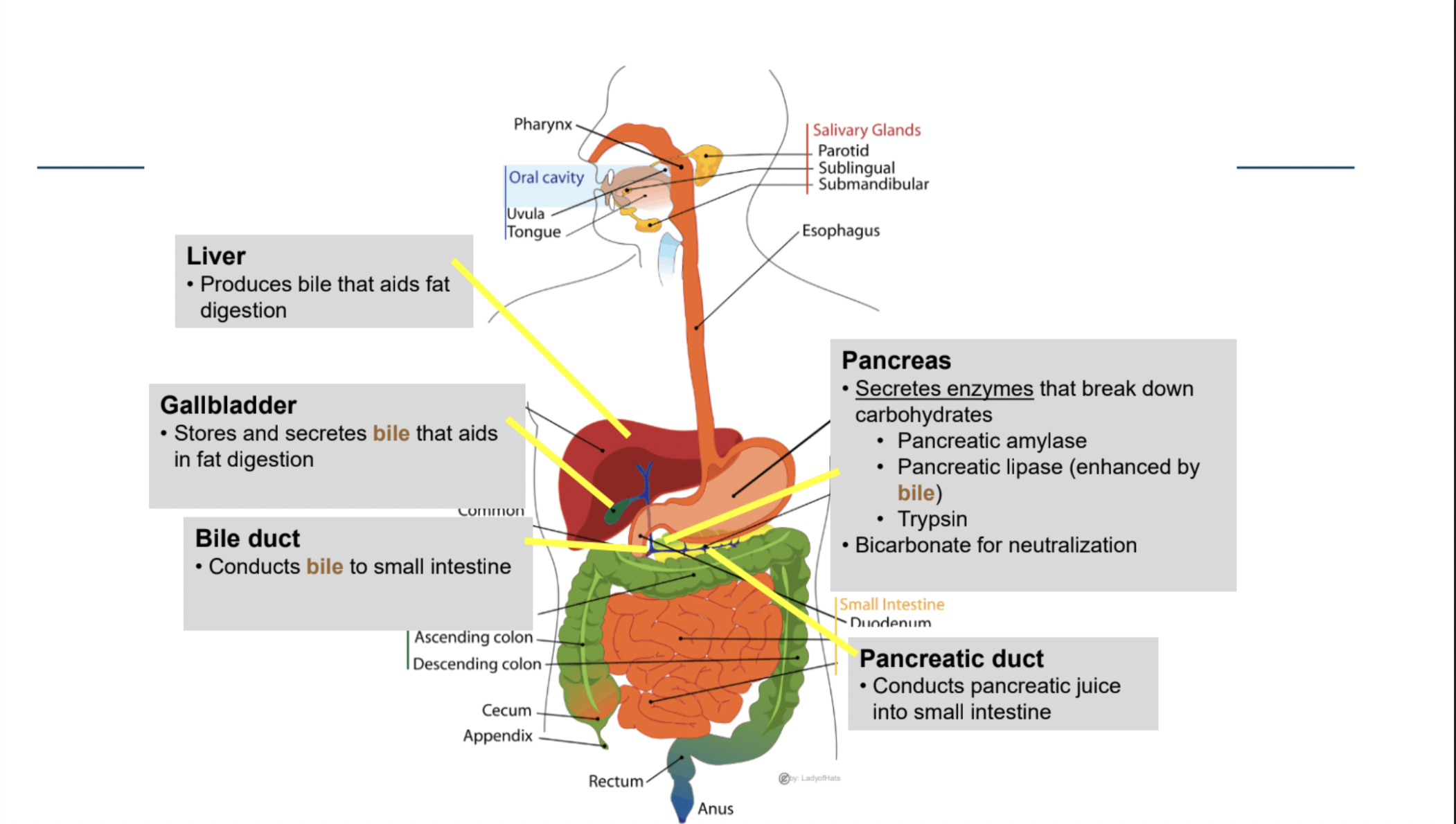
%%liver%% → produces bile that aids fat digestion
%%gallbladder%% → stores and secretes bile that aids in fat digestion
%%bile duct%% → conducts bile to small intestine
%%pancreas%% → Secretes enzymes that break down carbohydrates
• Pancreatic amylase
• Pancreatic lipase (enhanced by bile)
• Trypsin
• Bicarbonate for neutralization
%%pancreatic duct%% → conducts pancreatic juice into small intestine
%%gallbladder%% → stores and secretes bile that aids in fat digestion
%%bile duct%% → conducts bile to small intestine
%%pancreas%% → Secretes enzymes that break down carbohydrates
• Pancreatic amylase
• Pancreatic lipase (enhanced by bile)
• Trypsin
• Bicarbonate for neutralization
%%pancreatic duct%% → conducts pancreatic juice into small intestine
23
New cards
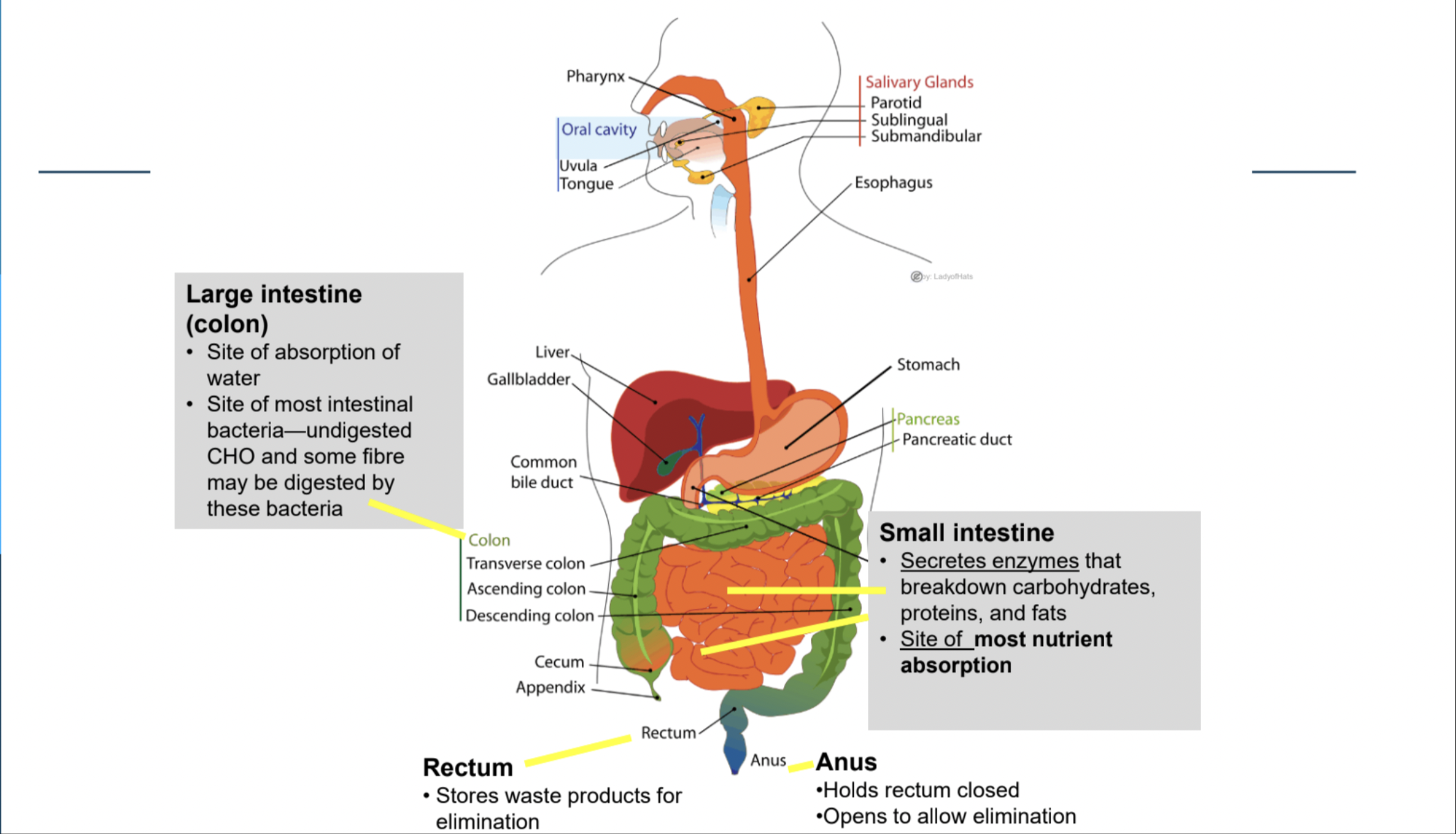
%%large intestine (colon)%% → site of absorption of water, site of most intestinal bacteria—undigested CHO and some fibre may be digested by these bacteria
%%small intestine%% → secretes enzymes that breakdown carbohydrates, proteins, and fats, site of most nutrient absorption
%%rectum%% → stores waste products for elimination
%%anus%% → holds rectum closed, opens to allow elimination
%%small intestine%% → secretes enzymes that breakdown carbohydrates, proteins, and fats, site of most nutrient absorption
%%rectum%% → stores waste products for elimination
%%anus%% → holds rectum closed, opens to allow elimination
24
New cards
cephalic phase
* the %%first step%% of digestion
* it is your first thought, small, sight of what you want to eat
* %%hunger and appetite%% work together to prepare the GI tract to digest food
* it is your first thought, small, sight of what you want to eat
* %%hunger and appetite%% work together to prepare the GI tract to digest food
25
New cards
**absorption and digestion is enhanced by _____ that lies in the intestinal wall**
* villi lining
26
New cards
structures of the intestines
* %%675 square feet%% (1/3 football field)
* much of this need (%%50% in small intestine and 80% in large intestine%%) met by food that is being digested
* much of this need (%%50% in small intestine and 80% in large intestine%%) met by food that is being digested
27
New cards
blood vessels
arteries and veins infiltrate villi:
* arteries %%pick up nutrients%% (CHO & PRO breakdown products)
* veins %%take away wastes%%
* arteries %%pick up nutrients%% (CHO & PRO breakdown products)
* veins %%take away wastes%%
28
New cards
lymphatic system
* vessels infiltrate villi
* %%fat dig by-products%% mostly absorbed by lymph vessels
* lymphatic fluid has substances to bind fat and carry it to blood stream near heart where systems merge to one vessel
* %%fat dig by-products%% mostly absorbed by lymph vessels
* lymphatic fluid has substances to bind fat and carry it to blood stream near heart where systems merge to one vessel
29
New cards
fibre in the digestive tract
* humans have %%no enzymes%% break down fibre
* %%high fibre meals%% pass through the large intestine faster than low fibre meals
* some fibre is digested (ferment) in the large intestine by bacteria
* %%high fibre meals%% pass through the large intestine faster than low fibre meals
* some fibre is digested (ferment) in the large intestine by bacteria
30
New cards
3 key functions of the large intestine
* %%water, sodium,%% and %%some bacterial%% by products absorbed here
* home to %%many bacteria%%
→ use undigested fibre and complex carbohydrates
* unabsorbed substances collect in the large intestine then %%excreted in the stool%%
* home to %%many bacteria%%
→ use undigested fibre and complex carbohydrates
* unabsorbed substances collect in the large intestine then %%excreted in the stool%%
31
New cards
digestion and absorption
* %%99%%% of carbohydrates are digested and absorbed
* %%95%%% of proteins are digested and absorbed
* %%92%%% of fat are digested and absorbed
* %%95%%% of proteins are digested and absorbed
* %%92%%% of fat are digested and absorbed
32
New cards
digestive disorders
* are one of the leading %%causes of hospitalization%% in the US and Canada
* adequate fibre intake in many cases offers %%prevention%% and %%protection%%
* adequate fibre intake in many cases offers %%prevention%% and %%protection%%
33
New cards
Irritable Bowel Syndrome (IBS)
* common symptoms include: gas production, bloating, diarrhea, and constipation
* prevention (mild cases): low fat diet, fibre, probiotics and medications
* prevention (mild cases): low fat diet, fibre, probiotics and medications
34
New cards
Constipation and Hemorrhoids
* due to: diets with little fibre and lack of physical activity
prevention: fibre intakes of %%25 - 30 g/day%% & %%plenty of fluids%%
prevention: fibre intakes of %%25 - 30 g/day%% & %%plenty of fluids%%
35
New cards
Ulcers and Heartburn
* fatty foods, coffee, alcohol citrus fruits, soft drinks…
* prevention: %%high fibre diets%%
* prevention: %%high fibre diets%%
36
New cards
diarrhea
* leading cause: %%bacterial or viral contamination%% of food/water
* %%vitamin A, zinc%% or other nutrient deficiency
* %%> 2 weeks%% = dehydration, heart and kidney malfunction, possibly death
* world's children 5 and under = %%3.5 million deaths%%
* %%vitamin A, zinc%% or other nutrient deficiency
* %%> 2 weeks%% = dehydration, heart and kidney malfunction, possibly death
* world's children 5 and under = %%3.5 million deaths%%
37
New cards
prevention of diarrhea
* food and water %%sanitizations, immunizations, and adequate diets%%
* %%oral rehydration fluid%% (pedialyte and rehydralyte) shorten duration
* once rehydration (%%4-6 hours%% post rehydration fluid)
* yogurt, milk, chicken, potatoes and other vegetables, dried beans, and rice and other cereals provide nutrients needed for the repair of the intestinal tract
* %%avoid sugary drinks%%
* %%oral rehydration fluid%% (pedialyte and rehydralyte) shorten duration
* once rehydration (%%4-6 hours%% post rehydration fluid)
* yogurt, milk, chicken, potatoes and other vegetables, dried beans, and rice and other cereals provide nutrients needed for the repair of the intestinal tract
* %%avoid sugary drinks%%
38
New cards
diverticulosis
* intestinal walls develop bulges in weakened areas
* bulging pockets can %%worsen constipation%%
* diverticulosis develops when pockets:
\-%%entrap feces%%
%%-become infected and inflamed%%
* bulging pockets can %%worsen constipation%%
* diverticulosis develops when pockets:
\-%%entrap feces%%
%%-become infected and inflamed%%
39
New cards
prevention of diverticulosis
* %%increase%% dietary fibre
* fibre %%increases fecal mass%%
* increased fecal mass %%stimulates muscle contractions%%
* contractions strengthen intestinal muscles
* fibre %%increases fecal mass%%
* increased fecal mass %%stimulates muscle contractions%%
* contractions strengthen intestinal muscles
40
New cards
flatulence
* most people produce %%1/2 to 1 1/2 litres%% and pass gas about %%14 times/day%%
41
New cards
gas in the digestive tract comes from
1. %%swallowed air%%
2. breakdown of certain %%undigested foods%% by %%colonic flora%%
42
New cards
bacterial production of gas
* gas related to dried beans, broccoli, cauliflower, Brussels sprouts, onions, corn, and other vegetables that contain %%complex carbohydrates%% that bacteria, not humans, break down
* bacteria produce gas as byproduct of %%carbohydrate digestion%%
* heartburn, gastrointestinal tract disorders, and some medications associated with gas production
* bacteria produce gas as byproduct of %%carbohydrate digestion%%
* heartburn, gastrointestinal tract disorders, and some medications associated with gas production
43
New cards
lactose intolerance
* reduced digestion of lactose due to the %%unavailability of the enzyme lactase%%
* genetically determined low production of enzyme lactase
* lactose in the large intestine = lactose intolerance = GI symptoms
* genetically determined low production of enzyme lactase
* lactose in the large intestine = lactose intolerance = GI symptoms
44
New cards
symptoms of lactose intolerance
1. nausea
2. bloated feeling
3. diarrhea
4. gas
5. abdominal cramping (excess gas by-product of bacteria digestion of lactose)
45
New cards
incidence of lactose intolerance
* many individuals have %%partial inability%% to digest
* %%yogurt%% (cultured buttermilk, aged cheese etc.) do not produce as many problems
* bacteria used to culture yogurt can digest ≥ 1⁄2 of the lactose
* %%yogurt%% (cultured buttermilk, aged cheese etc.) do not produce as many problems
* bacteria used to culture yogurt can digest ≥ 1⁄2 of the lactose
46
New cards
managing lactose intolerance
* fortified orange juice, soy or rice milk
* %%low-lactose%% cow’s milk
* milk pre-treated with %%lactase drops%%
* yogurt
* %%lactase tablets%% 30 min prior
* %%low-lactose%% cow’s milk
* milk pre-treated with %%lactase drops%%
* yogurt
* %%lactase tablets%% 30 min prior
47
New cards
mouth (carbohydrates)
* begin with: sugars, fibre, and %%polysaccharides%%
* salivary amylase
* left with: sugars, small starches, and fibre
* salivary amylase
* left with: sugars, small starches, and fibre
48
New cards
small intestine (carbohydrates)
* begin with: small starches, sugars, and fibre
* pancreatic amylase: left with fibre and %%disaccharides%%
* brush border enzymes: left with fibre and monosaccharides
* pancreatic amylase: left with fibre and %%disaccharides%%
* brush border enzymes: left with fibre and monosaccharides
49
New cards
large intestine (carbohydrates)
* begin with: fibre and %%monosaccharides%%
* bacertial enzymes (microbiota): leads to %%gas and acid%%
* feces →bacteria, dead cells, undigested food, and fibre
* bacertial enzymes (microbiota): leads to %%gas and acid%%
* feces →bacteria, dead cells, undigested food, and fibre
50
New cards
protein (stomach)
* begin with protein
* hydrochloric acid and pepsin
* left with: %%polypeptides%%
* hydrochloric acid and pepsin
* left with: %%polypeptides%%
51
New cards
small intestine (protein)
* begin with: polypeptides
* %%trypsin%% and various enzymes
* left with: %%amino acids%%
* %%trypsin%% and various enzymes
* left with: %%amino acids%%
52
New cards
mouth (fat)
* begin with: lipids
* %%salivary lipase%%
* left with: lipids
* %%salivary lipase%%
* left with: lipids
53
New cards
stomach (fat)
* begin with: lipids
* %%gastric lipase%%
* %%bile%% (coming from the gallbladder)
* left with: lipids
* %%gastric lipase%%
* %%bile%% (coming from the gallbladder)
* left with: lipids
54
New cards
smalle intestine (fat)
* begin with: lipids
* %%pancreatic lipase%%
* left with: fatty acids
* %%pancreatic lipase%%
* left with: fatty acids