CNS and applied Neurophysiology
 Call Kai
 Learn
 Practice Test
 Spaced Repetition
 Match
 Flashcards
 Knowt Play
1/179

There's no tags or description
Looks like no tags are added yet.
180 Terms
a person who can understand a sentence, but would have trouble repeating it, may have aphasia in the
broca’s area
based on experimental evidence, the ___ hypothalamus acts as the body’s thermostat
preoptic-anterior
the ___ contains the pineal gland, which secretes the hormone ____
epithalamus; melatonin
what is false about the somatosensory cortex?
it is the pre central gyrus of the central fissure
somatosensory cortex

the region of the brain's cerebral cortex that processes sensory input related to touch, pressure, temperature, pain, and body position
which of the following structures is avascular and composed of about a thousand layers of cells tightly joined together?

the lens
T OR F: there are many synaptic connections between limbic system structures and the cerebral cortex

true
T OR F: Would damage to the white matter of the brain prevent transmission of information between nuclei?
true
the production of releasing and inhibiting hormones by the hypothalamus are needed to control the ____
anterior pituitary gland
Why would a patient experience ear pain and reduced hearing when they have a cold and recently disembarked from an international flight?
the long flight at a high altitude and their cold could have led to their eustachian tube being unable to equalize pressure on both sides of the tympanic membrane
Sensations of heat, cold, and pain travel to the spinal cord, cross to the contralateral side, and ascend to the thalamus by way of the ______ tracts.
lateral spinothalamic
coordinates complex motor skills
cerebellum
____ plays a role in drug addiction
midbrain
What contains the cardiac, respiratory, and vasomotor control centers?
medulla oblongata
aids in respiration control through apneustic center
pons
the conversion of short-term memory to long-term memory would be inhibited by
ablation of the hippocampus
T OR F: it is more common for females to have color-blindness compared to males
false
the function of ___ neurons is to link sensory stimuli with the appropriate motor responses
association
T OR F: destruction of wernickes area destroys language comprehension
true
T OR F: the reticulospinal tracts are the major descending pathways of the pyramidal system
false
in the spinal cord, the gray matter is on the ___ and the white matter is on the ____
inside; outside
tinnitus refers to
ringing in the ears
regarding the somatosensory cortex, which of the following is incorrect?
motor commands to respond to cutaneous sensations are generated in this area
which statement is true regarding rods and cones?
rods are more sensitive to light than cones
the inability to reach out and touch an object with accuracy and control may result from damage to the
cerebellum
T OR F: mirror neurons are found in the frontal lobe, parietal lobe, and Broca’s motor speech area, and are connected to the limbic system through the insula.
true
the major tract of axons that functionally interconnects the right and left cerebral hemisphere is called the
corpus callosum
The descending motor tract that contains axons that pass from the precentral gyrus to the spinal cord and cross in the medullary pyramids is the
lateral cotricospinal tract
the post central gyrus of the central fissure contains the
somatosensory cortex
the brain and the spinal cord are parts of the ____
central nervous system
The largest region of the somatosensory cortex is assigned to which body part?

hands, fingers, and face (including the lips and tongue)
Sensations of heat, cold, and pain travel to the spinal cord, cross to the contralateral side, and ascend to the thalamus by way of the ____
lateral spinothalamic
if blood supply to the eye were damaged or destroyed, which of the following structures may be compromised?
the retina and choroid
the major tract of axons that functionally interconnects the right and left cerebral hemisphere is called the ____
corpus callosum
upon hearing a sound, which of the following is the first to vibrate?

tympanic membrane (eardrum)
upon hearing a sound, which of the following is the last to vibrate?
hair cells of spiral organ
the foot plate is part of the ___
stapes
T OR F: the middle ear has four small bones that transmit vibrations from the tympanic membrane to the oval window
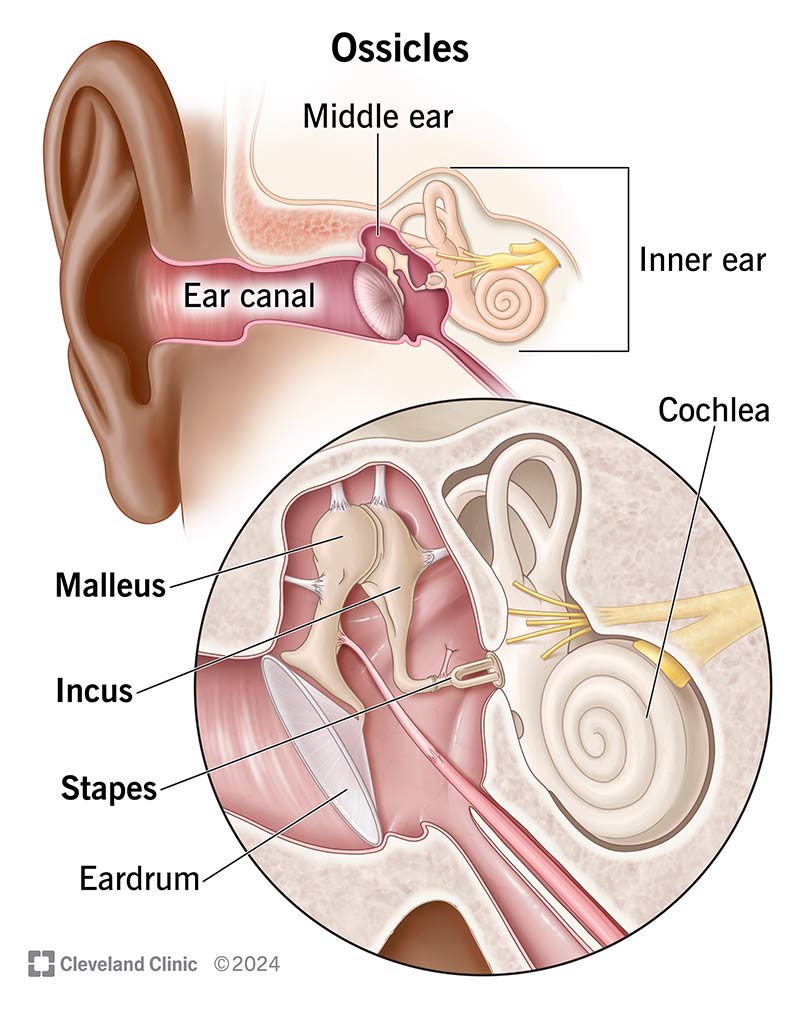
false (the middle ear has three small bones)
T OR F: short wavelengths, from high pitched sounds cause displacement of the basilar membrane near the oval window
true
To view close objects, the ciliary muscle will ___; the suspensory ligament will ___; and the lens will become more _____.
contract; loosen; round
What types of neurons aid in imitating, understanding intentions and behaviors of others,and having empathy with the emotions of others?
mirror neurons
The brain and the spinal cord are part of what?
CNS
damage to the temporal lobe of the cerebrum would limit _____.
hearing (auditory processing) and the understanding or interpretation of language and speech
True or false: Gray matter is only found in the cerebral cortex.
false
Ablation of the amygdala and limbic system would primarily result in _____.
reduction of aggressive behaviors (or a calming of anger and fear responses)
True or false: The reticulospinal tracts are the major descending pathways of thepyramidal system.
false (reticulospinal tracts are part of the extrapyramidal system)
Sensations of heat, cold, and pain travel to the spinal cord, cross to the contralateralside, and ascend to the thalamus by way of _____ tracts.
lateral spinothalamic
Which of the following is the correct list of lobes of the cerebrum?
frontal lobe, parietal lobe, temporal lobe, and occipital lobe
True or false: Descending tracts carry motor impulses from the cerebral cortex to thespinal cord.
true
Damage to the postcentral gyrus of the central fissure may interfere with _____.
the ability to feel the touch of a feather on the skin (or general somatosensory perception such as touch, pressure, and proprioception)
The structure necessary for memory that is affected by sleep and emotion is _____.
hippocampus
The _____ is involved in the improvement of memory when the memory has emotional content.
amygdala
Vision may be affected by a number of age-related changes. A disorder that may developas a result of these changes and directly affects the retina is _____.
Macular degeneration (or age-related macular degeneration)
What is the body's master controller for communication?
the nervous system
How does the nervous system communicate?
Through electrical and chemical signals.
What are the advantages of nervous system signals?
They are fast, efficient, and specific.
What are the three main functions of the nervous system?
Sensory input
Integration
Motor output
What is sensory input?
Detecting information from both outside and inside the body.
What are examples of sensory input?
External: temperature, light, or sound.
Internal: changes in blood pressure or body conditions.
What is integration?
Interpreting sensory information and deciding how to respond.
What is motor output?
Responding to stimuli by activating effector organs.
What are effector organs?
Muscles or glands that carry out the body's response.
What is the sequence of nervous system communication?
Sensory input → Integration → Motor output
Sensory input: Detects information.
Integration: Processes information and decides what to do.
Motor output: Carries out the response.
What makes up the Central Nervous System (CNS)?

The brain and spinal cord.
What is the main function of the CNS?
It acts as the body's integration and command center by processing information and coordinating responses.

What makes up the Peripheral Nervous System (PNS)?
The nerves located outside the brain and spinal cord, including cranial and spinal nerves.
What is the main function of the PNS?
It carries messages to and from the brain and spinal cord.
What are cranial nerves?
Nerves that connect the brain to other parts of the body.
What are spinal nerves?
Nerves that connect the spinal cord to other parts of the body.
How do the CNS and PNS work together?
The PNS carries sensory information to the CNS, and the CNS processes it and sends commands through the PNS.
What are the parts of the peripheral nervous system (PNS), that specifically act as the communication pathways to and from the central nervous system (CNS) called?

Sensory (afferent) division
Motor (efferent) division
What does the sensory (afferent) division do?
Carries sensory impulses to the CNS from different parts of the body.
What does “afferent” mean?
Arrives at the CNS. Sensory information travels toward the brain and spinal cord.
What are sensory afferent fibers?
Fibers that carry sensory impulses from the skin, skeletal muscles, and joints toward the CNS.
What are visceral afferent fibers?
Fibers that carry sensory impulses from the internal organs toward the CNS.
What is the difference between sensory afferent and visceral afferent fibers?
Sensory afferent: Information from skin, skeletal muscles, and joints.
Visceral afferent: Information from internal organs.
What does the motor (efferent) division do?
Carries signals away from the CNS to effector organs.
What does “efferent” mean?
Motor commands travel away from the brain and spinal cord (exits the CNS)
Where do motor (efferent) signals travel?
From the CNS to effector organs, such as muscles and glands.
What is the main difference between afferent and efferent pathways?
Afferent: Sensory information travels toward the CNS.
Efferent: Motor commands travel away from the CNS.
What is the pathway from sensing a stimulus to responding?
Sensory (afferent) input → CNS processes information → Motor (efferent) output.
What are the two main parts of the PNS motor division?
Somatic Nervous System
Autonomic Nervous System
What does the Somatic Nervous System control?
Voluntary movement of skeletal muscles (conscious control).
Is the Somatic Nervous System voluntary or involuntary?
Voluntary — for example: you consciously control skeletal muscle movements.
What does the Autonomic Nervous System (ANS) regulate?
Smooth muscle
Cardiac muscle (heart)
Glands
Is the Autonomic Nervous System voluntary or involuntary?
Involuntary — it regulates functions that generally occur without conscious control.
What are the two divisions of the Autonomic Nervous System?
Sympathetic division
Parasympathetic division
What is the main difference between the Somatic and Autonomic Nervous Systems?
Somatic: Voluntary control of skeletal muscles.
Autonomic: Involuntary regulation of smooth muscle, cardiac muscle, and glands.
Which nervous system controls voluntary skeletal muscle movement?
The Somatic Nervous System.
Which nervous system regulates involuntary body functions?
The Autonomic Nervous System (ANS).
Which nervous system controls cardiac muscle?
The Autonomic Nervous System.
Which nervous system controls smooth muscle and glands?
The Autonomic Nervous System.
What are neurons?
Excitable cells that transmit electrochemical signals and release neurotransmitters.
What is the structural and functional unit of the nervous system?
The neuron.
What does it mean that neurons are excitable cells?
They can respond to stimuli and generate electrical signals.
How do neurons communicate with other cells?
They transmit electrical signals and release chemical messengers called neurotransmitters.
What are neurotransmitters?
Chemical messengers released by neurons to communicate with other cells.
What does amitotic mean when describing neurons?
Neurons generally do not divide to produce new cells; the cells do not undergo mitosis (cell division) and cannot reproduce to create new copies of themselves once they reach maturity
What are supporting cells of the nervous system called?
Neuroglia, also called glial cells.
What are the main functions of supporting cells?
Surround and support neurons.
Wrap around neurons.
Provide nourishment and help maintain a healthy environment.