1. Tuberculosis and Lyme Disease - Systemic Disease Fall 2026
 Call Kai
 Learn
 Practice Test
 Spaced Repetition
 Match
 Flashcards
 Knowt Play
1/127

There's no tags or description
Looks like no tags are added yet.
128 Terms
True or False:
Infectious causes remain one of the leading causes of preventable blindness worldwide
True
_____ often signal systemic disease
Ocular infections

True or False:
Infectious diseases are always confined to one region
false

Disease can spread rapidly across borders d/t what factors?
-Increased Travel and Migration
-Trade and Global Supply Chains
-Climate Change and Environment
-Urbanization and Population Growth
_____ is by far the leading infectious cause of blindness worldwide, esp in underdeveloped countries
Trachoma
_______ is a major cause of infectious vision loss in developed countries
Herpes Simplex Keratitis
What is the importance of interdisciplinary care when dealing with infectious diseases?
-Collaboration is essential between eye care providers + infectious disease + primary care
-Ocular signs may guide new systemic diagnosis
What is Tuberculosis?
Bacterial Infection (Mycobacterium tuberculosis)
What is the mode of transmission of TB?
aerosolized and spread through inhalation
There’s a _____% risk of TB infection in a healthy person exposed to an infected person
25
There is a higher risk of TB infection in what type of patients?
-Higher risk if immunocompromised (HIV patients)
-Immunosuppresssive therapy (RA, MS, IBD)

_____ of the world's population is infected with latent TB
1/3

True or False:
TB is one of the 10 most common causes of death worldwide
true

______ is a growing problem with TB
Multidrug resistance

Where are high rates of TB found?
Southern Africa, India, and Southeast Asia

There has been an (increase/decrease) in cases of TB in the US since 2020
slight increase

What are most cases of TB in the US related to?
-Exposure in endemic countries
-Homelessness
-Incarceration
What are the 2 stages of TB infection?
-Latent
-Active
What percent of immunocompetent people with TB that are in the latent stage?
90%
What are the characteristics of latent TB?
-Asymptomatic
-No evidence of active disease
-Non-infectious
What percent of immunocompetent individuals with tb are in the active stage?
10%
What % of individuals with TB have active disease?
10%
What are the characteristics of active TB?
-Symptomatic (cough, fever, night sweats)
-Infectious
Is TB still infectious if latent disease reactivates? What percent of latent TB patients have reactivation?
Yes; 5-10% of patients
What are the common sites of TB infection?
-Pulmonary
-Extrapulmonary
-Military
What is the primary site of infection in pulmonary TB?
lungs
What is the most common form of TB?
pulmonary
What are the symptoms of pulmonary TB?
-chronic coughing
-hemoptysis (coughing up blood)
What is extrapulmonary TB?
TB spread hematogenously to the kidneys, spine, adrenal gland, meninges, and lymph nodes
What is the most common form of TB in immunocompromised patients?
extrapulmonary TB
What is military TB?
TB involving multiple organs (lungs, liver, spleen, bone marrow)
Military TB is _____ if untreated
fatal
What are the classic signs/symptoms of TB infection?
-fever
-fatigue
-night sweats
-weight loss
-body aches
-Pulmonary: cough, pleuritic chest, hemoptysis
-Spinal: back pain
-Lymph nodes: lymphadenopathy
What are the routes that TB can lead to ocular involvement?
-Hematogenous spread
-Hypersensitivity rxn
What are the common sites of ocular TB infection?
-Anterior segment
-Posterior segment
What are the sites of anterior segment involvement of ocular TB?
-Conj
-Sclera
-Cornea
-Iris
-CB
What are the sites of posterior segment involvement of ocular TB?
-Retina
-ON
-Choroid
What are the common symptoms of ocular TB?
-Photophobia
-Irritation
-Tearing
-Eye pain
-Blurred vision

What are the signs of chronic granulomatous anterior uveitis as related to TB?
-Mutton fat granulomatous KPs
-Iris Nodules

What is interstitial keratitis and is it specific to TB?
-Not specific to TB
-Stromal haze and scarring possible
-Neovascularization possible

Is interstitial keratitis ulcerative?
No -- it is non-ulceratitve

What are the types of iris nodules that can present with ocular TB?
-Koeppe Nodules
-Busaca Nodules

Describe the location of Koeppe nodules
pupillary margin
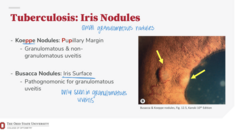
Describe the cause of Koeppe nodules
Granulomatous & Non-granulomatous uveitis
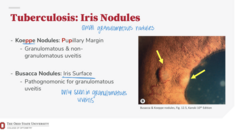
Describe the location of Busacca nodules
Iris surface
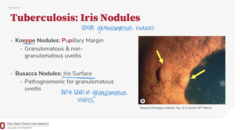
Describe the cause of Busacca nodules
Pathognomonic for granulomatous uveitis
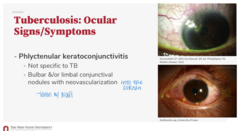
What is phlyctenular keratoconjunctivitis and is it specific to TB?
-Bulbar and/or limbal conjunctivitis nodules with neovascularization
-Not specific to TB

What are the posterior signs/symptoms of TB?
-Choroidal granuloma "Tuberculoma"
-Chorioretinitis
-Vasculitis
-Vitritis
-Optic Disc Edema
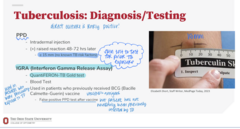
What are the diagnostic tests for TB?
-PPD test
-IGRA (Interferon Gamma Release Assay)
-Chest Xray
-Sputum Culture
-Extrapulmonary Options

Describe the PPD test and (+) criteria
-Intradermal injection
-(+) is a raised reaction >15mm 48-72 hours later
-Testing for prior exposure to TB

Describe the IGRA test and when it is used?
-QuantiFERON-TB Gold test
-Blood test
-Used in patients who previously received Bacille-Calmette-Guerin (BCG) vaccine

Patients who received the BCG vaccine for TB will have a false (+/-) test on the PPD test
+

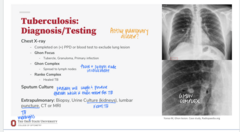
When is a chest Xray needed on TB patients?
With (+) PPD or blood test

What is the point of doing a chest xray on PPD (+) patients?
To check for lung lesions

What is the name for tubercle, granuloma (primary infection) of TB in the lungs found on chest xray?
Ghon Focus

What is the name for tubercle or granuloma (primary infection) + spread to the lymph nodes in a TB patient?
Ghon complex

What is the name for tubercle or granuloma (primary infection) that has healed?
Ranke Complex
Why is a sputum culture used for diagnosis of TB?
Patient will cough & produce sputum and then it is tested for TB

What are the extrapulmonary TB testing options?
-Biopsy
-Urine Culture (kidney TB)
-Lumbar puncture (spinal TB)
-CT/MRI
What is the initial intensive phase of systemic treatment for TB?
-4 drugs for 2 months
-RIPE
-Rifampin
-Isoniazid
-Pyrazinamide
-Ethambutol
What is the continuation phase of treatment for systemic TB infections?
-2 drugs, 4-6 months
-Rifampin and Isoniazid usually
What is the treatment for latent TB?
-Treated with Isoniazid for 6-9 months
-OR can be treated with Rifampin for 4 months
-OR Isoniazid + Rifampin x 3 months in HIV patients
What is the point of treating latent TB with systemic medications?
To reduce the risk of reactivation of the bacterial infection
How is streptomycin used in the treatment of TB?
-Reserved for resistant strains of TB
-Injected
-Second line medication w/ intolerance to 1st line meds
What are the OCULAR treatments for TB infections?
-Topical steroids
-Cycloplegics
-Monitor IOP and complications
When can topical steroids be used for ocular TB infections?
After or alongside systemic TB meds. CANNOT BE STARTED ALONE AS THIS WILL WORSEN INFECTION!!
What are the possible complications of ocular TB that need to be monitored for?
-Cataracts
-Macular edema
-RD
-Vit heme
Active TB is a _____ disease
reportable
What does "reportable disease" mean?
Responsibility of the provider to report the diagnosis to public health authority
_____ (treatment for TB) can have the side effect of optic neuropathy in 1% of patients
Ethambutol
Comprehensive exams of individuals who are taking ethambutol include what testing?
-VAs
-Color vision
-Amsler Grid
-VF
-OCT
-Need Baseline testing + periodic checks
What systemic TB medications can cause hepatotoxicity?
Isoniazid & Rifampin
_____ is secreted into saliva and tears and can result in an orange discoloration of SCLs
Rifampin
_____ (systemic TB med) can result in hearing loss and vestibular dysfunction
Streptomycin
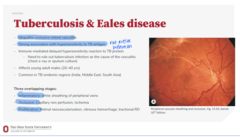
What is Eales Disease?
Idiopathic occlusive retinal vasculitis with a strong association with reacting to TB antigens

Eales Disease has a strong association to what?
Hypersensitivity (immune mediated delayed type reaction) to the TB antigen

If vasculitis is present on retinal exam, what needs to be ruled out?
Tuberculosis infection (do chest xray or sputum culture)

What population does Eales disease affect?
20-40yo young adult males

Where is Eales disease common?
TB endemic regions (India, Middle East, South Asia)

What are the 3 overlapping stages of Eales Disease?
-Inflammatory
-Occlusive
-Proliferative

Describe the inflammatory phase of Eales Disease (TB)
White sheathing of peripheral veins

Describe the occlusive phase of Eales Disease (TB)
Capillary non-perfusion and ischemia d/t occlusion of veins

Describe the proliferative phase of Eales Disease (TB)
Retinal neovasc, vitreous hemes, tractional RDs possible
What is Lyme Disease?
Bacterial infection by Borrelia Bergdorferi (spirochete)
Lyme Disease is a _____ borne illness
Tick
What is the mode of transmission of Lyme Disease?
-Bacteria typically resides in small animals (deer, birds, field mice)
-Transmitted through the bite of Ixodes tick
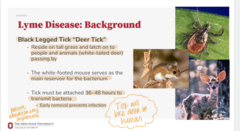
What types of ticks transmit Lyme Disease?
Black Legged Tick (Deer Tick)
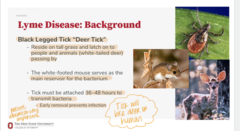
Where do deer tick reside and what do they latch onto?
Reside on tall grass and latch on to people and animals passing by

What is the MAIN RESERVOIR of the Lyme Disease bacterium?
white-footed mouse

The tick must be attached to person/animal for ____ hours in order to transmit its bacteria
36-48

___ prevent infection of Lyme Disease
Early removal

Where are the cases of Lyme Disease concentrated in the US?
-NE
-Mid-Atlantic
-Upper Midwest

Lyme Disease is (increasing/decreasing) in incidence d/t expanded tick habitats and climate change
increasing
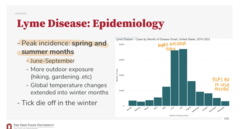
When is peak incidence of Lyme Disease?
spring and summer months (June-Sept)

True or False:
Ticks tend to die off during the winters and thus prevalence decreases during these months
true

What are the trends in Lyme Disease in Ohio?
-Steady increase over the past decade
-Highest incidence in NE and Eastern counties
-Tick populations expanding westward d/t climate and habitat changes

What are the 3 stages of Lyme Disease?
1) Early Localized
2) Early Disseminated
3) Late (Chronic)

What is the time frame for Early Localized Lyme Disease infection?
days - weeks

What are the key features of an Early Localized Lyme Disease infection?
-Erythema Migrans (Bulls Eye Rash)
-Flu Like symptoms (myalgia, HA, fatigue, sweating)

What is the time frame for Early Disseminated Lyme Disease infection?
weeks - months