Physical Exams
 Call Kai
 Learn
Learn Practice Test
 Spaced Repetition
 Match
Match Flashcards
 Knowt Play
1/80

There's no tags or description
Looks like no tags are added yet.
Name | Mastery | Learn | Test | Matching | Spaced | Call with Kai | Chat |
|---|
No analytics yet
Send a link to your students to track their progress
81 Terms
urinary bladder, colon
What are two landmark structures that can be felt when palpating the abdomen?
both
In cats you should feel _______ kidneys when performing an abdominal palpation
left (caudal pole)
In dogs you should feel the __________ kidney when performing an abdominal palpation
small intestines, colon
What two digestive organs should you be able to palpate in the abdomen?
liver
In small dogs and cats, you can palpate the edge of ________ lobes just caudal to the ribs
uterus
What female reproductive organ might you be able to palpate during a small animal abdominal palpation?
prostate
What male reproductive organ can you palpate with a rectal exam in small animals?
can
In the majority of dogs and cats, you _______ (can/cannot) palpate the spleen during an abdominal exam
mid to cranial
During an abdominal palpation, you should feel the small intestines in the ____________ abdominal cavity of small animals
symmetry
When evaluating the hind limbs, look at:
General conformation
Movement
Whether or not they are weight bearing
Palpate major muscle groups for ___________ and pain
distal, proximal
In small animals, joints are evaluated ________ to __________ and manipulated individually WITHOUT moving the portion of the leg more proximally
submandibular, popliteal
What two lymph nodes are normally palpated in small animals?
popliteal
What lymph node is being palpated?

popliteal notch
When palpating the popliteal lymph nodes, press medial to lateral in the __________________, ensuring you locate the lymph nodes and not musculature or fat
popliteal, inguinal
What two sets of lymph nodes should you palpate for (one should not be able to be palpated if normal) during an examination of the hind limbs?
should not
In dogs and cats, the inguinal lymph nodes __________ (should/should not) be palpable
pelvis
When examining the ________ in a small animal, palpate the ilium and ischium, tuber coxae, and greater trochanter for pain and asymmetry of muscle mass
20/25
When administering intramuscular injections in small animals, you should use a small _________ gauge needle
5
When administering intramuscular injections in small animals, you should administer small volumes, generally less than ______ mLs
aspirate, massage
Always ____________ before injecting a drug intramuscularly to ensure there is no blood, and __________ the muscle once you have administered the medication
femur, femoral nerve
What two structures are we most worried about hitting when giving an intramuscular injection in the quadriceps?
quadriceps
What intramuscular injection site is being demonstrated?

good blood supply (fast onset)
What is a benefit of administering intramuscular medications in the quadricep?
lumbar
What is the most common intramuscular injection site in small animals?
lumbar
What intramuscular injection site is being demonstrated?

hamstrings
What intramuscular injection site is being demonstrated?

femur, sciatic nerve
What two structures are we most concerned about avoiding when administering an intramuscular injection in the hamstrings?
hamstrings
The ____________ are made up of two muscle bellies with a central cleft that houses the sciatic nerve which should be avoided when administering an intramuscular injection
20/22, bevel up, slowly (prevent collapse)
When performing a venipuncture, a _________ gauge needle should be inserted ____________ at a 25-30 degree angle. You should then aspirate ___________, release occlusion, and withdrawal the needle.
caudal, cranial
When performing a venipuncture on the lateral saphenous vein in dogs, the stifle should be extended and the vein should be rolled _________ to ___________. Be aware there is less connective tissue surrounding this vein so it tends to move more.
lateral saphenous
What venipuncture site is shown?

history, physical exam
What are the two overarching components of an equine patient examination?
history
The first step to an equine physical examination is to take a step back to look at the animal as a whole, looking for any obvious signs of discomfort or asymmetry. During this time, you can ask the owner about the __________ of the horse
abdominal pain
The Flehmen response could be behavioral, or may be an indicator of _______________

back pain
This angry response could be behavioral, or may be an indicator of __________________

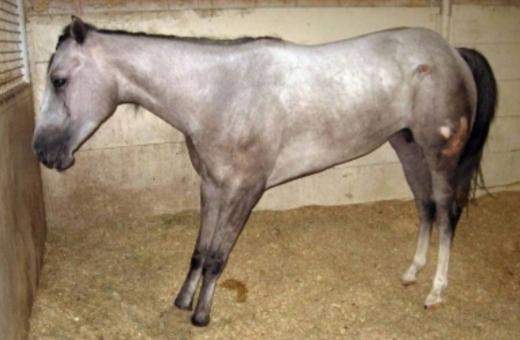
laminitis
This is the classic ___________ stance in which the horse looks listless and painful, shifts weight to their hind end, and spends more time lying down (indicated by the bed sores on the hip)
difficulty breathing
Flared nostrils could be an alert or reactive response to outside stimuli, or may be an indicator of _________________

signalment, past history, recent history
What three components make up the patient history?
false (same signs in a fit show horse could be indicative of something different in a pasture pet)
True or False: The presenting symptoms lead you to a diagnosis, with no bearing on the horse’s history or signalment
respiratory rate
What component of TPR typically varies the most based on the state the horse is in (ie did they just exercise, are they overly excited, etc.)?
99.5 ± 1 F
What is the normal temperature of a horse at rest?
36 ± 10 bpm
What is the normal heart rate of a horse at rest?
12 ± 4 bpm
What is the normal respiratory rate of a horse at rest?
head
When performing an equine physical exam, you should follow a set routine, starting at the ___________ and working around
color (horses usually are paler than small animals), moisture, CRT (capillary refill time → 1-2 seconds)
As you start the equine physical exam, what three parameters should you evaluate when you look at their gums?
teeth
What do you use to age horses?
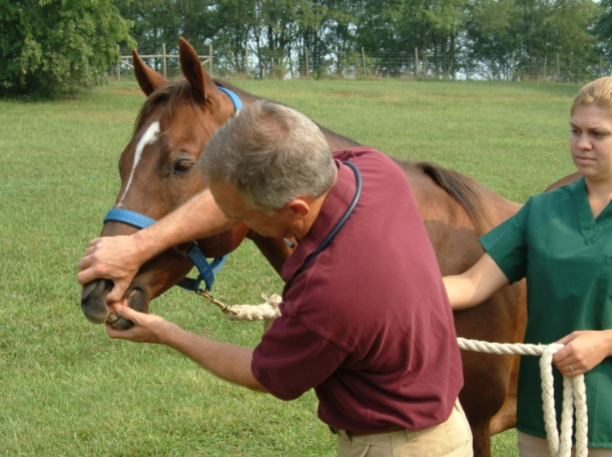
gums
Step 1: The veterinarian is looking at the horse’s ________ for Capillary Refill Time, Moisture, and Color
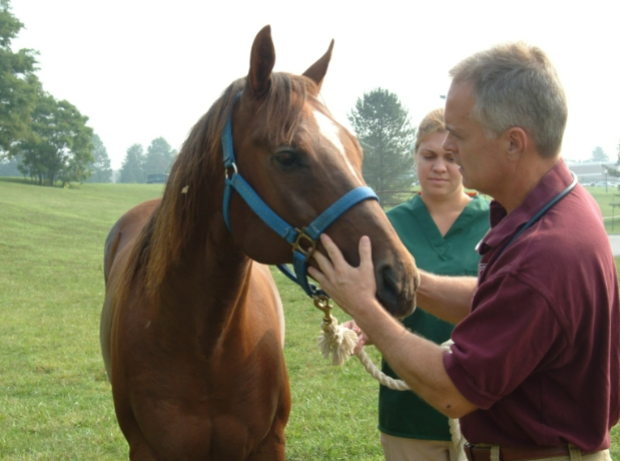
asymmetry
Step 2: The veterinarian is looking for ______________ visually and when palpating the cheeks
percussing
Step 3: The veterinarian is ______________ the sinuses
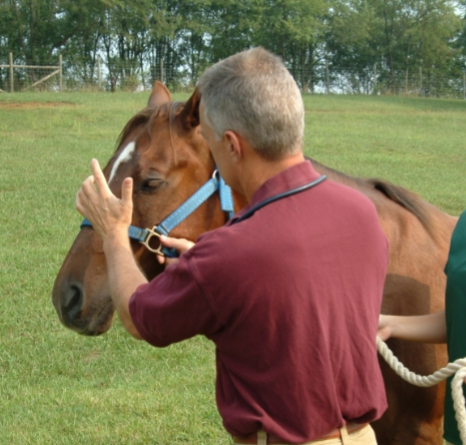
menace
Step 4: The veterinarian is testing the ___________ response to ensure the horse is processing visual information
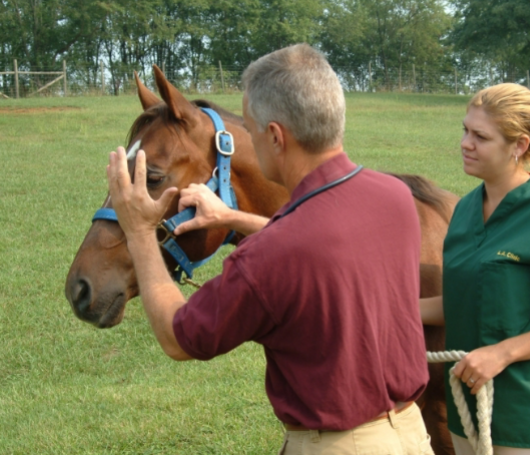
submandibular, retropharyngeal
What lymph nodes should you palpate for in equine during a physical exam?
submandibular
Step 5: Palpate the _______________ lymph node

retropharyngeal
Step 6: Palpate the ________________ lymph node

fluid wave
Step 7: Hold off the external jugular vein, then watch if refill. You are watching for a ____________

squat
When bending down near a horse, you should always _______________ (squat, kneel)
muscle fill
Step 7: As you palpate the horse, feel along the neck and topline for ____________ and vertebrae, then palpate each leg

distal pulse
Step 8: Check the ______________ of EACH limb for indications about the health and circulation to each limb

heart, lungs, trachea, abdomen (four quadrants)
Step 9: Auscultation
What four general regions of the body should you listen to?
upper
Listening to the trachea during an equine physical exam gives you a clue to ___________ respiratory disease that may be difficult to differentiate in the lung field
left dorsal, left ventral, right dorsal, right ventral
What are the four quadrants of the equine abdomen that you should auscultate during a physical exam?
low
Horses typically have normal, continuous, ________ frequency gut sounds in the abdomen
colic
Step 10: Feel for ________ scars
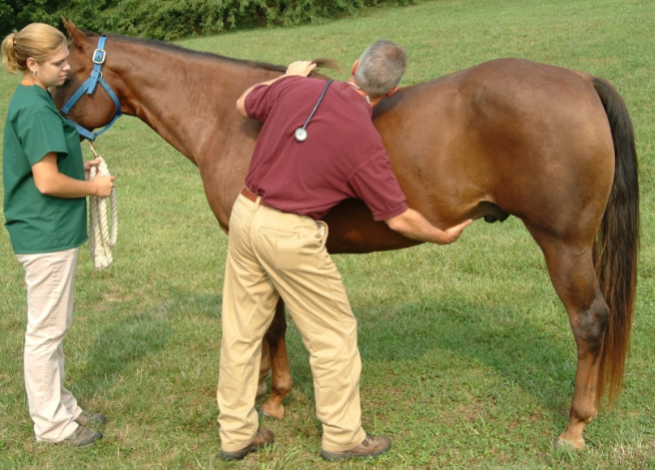
inguinal ring, mammary
Step 11: Feel for _____________ abnormalities in males or ______________ gland in females

temperature
Step 12: Take the ______________ which may be difficult due to the thickness of the rectum and potential for a low reading due to fecal presence
crest of neck, withers, behind shoulder, over ribs, along back, tailhead
What six regions of the horses’ body can be used to evaluate their body condition score?
1, 9
On a 1-9 scale, the overly thin horses fall closer to ______ while the overweight horses fall closer to ________
poor (1)
Horses with a body condition score of ________ are extremely emaciated such that their backbone, ribs, hip bones, tailhead, withers, shoulders, and neck are prominent, and NO fatty tissue can be felt
very thin (2)
Horses with a body condition score of ________ are emaciate such that they only have a slight covering of fat over the vertebrae. Their backbone, ribs, tailhead, and hip bones are prominent, and their withers, shoulders, and neck are discernable
thin (3)
Horses with a body condition score of ________ have fat built up about halfway on their vertebrae and a slight fat layer can be felt over the ribs (although they can be easily seen). The tailhead is prominent but individual vertebrae cannot be seen. The hip bones, withers, shoulders, and neck are faintly discernable
moderately thin (4)
Horses with a body condition score of ________ have a slight ridge along their back and palpable fat around their tailhead. A faint outline of the ribs can be seen, hip bones are not obviously discernable, and the withers, neck, and shoulders are not obviously thin
moderate (5)
Horses with a body condition score of ________ have a level back, rounded withers, and the shoulders and neck blend smoothly. The ribs can be easily felt, but not seen, and fat around the tailhead is beginning to feel spongy
moderately fleshy (6)
Horses with a body condition score of ________ may have a slight crease down the back with fat beginning to deposit along the sides of the withers, behind the shoulders, and in the crest of the neck. Fat over the ribs feels spongy and fat around the tailhead is soft
fleshy (7)
Horses with a body condition score of ________ may have a crease down the back with noticeable fat deposited along the withers, behind the shoulders, and in the crest of the neck. Individual ribs can be felt, but there is noticeable fat deposition over the ribs and the fat around the tailhead is soft.
fat (8)
Horses with a body condition score of ________ have a prominent crease down their back, barely palpable ribs, and prominent fat around the tailhead. The area along the withers and behind the shoulders is filled with fat, the crest is prominent, and fat is deposited along the inner buttocks
extremely fat (9)
Horses with a body condition score of ________ have an obvious crease down their back with fat patches over the ribs and bulging fat over the tailhead, withers, neck, and behind the shoulders. The crest of the neck is very prominent and fat along the inner buttocks may rub together. The flank is filled in flush with the barrel of the body
4-6
What is the ideal body condition score for equine?
overweight
A body condition score of 7 is considered _____________
obese
A body condition score of 8 or 9 is considered ___________
body condition score
A subjective measure of a horse’s weight
weigh tape
An objective measure of a horse’s weight
trends
Weigh tapes are a good way to monitor __________ in your horse’s weight