Biology Exam 2
 Call Kai
 Learn
 Practice Test
 Spaced Repetition
 Match
 Flashcards
 Knowt Play
1/265

There's no tags or description
Looks like no tags are added yet.
266 Terms
Metabolism
The totality of an oragnism’s chemical reactions
An organism’s ___ transforms matter and energy
Metabolism
What is required to link Amino Acids together
Energy
Metabolic Pathway
Thousands of biochemical reactions that require energy transformations
Each step of a metabolic pathway is
A separate chemical reaction catalyzed by a specific enzyme
What are the two types of metabolic pathways required to maintain the cell’s energy balance?
Catabolic and Anabolic
Catabolic Pathways
Carbs, Lipids, Proteins; Break down complex molecules (food) into simpler ones; releases energy
Anabolic Pathways
Occurs in the body, it uses small molecules to build other substances, requires energy
Example of Catabolic Pathways
Cellular Respiration
Examples of Anabolic Pathways
Photosynthesis, Gluconeogenesis
Energy
The capacity to cause to change
Bioenergetics
Study of energy flow through a living system
Potential Energy
Energy matter has because of its structure
Kinetic Energy
Movement of objects
Free Energy
Available energy to do work
Gibb’s Free Energy (G)
The free energy change of a reaction; informs whether reaction is spontaneous or nonspontaneous
Spontaneous Change
Addition of external energy is not required, free energy decreases and the stability of a system increases, G is negative
Exergonic Reaction
Energy is exiting the system, spontaneous, G is negative
Endergonic Reaction
Energy is entering the system, reaction absorbs free energy from its surroundings, non spontaneous, G is positive
Activation Energy
The initial energy required for a reaction to start
What is the main source of activation energy in the cell?
Heat Energy obtained from the surroundings of the sistem
Heat Energy causes reactants to become
Contorted and unstable
Light Energy
For of electromagnetic energy (radiation)
Radiation
Composed of photons (packets of energy)
Electromagnetic Spectrum
The entire range of electromagnetic energy
Closed System
Isolated from its surroundings; reactions eventually reach equilibrium; G=0
Open System
Energy and matter can be transferred between the system and surroundings
What prevents equilibrium in organisms?
The constant flow of food in and waste out
1st Law of Thermodynamics
Energy cannot be created or destroyed. Energy can be transferred and transformed.
2nd Law of Thermodynamics
Spontaneous changes that do not require outside energy increase the disorder of the universe
Which has the greater entropy a liquid or solid state?
Liquid
When does entropy increase?
When a substance is broken down into parts, as temperature increases
What does entropy increase in (unit)?
rxns. where product molecules are greater in number than the reactant molecules
Entropy
Measure of unusable energy in a closed system, randomness, disorder
ATP
Cell’s primary energy transport, powers cellular work by coupling endergonic and exergonic reactions.
ATP Structure
Composed of an adenosine backbone and 3 phosphate groups attached
Breakdown of ATP is what
ADP with the release of energy
When is energy from ATP released
When a phosphate bond is broken
How does ATP drive endergonic reactions
phosphorylation, transferring a phosphate to other molecules
Phosphorylation
Transferring a phosphate to other molecules
Energy Coupling
The transfer of energy from catabolism to anabolism or from exergonic to endergonic
Enzyme
A Catalytic protein
Catalyst
Agent that speeds up a reaction without being consumed or permanently changed
Activation Barrier
Energetic hurdle that reaction must get over
The lower the activation barrier, the ___ the reaction can occur
faster
Enzyme Steps
The substrate moves toward the enzyme’s active site, chemical reaction is triggered, enzyme releases product.
What can affect an enzymes activity?
Temperature and pH, cofactors and regulatory molecules, local conditions
Why is enzyme activity regulated?
To help cells control their environment and meet their specific needs.
3 primary ways to regulate enzymes
Enzyme Activity Cofactors
Non-protein enzyme components (metals, NAD+)
Regulatory Molecules
Positive or negative regulation
Competitive Inhibitors
Similar shape to the substrate, compete for the active site
Noncompetitive Inhibitors
Bind to enzyme at different location (allosteric site, not active), causes a slower reaction rate
Disulfiram
Rx Drug, competitive inhibitor of aldehyde oxidase, causing build up of acetaldehyde and nausea and vomiting.
Cyanide
Compound that acts as a noncompetitive inhibitor, inner membrane protein in the mitochondria.
Allosteric Site
A special binding location on a protein or enzyme that is separate from the main active site
Nearly all cases of noncompetitive inhibition are ____ regulation
Allosteric
Feedback Inhibition
The end product of the metabolic pathway shuts down the pathway. Important regulator in cells
Within the cell, enzymes may be:
Grouped into complexes, incorporated into membranes, contained inside organelles
Membranes
A collage of different proteins embedded in the fluid matrix of the lipid bilayer
Plasma Membrane
The boundary that separates the living cell from its nonliving surroundsing
Selective Permeability
Allows some substances to cross more easily than others
What membrane is selectively permeable
Plasma Membrane
Functions of the Plasma Membrane
manages what enters and exits; receives external signals and initiates cellular response
Fluid Mosaic Model
States that a membrane is a fluid structure with a mosaic of various proteins in embedded in it
Cellular membranes are ___ ___ of lipids and proteins
Fluid mosaic
Phospholipids (membrane)
Main fabric of the plasma membrane; amphipathic;
Sterols (membrane)
Important for the fluidity of the plasma membrane
Squalene
Precursor for sterols and Hopanoids
Temperature’s Affect in the Nembrane
Affects movement “rate/speed” and distance of phospholipids
Cold Membrane
Close, restricting small molecules
Warm Membrane
Gaps, large holes
Fatty Acid Composition in the membrane
Fatty Acid Hydrophobic Tails
Saturated Fatty Acids in the Membrane
Less fluid because they are straight and tightly packed
Unsaturated Fatty Acids in the Membrane
More fluid because there are kinks creating space
Cholesterol in the Membrane
Creates space between phospholipids; random distribution.
Low temps of Cholesterol
Increases amount and fluidity
High temps of Cholesterol
Decreases amount and fluidity
Proteins in the Cell Membrane
2nd major component of membranes
What membrane does every single cell have?
Plasma Membrane
What is necessary to receive extra cellular signals from the environment?
Receptors in the plasma membrane
Functions of proteins in membranes
Transport, Reception, Enzymes, Binding and Adhesion
Integral Proteins
Integrated completely into the bilayer, amphipathic in nature
Why are Integral Proteins Amphipathic in nature?
Their shape and presence of amino acids
What determines how Integral proteins are arranged?
Locations and number of these regions
Peripheral Proteins
Occur only on the surfaces, enzymes or structural attatchment
What will always be the hardest thing to move across the membrane
Ions (need proteins)
Where are carbohydrates located in the plasma membrane?
On the exterior surface
Glycoproteins
Carbohydrate bound to a membrane protein
Glycolipids
Carbohydrate bound to a phospholipid
What are the functions of carbohydrates in the plasma membrane?
Cell to Cell recognition and attachment

What is this?
Alpha-helix protein

What is this?
Glycoprotein
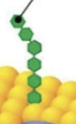
What is this?
Glycolipid

What is this?
Peripheral Protein

What is this?
Integral protein
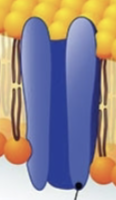
What is this?
Channel Protein
Viral Recptor
Glycoprotein that attaches to host cell
CD4
Cell adhesion molecule that functions to keep other immune cells close by when an immune response is generated