Animal Science Exam 1
 Call Kai
 Learn
Learn Practice Test
 Spaced Repetition
 Match
Match Flashcards
 Knowt Play
1/117

There's no tags or description
Looks like no tags are added yet.
Name | Mastery | Learn | Test | Matching | Spaced | Call with Kai | Chat |
|---|
No analytics yet
Send a link to your students to track their progress
118 Terms
What is animal science?
The study of domesticated animals
Equation for domestication
Genetic changes + Environmental influences
1st wave of domestication
8-15 thousand years ago, traditional species plus dogs and cats
2nd wave of domestication
Within last 100 years, new meat producers, laboratory animals, and fur animals
Food uses?
Red Meat and Poultry
Milk Products
Eggs
By-products
Significance of food
World population increasing, world hunger and malnutrition, enlarging diets of people
Other animal contributions
fabric/fibers
power source
body wastes
pest/weed control
Cultural significance?
companionship
sports and exhibition
religion
What makes beef cattle uniquely valuable?
They are able to convert resources that humans cannot digest to high-quality protein
Why can humans not digest forage like cows?
We lack cellulase to break down cellulose
Cattle have:
4 part ruminant stomach
a large rumen
microbial populations that ferment fiber
Ways beef cattle help the environment:
utilizing land that is not suitable for crop production to graze instead
consuming waste material like cornstalks and wheat straw
also sweet stuff like corn cannery waste and sugar beet pulp
3 Structures of the beef industry
Cow-Calf operation
Stocker Phase
Feedlot system
Cow-calf operation
calves are produced and feed off pasture/forage plus mother
ends around 6-10 months and 300-700 lbs
Stocker Phase
growth of a calf after weaning
fed pasture and forage
goal: INCREASE BODY WEIGHT
Feedlot system
maximize muscle growth and fat deposit on adults
fed either grain-based ration OR grass/pasture to reach market weight
Slaughtered at 18-22 months
tradeoff for grass-finished beef
+uses more pasture (cheaper)
-slower growth and return on investment
tradeoff for grain-finished beef?
+rapid weight gain
-more expensive to feed
What makes dairy cattle uniquely valuable?
Convert forage and nutrients into milk
Why does a modern dairy cow produce more milk needed to nourish their calf?
selective breeding
human demand
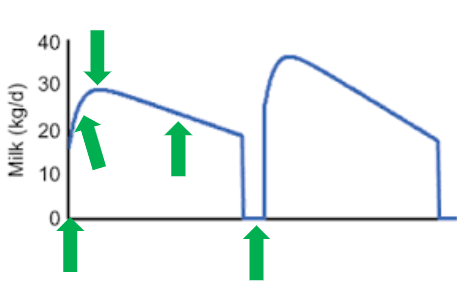
Dairy Cow Lactation Cycle
milk production begins when a cow gives birth
milk production increases rapidly
milk production peaks between 6-13 weeks after birth (bred again here)
Gradual decline
Dry period before next calving
How are dairy calves managed?
removed from mom at birth
housed individually most the time
fed milk until weaned at 60 days
How are dairy heifers managed?
considered heifers after weaning
fed mostly forage
bred at 2 years
How are lactating cows managed?
Considered a cow once they give birth
Milked every day except during dry period
last typically 3 lactation cycles
Tradeoffs in dairy production?
+makes tons of milk
-expensive (requires machines, feed, water)
-greater metabolic stress
what makes sheep uniquely valuable?
They’re adaptable to challenging environments and multipurpose
Sheep products
wool
meat
milk
grazing services
How are sheep grazed differently than cattle?
eat shorter vegetation
are more selective in their grazing
consume plants cattle tend to avoid
Advantages of wool production?
overall sustainable
sheep shorn annually
can be done over the entire span of a sheep’s life
What makes chickens uniquely valuable?
They’re very efficient and produce inexpensive proteins
What are the two kinds of chicken?
Layer and Broiler
Chicken diet?
Nutrient-dense feed
cannot digest large amount of forage like others
pellets made of corn/wheat/barley
Advantages of chickens?
Reach market weight quickly
require less space
Has most progress; breeding and selection techniques
Give some detail on the broiler industry.
Most broiler production concentrated to parent companies and their farms + operations (usually in the southeastern states)
low cost labor
especially profitable near cities
Give some details on the egg industry
a laying hen can produce 100s of eggs annually
most eggs in commercial operations do not touch human hands till removed by consumer
more dispersed than broiler production
What makes pigs uniquely valuable?
They have large litters and grow rapidly
Describe the pig life cycle.
Birth
Suckling
Weaning @ 8-9 weeks
Growing @ 9-16 weeks
Finishing @ 16-25 weeks
Slaughter @ any age (porkers at 30-54kg baconers at 24+ weeks)
Swine industry structure
more pigs owned by fewer people (like chickens)
farms centered near the cornbelt of the US (gain production heavy in these places)
Advantages of pigs?
more animals to market
faster herd expansion + return on investment
housed indoors
How does the body use nutrition?
Maintenance
Growth
Work/production
Reproduction
What’s the difference between essential and non-essential nutrients?
Essential - must be obtained in diet
Non-essential - synthesized in the animal
what is essential/non-essential varies by species
What are the 6 classes of nutrients?
Carbohydrates
Lipids
Proteins
Vitamins
Minerals
Water
Give an example of a carbohydrate
Starch, sugars, cellulose
What are the major classes of carbohydrates?
Mono, Di, and Polysaccharides
Uses for Carbohydrates
Fuel, molecular skeletons, plant cell walls
What are the major classes of lipids?
Triglycerides
Fatty acids (sat and unsat)
Phospholipids
Steroids
Uses for lipids?
Fuel (2.5x more than carbs)
Cell membranes
vitamin storage
hormone synthesis
Triglyceride structure?
glycerol + 3 fatty acids
Major classes of proteins?
Essential and non-essential amino acids
Uses of proteins?
structures (muscle)
biochemical processes
energy (though less than carbs and fats)
Essential amino acids
AAs that cannot be synthesized in the animal and must be provided via diet
Limiting amino acids/ Law of the minimum
Growth is controlled not by the total amount of amino acids available, but by the single AA in shortest supply
What are the major classes of vitamins?
Water soluble and fat soluble
What are vitamins used for?
catalysts in biochemical reactions
many regulatory functions
Fat soluble vitamins
A,D,E,K
Water soluble
B, C
What are the major classes of minerals?
Macro and Micro
Uses of minerals?
catalyze biochemical reactions
physical structures
Examples of minerals?
Calcium, phosphorus, potassium, sodium & chloride, sulfur, magnesium
Calcium
bones and teeth
Phosphorus
RNA/DNA
Potassium
electrical impulses of heart and other cells
Sodium & Chloride
controlling your blood pressure and blood volume
Sulfur
important for some proteins like insulin which regulates blood sugar
Magnesium
important for biochemical reactions in the body
Examples of micro-minerals?
zinc, iodine, iron, flourine, cobalt, selenium
What leads to white-muscle disease?
Vitamin E and selenium deficiency
How can water be obtained?
Drinking it or from moisture in food.
What is water used for?
metabolic reactions, transport, temperature regulation, shape
insufficient salt in the blood, often occurs when an animal is playing in or with water for long periods of time and ingests too much
Hyponatremia
“bone-eating”; common in herbivores when soil or plants are not sufficient in phosphorus, so they seek calcium phosphate by chewing on bones
Osteophagia
What are the five components of proximate analysis?
Moisture - 12%
Ash (inorganic matter) - 5%
Protein - 13%
Fat - 4%
Crude fiber - 10%
What are the functions of the digestive system?
Receiving
Conducting, storing
absorption, digestion
absorbing water, defecating
What are the events of digestion?
Physical
Chemical
Enzymatic
physical digestion
Prehension (grabbing)
Mastication
Salivation
Deglutition (swallowing)
Peristalsis (muscle in esophagus contracting food as it travels down the throat in wave-like movements)
OCCURS IN THE MOUTH
Chemical digestion
hydrochloric acid denatures proteins
bile helps digest fat
OCCURS IN THE STOMACH
Enzymatic
breaks bonds; organs, intestines, and microbes
OCCURS IN SMALL AND LARGE INTESTINE
Small intestine parts
Duodenum, jejunum, Ileum
Helps neutralize stomach acid and aid enzymatic digestion in the SI
Duodenum
Aids digestion and absorption in SI
Jejunum
helps absorption in SI
Ileum
Parts of the Large Intestine
Colon, cecum, and rectum
Absorbs water and forms feces
Colon
blind pouch, site of fermentation in some species
cecum
connects colon to anus
Rectum
ruminant mouth
no upper teeth
oral cavity
acquires food
initial mechanical breakdown
tongue muscle helps movement of food
esophagus
Moves food boluses from the mouth to the stomach through “peristalsis”
Ends at the lower esophageal sphincter
Prevents food and acid from the stomach from flowing backwards into the
esophagus
Very muscular
stomach - monogastric
single stomach
autoenzymatic digesters (enzymes secreted by the animal itself
are involved in the digestive processes)
limited capacity
located near the head
stomach - ruminant
4 compartments with high capacity
microbial fermentation
what are the 4 compartments of ruminant stomachs
rumen
reticulum
omasum
abomasum
Rumen
Fermentation vat, absorbs nutrients, microbial fermentation
Reticulum
Traps dense objects, sorts particles into those that need more digestion
Omasum
Fluid removal, water and nutrient absorption
Abomasum
“True stomach”, HCl and enzymes breakdown food material
Monogastric animals
Pigs, dogs, chickens
Mucus neck cells
secrete mucus
paretial cells
secrete HCl
chief cells
secrete enzymes
gallbladder
secretes bile to assist with lipid absorption