Exam 2 HPFW- Study Guide
 Call Kai
 Learn
 Practice Test
 Spaced Repetition
 Match
 Flashcards
 Knowt Play
1/106

There's no tags or description
Looks like no tags are added yet.
107 Terms
The concept of maximal oxygen consumption
The ability of the oxygen transport system to deliver blood and the cells to take up and utilize oxygen.
Goal of submaximal aerobic testing for PT
establish baseline stress for improvement but no physiological stress
Examples of Predictive Submaximal Tests (Used to estimate VO₂max using HR and workload relationships)
- Modified Bruce Treadmill Test
- Single-Stage Submaximal Treadmill Walking Test
- Canadian Aerobic Fitness Test (CAFT)
- 20-Meter Shuttle Test (20-MST)
- Astrand & Ryhming Cycle Ergometer Test
- Rockport 1-Mile Walk Test (Rockport Fitness Test)
Examples of Performance Submaximal Tests (Measure ability to perform functional tasks rather than predicting VO₂max)
- Self-Paced Walking Test (SPWT)
- Modified Shuttle Walking Test (MSWT)
- Bag and Carry Test
- Timed Up and Go (TUG)
- 6-Minute Walk Test (6MWT)
- 12-Minute Walk Test (12MWT)
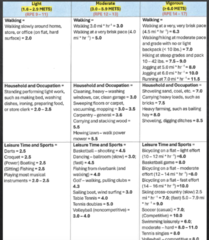
MET levels of intensity
Light 1.8-2.9 MET
Moderate 3.0- 5.9 MET
Vigorous >6.0 MET
Effects of some medications on vitals response
Beta-blocker medications can reduce the heart rate response during exercise and, therefore, put a patient at risk
Standard procedures and recommendations for clients prior to submaximal testing
Prior to conducting a maximal or submaximal aerobic capacity test, a full medical and surgical history should be taken.
Cardiopulmonary endurance
Ability to perform sustained activities (walking, arms overhead test, stepping tests).
Flexibility
Ability to move a joint through available ROM; influenced by muscle tightness, scar tissue, tissue extensibility.
Mobility / Joint ROM
Movement available at joints; influenced by structures like bone, joint capsule, scars, arthritis, and previous injuries.
Neuromuscular factors
Tone, control, and muscle mass (e.g., decreased tone → hypermobility, increased tone → restricted ROM).
Functional movement capacity
Ability to perform tasks like stepping, reaching overhead, or clearing a step.
Individual variation
ROM depends on the series of joints involved (cervical spine, ankle, etc.) and the functional demands of the person
Normal ROM for elbow:
150 degrees
Normal ROM Knee:
135 degrees
Arthritis
(Related impairments to ROM)
limits ROM, stiffness, capsular restriction, joint pain limiting motion
Scarring / contractures after burns or injury
(Related impairments to ROM)
Tighten permanently because of scarring, lost permanent "ROM."
Previous injuries (Related impairments to ROM)
Can restrict ROM or movement quality.
Hypermobility
(Related impairments to ROM)
Low tone → "joints are a little looser" and not limiting ROM.
Hypomobility
(Related impairments to ROM)
Pain, structural limitations, stiffness, tone issues.
Neuromuscular dysfunction
inability to activate muscles
Functional Excursion
Movement tied to daily activities.
- Related to "thinking about a function," not just the joint's max ROM.
- Influenced by what the person needs for ADLs, not full anatomical ROM.
Active Insufficiency
When a muscle cannot contract fully across both joints it crosses.
- when a person "can't engage or doesn't want to engage the muscles."
Passive Insufficiency
When a muscle cannot lengthen enough, restricting motion.
Examples shown include:
Tight structures → cannot reach position
Contractures from scarring reducing available length
PROM - Passive Range of Motion exercises
Movement done completely by external force
"Someone is doing it for them, ONLY external force."
Used when the patient cannot or should not actively move
E.g., paraplegia, post-surgery, high pain.
PROM - Passive Range of Motion goals
- Maintain joint mobility
- Reduce stiffness
- Protect healing tissues
AAROM - Active-Assisted ROM exercises
Combination of patient effort + external help
"Gravity helps, or other person helps."
AAROM - Active-Assisted ROM goals:
- Initiate gentle muscle activation
- Transition toward active movement
- Maintain mobility while protecting tissues
AROM - Active ROM
Patient moves limb using their own muscle power
Used when they "just came out of a cast, need to move muscles."
AROM - Active ROM Goals
- Improve motor control
- Prevent atrophy
- Maintain mobility and circulation
Dynamic Concentric
What it is:
Muscle shortens while producing force.
- the least force output type.
Dynamic Concentric Use / Why it's used:
Strengthening when lifting resistance (e.g., bicep curl upward phase).
- Used in functional tasks requiring force production while shortening the muscle (stairs up, lifting objects).
Dynamic Eccentric
What it is:
Muscle lengthens while producing force.
Produces more force than concentric.
Dynamic Eccentric Use / Why it's used:
Essential for controlled lowering (e.g., lowering a weight).
- Used for deceleration, shock absorption, and functional control (walking downhill, landing).
- Often emphasized in rehab because of greater force production and improved tendon loading.
Isometric (Static) What it is:
Muscle produces force without changing length and with no joint motion.
Isometric (Static) Use / Why it's used:
Used when movement is painful or restricted, but strength still needs to be maintained.
- Stabilization training (e.g., holding a plank).
- Helpful early in rehabilitation to maintain activation without stressing the joint through motion.
Isokinetic What it is:
- Muscle contracts at a constant speed throughout the entire ROM.
- Requires special rate-limiting equipment.
Isokinetic Use / Why it's used:
High-level strength testing and return-to-sport assessment.
- Provides maximal force output in a controlled, safe speed-controlled environment.
- Used in advanced rehab for measuring peak torque and muscle performance.
Age-related changes in muscle performance across the lifespan
- Gradual loss of muscle mass with aging
- Use it or lose it decreased use accelerates decline
- Consider age group when prescribing exercise
- Lifestyle, nutrition, behavioral/environmental factors influence performance
- Systems work harder due to stress placed on them
- Training intensity and volume must be adjusted for age
- Baseline and goals must match functional needs of the individual
Examples of task-specific training
- Mimic the desired function or task
- Mode of training influences type and magnitude of adaptation
- Exercise program should improve task-specific movements
- Include not performing conflicting tasks before an event
(e.g., "not running the day before a marathon")
examples
- Endurance Training (e.g., marathon runner):• High repetitions, sub-maximal loads• Focuses on aerobic exercise and fatigue resistance
- Strength Training (e.g., factory worker):• Low repetitions, high loads• Aims to increase muscle size, strength, and power
5 - Normal (0-5 MMT strength grading scale)
Against strong pressure
4- Good (0-5 MMT strength grading scale)
Against moderate pressure
3- Fair (0-5 MMT strength grading scale)
- Full ROM against gravity
- No resistance
2+ Poor (0-5 MMT strength grading scale)
partial ROM in test position
2 Poor (0-5 MMT strength grading scale)
Full ROM in gravity eliminated position
- 2 Poor
(0-5 MMT strength grading scale)
Ability to move through partial ROM in gravity eliminated position
1 - Trace (0-5 MMT strength grading scale)
unable to initiate movement in the limb in gravity eliminated position noticeable muscle contraction with effort
0 - Zero (0-5 MMT strength grading scale)
No contraction felt or seen
Muscle Strength
- A single maximal effort (1 rep)
- Tested using isometric strength tests
- Uses big muscle groups and requires controlled set-up
Muscle Power
- Max amount of work in a given unit of time
- Involves generating force rapidly
- Used in athletic or fast functional activities
Muscular Endurance
- Successive repetitions against a sub-maximal load
- Ability to hang, hold, or sustain activity
"hang, holding something - no motion"
- Prolonged submaximal contraction
Open kinetic chain exercise
- Distal segment is free to move
- Movement occurs at one joint
- Often non-weight bearing
closed kinetic chain exercise
- Distal segment is fixed or in a constant contact with a surface
- Movement occurs at multiple joint
- Often weight bearing
Ex: lunge, push ups, pull ups, plank
Knee extension machine (LAQ)
Hamstring curl machine
Biceps curl
SLR in any direction
Ankle resistance band work
Shoulder raises with dumbbells
These are examples of what type of kinetic chain exercise? closed or open
open kinetic chain exercise
Squats
Step-ups
Leg press
Lunges
Push-ups
Pull-ups
Wall sits
These are examples of what type of kinetic chain exercise? closed or open
closed kinetic chain exercise
Normal response to Physical activity HEART RATE- aerobic and resistance/isometric exercises (vitals)
- Increases with progressive workloads at a rate of ≈10 bpm per 1 MET
- Max HR decreases with age
- Blunted by β-blockers
- HR recovery post exercise: drop at least 12 beats after 1 min or 22 bpm after 2 mins.
Poor HR recovery:
- Ischemic heart disease mortality
- Ventricular dysrhythmias
Normal response to Physical activity RESPIRATORY RATE - aerobic and resistance/isometric exercises (vitals)
Increases linearly with aerobic activity as intensity increases
Little change with isometrics
Normal response to Physical activity O2 SATURATION - aerobic and resistance/isometric exercises (vitals)
Should remain near resting levelheart and lungs need to work
Normal response to Physical activity SYSTOLIC BLOOD PRESSURE - aerobic and resistance/isometric exercises (vitals)
- SBP increases with increasing workloads at a rate of ≈10 mm Hg per 1 MET
- Blunted by vasodilators, calcium channel blockers, angiotensin-converting enzyme inhibitors, and α- or β-adrenergic blockers
- SBP recovery: pre-exercise levels or lower after 6 min. Poor recovery: (Ischemic abnormalities)
Normal response to Physical activity DIASTOLIC BLOOD PRESSURE - aerobic and resistance/isometric exercises (vitals)
- DBP stays the same or slight drop with aerobic exercise
- DBP increases with resistance exercise
Normal recovery response after exercise
- No persistent distress signs (blue lips, dizziness) should be present.
- HR recovery post exercise:
drop at least 12 beats after 1 min or 22 bpm after 2 mins.
Frequency (FITT for Cardiorespiratory for adults)
• At least 3 days per week
Intensity (FITT for Cardiorespiratory for adults)
Moderate (40-50 HRR) and/or vigorous (60-89% HRR) intensity is recommended for most adults
Time (FITT for Cardiorespiratory for adults)
Most adults should accumulate 30-60 minutes per day (≥ 150 minutes per week) of moderate intensity exercise;
- 20-60 minutes per day (≥ 75 minutes per week) of vigorous intensity exercise to attain the recommended targeted volumes of exercise.
Type (FITT for Cardiorespiratory for adults)
Aerobic exercise performed in a continuous or intermittent manner that involves major muscle groups.
Frequency (FITT strength training)
• For novice trainers, each major muscle group should be trained at least 2 days per week.
• For experienced exercisers, frequency is secondary to training volume - based on personal preference.
Intensity (FITT strength training)
• For novices, 60 - 70% 1 RM, performed for 8 - 12 repetitions.
• For experienced, a wide range of intensities and repetitions are effective - dependent on goals.
Type (FITT strength training)
• Multi-joint exercises affecting more than one muscle group and targeting agonist and antagonist muscle groups are recommended for all adults.
• Single-joint and core exercises may also be included in a resistance training program, typically after performing multi-joint exercises for that muscle group.
• A variety of equipment and/or body weight can be used to perform.
FITT Recommendations for Children and Adolescents AEROBIC
Frequency: Daily; include vigorous intensity ≥3 days/week
Intensity: Moderate to vigorous
Time: As part of ≥60 min/day of exercise
Type: Enjoyable and developmentally appropriate activities
FITT Recommendations for Children and Adolescents RESISTANCE
Frequency: ≥3 days/week
Intensity: Body-weight resistance or 8-15 submax reps to moderate fatigue with good form
Time: As part of ≥60 min/day of exercise
Type: Muscle-strengthening activities can be unstructured or structured and supervised
FITT Recommendations for Children and Adolescents BONE STRENGTHENING
Frequency: ≥3 days/week
Intensity: Activities producing moderate to high bone loading
Time: As part of ≥60 min/day of exercise
Type: Running, jump rope, basketball, tennis, resistance training, hopscotch
FITT Recommendations for Older Adults AEROBIC
Frequency:
- 5 days/week moderate
- 3 days/week vigorous
3-5 days/week combination
Intensity:
- Moderate: 5-6/10 exertion
- Vigorous: 7-8/10
Start light, ~3 METs, progress slowly
Time:
- 30-60 min/day moderate
- 20-30 min/day vigorous
- Or combination
Type:
- Low-orthopedic stress modalities
- Aquatic or stationary cycling for limited WB tolerance
- Include balance, coordination, speed
FITT Recommendations for Older Adults RESISTANCE
Frequency: >2 days/week
Intensity:
- Light 40-50% 1RM
- Progress to 60-80% 1RM
- Or moderate 5-6 to vigorous 7-8
Time:
8-10 exercises targeting major muscle groups
- 1 set of 10-15 reps
- Power: 6-10 reps at 30-60% 1RM (fast and safe)
Type: PRE, functional training, power training, WB calisthenics, resistance machines
FITT Recommendations for Older Adults FLEXIBILITY
Frequency: >2 days/week
Intensity: To point of tightness or discomfort
Time: Hold 30-60 seconds
Type: Any flexibility-enhancing activity; static better than ballistic
FITT Recommendations for During pregnancy
>150 mins spread throughout the week
- Light to moderate intensity, RPE 5-6 on a scale of 0-10, "talk test" — can talk while exercising
** Aerobic and muscle strengthening **women who engaged in vigorous intensity aerobic activity can continue these activities if they remain healthy and discuss with their health care provider.
Obesity FITT guidelines AEROBIC
Frequency:
5-7 days/week
Bouts of 10' help if hard start
Intensity:
Initial; moderate 40-59% HRR
Progress >60% HRR for greater benefits
Time:
30 min/day (150'/week)
Increase to 60 min/day or >250-300 min/week
Type:
Prolonged rhythmic activities walking/ treadmill/ stationary cycle
Obesity FITT guidelines RESISTANCE
Frequency:
2-3 days/week
Intensity:
Moderate 60-70% RM
Gradual increase to enhance strength, lean muscle
Time:
2-4 sets of 8-12 reps
Major muscle groups
Type:
Machines, free weights
Obesity FITT guidelines FLEXIBILITY
Frequency:
2-3 days/week
Daily better
Intensity:
To the point of tightness or discomfort
Time:
Hold 10-30 sec.
2-4 reps
Type:
Static, dynamic or PNF
Obesity FITT Considerations
- Approximately 70% of the U.S. population are classified as either overweight or obese ( [BMI] ≥25.0 )
- Weight management (reduction) requires EE to exceed EI
- Reduce 500-1000 Kcal/day to lose 1-2 lb/week
- A weight loss of 3-5% reduces CVD risk factors.
- Initial reduction 5-10% Diet and Exercise can help reduce 20% more than just
diet
- Maintenance challenge: weight regain ~33-50% within 1 yr of ending treatment
To promote long-term weight loss: (Obesity FITT Considerations)
frequency ≥5 days per week and time of 150 minutes per week progressing to 250-300 minutes per week
Bariatric surgery: (Obesity FITT Considerations)
BMI>40 or comorbid risk factors and resistance to treatment. PA is an important part of long-term surgical program success.
Vigorous: > 6 METs = what on the Borg RPE scale?
Borg RPE > 14 / 20
Light: 1.6 - 2.9 METs =what on the Borg RPE scale?
Borg RPE 9-11/20
Moderate: 3 - 5.9 METs = what on the Borg RPE scale?
Borg RPE 12-13/20
Light Intensity
- METs: 1.6 - 2.9 METs
- Borg RPE (6-20 scale): 9-11
- %HRR: 30-39% HRR
Moderate Intensity
METs: 3.0 - 5.9 METs
Borg RPE (6-20): 12-13
%HRR: 40-59% HRR
Vigorous Intensity
- METs: ≥ 6 METs
- Borg RPE (6-20): ≥14 (commonly 14-17)
- %HRR: 60-89% HRR
HRR:
<40% → light
40-59% → moderate
60-89% → vigorous
≥90% → near-maximal to maximal
RPE:
9-11 = light
12-13 = moderate
14+ = vigorous
METs:
<3 = light
3-6 = moderate
>6 = vigorous
A patient walks at a very brisk pace (4 mph), which equals 5.0 METs.What is the correct intensity classification?
A. Light
B. Moderate
C. Vigorous
D. Near-maximal
B. Moderate
A patient reports an RPE of 12 during treadmill walking. What intensity range does this correspond to?
A. Light
B. Moderate
C. Vigorous
D. Near-maximal
B. Moderate
If a patient is exercising at 65% HRR, the intensity is:
A. Light
B. Moderate
C. Vigorous
D. Maximal
C. Vigorous
Walking slowly around the home equals 2.0 METs. What intensity is this?
A. Light
B. Moderate
C. Vigorous
D. Very vigorous
A. Light
A landscaping worker carries wood and loads it (5.5 METs). This activity represents:
A. Light intensity
B. Low-moderate intensity
C. Moderate intensity
D. Vigorous intensity
C. Moderate intensity
During a gym routine, a patient reports RPE 15. What is the MET equivalent minimum expected with this intensity?
A. 2.5 METs
B. 4.0 METs
C. 6.0 METs
D. 10.0 METs
C. 6.0 METs
A patient jogs at 5 mph (8 METs). Using HRR terminology, this corresponds most closely to:
A. 20-39% HRR
B. 40-59% HRR
C. 60-89% HRR
D. ≥90% HRR
C. 60-89% HRR
Which activity would MOST likely produce a moderate exercise intensity?
A. Washing dishes (2.0 METs)
B. Walking at 3.0 mph (3.0 METs)
C. Jogging at 6 mph (10 METs)
D. Digging ditches (8.5 METs)
B. Walking at 3.0 mph (3.0 METs)
A patient hikes a steep grade carrying a 20-lb pack (8.0-9.0 METs). Which RPE would MOST likely correspond?
A. RPE 9-11
B. RPE 12-13
C. RPE 14-17
D. RPE ≥18
C. RPE 14-17
A patient's target intensity is moderate. Which HRR range should the PT prescribe?
A. 20-39%
B. 40-59%
C. 60-89%
D. ≥90%
B. 40-59%