Chapter 1
 Call Kai
 Learn
 Practice Test
 Spaced Repetition
 Match
 Flashcards
 Knowt Play
1/41

There's no tags or description
Looks like no tags are added yet.
42 Terms
Financial accounting
The process by which information on the transactions of an organization is captured, analyzed, and used to report to decision-makers outside of the organization’s management team.
The external decision-makers are usually referred to as the financial statement users, who consist of equity holders, such as investors, and debt providers.
Managerial accounting
These are financial reports made for internal use by senior management, and its purpose is to inform decision-making internally.
Shareholders
The shareholders of a company are pretty much the owners of that company. Shareholders are investors who have invested resources (usually capital) into a company in exchange for ownership.
Board of directors
These are elected by the shareholders (and debtholders) to act in the interest of the share/debtholders. The board of directors hire the management team who operate the company.
Creditors
These are the people/organizations that lend money (debt) to a company rather than invest in it directly as investors do. Two major types of creditors:
Financial institutions and any other individual lender
Suppliers, employees, and the various levels of government
Corporate bonds
This is a way a corporation can borrow money by multiple lenders rather than a single lender.
Creditors: Financial institutions
These include banks, and other firms that may lend money to a company. They give these loans in hopes to generate a return from the loans through interest, and also expect that full amount repaid (principal) at the end of the loan agreement.
How do creditors evaluate companies they are lending money to?
These lenders need financial accounting information to assess the company’s ability to service the loan (that is, the company’s ability to pay interest and repay the principal as required). One of the ways this is done is by looking at the cash flows the company generates through its operations. They are also generally interested in the amount of the company’s inventory, equipment, buildings, or land, because these may be pledged as security by the borrowing company in the event that it cannot repay the loan.
Regulators
There are many types of regulators that are interested in the financial statements of the company. E.g. the federal and provincial government have regulations related to how a company reports their financial information (these may differ for public and private companies, however). The stock exchange on which the public company is traded have also have regulation about the timing and formatting of information that company must convey to them and to the investors.
Corporations
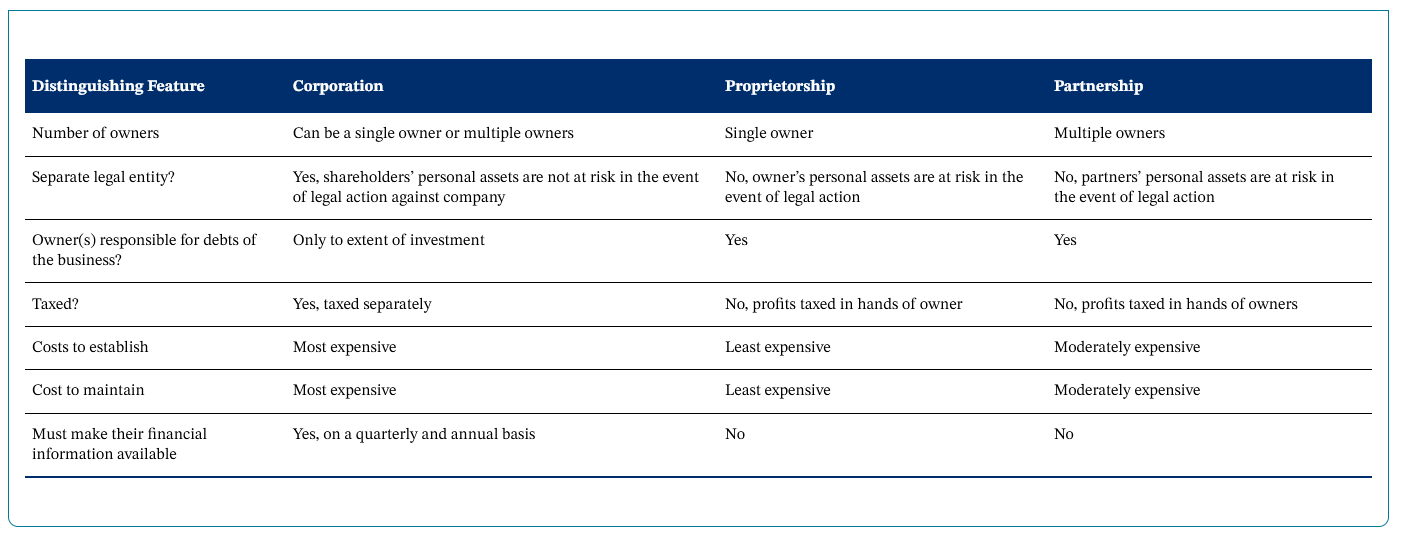
This is a type of way a company can be run, this pretty much allows the business to be its own legal entity, which means they are legally distinct from their owners (shareholders). These is where the term limited (or Ltd) comes from, it denotes the limited legal liability. If the company is sued and goes bankrupt, the liability of the owners is limited to their investment.
Types of corporations
Public companies: The shares of these companies is usually listed on a public stock exchange, and usually these companies are upheld to higher financial regulations.
Private companies: These companies are not on a public exchange, and their shares are privately held and usually don’t rapidly change (compared to public companies, who’s shareholders can change daily).
How often are financial statements prepared
They are prepared quarterly (or every three months).
Differences between a corporation, proprietorship, and partnership
Where does a company get initial financing?
A company’s financing comes from two main sources:
Investors, through the issuance of shares
Creditors, through taking out loans or making purchases on credit
When a investor invests in a company, what kind of returns do they expect?
Investors seek dividends and capital appreciation.
Capital appreciation is the increase or decrease of the shares they bought in the company once they decide to sell. If the shares have increased in price since they bought them, that is net gain for the investor.
When a creditor provides funds to a company, what kind of returns do they expect?
Credit providers expect to gain interest on their loan, on top of receiving their principal payment in full.
Retained earnings
This is when a company retains the profit it makes and reinvests it.
Operating activities
These are activities associated with developing, producing, marketing, and selling the company’s products or services.
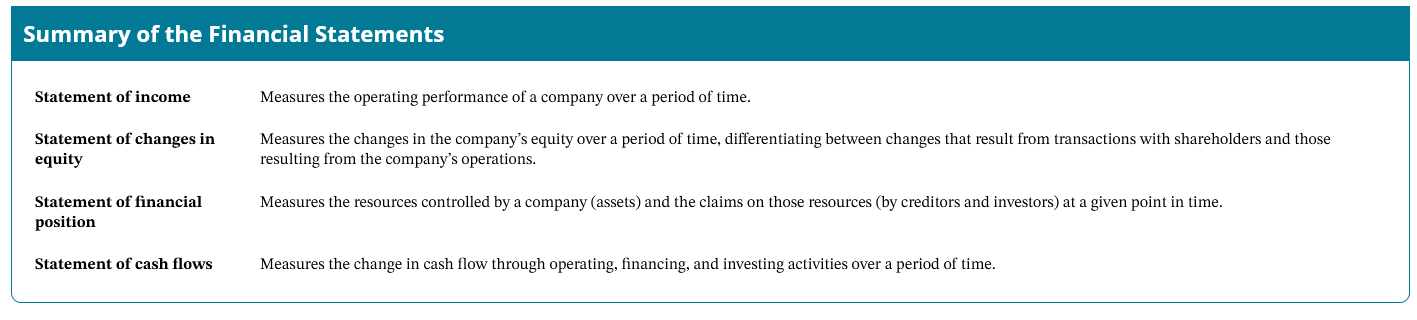
What is the objective of the statement of income?
The statement of income provides the results of a company’s operating activities for a time period (monthly, quarterly, yearly, etc.). The sum of these operating activities is the company’s profit; this value is determined by subtracting expenses incurred in the time period from the income earned during that time period.
This financial statement is also known as the income statement, or statement of profit or loss.
What other terms refer to profit?
Net income, net earnings, or earnings.
Income
Income (which includes revenue) is defined as increases in economic resources other than those contributed by shareholders. Revenues result when resources flow into the company from its ordinary activity.
Expenses
These are defined as decreases in economic resources, other than distributions to shareholders. They are more commonly though of as the money or other resources that flow out of the company in the course of generating revenue, Such as the cost of good sold.
Gross profit
Also known as the gross margin, it is the difference between sales revenue and cost of goods sold.

Operating profit
This value is the difference between the company’s revenue and the operating expenses (not including the interest expense, which isn’t considered an operating expense). It usually helps investors and creditors assess a company’s performance.
Net income
This is the
IFRS/GAAP
Generally Accepted Accounting Principles
International Financial Reporting Standards
ASPE
Accounting Standards for Private Enterprise - Followed by Canadian Private companies, similar to US GAAP.
Current and non current assets
Current: Consumed within one year (operating cycle)
Non-current: Benefits extend beyond one year
Tangible and Intangible assets
Tangible is something you can touch (Physical), while intangible is something non-physical (e.g. trademarks).
Accounting Equation
Assets = Liabilities + Equity
Total Assets Equation
Total Assets = Current Assets + Non Current Assets
Total Liabilities Equation
Total Liabilities = Current liabilities + None current liabilities
Retained Earnings
Opening retained earnings + Net income - Dividends declared = Ending retained earnings

Balance sheet (Statement of financial position)
The term financial position indicates that this statement presents the company’s financial status at a particular point in time.
Working capital
A common measure of a companies liquidity, to attain the value you get the companies current assets and subtract from that its current liabilities, which gives us the working capital. It measures a company’s ability to meet its short-term obligations using its short-term assets.

Characteristics of an asset
It is an economic resource controlled by an entity.
The company expects future economic benefits from the use or sale of the resource.
The event that gave the company control of the economic resource has already happened.
Types of assets

Liabilities
The accounting definition of liabilities encompasses this concept and refers to items that will require the outflow or sacrifice of economic resources in the future to settle an obligation that exists as a result of a transaction that has already taken place
Characteristics:
It is a present obligation of the entity.
The company expects to settle it through an outflow of economic resources.
The obligation results from an event that has already happened.

Shareholder’s equity
This section captures the amount of the shareholders’ interest in the assets of the company. Shareholders’ equity is often referred to as the net assets of the company or the shareholders’ residual interest in the company’s assets. This is the amount of assets that would remain after all of the company’s liabilities were settled.
Equity = Assets - Liabilities
Cashflow statement
The reporting objective of this statement is to enable financial statement users to assess the company’s inflows and outflows of cash related to each of these activities, so they can see where the company’s cash came from and how it was used. This statement differs from the statement of income in that it measures cash flows during the period rather than the revenues and expenses for the period, which may not be received or paid in cash.
Subsections within a cashflow statement
Cash flow from operating activities: Operating activities include all inflows and outflows of cash related to the sale of goods and services. They are the activities that the company performs in its normal operations. The starting point in this section is frequently operating income from the statement of income.
Cash flow from investing activities: Investing activities generally involve the purchase and sale of long-term assets such as property, plant, and equipment, and investments in other companies. In the case of Dollarama, we can see the company purchased property, plant, and equipment costing $212.8 million and intangible assets costing $34.0 million during the year ended February 2, 2025. It sold a small amount of long-term assets during the period, which generated $736,000 in proceeds. It also received distributions from an investment in another company of $27.4 million. This resulted in net cash outflows of $224.1 million for the period.
Cash flow from financing activities: Financing activities are transactions that either result from new funds being received from investors or creditors or from the return of funds to these two groups. Typical activities in this category are the issuance of shares, the proceeds of new borrowings, the payment of interest, the repayment of debt, the payment of dividends, or the repurchase of shares.
Summary of the financial statements