Chapter 1: Introduction to the Human Body
 Call Kai
 Learn
 Practice Test
 Spaced Repetition
 Match
 Flashcards
 Knowt Play
1/111

Earn XP
Description and Tags
Compare and contrast anatomy and physiology, including their specializations and methods of study; discuss the fundamental relationship between anatomy and physiology; describe the structure of the human body in terms of six levels of organization; list the eleven organ systems of the human body and identify at least one organ and one major function of each; Explain the importance of organization to the function of the human organism; distinguish between metabolism, anabolism, and catabolism; provide at least two examples of human responsiveness and human movement; compare and contrast growth, differentiation, and reproduction; discuss the role of oxygen and nutrients in maintaining human survival; explain why extreme heat and extreme cold threaten human survival; explain how the pressure exerted by gases and fluids influences human survival; discuss the role of homeostasis in healthy functioning; contrast negative and positive feedback, giving one physiologic example of each mechanism; demonstrate the anatomical position; describe the human body using directional and regional terms Identify three planes most commonly used in the study of anatomy; distinguish between the posterior (dorsal) and the anterior (ventral) body cavities, identifying their subdivisions and representative organs found in each; describe serous membrane and explain its function; discuss the uses and drawbacks of X-ray imaging; identify four modern medical imaging techniques and how they are used
112 Terms
Anatomy
the scientific study of the body’s structures
Gross Anatomy
the study of the larger structures of the body, those visible without the aid of magnification
Microscopic Anatomy
the study of structures that can be observed only with the use of a microscope or other magnification devices
Regional Anatomy
the study of the interrelationships of all of the structures in a specific body region
Systemic Anatomy
the study of the structures that make up a discrete body system—that is, a group of structures that work together to perform a unique body function
Physiology
the scientific study of the chemistry and physics of the structures of the body and the ways in which they work together to support the functions of life
Homeostasis
the state of steady internal conditions maintained by living things

Name the fundamental levels of organization that increase in complexity
subatomic particles, atoms, molecules, organelles, cells, tissues, organs, organ systems, organisms, and biosphere
Chemical Level
atoms bond to form molecules with three-dimensional structures
Examples of Chemical Level
hydrogen atoms and oxygen atoms
Cellular Level
a variety of molecules combine to form the fluid and organelles of a body cell
Examples of Cellular Level
smooth muscle cell; organelle; cell fluid
Tissue Level
a community of similar cells form a body tissue
Example of Tissue Level
smooth muscle tissue
Organ Level
2 or more tissues combine to form an organ
Examples of Organ Level
bladder; smooth muscle; skeletal muscle
Organ System Level
2 or more organs work closely together to perform the functions of a body system
Examples of Organ System Level
urinary tract system; kidney; ureter; bladder; urethra
Organismal Level
many organ systems work harmoniously together to perform the functions of an independent organism
Cell
the smallest independently functioning unit of a living organism
Organelles
flexible membranes that enclose cytoplasm, a water-based cellular fluid together with a variety of tiny functioning units
Tissue
a group of many similar cells (though sometimes composed of a few related types) that work together to perform a specific function
Organ
an anatomically distinct structure of the body composed of two or more tissue types
Organ System
a group of organs that work together to perform major functions or meet physiological needs of the body
List the 11 Organ Systems of the Human Body
integumentary; skeletal; muscular; nervous; endocrine; cardiovascular; lymphatic; respiratory; digestive; urinary; male reproductive; female reproductive
Integumentary System
encloses internal body structures; site of many sensory receptors
Assigned Organs to Integumentary System
Hair; skin; nails
Skeletal System
supports the body; enables movement (with muscular system)
Assigned Organs to Skeletal System
cartilage; bones; joints
Muscular System
enables movement (with skeletal system); helps maintain body temperature
Assigned Organs to Muscular System
skeletal muscles and tendons
Nervous System
detects and processes sensory information; activates bodily responses
Assigned Organs to Nervous System
brain; spinal cord; peripheral nerves
Endocrine System
secretes hormones; regulates bodily processes
Assigned Organs to Endocrine System
pituitary gland; thyroid gland; pancreas; adrenal glands; testes; ovaries
Cardiovascular System
delivers oxygen and nutrients to tissues; equalizes temperature in the body
Assigned Organs to Cardiovascular System
heart and blood vessels
Lymphatic System
returns fluid to blood; defends against pathogens
Assigned Organs to Lymphatic System
thymus; lymph nodes; lymphatic vessels
Respiratory System
removes carbon dioxide from the body; delivers oxygen to blood
Assigned Organs to Respiratory System
nasal passage; trachea; lungs
Digestive System
processes food for use by the body; removes wastes from undigested food
Assigned Organs to Digestive System
stomach; liver; gallbladder; large intestine; small intestine
Urinary System
controls water balance in the body; removes wastes from blood and excretes them
Assigned Organs to Urinary System
kidneys and urinary bladder
Male Reproductive System
produces sex hormones and gametes; delivers gametes to female
Assigned Organs to Male Reproductive System
epididymis and testes
Female Reproductive System
produces sex hormones and gametes; supports embryo/fetus until birth; produces milk for infants
Assigned Organs to Female Reproductive System
mammary glands; ovaries; uterus
Organism
a living being that has a cellular structure and that can independently perform all physiologic functions necessary for life
Anabolism
the process whereby smaller, simpler molecules are combined into larger, more complex substances; your body can assemble, by utilizing energy, the complex chemicals it needs by combining small molecules derived from the foods you eat
Catabolism
the process by which larger more complex substances are broken down into smaller simpler molecules; releases energy; the complex molecules found in foods are broken down so the body can use their parts to assemble the structures and substances needed for life
Metabolism
the sum of all anabolic and catabolic reactions that take place in the body
Responsiveness
the ability of an organism to adjust to changes in its internal and external environments
Development
all of the changes the body goes through in life
Differentiation
unspecialized cells become specialized in structure and function to perform certain tasks in the body
Growth
the increase in body size
Reproduction
the formation of a new organism from parent organisms
Nutrient
a substance in foods and beverages that is essential to human survival
Controlled Hypothermia
clinically induced hypothermia performed in order to reduce the metabolic rate of an organ or of a person’s entire body; hypothermia is the clinical term for an abnormally low body temperature (hypo- = “below” or “under”)
Pressure
a force exerted by a substance that is in contact with another substance
Decompression Sickness (DCS)
a condition in which gases dissolved in the blood or in other body tissues are no longer dissolved following a reduction in pressure on the body
Set Point
the physiological value around which the normal range fluctuates
Normal Range
the restricted set of values that is optimally healthful and stable
Negative Feedback
a mechanism that reverses a deviation from the set point
Sensor
also referred to a receptor, is a component of a feedback system that monitors a physiological value
Control Center
the component in a feedback system that compares the value to the normal range
Effector
the component in a feedback system that causes a change to reverse the situation and return the value to the normal range
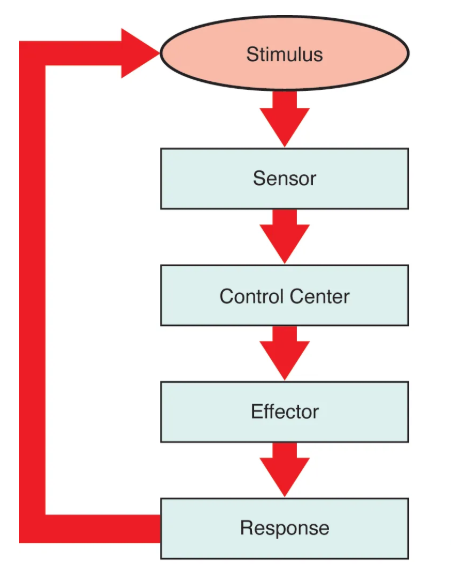
Negative Feedback Loop
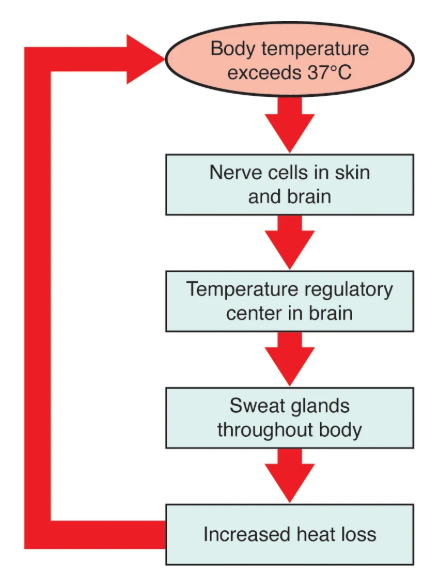
Body Temperature Regulation
Positive Feedback
intensifies a change in the body’s physiological condition rather than reversing it

Positive Feedback Loop
Anatomical Position
the body standing upright, with the feet at shoulder width and parallel, toes forward
Prone
a face-down orientation
Supine
a face up orientation
Anterior or Ventral
the front or direction toward the front of the body
Posterior or Dorsal
the back or direction toward the back of the body
Superior or Cranial
a position above or higher than another part of the body proper
Inferior or Caudal
a position below or lower than another part of the body proper; near or toward the tail (in humans, the coccyx, or lowest part of the spinal column)
Lateral
the side or direction toward the side of the body
Medial
the middle or direction toward the middle of the body
Proximal
a position in a limb that is nearer to the point of attachment or the trunk of the body
Distal
a position in a limb that is farther from the point of attachment or the trunk of the body
Superficial
a position closer to the surface of the body
Deep
a position farther from the surface of the body
Section
a two-dimensional surface of a three-dimensional structure that has been cut
Plane
an imaginary two-dimensional surface that passes through the body
Sagittal Plane
divides the body or an organ vertically into right and left sides
Midsagittal or Median Plane
vertical plane runs directly down the middle of the body
Parasagittal Plane or Longitudinal Section
divides the body into unequal right and left sides
Frontal or Coronal Plane
divides the body or an organ into an anterior (front) portion and a posterior (rear) portion
Traverse Plane
divides the body or organ horizontally into upper and lower portions
Oblique Plane
intersects the body at an angle and is not parallel or perpendicular to any of the other three commonly used planes
Dorsal/Posterior Cavity and Ventral/Anterior Cavity
the largest body compartments; these cavities contain and protect delicate internal organs, and the ventral cavity allows for significant changes in the size and shape of the organs as they perform their functions
Cranial Cavity
houses the brain
Spinal or Vertebral Cavity
encloses the spinal cord
Thoracic Cavity
the more superior subdivision of the anterior cavity, and it is enclosed by the rib cage
Abdominopelvic Cavity
the largest cavity in the body
Serous or Serosa Membrance
one of the thin membranes that cover the walls and organs in the thoracic and abdominopelvic cavities
Pleura
the serous membrane that encloses the pleural cavity; the pleural cavity surrounds the lungs