Terrestrial Fauna L13-23
 Call Kai
 Learn
 Practice Test
 Spaced Repetition
 Match
 Flashcards
 Knowt Play
1/145

There's no tags or description
Looks like no tags are added yet.
146 Terms
Describe Narrm / Melbourne’s distinct bioregions
Bioregion | Where it is on the map | Main landscape | Typical vegetation |
|---|---|---|---|
Victorian Volcanic Plains | West and south-west | Flat basalt plains | Grasslands and grassy woodlands |
Gippsland Plain | East and south-east | Coastal plains and wetlands | Heathlands, wetlands and forests |
Central Victorian Uplands | North and north-east | Hills and mountains | Eucalypt forests and woodlands |
Kulin seasons are marked by…
Bio-indicators (particular species at specific stage of life cycle)
Flowers, animals, changes in environment
Phenology: track life cycles
Not dictated by Gregorian calendar
Melbourne has 7 seasons
In what way has urbanisation changed the natural environment?
Vegetation and water courses altered
Creates an extreme environment
Altered access to resources (food / shelter)
Novel structures and surfaces (e.g. birds with glass, worms with concrete)
Introduced species
Noise
Light
New sources of mortality — cars, dogs, cats
Pollution (plastics, metals, bioaccumulating toxins, etc.)
Urbanisation
8.31 bill humans
6.7 bill people will be in urban centres by 2050
Commercial and residential development is the 3rd most frequently cited threat to species on the IUCN Red List
As natural habitats are degraded, the urban environment becomes more important as a potential habitat for animals
What is good for biodiversity is good for humans too, Green spaces:
Linked to lower stress levels (cortisol)
Linked to reduced risk of heart disease, diabetes and obesity
Tree cover reduces urban heat island effect
Trees improve air quality
But the structure of green spaces matters for biodiversity
Mid-storey: The best green spaces have complex structures and a diversity of species
Introduced urban wildlife
Many non-native (introduced) species in urban areas
Arrive with humans
Often already adapted to human environments (in other parts of the world)
Intentional or accidental
Intentional (E.g. The Acclimatisation Society of Victoria 1861: Sambar deer, pigeons, Indian mynas, foxes)
Accidental (E.g. Snails, Argentine ants, daddy longlegs)
Native urban wildlife
Simplified environment favours generalists
Resource increases for ecological generalist species
E.g. Common brushtail possum - Trichosurus vulpecula
Density is higher in urban than non-urban areas
Omnivore
Adaptable to human structures and non-native vegetation — Higher abundance of den sites (bins, roofs if not tree hollows) = more possums
Territorial
Being pre-adapted to a resource valued by humans
E.g. Maned wood duck - Chenonetta jubata
Able to exploit an abundant food resource - grass (lawns are valued by humans)
Sports fields, golf courses, parks and gardens, verges
Nesting is flexible — cavities, artificial nesting boxes and other human structures are used
Can nest a long way from water (~5km away) — not restricted by environment
E.g. Honeyeaters
Usually territorial
Can take advantage of nectar from showy plants like proteaceae (humans like)
A combination of adaptability and mobility
E.g. Grey-headed flying-fox — Pteropus poliocephalus
Urban heat island = higher minimum temps
More stable temp in the city e.g. no frost in the winter
Increase in food species
Loss of natural habitat outside cities
Black flying-fox species pushing south — aggressive and territorial
Humans cut down and remove their habitats outside = pressure, pull inwards (food and roosting resources lost outside city)
Novel behaviours in some populations — synurbanisation
Specific population in urban areas develop novel traits to persist
E.g. Sulfur-crested cockatoos - Cacatua galerita
Using intelligence to exploit novel resource (human waste)
Social structure allows learning
Cultural practices spreads in a population
E.g. bin raiding by ravens, foxes, etc
E.g. Possums make bins roosting sites
Urban resources can create an Ecological Trap
Ecological Trap: the illusion of being in a suitable habitat but long-term not suitable (reduced survival or lower reproductive success)
Animals use cues for suitable habitat to move into suburban areas
Food availability
Shelter
E.g. Owl hunts possums (found in urban areas) —> large food source BUT owls are large and need big tree hollows (almost none in melb - don’t support breeding)
False cues
Reduces survival of animals weighing into that signal
E.g. insects navigating with light are mislead by light pollution
Urban environments can support threatened species. What are threats to their ongoing persistence in urban areas?
Hollow loss from tree removal
Weeds replacing food and shelter
Toxins and pollutants (including light, sound, and human waste)
Possums have PFAs (endocrine disruptor: toxins are accumulating) in their livers
Birds have plastic in their stomachs
Predators and competitors
Many introduced species
Out of balance system with aggressive native species also dominating
E.g. Cats — no.1 predator in urban environment, along with foxes
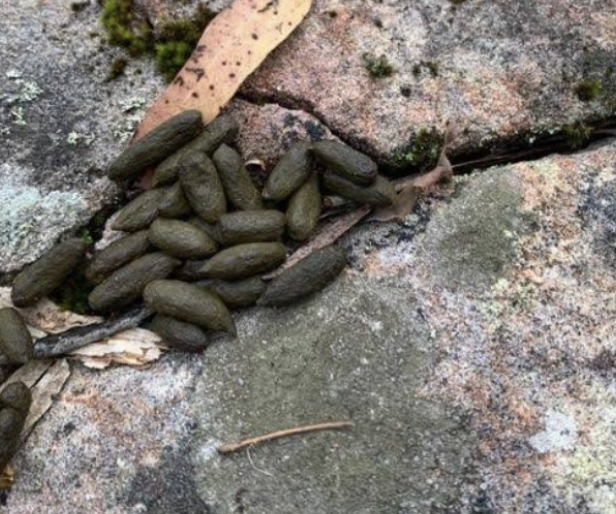
Which urban animal most likely deposited the scat shown?
Common brushtail possum
Australia is the 2nd driest continent on Earth. What are 2 predominant features that impact animals?
Climate
Physical geography
How does climate impact animals in arid zone?
1. Rainfall
Rainfall is unpredictable and thus availability of food for animals is also unpredictable
Arid: defined as insufficient rain for agriculture
Arid areas <250 mm
Semi-arid areas <500 mm
Seasonality: wet and dry seasons, but timing differs in N and S
Australia’s deserts are not the driest in the world
Rainfall variation in arid Aus: 10% higher compared to other arid zones around the world
E.g. Alice Springs: mean annual rainfall: 281 mm, range: 60-903 mm !!!! (impacts food)
Patchy distribution: within districts and between years
After rain: rapid plant growth, flowers and seeds provide food for animals
2. Temperature extremes
Up to 45°C + during day
Impacts water requirements and metabolism of animals
Can reach freezing point at night
How does physical geography impact animals in arid zone?
1. Environment
Vast flat low areas (stony or land), vast sand dunes and some low stony hills
Limited areas of mountainous ranges, and those ranges are low (all <1500 m) E.g. Pilbara
Landscape is highly weathered = low N and P
2. Refuge
Hills and caves provide refuge for animals E.g. Yellow-footed Rock Wallaby
When rain dries out, cracking soils also provide refuge for animals E.g. Planigale
Vast, very flat areas in arid zone may have large areas of grasses E.g. Triodia sp. “Hummock grasses”
Microhabitat for small animal species
Provides shelter and seeds (food)
Managed by fire
Hard to find refuge in stony desert or ‘gibber plain’
Polished, pebbly surface (wind tends to erode and polish these massive plains to look like gravel)
Animals that can move back and forth long distances can get around these inhospitable areas
In Australia’s arid regions, physical geography and climate leads to low productivity and therefore:
Low food / water availability for animals
Unpredictable environments / highly variable food and water availability for animals
It is a highly weathered landscape which has resulted in low soil nutrition
Rainfall pattern is low availability and high variability
What are challenges / constrainsts for animals in arid zones?
Poor nutrient soils
Overall low food availability and low quality
Unpredictable water and food supplies
High temperatures (Jan/Feb >40°C)
What are the 2 categories of ecological, physiological, and behavioural adaptations animals have?
Drought evasive: not active during really dry periods
dormant stage as egg or adult
develop and reproduce rapidly after heavy rains
OR move away from drought areas
Drought tolerant: often long-lived species
slower life cycle
tolerate very low levels of moisture and food (physiology) — have low energy / water requirements
behavioural strategies to assist survival
Compare vertebrates and invertebrates in arid zones
Vertebrates:
Mammals and birds — endothermic = relatively high energy needs
Reptiles and frogs — ectothermic = lower energy requirements than endo
Invertebrates:
Highest faunal diversity, ants and termites are dominant groups
Ectothermic and very small = lower total energy requirements than vertebrates
Don’t require permanent access to an energy source
Get most water from prey, don’t need a body of water to drink from
Ectothermic animals are sensitive to changes in air temp yet are common in arid zones due to their lower MR and therefore energy requirements.
What are drought-evasive strategies of animals?
1. Remain dormant as egg or adult during dry times
As egg: E.g. Shield shrimp
Cysts hatch and develop into adults very rapidly - approx 2 weeks after rain
Incredibly fast life cycle
When puddles dry out, cysts in ‘suspended animation’ (diapause) for years
Cysts are very tiny, can be dispersed by wind
Hermaphroditic = can easily swap gametes
As adult: E.g. Burrowing frogs (Cyclorana spp., Neobatrachus spp.)
Water conservation strategies:
Aestivation (lower their metabolism and remain inactive)
“cocoon” (to store water —> holds water under layer of skin)
Reproductive strategies:
Emerge and breed rapidly after rain
2. Migration to areas with water / food E.g. Birds — Budgerigars (arid zone distribution)
Behaviour: migratory / nomadic — flocks travel up to 1500 km to find food and water
Breed opportunistically when grass seeds (food) become available after rain
What are drought-tolerant strategies of animals?
1. Insulate against extremes such as high temp and low water availability
E.g. Honey pot ants: Special replete workers act as storage pots to feed colony —> in deeper part of the nest (has constant temp)
Arid zone mammals also
Regulate temps (e.g. via coat colour, evaporative cooling, behaviour, etc.)
Avoid high temps (behaviour: nocturnal, use of burrows)
Water conservation (physiology)
2. Energy conservation E.g. Southern Hairy-nosed wombats (Lasiorhinus latifrons)
Avoid high temperatures
Spend very little time above ground (use burrows)
Nocturnal (avoid highest temps)
Breeds seasonally
Relatively inactive (radio-tracking studies)
Survive on low quality food
Eats high silica, low N and P
Gut is able to get the most nutrients possible
Relatively low metabolic rate (for a mammal)
Reduces food and water requirements relative to mesic zone “cousin” - the common wombat
3. Maximise access to water E.g. Thorny devil (Moloch horridus)
Specialised skin texture (morphology) to capture dew and rainwater
Scales are surrounded bby tiny interconnected channels that attract water
Water is then funnelled from these into the mouth
4. Access water from food E.g. White-winged fairy wren — a tiny arid zone specialist
Food selection: diet of insects = high water content
5. Physiology to conserve water E.g. Eyrean grasswren (Amytornis goyderi)
Very efficient kidneys — assists water retention
Extract water from dry seeds and supplement with small insects
Long thought to be extinct: secretive behaviour, remote distribution
6. Energy conservation in mammals E.g. Fat-tailed dunnart (Sminthopsis crassicaudata)
Diet: insects = 70% water
Low MR
Fat storage in tail enables them to go into torpor (slows down metabolism and saves energy)
If insects are not available, they survive off fat
7. Water conservation in mammals E.g. Spinifex hopping mouse (Notomys alexis)
Diet: seeds (not as scarce or variable as insects but low in water)
Minimise respiratory water loss
Very dry faeces (water reabsorbed in hindgut)
Super-concentrated urine
If dehydrated, they can change how they source energy for processes in the body to produce metabolic water
Describe Australia’s alpine zone
0.15% of Australian landmass – very small total area
Mean temp. of warmest month <10°C (trees don’t thrive)
Snow 2-3 months per year – strongly seasonal conditions
25% of Australia's rainfall (a lot of rainfall)
Significant area for: water supply, recreation, nature conservation (contains unique group of native species)
Australian alpine zones are distributed in a series of disconnected regions from Tasmania to Southern NSW
Habitat for alpine animal populations is naturally fragmented due to variation in altitude. Populations are:
isolated in tiny land area
genetically distinct
more vulnerable
Is the alpine environment predictable & strongly seasonal, or unpredictable and variable?
Predictable & strongly seasonal.
Extreme temperature differences
Prolonged cold - winter, night and cloud
Permanent water & abundant moisture – high rainfall,
condensation, snow meltFlora: mostly herbs and lichens (i.e. small — very low biological productivity)
Snow gums (sub-alpine woodlands)
Also some energy input from sub-alpine areas through flying insects, wind-blown detritus, pollen and seeds
Nutrient delivery from winds coming upslope
Brings detritus and growth from down the mountain up the mountain
Alpine zone plants
Flora: small plants, summer flowering
E.g. Alpine grasses, Peat bogs, Alpine daisies
Low growing
Snow gums (sub-alpine)
Leaves can withstand freezing (waxy)
Doesn’t allow ice crystals to form —> no damage to the structures, no damage to tissues
Do not occur on mountaintops (not in alpine zone)
Highly susceptible to fire
Grow slowly and do not recover (unlike eucalypts)
Impacts of climate change on the alpine zone
Distribution of specialised alpine plants and animals is very restricted to the zone between tree-line and summit
As the continent warms, alpine adapted animals will have to move higher to access preferred conditions
Alpine is moving up the mountain —> bands of habitat moving up eventually is lost —> entire mountain is converted to sub-alpine rather than alpine conditions
Australia’s mountains are relatively low: climate change may leave specialised alpine species with nowhere to go
Concerns: whether it snows and how deep snow gets
Determines how long snow will last
Snow is insulative blanket for lots of animals over winter
What changes have occurred and are predicted to occur in the alpine zone due to climate change?
Tree-line at Mt Hotham in Victoria has already moved up 40m to an area that had not had trees for past 25 years
Expected 18-66% reduction in snow cover by 2030 and 39-96% by 2070, 100% loss by 2100
With small change in temp, the tops of 6 mountains will be the only remaining alpine ecosystems
What are conservation issues for alpine areas?
Extensive recreational use
Human infrastructure: loss of habitat, erosion, fragmentation, pollution etc.
Clears vegetation and rocks
Increasing frequency of fire
Due to drought
Cattle and sheep (grazing and trampling)
Alpine does not cope well, does not recover even after ~60 years
Feral animals – rabbits, cats, brumbies
Australian alpine zone fauna
Higher the altitude = Lower the species diversity
Less diverse than arid zone
Arid has larger land space
Faster life cycles in arid = more species evolving overtime
No truly alpine birds - migrate seasonally e.g. flame robin (in for summer, out during winter)
Low diversity of reptiles (only 1 species found over 2000m in altitude – Alpine skink)
Very few mammals, largest herbivores absent
Invertebrates most diverse and abundant group!
All species experience highly seasonal food availability
Compare endotherms and ectotherms
Endotherm: MR drives body temperature
High body temp and fast reaction rates
Active across a wide range of environments
High energy requirements all the time to maintain MR
Ectotherm: Body temperature drives MR
Body temp fluctuates with environmental conditions
Variable reaction rates (reliant on external thermal energy)
Active when conditions are suitable
Less energy used when conditions are not suitable
Ectotherms in the alpine zone
Lower energy requirements – useful in an energy poor environment
Body temp declines with environmental temperatures
Reduced metabolism and activity
Strategies (adaptations) to avoid freezing
dormant life stage
behaviour e.g. seek refugia (hide from cold e.g. snow blanket)
migrate
Invertebrates in alpine zone: adaptations to low biological productivity and cold
E.g. Tasmanian scorpionfly (Apteropanorpa tasmanica)
In winter consume moss – larvae only active in winter
Gather around edges of snow drifts and feed on detritus as it is released during snow melt (this is blown up from sub-alpine areas)
Enzymes and body physiology is adapted so the optimum temperature is really low
E.g. Mountain grasshopper (Monistria concinna)
Small size (SA:Vol is small)
occupy sheltered micro-climates
chunky to retain body heat
Stenothermic: physiology adapted for a narrow range of low temps
produce anti-freeze (series of proteins that prevent ice crystals forming inside their cells)
microbiome in their gut causes nucleation points for ice to form at higher temp = crystals grow slowly and don’t do damage to tissues
Small, reduced wings
Cannot fly, or hop far
Escape predation by camouflaging
Invertebrates in alpine zone: Behavioural thermoregulation
E.g. Chameleon grasshopper (Kosciuscola tristis)
Remain active all day (generally adapted to cooler conditions, but can cope with large temperature variation)
Movement in & out of sun
Thermal melanism:
Colouration is not for camoflage but to control body temp by changing how much thermal energy it is absorbing or reflecting at any one time
Cold conditions (higher altitude): darker/black, thus absorb heat
Can change throughout day (dark —> light —> dark)
Ectotherm vertebrates in alpine zone — frogs
Over-winter in alpine areas (low mobility, don’t migrate)
Winter: become totally inactive
Bury in microhabitats e.g. peat bogs, snow blanket
E.g. Corroboree frogs: Evolved life history adaptations to cold
2 species – northern and southern (isolated from one another due to speciation overtime)
Occur mainly >1800m elevation
Males dig burrow in sphagnum moss bogs & call
Females lay in this nest, but development is delayed until late winter (melt starting), and is slow metamorphosis as the burrow fills with water
Due to shorter periods of water availability / not enough rainfall / snowfall —> ponds dry up faster —> not enough time for its evolved slow metamorphosis process to transition to an adult before everything dries
Snowmelt: when burrows fill with water in spring they hatch and mature
They are rare and declining
2 alpine endotherm strategies
Migratory
many sp. avoid cold by migrating
E.g. birds, larger mammals like wallabies
Permanent residents
some sp. stay active (no state of dormancy)
some use torpor (adjust body temp) e.g. small mammals like Mountain pygmy possums
Alpine endotherms active during winter - give an example
E.g. Common wombat
Active all the time during winter
Medium body size
Mammals, thus high MR so can keep warm/active
Paws can dig out grasses and plants from snow (access to food)
Small SA:Vol = Efficient at retaining heat generating through metabolism of food
Daily adaptive hypothermia: Torpor
E.g. Mountain pygmy possum, Chocolate wattle bat
Decreased body temperature
Torpor = Reduced MR, respiratory rate, heart rate
Curl up (minimise surface area and thermal energy exchange)
Occurs in small endotherms – reduces their risk of starvation & conserves energy
Often a response to low food availability
Typical pattern of torpor in small mammals
Rapid entry into torpor - MR drops, body temp drops by passive cooling
Animals exit torpor by turning MR up, body temperature follows
Can be short-term (daily) or long-term
Seasonal adaptive hypothermia: Hibernation
Seasonally-induced deep torpor, longer bouts
Only two Australian mammals: Mountain pygmy-possum and Echidna
Fatten-up prior to winter
Retreat to hibernaculum (safe place when you can’t move) and go deep into torpor
Test drops in body temp
Periodic arousal to find water
Breeding patterns in alpine zone animals
Short period of warmer weather — growing season & breeding season are both short but predictable (unlike in arid zone)
Some species exhibit dormancy at other times of year (i.e. during non-breeding season)
Invertebrates: speed of development often not as crucial as in arid areas. Life-cycle usually completed in a season.
Larger animals (e.g. Mountain pygmy-possum) synchronise their breeding season, and have fast growth before winter
CS: Climate change impact on breeding patterns of Mountain pygmy possum (Burramys parvus) & Bogong moths
Mountain pygmy possum (Burramys parvus)
Highly seasonal
Entirely limited to alpine regions
Thought extinct until 1966, now endangered
Habitat: alpine boulder fields and rock screes
Mating occurs when snow melts and Bogong moths (food) arrive (store body fat)
Road was built which divided sexes: they couldn’t cross to breed (would get run over)
“Tunnel of love” built at ski resort - sexes occupy different habitats that had been fragmented by a road
High quality upslope (above the road) habitat was where females were congregating (have to put energy into reproduction)
Lower quality downslope territory was held by males (don’t raise young)
Bogong moth (Agrotis infusa)
Small grey-brown moth (wingspan approx 4cm), alpine seasonal migrant
Larvae winter in pastures in Sth QLD, NSW & SE Vic, but food plants dry off over summer
Intolerant of summer heat
Adults migrate to alpine areas, shelter in caves & crevices >1500m during spring/summer up to 17,000 individuals/m2
Aestivate when in alpine zone - survive on fat
storesClimate change is a severe threat
Because of light pollution up and down East Cost, moths get lose and off course (they use the moon)
They don’t make it to the high country = smaller food source for possums
Effects of climate change on mountain pygmy possums
Threaten survival because Burramys need 70cm-1m of snow to keep warm during winter (acts as a ‘doona’, keeping temp at approx. 2ºC)
The possum’s entire climatic habitat will be lost with only 1ºC warming
Also potential impacts on key diet item – Bogong moths
Environment is highly fragmented
where there are small populations, their genetics can start to be degraded
All individuals become very similar, no diversity in population and that can affect fitness of individuals
Possums were translocated from Mt Hotham to Mt Buller where possums were declining
hybrids are bigger and reproducing more successfully
Does North or South Australian rainforest have higher animal diversity?
North: Tropical rainforest
Higher animal diversity
Warmer, massive rainfall
South: Temperate rainforest
Lower animal diversity
Cooler
Tropical rainforests in Australia
70-100% canopy cover
From sea level to 1600m
Upland RF (cooler) = fewer animal sp
Higher altitude — Fewer but more unique species, similar to alpine
Lowland RF (warmer) = more sp
Rainfall is reliable, >1500m/yr
Massive amt of rain, large amt of water supports productivity
Small area: Only 1-2% of the total land area of Aus is considered tropical
Australia tropical rainforest diversity
Exact number of invertebrate species unknown, but it is very large
>75,000 sp. endemic
128 bird sp. (16.5% of Aus birds)
Behavioural and species diversity of birds is strong in tropical environments
E.g. Birds of paradise i.e. Victoria’s Riflebird
E.g. Palm cockatoo
160 reptile sp. (23% of Australia’s reptile fauna)
E.g. Lace monitor (goanna)
Big distribution overlaps with tropical rainforest (rainforest is part of their range)
47 frog sp. (23% of Australia’s frog fauna)
E.g. Stony creek frog Litoria wilcoxii
Amplexus: Male embraces female and triggers her to release eggs for him to externally fertilise
Sometimes males mistake cane toad for females (can die as cane toads may release poison from glands if stressed)
89 mammal sp. (1/3 of Australia’s mammal fauna)
E.g. Striped possum
E.g. Musky rat kangaroo (not found anywhere else)
Why do tropical rainforests support high animal diversity?
Habitat patchiness + high complexity + high productivity = massive biodiversity
Habitat patchiness at a local scale
Tropical rainforest in North Queensland: large areas of habitat
But varies at a local scale: potential barriers to movement which restrict / prevent populations of some species from mixing
Habitat patchiness (local-scale) can result in the isolation of sub-populations of some species (potential for speciation)
over time there might be changes in genetic structure of 2 populations because there is no gene flow — through changes in the selection pressures in the 2 populations OR just random chance (genetic drift)
Habitat patchiness at a larger scale across landscapes
Geographical barriers (e.g. valleys b/w mountains) can also result in the isolation of sub-populations
PNG has significant mountain areas but also in Aus
TK illustrate the links between Australia and PNG’s rainforest fauna
CS: In PNG Matschie's TK & Dingiso (TK)
Some tree kangaroo populations are isolated on mountain tops
Found in the tropical rainforest as animals that returned from the ground back into the trees
Evolved ~5mya
The musky rat-kangaroo is the closest living relative to the ancestral phalangerid (possum) from which kangaroos evolved (including tree kangaroos)
Some tree kangaroos have re-evolved some traits that we see in things like possums i.e. rotating ankles, muscular forearms, short legs (different from kangaroo)
CS: In Aus Lumholtz TK & Bennett’s TK
2 species, distributions don’t overlap (Daintree river has become a geographic barrier)
TK were once widespread, but distribution has contracted with rainforest contraction as the continent dried out — extant sp now restricted to tropical rainforests
The fossil records of TKs show that speciation and the diversity of this group actually happened across the continent (not just in Tropical rainforest)
Habitat patchiness: Explain how tropical rainforests are biodiversity hotspots
Climate becomes cooler/wetter —> Rainforest expands —> Animals move into newly available rainforest —> Populations become separated in different areas —> Over time → speciation (new species)
Climate becomes warmer/drier —> Rainforest contracts —> Suitable habitat disappears from much of Australia —> Species' ranges shrink —> Species become concentrated in remaining rainforest
When rainforest expanded, animals could spread into new areas and populations could diversify. When rainforest contracted, those species were pushed back into the remaining rainforest
The rainforest becomes a refuge for all the species that may have evolved over a broader scale in Australia and now are only found in this really small patch of country in the tropical north
Habitat patchiness: Habitat / geographic barriers impact variably on animal species depending on their…
Mobility
E.g. Bat vs Antechinus
Bat: able to fly = adapted to urban environments — more resilient to the degradation and fragmentation of habitat if they can move across non-suitable habitats
Antechinus: Much harder for them to cross vast distances if there is fragmentation happening = more likely to see speciation
Body size
E.g. Antechinus, insects
Small body size = less likely able to cross over geographic barriers
Degree of habitat specialisation
E.g. Dingo
Very broad diet = capable of surviving in lots of different environments = less likely to see speciation based on geographic change because they're able to move through multiple different types of environments and still survive and reproduce
Habitat patchiness: Diversity of rainforests increased through faunal links with PNG and Asia continent (Australasian rainforest fauna)
The mobility of species and their ability to cross “habitat barriers” has an important influence on their distribution and diversity
Faunal diversity is a result of current movements and past land bridge
Approx. 50% of Australian tropical rainforest birds are shared with PNG
Some migrate back and forth, some distributions span both land masses
E.g. Buff Breasted Kingfisher
Stays over-winter in PNG & migrate to Aus to breed in lowland rainforests in the summer
Form pairs, establish territories, nest in termite mounds (protected, insulated, dry)
Adults migrate back to PNG March-April (juveniles later)
Juveniles are left behind with genetic imprinting, they are instinctively triggered to move back to PNG as weather starts to cool down
E.g. Little Red Flying Fox (mammals)
Fission fusion structure
Move between camps all the time
There is a mix of animals roosting in different parts of the range over the year — it's one massive population through PNG and the top end of Australia
Flying foxes highly mobile, capable of long-distance movements
Effectively one large population in Aus and PNG
E.g. Amethystine python
Australia’s largest snake up to 8m, major predator in rainforest
No migration, thus PNG and Australian populations now isolated
Torres Strait = current geographic barrier
Starting to see evidence of speciation
How does habitat complexity of rainforests support high animal diversity?
Diverse possibilities of habitat niches = more diversity at each layer = animals find a specialisation and support a specialised diet
Carnivorous birds exploit high complexity
E.g. Red Bellied Pitta specialises on rainforest snails
Good at finding snails in the complexity of the rainforest
Diversity of snails and food is able to support an animal that only eats snails
Level of competition in these environments are quite low
How does high productivity of rainforests support high animal diversity?
Frugivore (herbivorous) birds exploit high productivity and lots of fleshy fruit available in rainforest
E.g. Superb Fruit Dove and Fig Parrot
Tropical rainforest trees often fruit heavily and are used by many species
They eat similar fruits but low competition cause there so many fruits
Temporal isolation / speciation in resource use reduces comptition
E.g. Bats feed on fruits at night when frugivorous birds not active
Feathertail glider feeds on nectar at night; honeyeaters, butterflies, and friar birds feed during day
What are endemic species?
Unique to a particular geographic region or locality
Assumed to have evolved there
Large number of endemic species in Australian tropical rainforest
More endemic at higher altitude
Separation of population = speciation
E.g. species ends up only existing on mountain tops = endemism (evolved there, not able to travel easily from that particular environment to somewhere else)
Rainforest endemics:
There are more reptiles and frogs that are endemic than birds and mammals
E.g. Golden bower bird
Occurs above 900m
Feeds on fruit
Smallest birds but males build largest bowers (to attract females)
Generations build on previous work
E.g. Boyd’s forest dragon
Occurs in very dense rainforest areas: high and low altitude
Don’t bask, and operate at lower temperatures to avoid pythons (except pregnant females)
Use chemical signals of new growth (plants) that attract stick insect that they eat
E.g. Musky rat kangaroo
Last of a Gondwanan group
~20 mill yr history
Conservation: Key issues for endemic rainforest species
Limited distribution, often habitat specialists (loss of habitat or population = loss of that
species world wide)Often rare & difficult to study, often little knowledge of biology
CS: Conservation of striped possums (rainforest)
Quite common in PNG, not particularly common in Aus (Australia represents the edge of its range so it's quite rare as a species)
It is of conservation concern in Australia, not so much in PNG
Asking key ecological questions: What is their diet? What are their habitat use and area requirements? How do they compare to closely related species?
Finding answers: The link b/w what they eat and how much space they need = the idea of trophic levels and how energy moves through an ecosystem
Bigger area = carnivorous (rather than herbivorous)
The metabolisms of most species are highly inefficient — about 90% of everything we eat is lost as thermal energy
They must find food across a wide area
Using known diets of other Petaurid (gliding) possums:
Plant exudates (sap, gum, nectar) a major component of diet (major part)
Smaller species supplement diet with invertebrate (minor part)
Looking at unusual morphological characters of Striped Possums:
Klinorhynchy (rounded cranium)
suggests that potentially they're processing information — hunting requires thought and complexity
Large procumbent lower incisors
Suggests they have a specialised diet
Tongue & 4th finger elongated (similar to Aye-aye)
Suggests specialised diet of invertebrates
RESULTS: Striped possum diet: specialised insectivore
Wood-boring beetle larvae and social insects very important in diet
Other invertebrates taken opportunistically
Plant exudates used occasionally
The inverse of all of their cousins, where they're feeding mostly on insects and plant exudates are used occasionally
Radio-tracking data showed that habitat requirements are huge compared to other petaurid possums
Key conservation issue of rainforests: loss of biodiversity
1. Habitat loss: extensive clearing of tropical rainforest is a direct threat to fauna
80% of Australian tropical rainforest is impacted by human activities, only 20% undisturbed = huge potential impact on fauna
Disturbance creates ‘edges’ — opens up forest to invasion by weeds and feral species
Rainforests can grow back but what grows back is of less quality
Loss of components of habitat: E.g. Ulysses Butterfly - dependent on one plant genus for oviposition: Genus: Melicope, caterpillars feed on it’s leaves
2. Impact of increasing human population
Human popns, development, and changed land management, along with continued traditional hunting
3. Poaching
Wealthy animal collectors drive poaching of rare species for their private collections
4. Invasive species
E.g. Yellow Crazy Ants
Can form super colonies and dominate the foraging spaces on ground
Incredibly aggressive, very effective at taking advantage of any food source they can find (outcompete)
E.g. Wild pigs
Wallowing and other destructive behaviours = erosion and damage water sources
A vector for disease
5. Disease
E.g. Sharp-Nosed Torrent Frog (G. Taudactylus) threatened by chytrid fungus
Damages the skin and impacts ability to keep infection out and gas exchange
E.g. Spectacled Flying Fox (Pteropus conspiculatus) threatened by human activity, but also a reservoir for disease
More likely to spread pathogens when under stress(high cortisol suppresses immune system
Caused by humans: restrict their food sources, interrupt their habitat, stress them
Zoonoses: more likely to spread to humans
Bats tend to have long-standing relationships with diseases
Key conservation issue: loss of biodiversity = loss of functon
1. Seed dispersal:
E.g. Bats (flying foxes)
If there is a big heat event coming through when the pups are still reliant on mum, they are quite vulnerable to heat
E.g. Cassowaries
Feeds on fruit and disperses seeds
Large birds, thus can carry large seeds & a large volume of seeds
Large home ranges (smaller home ranges at lower altitudes)
Populations declining in many areas
E.g. Musky rat kangaroo
Important seed dispersers in rainforest via scatter-hoarding (bury fruits and seeds but forget where they are)
Contribute to forest regeneration and ecosystem health
2. Nutrient recycling
E.g. Insects i.e. termites
E.g. Non-animal groups i.e. fungi
Bulk of rainforest nutrients is in plants rather than soil (Australia's soil is low in N and P)
High productivity in these environments is because of rapid cycling of nutrients
Australia is the only continent with all 3 extant groups of mammals
1. Placentalia aka Eutherians (terrestrial / aquatic)
“true” mammals
Have a well-developed placenta that supports the young prior to birth
2. Monotremes
Somewhat semi-reptilian in their habits
3. Marsupials (polyprotodont / diprotodont / ?)
Pouched mammals
The development of their young happens more outside of the body of the female
But Australia does not have very large extant native land mammals (compared to across the world: In Africa: elephants and giraffes or In Europe: bears and moose)
Characteristic of Class Mammalia
Have hair (could just be whiskers)
Females lactate (produce milk) to feed young
Distinctive skeletal characteristics
Endothermic
List the terrestrial eutherians of Australia
No large terrestrial eutherians in Australia, all are relatively recent arrivals
Bats
microbats / insectivorous bats
megabats (e.g flying foxes - more dog-like face, good sense of smell, generally feed on blossoms, fruits, etc)
Dingo (arrived pre-Europeans, present for 7000-10,000 years)
Rodents: native rats & mice (approx. 56 extant spp. — make up the bulk in Australia)
List the marine eutherians of Australia
Whales & dolphins
Humpback whales do a migration down to Antarctica (feeding) and back to Australia (breeding)
Seals
Dugongs
Range in the North of Australia
List the monotremes
Platypus (1 species)
Echidnas (4 species: 1 in Aus, others in PNG)
What makes monotremes different to other mammals?
Monotremes are mammals
They have hair
They lactate (produce milk but do not have teats — excrete milk straight out of skin)
But Monotremes are different to other mammals – have unique characters – some ancestral “reptilian” characters:
Oviparous (lay eggs)
laid into a pouch (echidna) / burrow (platypus)
Pectoral girdle and limbs “reptile-like”
Reptiles: fins became limbs that were out to the side
Monotremes have electroreception (to locate prey)
Specialised sensors in bill
Detect very weak electrical fields (generated by muscle contraction in prey)
Platypus are foraging in murky river water, can’t really see (more effective / essential than in echidna)
Marsupials
2/3 of species found in Australia
Australian marsupials are very diverse
different from South American marsupials
Viviparous (live bearing)
But give birth very early (underdeveloped when outside the mothers body)
Females carry young in their pouch
In the pouch is where most of growth happens
Marsupials: 2 main groups
Polyprotodont (>1 pair of incisors, smaller)
Carnivores: Dasyurids i.e. Tas devil, Quoll, Planigale, Antechinus
Omnivores: Peramelids i.e. Bandicoots & bilbies
Diprotodont (1 pair of incisors, larger)
Herbivores or omnivores: E.g. Wombats, koala, possums, macropods (most diverse)
Polyprotodont / Diprotodont ??
Marsupial moles
Found in sandy deserts, arid central & western Australia (notoryctids)
Blind and deaf
Keratinized front of the face
Predators
Pouch faces backwards
When was megafauna extinction and what are the hypotheses?
50,000-20,000 ya (Late Pleistocene)
Several hypotheses:
Climate change – increasing aridity
Habitat change by humans (fire)
Changes in the landscape
Over-hunting by humans
Recent mammalian extinctions
Australia has a poor record of conserving smaller terrestrial sp. post European settlement (keeps increasing)
39 species already extinct
many endangered 55
Causes of extinctions
Introduced mammals (are serious pests)
Ecosystem degradation
Consuming vegetation, damaging vegetation / waterways
Competition with native species
Habitat, food source
Predators on native species
Predators hunting small mammals as well
E.g.
Cat & fox (+ dingo??)
Horse & donkey
Buffalo, pig, goat, deer & camel
European rats & house mouse
Rabbit & hare
CS: Analysing Dingo’s role in conservation and influencing landscapes
Role in conservation?
There is persistence of smaller marsupials that have geographic overlap with dingos
Dingos may partly “control” foxes and cats ? (especially in more arid areas)
Dingoes may suppress fox and feral cat populations through direct killing, competition and behavioural displacement (mesopredator suppression)
But it's not so simple as a clear r/s is not seen
Influencing landscapes
Dingoes suppress the predators of small mammals
Small mammals consume and reduce vegetation cover where dingoes are present
Shrub density is higher where dingoes excluded/absent because less small mammals
Shrubs stabilise dunes (prevents dune movement)
The basics of mammalian reproduction
Females mammals feed their young milk secreted by mammary glands
The three mammal groups (monotremes, marsupials & eutherians) differ dramatically in their reproductive patterns + there is some variation in structure of the reproductive tract
However there is also variation WITHIN groups
Generalised reproductive system in female mammals

Variation in female mammal reproductive tract structure
Marsupial: urinary and reproductive tract are merged, digestive tract is separate
the urinary system and the reproductive system share the same opening but the rectum is separate
same opening for the birth of young and the excretion of urine
horned uterus, 2 functional ovaries, vaginal canal splits into three (medial and 2 lateral)
Eutherian: urinary tract, reproductive tract, and digestive tract
Monotreme: all 3 systems are merged and empty into the same exit point
Horned uterus
Platypus: co-evolution might have happened between the male and the female platypus such that the left-hand side of the reproductive system is more functional than the right

Variation in mammalian reproduction: Monotremes
Lay eggs
Platypus 1-3 eggs: female remains in burrow after laying eggs (fasting) — has to thermoregulate and provide milk for young
Echidna 1 egg: laid into pouch, female remains active (foraging etc.)
Eggs are small relative to reptile ancestors as reptiles do not lactate so must produce larger egg to nourish young
Hatching: 10-14 days
Pouch
Platypus: no
Echidna: yes
Both species are seasonal breeders
No teats (milk is secreted through pores)
Lactation:
Platypus 3-4 months (faster development)
Echidna 6-7 months (slower development)
Variations in behaviour
Echidnas:
Form a “mating train” – female at the front, males follow her around —> try to dig a rut and push female into it —> compete
Echidna penis is only to deliver sperm and compete with others, not for urine (they have cloaca)
After awhile, echidna young are left in burrow when they can thermoregulate & spines begin to form (puggle)
Platypus:
Have mating ritual in the water
Platypus females dig an extensive breeding burrow – up to 20m long
Female is stuck there until the young are big enough to thermoregulate for themselves
At emergence, platypus babies combined weight may be more than their mothers (a lot of energy input)
Variation in mammalian reproduction: marsupials
Gestation in different sp.: 12-46 days
Teat number & litter size varies considerably between and within species. Teats: 2 - 22
Koalas: 2 teats, generally only 1 young per breeding season
Antechinus: 6-10 teats (geographic variation within species), supernumerary young
Pouch life varies: ~1 – 11 months
Young after permanent pouch exit:
May be left in nest, mother returns to suckle young E.g. Antechinus
May be carried on back “back-young” E.g. Koala
May be “young-at-foot” accompanies mother E.g. Wombat
Milk composition during lactation varies significantly
Massive span of growth and development that has to be supported by milk
Early:
tiny young
continuous sucking on the teat
mammary gland small
dilute milk (mainly carbohydrates — sugars for rapid growth and hormones for organ development)
Late:
larger (more developed) young
intermittent sucking (face unfuses from the teat)
mammary gland large
concentrated milk, higher in energy (including more protein & fats)
Some kangaroos & wallabies have simultaneous lactation!!
2 different mammary glands produce 2 different types of milk (can support young at different stages of development at the same time)
Embryonic diapause
Some female kangaroo/wallaby species can have 3 “young” at different stages at any one time: one blastocyst (fertilized), one in pouch - feeding on teat, one young-at-foot (almost weaned) - feeding on teat
Occurs in most macropods (kangaroos & wallabies), some small possums
Marsupials: Antechinus reproduction
Male testosterone levels extremely high prior to and during breeding season
Usually in their first year of life, males are aggressive
fight, constant mate-seeking behaviour until they stop feeding (usually winter)
Prolonged and frequent copulation
All males die from stress-related complications
Can have a short life span (die from high levels of testosterone, injured from competition)
Males die before females give birth – no males in population for a period
Males in captivity deprived of mating can survive much longer
Embryonic diapause — some marsupials and eutharians have
A period of stasis or lack of metabolic activity at the egg stage (an arrested blastocyst)
Female can mate within a day of giving birth (already have young)
But 2nd embryo development stops at blastocyst stage due to feedback of sucking stimulus of young already in pouch
Embryo recommences development at weaning / death of older young (under hormone control due to no more sucking stimulus)
Occurs in most macropods (kangaroos & wallabies), some small possums, and some eutherians e.g. seals, bats
Variation in mammalian reproduction: eutharians
Longer gestation, more advanced young at birth (compared to marsupials & monotremes), shorter lactation (relative to gestation)
However, there is much more variation in developmental stage of young at birth:
Active & running / swimming already
“Helpless” E.g. mouse, humans
Milk composition is relatively constant during lactation
Pattern is often:
large eutherian mammals = slow growing, long-lived, slow reproducing
small eutherian mammals = shorter lived, rapid reproduction, produce lots of young
But there are exceptions: Mega bat reproduction compared to other small eutherians
Generally long lived
Slower development, gestation longer (2 – 8 months)
Litter size small, slow reproduction: most bats 1 young/year
Form maternity colonies before giving birth
Large young – up to 30% of female weight!
Initially: mothers carry young, then leave them in nursery
Must locate own offspring among many others in the “nursery” at the colony
Embryonic diapause
Some eutherians E.g. seals, bats
Marsupial vs eutherian placentation: both have a placenta during pregnancy
Eutherians: efficient allantoic placenta (hollow sac-like structure filled with clear fluid)
Role: respiration, nutrition, excretion
Most marsupials: yolk-sac placenta
Highly vascularised, but less efficient, however gestation very short
EXCEPTION: Peramelid marsupials (bandicoots): yolk-sac + allantoic form
Starts of with yolk-sac placenta that turns into the allantoic form = more efficient / shorter gestation periods
Key difference b/w Monotremes &Marsupials vs Eutherians
Monotremes & Marsupials: lactation specialists (short gestation + long lactation)
Eutherians: gestation specialists (long gestation + short lactation)
Marsupial reproductive strategies have advantages:
Some species can have multiple young at different stages of development at the same time
Can stop investing in young early if environmental conditions deteriorate – thus overall lower energetic “cost” if they lose a young
Some species have embryonic diapause – can restart reproduction quickly if environmental conditions become favourable
Highly evolved character: variable milk composition throughout lactation
Birds evolutionary history
F: Dromaeosaurid theropods (shared ancestor between birds & dinosaurs) e.g. velociraptor
Birds are the result of the evolutionary lineage that gave rise to dinosaurs and continued with the feathered version
Similar body morphologies: two hind legs, long forearms for reaching, movement in terms of the way they get around
Birds are monophyletic, reptiles are paraphyletic
What are the types of phylogenies and what animal groups are examples for each?
A set of evolutionary relationships based on morphological, fossil and molecular data
Monophyletic E.g. Mammals and birds
Originally based on morphology, but evolutionary molecular patterns for mammals happen to group nicely together - all the current examples of mammals share a common ancestor
Paraphyletic: E.g. Reptiles
The current species that we have on the planet today don't all necessarily share a recent ancestor
In order to group them together and call them something different from everything else, bits of their evolutionary traits are left out
Polyphyletic E.g. Algae
Useless in terms of trying to understand evolution
Across the algae, they've emerged mutiple times in very different evolutionary history
Some are single-cells, some of them are huge multi-celled structures. Only thing in common is that they're all photosynthetic, and they're not plants
What was the oldest known fossil bird (genus)?
Archaeopteryx 147MY (Jurassic)
Theropod dinosaur with flight feathers
“Missing link” between dinosaurs and birds
Maintain a lot of reptilian characters (not in birds anymore): long bony tail with all the vertebrae extending out beyond the body, jaws with teeth, claws at the ends of limbs
But has feathers, and flight is supported

Advantages of flight
Air - unexploited habitat / niche
Abundance of prey (flying insects)
Escape from terrestrial predators
Allows wide and fast travel
Migration – access to year-round favourable climate and resources
What were the hypotheses of what drove the evolution of flight?
Wings evolved from forelimbs (arms)
Ground Up (most plausible explanation based on Archaeopteryx body form)
Wings evolved from arms used to capture small prey
Wings evolved because bipedal animals were leaping into the air; large wings (forelimbs) assisted leaping
Trees Down
Wings evolved from gliding ancestors that began to flap their gliding structures in order to produce thrust (individuals with better wings “selected”)
Sexual selection
Wings were used as sexual display structures: bigger wings were preferred by potential mates
Australian bird fossils
Birds make poor fossils - small delicate bones
110 MYA fossil feathers from Koonwarra, Vic
very similar to feathers in present (feather structure hasn’t changed much)
30 MYA penguin fossils & F:Dromornithidae tracks suggest moving in flocks
20 MYA extensive fossils of wetland birds in Central Australia (once supported wetter environments)
F:Dromornithidae — Dromornis stirtoni aka “Stirton’s Thunder Bird” or the Demon Duck of Doom
Central Australia 15 mya
Flightless, weight 500+ kg, 3m tall
Related to geese (also flock)
Most likely not predators
Beak and toenails not hooked / necessarily evolved for predatory behaviours (tearing open, holding prey down)
Diet: vegetarian (based on a.a. in eggshell)
F:Dromornithidae — Genyornis newtoni: present in Australia until approx 50,000 ya
Rapid extinction due to climate change or overhunting
Characters that define birds
Feathers
Wings (but not all can fly, some are secondarily terrestrial or amphibious)
Very light (reduced weight), very strong skeleton, bones hollow
Beak (no teeth) - could be for weight loss
Lay hard-shelled eggs (oviparous)
Endothermic
Modern birds: what class and subclasses?
Class: Aves
2 subclasses: Paleognathae (ratites) & Neognathae (everything else)
Neognathae i.e. O: Passeriformes (passerines) = “perching birds”/song birds.
contains approx ½ worlds sp.
most diverse & widespread (global)
Gondwanan origins: evolved in Australia 54mya
Non-passerines: 34 Orders (21 orders in Australia)
some gondwanan, some not
Diversity worldwide and in Australia
Diversity worldwide (class Aves)
Approximately 10,000 living species (more species than any other vertebrate group except fishes)
From 1.8g to 160 kg
Diversity in Australia (including offshore islands)
about 898 species
45% are endemic
Largest: Cassowary
Smallest: Weebill
Convergent evolution: Many Australian species resemble northern hemisphere spp.
The selection pressures that have happened in that particular region, has meant that there are similar sorts of animals evolving over time even though not related
E.g. English robins and Australian robins
E.g. English wren and Australian wren
E.g. Northern hem nuthatch and Australian Sitella
Both got beaks evolved for digging insects out from under bark
Both have similar body movement in that they hop up and down the tree, the tree trunks, hunting for insects
Both have similar couring
DNA studies allow origin and evolution to be unravelled
Proves that these Australian birds are not derived from northern hemisphere stock - more closely related to each other than to their N.H. “look-alikes”
Diversity: 5 broad categories of Australian birds
Non-phylogenetically accurate, but convenient groups
Long-established non-passerines of Gondwanan origin
Australasian passerines (perching/song birds)
Distributions extend to Asia
Recent colonists from Eurasia
Aus birds radiated out ~50 mya, and then over time species returned to Aus
Introduced species
Worldwide groups
Australian birds: 1. Long-established non-passerines of Gondwanan origin
a) Ratites - emu & cassowary: flightless, bulky
Emu: adapted for long distance out on the plains, lean body form
Cassowary: rainforest adapted (highly nutritious, productive environment), very solid, stocky body form
World distribution of ratites (Gondwanan): good evidence of plate tectonics and the separation of continents away from Gondwana over time
Tinamous can fly, rest are flightless
Since they are flightless, they could not easily cross oceans to colonise other continents — isolated popn evolve
Tiniest ratite: Kiwis – 5 species, smallest only 1.2 kg, only present in NZ
b) Parrots
332 spp, mostly Southern Hemisphere
88 Australasian endemics
54 spp. in Australia
2 groups
F: Cacatuidae — Cockatoos (endemic Aust & Sth E Asia)
F: Psittaculidae — Old World Parrots
Parrot characteristics:
Very strong curved beak (good at breaking open)
feed on cones, seeds, fruit, nectar
Strong legs & claws (zygodactyl foot - 2 toes at the back, 2 at the front)
can manipulate food
Most are brightly coloured & often lack sexual dimorphism
Occur in all habitat types (from Taz to tropics)
Most nest in tree hollows
Many are long-lived e.g. Palm cockatoo
Some are struggling with loss of habitat and predation
Parrots diversity of ecology and distribution:
many species form flocks
many species pair – monogamy
habitats: rainforest, woodlands mallee, arid zone, etc.
some sp. make long range movements to escape drought
Some species have very broad distributions, others are very restricted
Threats:
Habitat fragmentation & loss e.g. loss of food trees, loss of tree hollows for nesting
Illegal trade/harvest
*Not universal threats for all species, some species are widespread, abundant & populations are expanding
c) Penguins
World total: 17 species
Most in subantarctic
1 in Australia
Southern hemisphere distribution
further south = colder = bigger penguins
Australian birds: 2. Australasian passerines (perching/song birds)
Most recently evolved group of birds
Australians passerines: magpies, fairy-wrens, honeyeaters
‘Corvid’ passerines: includes crows, ravens
The broader family of corvids originally evolved in the Australian region (part of ancient Gondwana), spread outward to Asia and other parts of the world, and later the specific Corvus genus (crows and ravens) re-entered Australia from Asia in relatively recent geological prehistory

Australian birds: 3. Recent colonists from Eurasia
Of ‘Asian origin’ — Families that ‘recently’ colonised Australia and now breed here (i.e. established & “native”)
Swallows, larks, cisticolas, some raptors - taxonomically mixed (some gondwanan origin, some introduced)

Australian birds: 4. Introduced species
E.g. Starling, blackbird, Indian mynah
Deliberate introductions by humans (Europeans), now are pest species

Australian birds: 5. Worldwide groups
Long-distance flight capabilities
Strong powers of dispersal
Raptors (birds of prey)
Diurnal - eagles, kites, falcons etc. (but no vultures or secretary birds in Oz)
Nocturnal - owls, nightjars & frogmouths
Seabirds and shorebirds
Retain a regular migration pattern
distribution is global because they move from N to S hemisphere every year
Species with strong powers of dispersal
E.g. Red knot
Annual migratory sp.
Nest in northern hemisphere (Arctic Circle), migrate away from northern winter each year to Australia, Indonesia, and NZ
Have various points (coastal wetlands) to land and refuel
Bird mating systems
There is usually a strong association between mating system and level of parental care
Monogamy
Polygyny (male ← many females)
Polyandry (female ← many males)
Promiscuity (multiple matings)
Bird mating: Monogamy
One male mates with one female
Pair bond lasts for b/w one season to a lifetime (varies in different sp.)
Pair mate, incubate and raise chicks together (shared effort) — a lot of courting rituals and establishing r/s
Most widespread pattern in birds
Monogamy is social, not necessarily genetic
E.g. Albatross (social & genetic)
Can live up to 50 years
Lifelong pair bond
Single chick takes up to 280 days to reach independence
Parents take turns to undertake long foraging trips
High demands of chick rearing favours evolution of monogamy
E.g. Black Swans (social)
Males and females pair for life
they are social pairs — swim together, build a nest together, and raise offspring together
BUT may not be genetically/sexually monogamous
about 15% (1 in 6) cygnets (baby swans) are ‘illegitimate’
Can form heterosexual pairings and homosexual pairings
About 25% of the pairings in a population of swans will be male-male
Tend to have a high success rate of raising young of about 80% in terms of getting them to survival and independence (compared to about 30% for most heterosexual pairings)
E.g. Fairy-wrens (social)
Males & females pair for life (~13-14 yrs)
Both parents care for young
Philandering
Males show a variety of adaptations for ‘extra-pair’ mating
Females are trying to keep each other out of each other's territories, meanwhile the males are trying to sneak into each other's territory
76% of all offspring are ‘illegitimate’
Bird mating: Polygyny
1 male mates with several females
Sexual dimorphism is common
Males often exhibit courtship and have elaborate colouration compared to females E.g. riflebirds
OR males build structures for courtship
Generally no male contribution to care (building nest, feeding, incubation)
E.g. Satin bowerbird
Males build ‘avenue bowers’ and decorate them with blue objects
Females tour bowers during the breeding season
Females decide whether or not to mate after judging bower - “mate choice”
Female builds nest & raises young alone - polygyny
Bird mating: Polyandry
1 female mates with several males
Separate clutches for each male (into nest that he has built)
May be ‘successive’ or ‘simultaneous’
successive: there is a break in time before next mating
simultaneous: 3-4 clutches of eggs being laid in a short window of time for different males, all being raised in parallel
Male raises offspring (incubating and raising young)
Various ways in which they care for young
E.g. Painted snipe
E.g. Comb-breasted jacana
E.g. Southern cassowary
Successive polyandry
Female lays for up to 3 males
Male incubates 2 months
Extended male care: 9 months
Forms of parental care in birds
Bi-parental
Paternal or maternal
Mound-builders (care during incubation, no care after they hatch)
Cooperative breeders (the whole family)
No care (inter/intra-specific brood parasites)
Bird parental care: Bi-parental care
E.g. Little penguins
Monogamy
Even when laid days apart, they hatch at the same time (synchronous hatching)
Chicks are raised in underground burrow
Chicks are usually big
Male and female alternate shifts during incubation and feeding
Bird parental care: Paternal care
E.g. Emus
Successive polyandry
Male builds nest (2m diam.)
Female lays 5-15 eggs
Male incubates clutch for 55 continuous days
Male continues to care for young for up to 6 months
If egg falls out of nest space, male does not recognise it as its young anymore :(
Bird parental care: Mound builders
Build big structures (out of soil, sticks, vegetation, etc.) that has internal heat generation process to incubate the eggs
There is rotting vegetation and organic matter inside the mound that produces heat like a compost bin which supports the right temperature to get those eggs to germinate
E.g. Malleefowl
Eggs laid inside a mound built by both parents
Rotting process generates heat —> incubates eggs
Male maintains mound @33°C (checks temperature with tongue many times a day)
Chicks independent at hatching (they have to dig their way out themselves, no further care from parents)
Bird parental care: Cooperative breeding
Breeding pair assisted by ‘helpers’ in the care of young
Helpers are usually grown offspring from previous broods
Quite common in Aus birds
Helps with territory defence, incubation and nestling feeding (helps find food, particularly if that food is invertebrates or things that they must hunt a little bit further for)
Altruistic behaviour?
Why helpers stay:
Shortage of breeding territories and/or mates
forces offspring to stay at homePossible benefits:
gain breeding experience (and possibly matings)
indirectly pass on ‘own’ genes by helping parents raise more brothers and sisters (they are related)
E.g. Choughs E.g. Apostlebirds
Live in groups of 2-20 individuals - highly social
small groups are not as successful as raising young, the bigger the better
Difficult foraging niche (sub-surface invertebrates)
Slow transition to independence for young
Acute dependence on helpers (cooperative extremes):
nesting pairs and trios always fail
groups may try to kidnap helpers (raid other flocks)
Bird parental care: No parental care
Inter-specific brood parasitism
female drops eggs into nests of a different “host” sp.
E.g. Cuckoos
Intra-specific brood parasitism
female lays some eggs into nests of the same sp.
E.g. Swallows E.g. Coots etc. (but females will also have own nest)
E.g. Australian cuckoos (inter-specific)
Cuckoo adds an egg to the clutch of the ‘host’
Cuckoo chick develops more quickly and hatches earlier than host chicks
Requires more food than host chicks
Instead of 3 chicks, there is just one cuckoo
Cuckoo chick ejects the host eggs & is fed by host
Selected for producing eggs that either the eggs mimic that of the host or when the chicks hatch they look very similar to the host's chicks
E.g. Canny cuckoos and wily wrens (inter-specific) — an evolutionary ‘war’
Horsfield’s bronze cuckoo lays a mimetic egg that tricks fairy-wren into accepting it
In response, fairy-wrens have learned to recognise and reject chicks
What are 2 main functions of bird song, and what forms of Australian bird vocalisation are there?
Territory defence
Mate attraction (mostly males sing)
Australian themes:
Duets
Female song
Vocal mimicry