The Eye and Retina
 Call Kai
 Learn
Learn Practice Test
 Spaced Repetition
 Match
Match Flashcards
 Knowt Play
1/34

There's no tags or description
Looks like no tags are added yet.
Name | Mastery | Learn | Test | Matching | Spaced | Call with Kai | Chat |
|---|
No analytics yet
Send a link to your students to track their progress
35 Terms
What is the stimulus for vision
Light
Electromagnetic spectrum
Energy is described by WHAT
Electromagnetic spectrum
Energy is described by WAVELENGTH
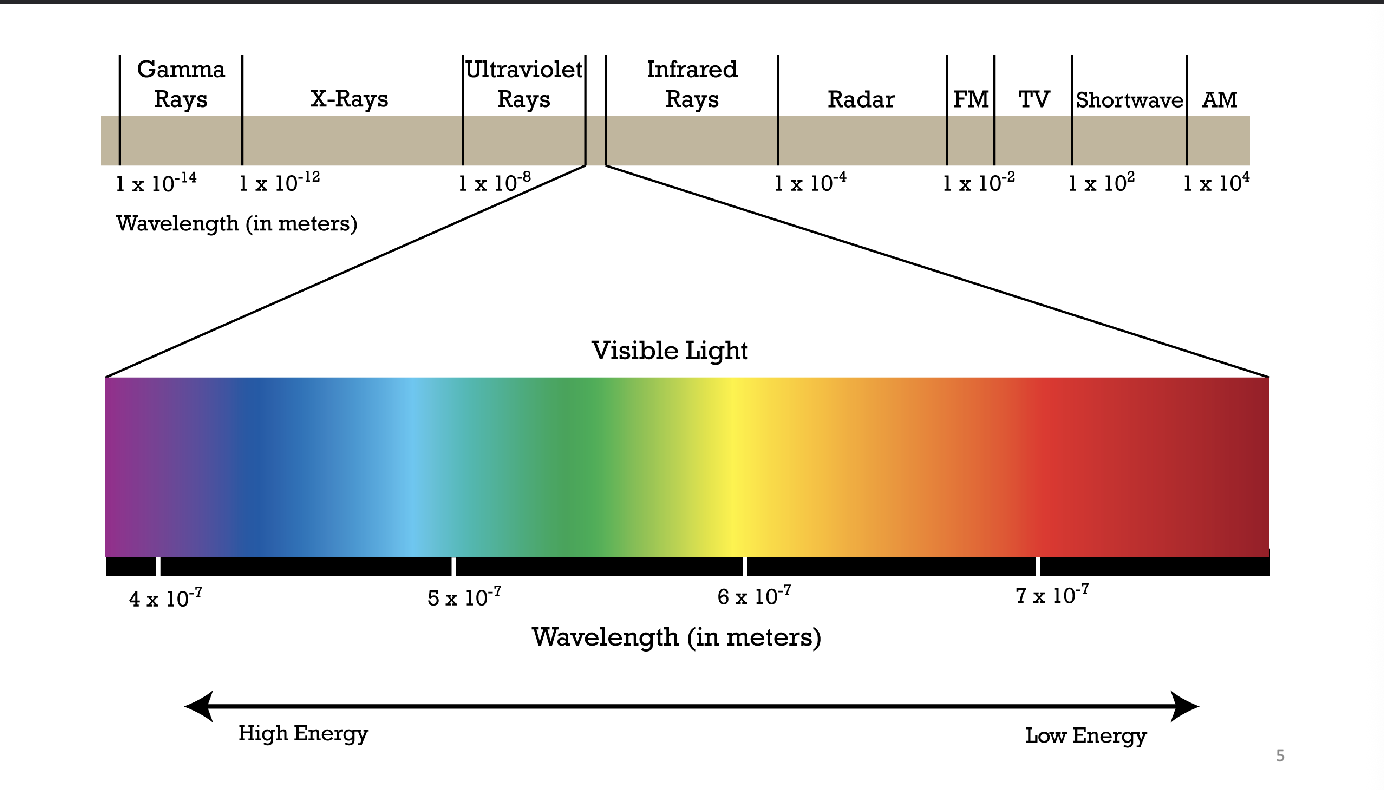
Electromagnetic spectrum
Spectrum ranges from WHAT wavelength WHAT rays to WHAT wavelength WHAT waves.
Electromagnetic spectrum
Spectrum ranges from SHORT wavelength GAMMA rays to LONG wavelength RADIO waves.
Electromagnetic spectrum
Visible spectrum for a human ranges from WHAT to WHAT
nanometers.
Electromagnetic spectrum
Visible spectrum for a human ranges from 400 to 700
nanometers.
Electromagnetic spectrum
Most perceived light is WHAT light
Electromagnetic spectrum
Most perceived light is REFLECTED light
The eye contains WHAT for vision
The eye contains RECEPTORS for vision

Light enters the eye through the WHAT and is focused by the WHAT and WHAT to a sharp image on the WHAT
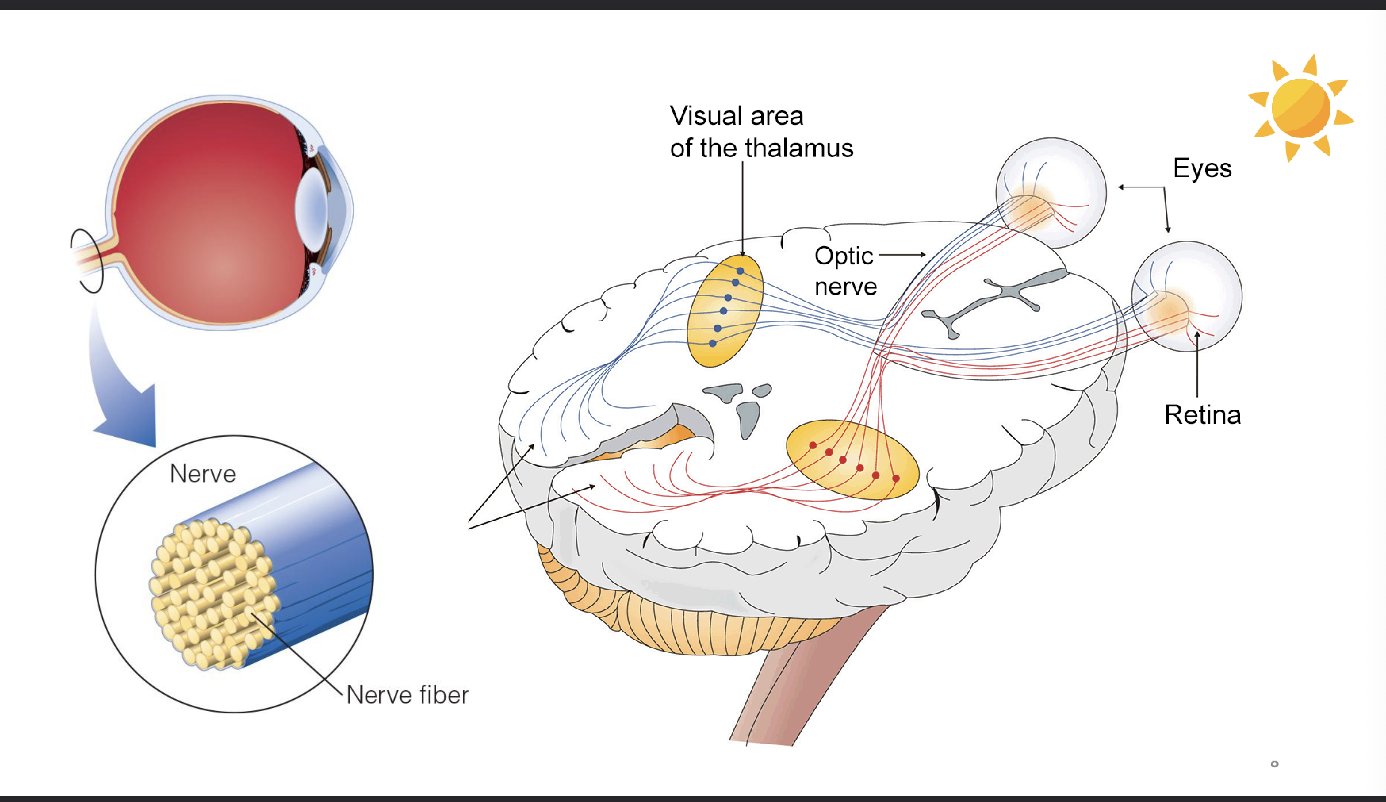
Light enters the eye through the PUPIL and is focused by the CORNEA and LENS to a sharp image on the RETINA

WHAT and WHAT are the visual receptors in the retina that contain visual WHAT
RODS and CONES are the visual receptors in the retina that contain visual PIGMENT

the WHAT carriers information from the retina toward the brain
the OPTIC NERVE carriers information from the retina toward the brain
What are the three differences between rods and cones
WHAT
WHAT
WHAT
What are the three differences between rods and cones
Shape
Distribution on retina
Number
Shape
Rods = WHAT and WHAT
Cones = WHAT and WHAT
Shape
Rods = LARGE and CYLINDRICAL
Cones = SMALL and TAPERED

Distribution on the retina
Fovea consists solely of WHAT
Peripheral retina has WHAT and WHAT
More WHAT than WHAT in the periphery
Distribution on the retina
Fovea consists solely of CONES
Peripheral retina has RODS and CONES
More RODS than CONES in the periphery
There about WHAT million rods and WHAT million cones
There about 120 million rods and 6 million cones
Blind spot
Place where optic nerve leaves the eye
We can’t see the blind spot because
One eye covers the WHAT of the other
It is located at the edge of the WHAT
The brain "WHAT” in the spot
We can’t see the blind spot because
One eye covers the BLIND SPOT of the other
It is located at the edge of the VISUAL FIELD
The brain "FILLS IN” in the spot
What are the two types of retina degeneration
WHAT
WHAT
What are the two types of retina degeneration
Macular degeneration
Retinitis pigmentosa
Macular degeneration
Degeneration of the fovea and its surrounding area.
The affect individuals can’t see what they look at directly

Retinitis pigmentosa
The peripheral retina initially degenerates, and the degeneration may extend and eventually affects the fovea also

The cornea, which is fixed, accounts for about WHAT% of focusing
The cornea, which is fixed, accounts for about 80% of focusing

The lens, which adjusts its WHAT based on object distance, accounts for the other WHAT%
The lens, which adjusts its SHAPE based on object distance, accounts for the other 20%

Accommodation (change in the WHAT shape) results when WHAT are tightened, which causes the lens to WHAT
Accommodation (change in the LENS’S shape) results when CILIARY MUSCLES are tightened, which causes the lens to THICKEN

The thickened lens focus WHAT objects on the retina
The thickened lens focus NEAR objects on the retina

What are the two types of vision problems
WHAT
WHAT
What are the two types of vision problems
Myopia (nearsightedness)
Hyperopia/presbyopia (farsightedness)

Myopia (or Nearsightedness)
Inability to see WHAT objects clearly.
Myopia (or Nearsightedness)
Inability to see DISTANT objects clearly.
Myopia (or Nearsightedness)
Image is focused WHAT of retina.
Myopia (or Nearsightedness)
Image is focused IN FRONT of retina.
Myopia (or Nearsightedness) - Caused by:
WHAT myopia
Constant WHAT (the muscles fail to relax).
WHAT myopia
Myopia (or Nearsightedness) - Caused by:
REFRACTIVE myopia
Constant ACCOMMODATION (the muscles fail to relax).
AXIAL myopia
Refractive myopia
cornea or lens bends TOO MUCH light.
Axial myopia
Eyeball is too LONG.
Myopia (or Nearsightedness)
Corrective (WHAT) lenses are needed for seeing WHAT objects.
Myopia (or Nearsightedness)
Corrective (CONCAVE) lenses are needed for seeing DISTANT objects.
Hyperopia/presbyopia (or Farsightedness)
Inability to see WHAT objects clearly.
Hyperopia/presbyopia (or Farsightedness)
Inability to see CLOSE objects clearly.
Hyperopia/presbyopia (or Farsightedness)
Image is focused WHAT the retina.
Hyperopia/presbyopia (or Farsightedness)
Image is focused BEHIND the retina.
Hyperopia/presbyopia (or Farsightedness) - Caused by:
Eyeball being too WHAT.
Hardening of the WHAT and weakening of the WHAT (muscles fail to contract).
Hyperopia/presbyopia (or Farsightedness) - Caused by:
Eyeball being too SHORT.
Hardening of the LENS and weakening of the CILIARY MUSCLES (muscles fail to contract).
Hyperopia/presbyopia (or Farsightedness)
Corrective (WHAT) lenses are needed for WHAT activities, such as reading.
Hyperopia/presbyopia (or Farsightedness)
Corrective (CONVEX) lenses are needed for CLOSE activities, such as reading.
Hyperopia
Is not a consequence of WHAT
Can occur from WHAT or WHAT
Cause is unusual shaped WHAT, WHAT or WHAT
Hyperopia
Is not a consequence of AGING
Can occur from CHILDHOOD or BIRTH
Cause is unusual shaped EYEBALL, LENS or CORNEA
Presbyopia
Is a consequence of WHAT
Usually first occurs from the age of WHAT on
Caused by WHAT of the lens and weakening of WHAT over time
Presbyopia
Is a consequence of AGING
Usually first occurs from the age of 40 on
Caused by HARDENING of the lens and weakening of CILIARY MUSCLES over time