Neuro Quiz 2 (Lectures 12-16)
 Call Kai
 Learn
Learn Practice Test
 Spaced Repetition
 Match
Match Flashcards
 Knowt Play
1/80

There's no tags or description
Looks like no tags are added yet.
Name | Mastery | Learn | Test | Matching | Spaced | Call with Kai | Chat |
|---|
No analytics yet
Send a link to your students to track their progress
81 Terms
Battery

Batteries in Series

Switch

Capacitor

Ammeter
also can be a straight vertical line
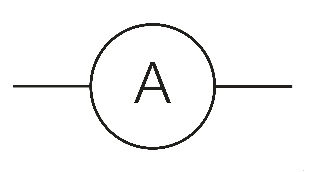
Voltmeter
also can be a diagonal arrow

Ground

Amplifier

Resistor

Resistors in Series

Resistors in Parellel

What do Electrical Circuit Diagrams help to understand?
1) Physical Properties of the Membrane
2) How Current Flows in the Membrane
Current Equation
I = Q/t
Conductance Equation
g = I/V
Resistance Equation
R = V/I
Capacitance Equation
C = Q/V
Nernst Equation (at room temp)
E ion = 58mV/z * log out/in
Three Passive Properties Important to Electrical Signaling
1) Membrane Resistance (Rm) → should be high (no leaking)
2) Axial (Internal) Resistance (ra/ri) → should be low for smoother flow
3) Membrane Capacitance (cin) → should be low, static property → inhibiting flow of charge bc its storing it
What do the 3 passive properties determine? What does it NOT determine?
Determines:
Time Course and Amplitude → local graded potentials
Speed of Propagation → both local graded and action potential
DOESN’T Determine:
Shape of the action potential
Difference between Local Graded and Action Potentials
Local Graded can be hyperpolarizing OR depolarizing
Action Potentials are ONLY depolarized
Injecting a POSITIVE current will result in…
DEPOLARIZATION of the membrane
Opens the Na+ channels
Reversing the current flow results in…
HYPERPOLARIZATION of the membrane
→ slow closing K+ channels (K+ is going outward) remain open for too long, now the membrane is getting negative
Current-Voltage (I-V) relationship
DeltaV = I x Rin
Rin = input resistance → voltage/current
Input Resistance (Rin) affects membrane potential because…
It gives opposition to a system under large changes of voltage. If you have a system that has a large change of voltage vs one that doesnt and you inject the same amount of current, the system with the large change has to accomodate with a larger Rin to make sure the change isn’t gonna be a problem
How does Neuronal SIZE affect input resistance and capacitance?
The larger the cell body → the smaller the input resistance
→ ions have more space/room to leave, so resistance weakens
→ it’s gonna take longer for the current to change, so the resistance stays low
→ you dont want a big change in current, so if its a small cell it’ll change quickly
A larger area means larger capacitance or more room to store charge
→ larger cell body is a larger capacitance
How does Capacitance impact membrane potential?
Increasing capacitance reduce the rate of membrane potential change I
Im equation (total current crossing the membrane)
Im = Ii + Ic
Total current crossing the membrane (Im) equals the sum of the ionic current (Ii) and the capacitive current (Ic)
Why does membrane capacitance slow down potential change?
Incoming ions must first “charge” the cell membrane by storing electrical charge rather than immediatley changing voltage
Rising phase of the potential change
Delta Vm (t) = Im*Rin (1-e^-t/tau)
What does TAU represent?
Membrane Time Constant - product of input resistance (Rin) and capacitance (Cin) of the membrane (RinCin)
tau = Rin x Cin
It determines the time when the potential change reaches 63% of its final value
Axons are not as good transmitters of electrical signals as undersea cables.
WHY?
Passive Properties - biological structures that are constrained by physics and chemistry
1) Axial Resistance (Internal resistance)
2) Membrane Resistance (Rm)
3) Membrane Capacitance (Cm)
How does CURRENT flow in an axon?
It flows along the axon and is leaking out through the membrane
If membrane resistance is HIGH relative to the axial resistance…
Larger length constant, or the current and membrane potential can travel long distances before decaying
Length Constant
Describes the exponential decay of membrane voltage along an axon.
It is defined as the distance from the site of injection, where the potential reaches 1/e or 37% of its original value at the site of injection.
→ INPUT RESISTANCE determines the magnitude or size of the voltage response that defines the length constant (think of it like friction opposing current flow)
Equation is… square root (rm/ra)
What can be EXPERIMENTALLY determined?
Input Resistance and Length Constant
What can be CALCULATED?
Axial resistance and Membrane Resistance
Specfic axial resistance and specific membrane resistance
Allow us to compare different neuronal membranes independent of size
Rm = rm * 2pi a
Ra = ra pi*a²
a is the radius of the process
How can you speed up conduction velocity?
By increasing the length constant and decreasing the time constant
What are 2 EVOLUTIONARY mechanisms how neurons speed up electrical signal propagation?
1) Myelination → Schwann cells and oligodendrocytes wrap around axons to insulate them, which prevents ion leakage and reduces membrane capacitance
2) Increase axonal diameter
Stimulus intensity determines
FREQUENCY of action potentials
Stimulus duration determines
The NUMBER of action potentials
Characteristics of an ACTION POTENTIAL
Unique long-range electrical signal
Triggered by a depolarization of about 10-20mV
“All-or-none” event
Regenerative and propogation without decrements
Has an absolute refractory period → where it is impossible to fire another action potential during this time
Has an overshoot and undershoot
What did Hodgkin, Huxley, and Katz use to study the mechanism of AP generation?
Voltage Patch Clamp Technique
Giant Squid Axon
Voltage Clamp
Allows one to control / “clamp” the membrane potential at any level desired while measuring the current necessary to maintain that membrane potential.
Allows us to see how the membrane potential influences ionic current flow across the membrane
Often, whole-cell patch clamp with a single electrode is used
What happens when the membrane is depolarized?
Intial brief capacitive current
Followed by a rapidly rising inward ionic current (positive charge is entering the cell — cations in or anions out)
Followed by a slower and delayed, outward current
Ionic Substitution
90% reduction in external sodium (replacement with impermeant choline ions to maintain osmolarity) elimated the early inward current.
→ replacement of intracellular K+ with Cs+ (via dialysis through the whole cell patch electrode) eliminates outward current.
What are some selective poisons for voltage-gated ion channels?
Blocks: voltage-gated Na+ channels but not K+ channels
Tetrodotoxin (TTX) → from puffer fish
Saxitoxin (STX) → from shell fish
Conotoxin → from snails
Blocks: voltage-gated K+ channels but not Na+ channels
Tetraethylammonium (TEA) and 4-aminopyridine
3: Voltage-Dependent Conductance Model
1) Both conductances are VOLTAGE DEPENDENT (gNa and gK increase progressively as the neuron is depolarized)
2) Both conductances change over time
→ gNa reaches peak around 0.5 sec, whereas gK requires more than a msec to reach its peak (inward flow of Na+ precedes outward flow of K+)
3) Activation Saturates
→ initial depolarization causes the voltage gated Na+ channels to open, Na+ enters the cell and causes further depolarization
→ the rate of depolarization decreases because the driving force for sodium decreases, sodium channels become inactivated, and potassium channels open using repolarization
Evidence for Na+ current
1) The equilibrium potential (E Na) is equal to 55mV at the peak of the overshoot so Vm = ENa
2) Ionic substitution
3) Use of the TTX (blocker)
Evidence for the K+ current
1) Ionic substitution
2) Use of TEA (blocker)
How to calculate change in conductance (g) for each ion
g ion = I ion / Driving force or (Vm-Eion)
Current/driving force
3 Important Phenomena - Voltage-Dependent Conductance Model
Magnitude and Time Course of Conductance Change are Voltage Dependent
1) Both conductances are voltage-dependent
ex.gNa and gK increase progressively as the neuron is depolarized
2) Both conductances change over time
ex. Inward flow of Na+ precedes the outward flow of K+
3) Activation saturates
→ saturation depends on how many channels are gonna be open so if its 100% saturated during depolarization
Negative Feedback Loop of Ionic Currents During Action Potential (AP)
The outward potassium current I(K) involves a negative feedback loop
→ depolarization causes an increase in gK, which causes the increase in outward K+ current, causing repolarization followed by decrease in gK
Positive Feedback Loop of Ionic Currents During Action Potential (AP)
Inward of sodium current I(Na) involves a positive feedback loop
→ in ward Na+ current causes depolarization, then that causes an increase in gNa, which causes more neightboring Na+ inward current and it just keeps cycling
Absolute Refractory Period
Brief period after a neuron fires an action potential, during which it is impossible to make the neuron to fire another action potential
→ This is due to inactivation of sodium channels
→ Varies from one neuron to another (usually lasts about 1msec)
→ causes action potential to maintain its DIRECTION
Relative Refractory Period
Follows the absolute refractory period, during which time it is unlikely to fire another action potential.
→ due to the opening of some potassium channels and hyperpolarization
Refractory Period & Direction of Propagation
1) It limits the firing frequency
2) Causes the AP to continue propagating in 1 direction
Passive Properties affecting AP Velocity
1) Membrane leakiness: peak of AP decrements along the axon, but is regenerated by the opening of new adjacent sodium channels
→ gets regenerated because of the nodes of Ranvier
2) Time constant: neurons with a small time constant reach the threshold faster
3) Length constant: neurons with a large length constant maintain depolarization over longer distances
Factors that influence AP Velocity
1) Axonal Diameter
→ the larger the axon, the smaller is the internal or axial resistance (ra), thus the faster is the AP propagation
2) Membrane Resistance
→ the higher the membrane resistance (Rm), the more likely the current stays inside, thus the faster the AP propagation because less signal loss
Myelination - Insulating the Axon
→ membranes of myelinated axons have voltage sensitive Na+ and K+ channels RESTRICTED to the NODAL REGIONS ONLY
→ via Schwann Cells (PNS) and Oligodendrocytes (CNS), increases the membrane resistance and therefore velocity
→ causes Saltatory Conduction between the nodes
Where does Saltatory Conduction occur?
Between the node of Ranvier
→ distance between nodes varies from about 0.2 to 2mm, with the average internodal distance being 1mm
Why does the AP triggered at the axon hillock?
It has the highest density of voltage gated Na+ channels
Where are Voltage-Gated Na+ channels concentrated?
At the NODES of myelinated axons
Where are Voltage-Gated K+ channels concentrated?
At the PARANODES of myelinated axons
Why don’t dendrites and neuronal cell bodies not generate APs?
Because of the low-density of voltage-gated sodium channels
Where are the most APs triggered?
At the axon hillock
→ it has the highest density of voltage-gated sodium channels
Where else can AP’s occur according to recent evidence?
Dendrites w/ elaborate branching
Purkinje cells
Cortical Pyramidal Cells
Where might AP’s fail to go into both directions?
At the branch points of dendrites
Local Anesthetic
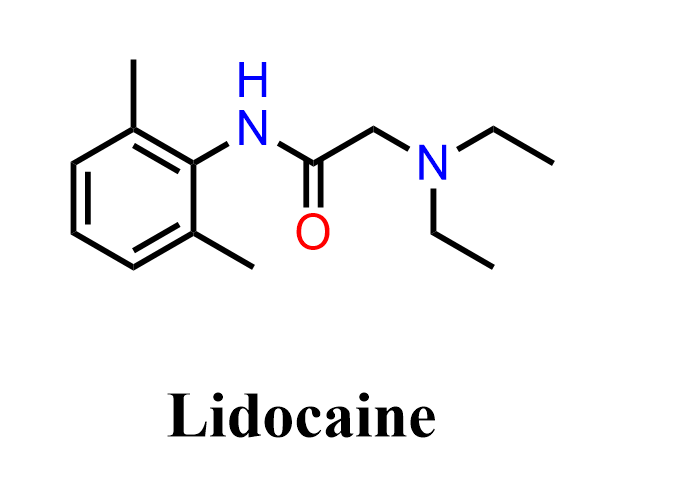
LIDOCAINE
→ can act as reversible inhibitor of voltage-gated Na channels to temporarily block action potential propagation
Movement of Ions during DEPOLARIZATION
Positive Ion (ex. Na+) moving INWARD, making inside of the cell LESS negative
Movement of Ions during HYPERPOLARIZATION
1) Positive Ion (ex. K+) moving OUTWARD, making the inside of the cell more negative
or
2) Negative Ion (ex. Cl-) moving INWARD, making the inside of the cell more negative
Can ions FREELY pass the plasma membrane?
NO → this is due to the hydrophobicity of the lipid bilayer of the plasma membrane which is highly selective to ions
→ they MUST rely on transmembrane proteins to move in and out of the cell
What’s a general search engine for articles?
Google Scholar
What’s a database for articles in biomedical sciences?
PubMed
→ designed to provide public access to articles from the biomedical literature
What is ISI Web of Science?
Helpful literature database for finding articles and direct links to cited references
Molecular Biology Databases
NCBI , EBI (european)
How to search for/find a scientific paper
1) search for article using keywords or author information
2) search for key articles related to the specific topic at hand
3) journal impact factor
What is a Journal Impact Factor
Measure of the frequency with which the average article in a journal has been cited in a particular year
How to calculate this:
→ Two year period that involves dividing the number of times articles were cited by the number of articles that are citable/published.
Components of a Scientific Article
TItle, Abstract, Introduction, Materials & Methods, Results, Discussion, Acknowledgements, References
How many citations does the typical research paper have?
40-60 citations
Free reference softwares
Mendeley, Zotero, Endnote