NSG 202: Cellular Regulation
 Call Kai
 Learn
 Practice Test
 Spaced Repetition
 Match
 Flashcards
 Knowt Play
1/33

There's no tags or description
Looks like no tags are added yet.
34 Terms
Where is this Concept?
Nursing 119
Intro to cancer
Nursing 202
Lung CA
BPH/Prostate CA
Nursing 207 (peds)
Leukemia
Sickle Cell Disease
Cellular Regulation
Refers to all functions carried out in the cells to maintain homeostasis, including their responses to extracellular signals (hormones, cytokines and neurotransmitters) & the way each cell produces an intracellular response
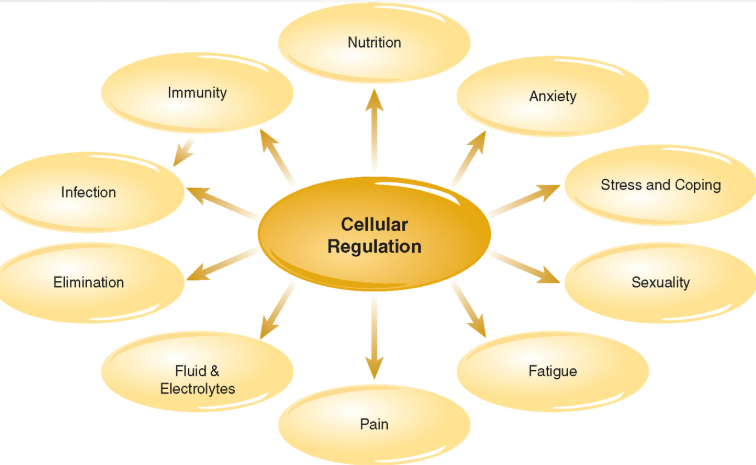
Cellular Regulation Interrelated Concepts
Lung Cancer
Second most common cause of cancer related death
Survival rate approximately 5 years
Prognosis poor r/t late diagnosis
High potential for mets
Pathophysiology of Lung Cancer
Tumors arise from mutated epithelial cells
Carcinogens cause those cells to multiply
Can take 8-10 years to reach 1cm
May not show on x-ray right away
Metastasis
Direct extension
Via blood, lymph glands, vessels
Interferes with gas exchange
Lymph nodes, other tissue, bone, liver, brain & adrenal glands
Incidence/Prevalence
Smoking responsible for 81% of lung cancer deaths
Second hand / third hand smoke
E-cigarettes, vaping
Hookah
Chronic exposures
Genetics
First degree relative
Age
More exposure
Assessment
Health hx
Pack Years
Physical exam
ID risk factors
Clinical Manifestations of Lung Cancer
Persistent cough with sputum (most common)
Dyspnea
Wheezing
Hemoptysis
Heart sounds
Chest Pain
Later Manifestations of Lung Cancer
Later manifestations:
Anorexia, fatigue, weight loss
N/V
Dysphagia
Superior vena cava syndrome - EMERGENCY
Mental status changes
Benign vs Malignant
Benign
Slow Growing
Capsulated
Non-Invasive
Does not metastasize
Well Differentiated
Malignant
Fast Growing
Non-Capsulated
Invasive & Infiltrates
Metastasizes
Poorly Differentiated
Suffix: "Carcinoma" or "Sarcoma"

Types
Small Cell (SCLC)
Grows rapidly
Spreads quickly
Early metastasis
Poor prognosis
Non-Small Cell Carcinoma (NSCLC)
Every other cancer that is not the small cell type
Non-Small Cell Carcinoma (NSCLC) Examples
Squamous cell carcinoma
Slow growing
Early symptoms
Adenocarcinoma
Moderate growing
Most common in non-smokers
Large-cell carcinoma
Rapid growing
Highly metastatic
Staging of NSCLC

Diagnostic Testing
Radiology
CXR
CT
MRI
Radionuclide scans
Biopsy
Tissue
Pleural effusion fluid
Thoracoscopy
Via VAT
PET scan

Nonsurgical Management
Chemotherapy
Targeted Therapy for NSCLC
Immunotherapy
Radiation
Photodynamic therapy (PDT)
Chemotherapy
Primary tx for SCLC
Adjuvant therapy for NSCLC
Destroys ALL cells
HIGH risk for infection
Reduces Immunity
Neutropenia (low WBC)
Thrombocytopenia (decreased platelets)
Nadir
Chemotherapy Side Effects
Side effects
N/V
Alopecia
Mouth sores
Immunosuppression
Anemia
Altered bowel elimination
Cognitive changes
Sleep disturbances
Peripheral neuropathy
Targeted Therapy
For NSCLC
Focuses on specific molecules within cancer cells
Not the same as chemotherapy
Very targeted to very specific cells only
Immunotherapy
A type of targeted therapy
Pt's own immune system recognizes and attacks the cancer cells
Doesn't replace chemo or radiation
Is not a cure
Radiation Therapy
For cancer confined to the chest
For SCLC and NSCLC
Best used in conjunction with surgery and/or chemo
May be used pre-op to reduce tumor mass for easier removal
Side effects:
Skin irritation and peeling
Fatigue
Nausea
Taste changes
No sun for 1 year
Stereotactic Body Radiotherapy (SBRT)
High dose radiation accurately delivered to tumor
Smaller part of healthy lung exposed
Outpatient therapy over 1-3 days
Photodynamic Therapy (PDT)
Uses photosensitizing agents & light to kill cancer cells
Can be topical or injected into bloodstream
Drug accumulates into cancer cell withing 48-72 hours
Pt intubated and laser light is focused on tumor
Causes irreversible damage & death to cells that have retained the chemical
Surgical Management
Tx of choice for stages 1 & 2 NSCLC
May result in a cure
May include:
Tumor removal only
Segmental, wedge or sleeve resection
Lobectomy
Pneumonectomy
Open thoracotomy or minimally invasive
VATS
May need chest tube post-op
Chest Tube
Catheter in the pleural space
Allows lung expansion
Prevents air/fluid/blood from returning to the chest
Closed chest drainage
Drains air
Drains fluid
General Nursing Care
Ensure integrity of system
Promote comfort
Ensure tube patency
Prevent complications
Why a Chest Tube?

Water Seal & Dry Seal

Ongoing Nursing Implications
Respiratory Status
Breath sounds
Work of breathing
SpO2 <90
Drainage
Amount
Color
Character
Water Seal Chamber
Tidaling = Normal
No Tidaling = lung re-expanded or a blockage
Continuous bubbling = possible air leak
System Position
MUST be below chest level
Ensure: no dependent loops/no kinks/secure to bed or floor
Insertion site
Dressing intact
So subcutaneous emphysema
Things to Not Do
Do not clamp
Do not strip
Do not lift above chest

Chest Tube
Call the Provider When:
Sudden bright red drainage
System breaks
New/worse respiratory distress
Dislodged
New continuous bubbling
Palliative Care Lung Cancer
Oxygen therapy
When pt is hypoxemic and to help relieve dyspnea & anxiety
Radiation therapy
Help with difficulty swallowing & pain
Thoracentesis
For pleural effusion
Dyspnea management
Keep pain free if possible
High fowlers
Oxygen
Pain management
Oral, parenteral, transdermal
Around the clock with PRN analgesics for breakthrough pain
Hospice
For pt in terminal phase
Offers support
What is a thoracentesis?
What do you think would be the priority of care after the patient has a thoracentesis?
What is a thoracentesis?
What do you think would be the priority of care after the patient has a thoracentesis?

Lung Cancer Nursing Diagnosis
Ineffective breathing pattern
Impaired gas exchange
Ineffective self health management
Your post op patient has 2 chest tubes in place. The patient reports burning pain in his lower chest. On assessment, the nurse notes there is no bubbling on exhalation in the water seal chamber. The patient is hunched over at the middle of the bed. What action will the nurse perform first?
Immediately notify the rapid response team
Reposition the patient and reassess the water seal chamber for bubbling.
Administer the prescribed opioid analgesic immediately and then assess the chest tube system.
No action is needed because these responses are normal for the first post-op day after a lobectomy.