Periodic Table Vocab
 Call Kai
 Learn
 Practice Test
 Spaced Repetition
 Match
 Flashcards
 Knowt Play
1/30

There's no tags or description
Looks like no tags are added yet.
31 Terms
Ionic Bonding
The attraction between positively and negatively charged ions formed when electrons are transferred from one atom to another. Usually occurs between a metal and a nonmetal.

Covalent Bonding
The sharing of electrons between atoms. Usually occurs between two nonmetals.

The Octet Rule
Atoms tend to gain, lose, or share electrons to achieve 8 valence electrons and become more stable. Hydrogen follows the duet rule (2 electrons).
Electron Dot Structures (Lewis Structures)
Diagrams that show an element's valence electrons as dots around its chemical symbol. Shared pairs represent bonds, and unshared pairs are lone pairs.

Formula Unit
The lowest whole-number ratio of ions in an ionic compound.

Properties of Ionic Compounds
Usually crystalline solids; have high melting and boiling points; are hard and brittle; conduct electricity when melted or dissolved in water, but not as solids.

Empirical Formula
The simplest whole-number ratio of atoms in a compound. Example: C6H12O6 becomes CH2O.
Properties of Molecular Compounds
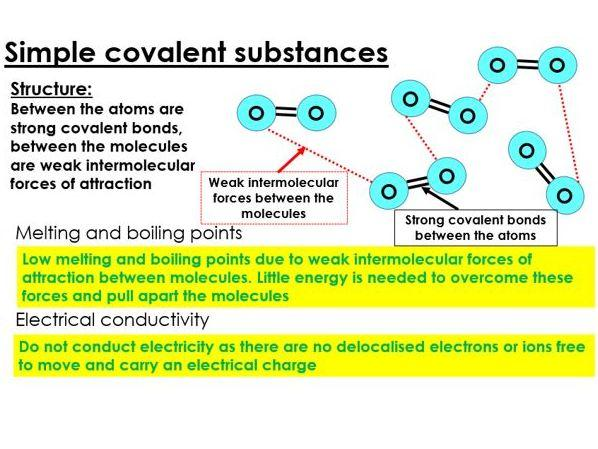
Usually have lower melting and boiling points than ionic compounds; may be solids, liquids, or gases; generally do not conduct electricity.
Structural Formula
A formula that shows how atoms are connected and bonded to each other in a molecule.
Single Bond
A covalent bond in which two atoms share one pair of electrons (2 electrons). Represented by one line.
Double Bond
A covalent bond in which two atoms share two pairs of electrons (4 electrons). Represented by two lines.
Triple Bond
A covalent bond in which two atoms share three pairs of electrons (6 electrons). Represented by three lines.
Valence Shell Electron Pair Repulsion Theory (VSEPR)
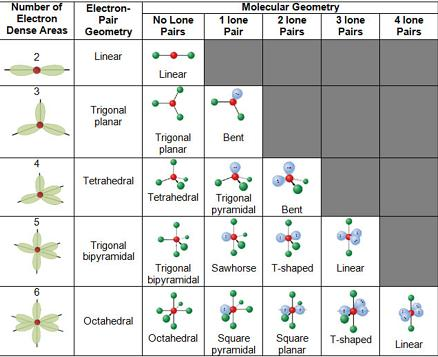
A theory stating that electron groups around a central atom repel each other and arrange themselves as far apart as possible, determining molecular shape.
Dash-Wedge Notation
A way to show 3D molecular shapes: a straight line represents a bond in the plane of the paper, a solid wedge points toward you, and a dashed wedge points away from you.

Linear Molecular Shape
2 bonded atoms, 0 lone pairs on the central atom; bond angle = 180°. Example: CO2.
Bent Molecular Shape
2 bonded atoms and 1 or 2 lone pairs on the central atom; bond angle is less than 120° with 1 lone pair (about 118°) or about 104.5° with 2 lone pairs. Examples: SO2 and H2O.
Trigonal Planar Molecular Shape
3 bonded atoms, 0 lone pairs on the central atom; bond angle = 120°. Example: BF3.
Pyramidal (Trigonal Pyramidal) Molecular Shape
3 bonded atoms, 1 lone pair on the central atom; bond angle = about 107°. Example: NH3.
Tetrahedral Molecular Shape
4 bonded atoms, 0 lone pairs on the central atom; bond angle = 109.5°. Example: CH4.
Trigonal Bipyramidal Molecular Shape
5 bonded atoms, 0 lone pairs on the central atom; bond angles = 90°, 120°, and 180°. Example: PCl5.
Polar Bond
A covalent bond in which electrons are shared unequally because one atom attracts electrons more strongly than the other. Creates partial positive and partial negative charges.

Nonpolar Bond
A covalent bond in which electrons are shared equally or nearly equally between atoms. There is no significant charge separation.
Monatomic
Consisting of only one atom. Example: Na+ or He.
Polyatomic
Consisting of multiple atoms. A polyatomic ion is a group of bonded atoms with an overall charge. Example: SO4^2- (sulfate).

Naming Ionic Compounds
Name the positive ion (cation) first, then the negative ion (anion). Change the ending of a single-element anion to -ide. Keep polyatomic ion names unchanged. Example: NaCl = sodium chloride.
Roman Numerals
Used in ionic compound names to show the charge of a metal that can have more than one possible charge. Example: FeCl3 = iron(III) chloride.
Writing Formulas for Ionic Compounds
Write the cation first and the anion second. Balance the charges so the total charge equals zero. Use subscripts to show the lowest whole-number ratio. Use parentheses around polyatomic ions when more than one is needed. Example: Mg2+ + Cl- = MgCl2.
Naming Acids
Binary acids (H + nonmetal): hydro- + nonmetal root + -ic acid. Example: HCl = hydrochloric acid. Oxyacids: anion ending -ate becomes -ic acid; anion ending -ite becomes -ous acid. Do not use hydro- for oxyacids. Example: H2SO4 = sulfuric acid; H2SO3 = sulfurous acid.
Prefixes
Used to show the number of atoms in covalent compounds: 1 = mono, 2 = di, 3 = tri, 4 = tetra, 5 = penta, 6 = hexa, 7 = hepta, 8 = octa, 9 = nona, 10 = deca.
Naming Covalent Compounds
Use prefixes to show the number of atoms. Name the first element normally (usually omit mono- on the first element). Name the second element with a prefix and change its ending to -ide. Example: CO2 = carbon dioxide.
Writing Formulas for Covalent Compounds
Write the element symbols in the order named. Convert the prefixes into subscripts. Do not reduce the subscripts. Example: dinitrogen pentoxide = N2O5.