neu 335 exam 3
 Call Kai
 Learn
 Practice Test
 Spaced Repetition
 Match
 Flashcards
 Knowt Play
1/69

There's no tags or description
Looks like no tags are added yet.
70 Terms
What is explicit memory?
A type of memory that requires you to consciously recall events
e.g. recalling the year of the American Revolution
What is implicit memory?
A type of memory where no conscious retrieval of information is required
e.g. brushing your teeth
Semantic memory
The type of long-term memory associated with recalling facts
Working memory
Type of short-term explicit memory associated with temporally holding information
e.g. remembering a verification code
Habituation
A type of implicit memory where you get used to a stimulus (can be short term or long term)
e.g. habituating to your smelly roommate after a few minutes of him arriving from the gym

Which cell is a better candidate for a working memory cell?
The 2nd cell because it is very active during the delay period of the Delay-Response task when there is no visual stimulus —> suggesting that the cells are processing where the plate could be


With respect to this image, describe what goes on during the delay period of the delay-cue task?
Neurons engage in a feedback excitation loop after the primate is exposed to the visual stimuli —> the loop persists during delay and is amplified during the choice phase
Which part of the brain did patient HM’s brain was damaged?
medial temporal lobe
Retrograde Amensia
a type of memory loss where one can’t recall what happened some time before a traumatic event
Anterograde Amnesia
A type of memory loss where one can’t form new memories after a traumatic event
Did patient HM suffer from anterograde or retrograde amnesia?
He suffered from both, though it was a mild form of retrograde amnesia and a very severe form of anterograde amnesia
Is the medial temporal lobe involved in the formation of long-term or short-term explicit memories?
Long term explicit memories
Describe the structure of the morris water maze?
A small pool of shallow water containing a hidden platform. This experimental design is used for training spatial memory.
What are the effects of a bilateral lesion on the medial temporal lobe on brief working memory and long-term memory?
working memory unaffected but long term memory disrupted
Compare the performance of a trial 1 and trial 10 of a mouse in a Morris water maze after they suffer a hippocampal lesion.
The performance is about the same
What are place cells?
cells in the hippocampus that fire when an animal enters a specific place in their environment
what is a place field?
the specific region in space that an animal can stand in and the place cell fires
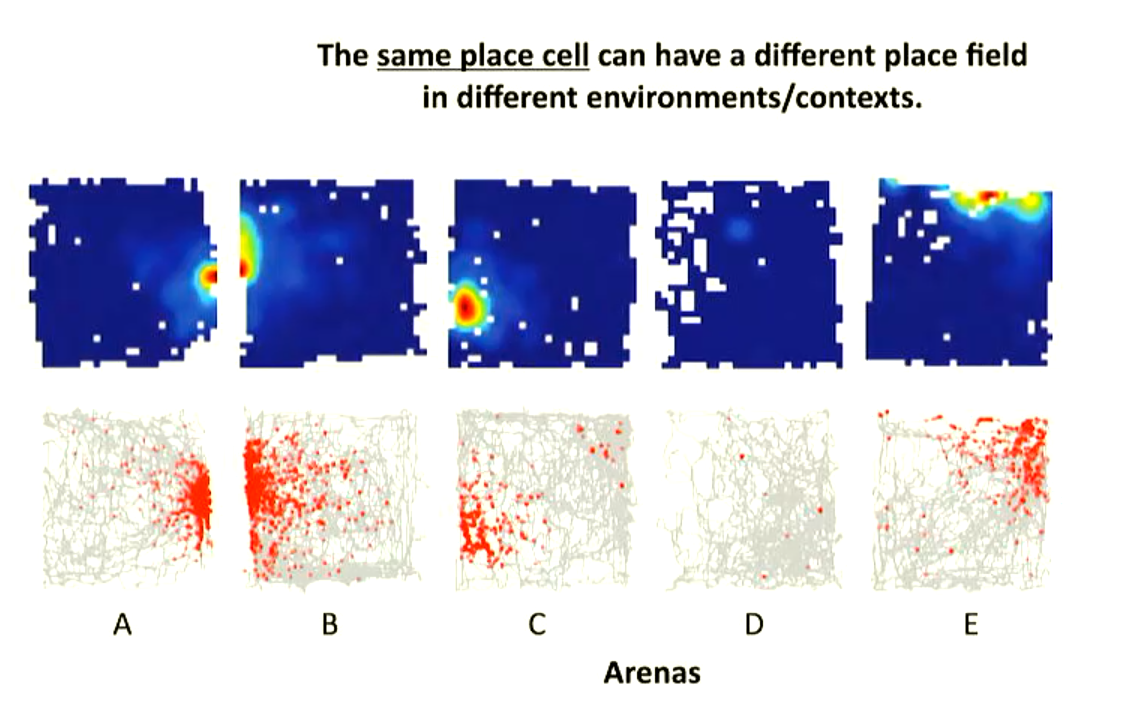
T/F a place cell can have different place fields in different environments?
True
what type of cells function as the “where” component of episodic memory?
place cells
Describe the development of place cells during spatial memory training?
After several trials, place cells can form excitatory connections with each other so they can stimulate subsequent place cellsW
What is a grid cell?
Cells in the entorhinal cortex that fire when an animal is in ANY of its place fields
Don’t provide a direct representation of where an animal is in space
Presynaptic to place cells

How can you identify the location of an animal using grid cells and place cells?
Since grid cells are presynaptic to place cells, place cells sum all grid cell inputs and fire only when the rat is at a specific location
describe classical (pavlovian) conditioning
Prior to conditioning:
An unconditioned stimulus (e.g. food bowl) —> unconditioned response (e.g. salivating, which is untrained)
After conditioning:
conditioned stimulus (e.g. metronome click) —> conditioned response (e.g salivating, which is now a trained response)
What type of response is the conditioned salivating by pavlov’s dog?
implicit reseponse bc it dosn’t require any conscious recollection that the bell is associated with food
T/F operant conditioning is a type of implicit memory?
T
Describe the structure of fear conditioning?
Initially, there’s a tone (neutral stim) played while a foot shock (US) electrifies that mouse, causing it to freeze (UR). Over time, just playing the tone (CS) is enough to freeze (CR) the mouse.

Which of the following examples would exemplify stronger conditioning?
Example 1 because the shock is always aligned with the tone
What is extinction wrt to fear conditioning?
Extinction is when the tone is playd without a foot shock and over time the mouse is less likely to freeze

What is the difference in fear conditioning between mice with hippocampal lesions and amygdala lesions before fear conditioning training?
Damaging the hippocampus has a small effect on fear conditioning while damage to the amygdala prevents the mouse from learning the association
What does the GAL4 line represent?
GAL4 is the gene that determines in which cells another particular gene is expressed in.
What does the UAS line represent?
A gene that determined “WHAT” gene will be expressed.
e.g. if GAL4 only expressed in optic lobes, and UAS paired with GFP, GFP will be expressed in the optical lobes
What is the similarity between the Morris water maze + the experimental design of the Ofstad et al. 2011 paper?
Like the mice, the flies in Ofstad et al. also needed to find a specific spot in their experimental structure
flies also use visual cues to ID where they are
both protocols measure how fast an animal can get to the spot
In Ofstad et al. what happens after the flies find the cool spot?
After the flies find the cool spot, the arena rotates, which displaces the cool spot and the LED visual cues → forcing the flies to find the cool spot again
What evidence did the paper provide for showing that the flies are learning to quickly find the cool spot?
Flies take less time to find the spot with each subsequent sub-trial

Which figure clarifies that the flies are NOT just walking faster to the next school spot?
Figure 2D shows walking speed throughout each trial is the same
Define Direction Index and why it improves over trials?
Direction Index is the ratio between flies moving in the right direction toward the cool tiles over number of flies moving in the opposite direction of the cool tile
Over time, the flies rmr where the cool tile is at so mor of them start moving in the right direction
What research question were the Ofstrad et al 2011. researchers trying to answer?
Trying to answer if flies can learn spatial locations using visual cues + which brain regions required?
What did the researchers in Ostad et al find about the Ellipsoid body?
Silencing EB neurons impair visual place learning, and only that one.
What did the researchers in Ostad et al find about the Mushroom body?
Silencing MB neurons did NOT impair visual place learning, but are important for olfactory learning
What is the MAIN finding of the Ofstad et al paper?
Flies can retain visual place memories for up to 2 hours.
In terms of time, how do short term and long term habituation differ?
short term = seconds to minutes
long term = hours to years

Describe the gill reflex neural circuit in aplysia?
Siphon stimulated → sensory neuron detects mechanical stimulus → excite motor neuron → cause gill retraction
Describe habituation at the cellular level
During habituation, there’s a decrease in NT release from sensory neurons to MN → decrease in NT release from MN to gill → decrease gill withdrawal
Is the aplysia gill circuit an example of short term or long term habituation?
short term

which of these 2 images represent long term habituation on the aplysia circuit?
the 2nd one because it shows limited activation of the MN

which of these 2 images represent long term habituation on the aplysia circuit?
The 2nd image because in long term habituation there is a decrease in synapses from sensory neuron to MN
What is the relationship between more noxious stimuli in sensitization and ill withdrawal in aplysia
More noxious stimuli done multiple times per day create more long term sensitization
The difference between sensitization and classical conditioning?
Sensitization:
strengthen response to the same stimuli
Classical conditioning:
create new behavioral response to previously neutral stimuli

What happens at the molecular level with sensitization?
More NT release from sensory neuron → MN
More NT release from MN → gill
increased gill retraction

What causes the increase in NT release from sensory neuron to MN in SHORT TERM sensitization
the tail shock stimulus activates a modulatory serotonin neuron, which synapses onto the axon terminal of sensory neuron → release serotonin (5-HT) onto terminal of sensory neuron → greater cAMP production in terminal of sensory neuron → greater levels of PKA → greater Glutamate release onto MN
How does PKA increase glutamate release?
PKA phosphorylates K+ channels in terminal of sensory neuron → K+ Channels close → prolongs AP because less (+) leaving cell → more time for Ca2+ to enter terminal of sensory neuron → greater Glutamate release
Is only increasing NT release related to short term or long term sensitization?
short term sensitization is associated with greater NT release at ONE synapse
Describe long-term sensitization
during long term sensitization, an abundance of PKA travels to the nucleus → transcriptional changes → growth of new synapses from sensory neuron to MN

why does the right image result in long term sensitization?
because the amount of serotonin added is great, mimicking greater shock frequency

why does the smaller addition of serotonin also cause long-term sensitization in the right neurons?
the serotonin stimulation of left synapse leads to the expression of synaptic growth proteins in the nucleus of the sensory neuron. These proteins are shared by both synapses, also causing long-term sensitization changes in the right synapse
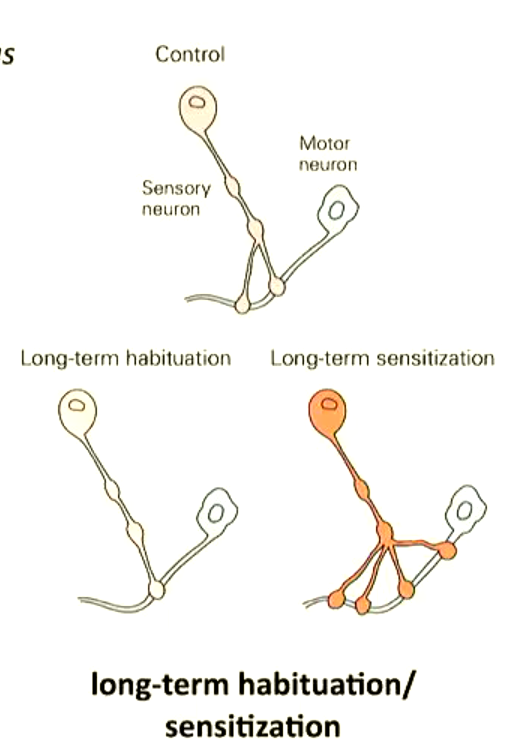
are these images examples of short term or long term habituation/sensitization?
left: long term habituation due to lower # of synapses on MN
right: long term sensitization due to higher # of synapses onto MN
Describe the direct and indirect circuit of the hippocampus
Direct: EC (main input) → CA1 (main output cells) → other cortical parts of brain
Indirect: EC (main input) → denudate gyrus (granule cells) → CA1 → CA3
circuit of Schaffer colateral patwhways?
CA3 → CA1

Which type of receptor does the CA3 glutamate bind onto?
CA1 AMPARs → Na+ flow into the cell → CA1 neuron undergoes EPSP
What 4 things are NMDARs coincidence detectors of?
glutamate release from presynaptic membrane
"AMPAfication" of postsynaptic membrane
depolarization of postsynaptic membrane
Mg2+ dislodged from NMDA receptors in postsynaptic membrane
open when both pre and post cells active
Describe initiation of LTP?
Strong stimulation releases glutamate, activating AMPA receptors and depolarizing the postsynaptic neuron. This removes the Mg²⁺ block from NMDA receptors, allowing Ca²⁺ and Na+ to enter + cause large EPSP
explain how NMDARs → AMPAfication?
Ca2+ via enter post cell via NMDARs and activate kinases (PKC or CaMKII), which phosphorylate AMPARs and cause them to add onto the membrane
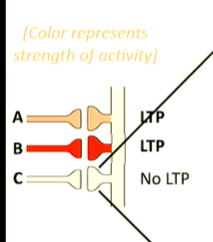
describe what’s going on here
neuron B receives a large stimulus, causing a large EPSP in the post cell that ends up spreading to the synapse between neuron A and the dendrite. HOWEVER, no glutamate is released by A
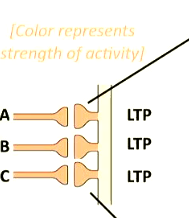
how can this occur if no neuron is strongly activated?
each synapse is weakly activated, which can lead to LTP at all synapses
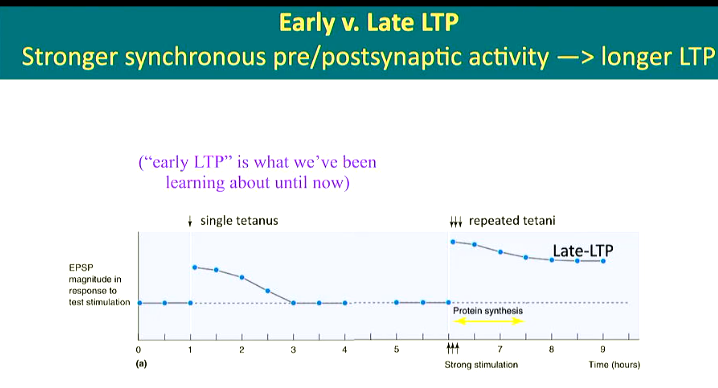
According to this image, what can cause late LTP?
more frequent tetanus → long term LTP
what is the main cause of late LTP?
prolonged Ca2+ influx into post cell caused by repeated tetanus stim

Describe the late LTP signaling pathway?
Prolong Ca2+ signaling due to repeated tetanus stim → activation of adenyl cyclase → greater cAMP → greater activation of PKA → greater activation MAP kinase → expression CREB-1 → newly made synaptic growth proteins
Early LTP v Late LTP?
AMPAfication vs synthesis of synaptic growth proteins
What is the main driver of LTD
weak stimulation → weak glutamate release → weak activataion of NMDARs —> small influx of Ca2+ into post cell → activate phosphatases → removing AMPARs from membrane