Lecture 4 - Chromosomes
 Call Kai
 Learn
Learn Practice Test
 Spaced Repetition
 Match
Match Flashcards
 Knowt Play
1/89

There's no tags or description
Looks like no tags are added yet.
Name | Mastery | Learn | Test | Matching | Spaced | Call with Kai | Chat |
|---|
No analytics yet
Send a link to your students to track their progress
90 Terms
Evidence that genes reside in the nucleus and chromosomes
1854 to 1874: Direct observations of fertilization through union of nuclei of eggs and sperm (frog and sea urchin). Conclusion: something in the nucleus must contain the hereditary material
1880s – improved microscopy and staining techniques. Long, threadlike bodies (chromosomes) visualized in the nucleus. Movement of these bodies followed through cell division
1902 - Sutton and Boveri proposed what we now call the chromosome theory of inheritance
Walter Sutton (American)
• Studied grasshopper chromosomes and noted that their behavior during meiosis paralleled Mendel's laws
Theodor Boveri (German)
• Studied sea urchin embryos and separately reached similar conclusions about chromosomes carrying hereditary information
Sutton-Boveri Chromosome Theory of Inheritance
they never worked together, they worked independently, but they came to simmilar conclsions
Genes are physically located on chromosomes, and chromosome behavior during meiosis is the physical basis for Mendel's laws
This theory connected Mendel's abstract "hereditary factors" (genes) to physical, observable structures in the cell
Chromosome
self-replicating DNA/protein complexes in the nucleus that contain genes
If we stretch out the DNA from one chromosome of a human cell into a straight thread, it could reach
~6 feet -> the diameter of a human cell nucleus is only ~6 um!
How do chromosomes fit in the nucleus?
DNA undergoes several levels of compaction

_____ is the basic structural unit of chromatin
Nucleosome
Histones:
small DNA-binding proteins containing many positively charged amino acids (lysine and arginine)
Nucleosome:
short segment of DNA (~160 base pairs) wrapped twice around a core of eight histone proteins (an octamer, 2 each of H2A, H2B, H3, H4) resembling "beads on a string“ ➢ DNA + histones
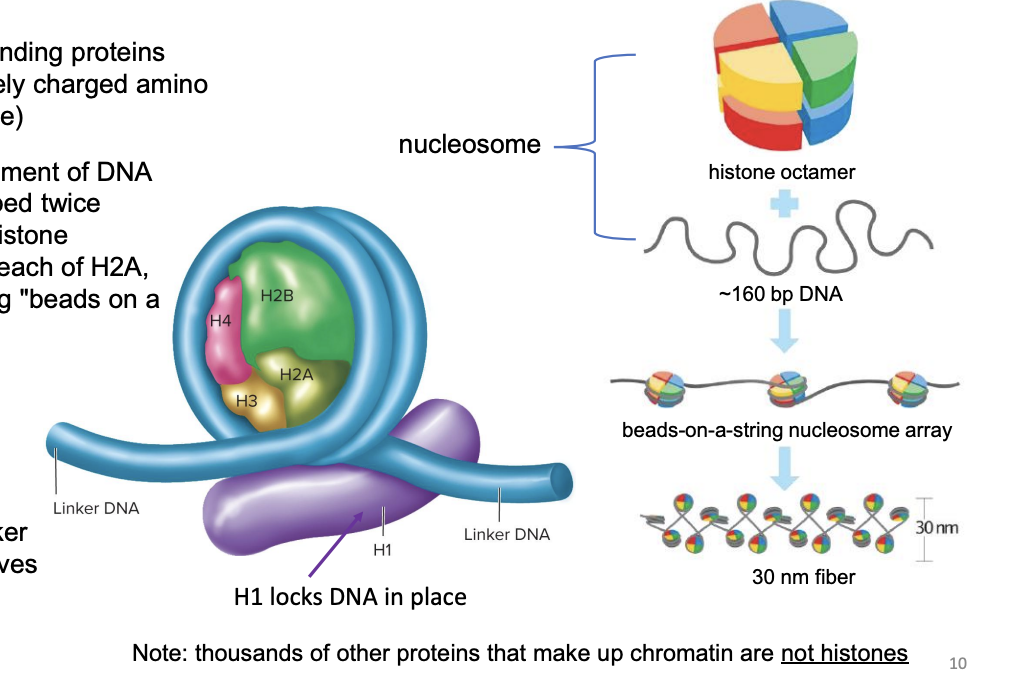
H1 (linker Histone):
outside the nucleosome core, associates with linker DNA as it enters and leaves the nucleosome core
Note: thousands of other proteins that make up chromatin are
not histones
Nucleosome supercoiling model of higher-order packaging
We don’t have complete certainty about all the compaction steps between "beads on a string" and a fully condensed mitotic chromosome
Structures underlying additional chromosome compaction are unknown
One possibility, supported by electron microscopy, is that a 100 Å nucleosomal chromatin fiber compacts into 300 Å (30 nm) superhelix by supercoiling ➢ The is a histone-driven level of compaction

_____ shape chromosomes via loop-based compaction
Condensins
condensins
Loops of DNA are formed by protein complexes called condensins
• Five protein subunits constitute condensin
• Exist as rings that form around nucleosome-studded DNA where chromosome passes through ring twice to form loop
➢ Further higher-order coiling/scaffolding results in the highly condensed, visible structure seen specifically during mitosis/meiosis
Two types of nuclear division and chromosome sorting
Mitosis
Meiosis
Mitosis
Nuclear division that generates two daughter cells containing the same number and type of chromosomes as parent cell
Meiosis
Nuclear division that generates gametes (egg and sperm) containing half the number of chromosomes found in other cells
Diploid versus haploid: 2n versus n
• Most body cells are diploid (2n) (each chromosome pair has one maternal and one paternal copy)
• Meiosis produces haploid (n) gametes
Organisms can differ in haploid chromosome number and in ploidy
• In Drosophila, 2n = 8, n = 4
• In Humans, 2n = 46 and n = 23
Chromosome numbers vary widely across species

Species X: 2n=600. Species Y: 3n=60. Which is more polyploid?
A) Species X, since 600 > 60
B) Species Y, since it has 3 sets vs. 2
C) Both are equally polyploid
D) Cannot be determined from this information
b
Ploidy counts complete chromosome sets, not individual chromosomes.
Higher chromosome count doesn't mean higher ploidy.
Fertilization
the union of haploid gametes to produce diploid zygotes
• Two gametes fuse during fertilization to form a
zygote
how many sets of choromosme - haploid vs diploid
• Haploid gametes (n) carry only a single set of chromosomes
• Zygotes are diploid (2n) – carry two matching sets of chromosomes, one each from egg and sperm
chromatin
Chromosomes usually exist in the nucleus as chromatin
Chromosome structure in the nucleus

Duplicated chromosomes (chromatids) are joined at the
centromere
Only in preparation for cellular division (mitosis or meiosis) does chromatin duplicate and condense into the visible chromosomes of a ____
karyotype
Centromere
specific location at which sister chromatids are attached
Metacentric chromosome:
centromere is in the middle

Acrocentric chromosome:
centromere is near one end

Sister chromatids
are identical copies of a replicated chromosome

Homologs
contain the same set of genes, but can have different alleles for some genes

Nonhomologous
carry completely unrelated sets of genes
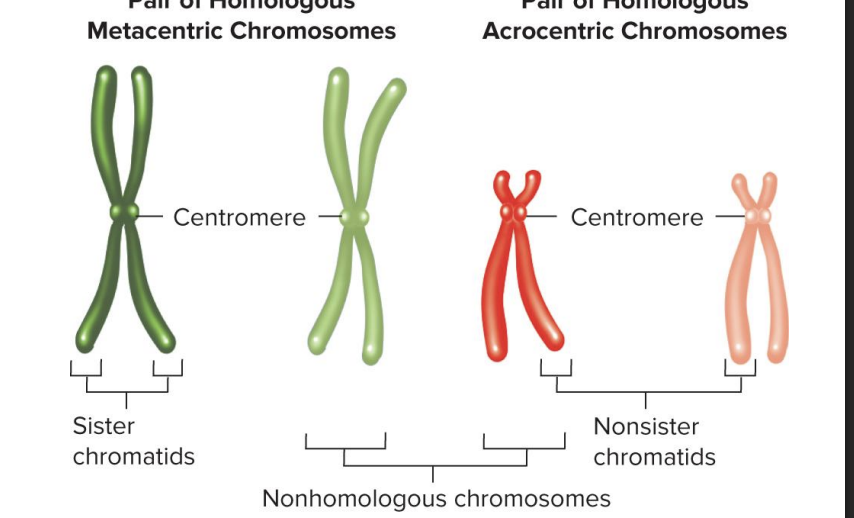
Homologous chromosomes: x
Homologous chromosomes: same size, shape, and banding
Autosomes:
all chromosomes except X and Y
Sex chromosomes:
unpaired X and Y
Amniocentesis
in relation to the number chromsomes nun else
procedure used to obtain fetal cells for karyotype analysis (and other genetic testing) before birth, allowing detection of chromosomal abnormalities while the pregnancy is ongoing ➢ Example: Trisomy 21 (Down syndrome)
Aneuploidy
abnormal chromosome number
Down syndrome (Trisomy 21)
Down syndrome (Trisomy 21) was first human genetic disorder attributable to an abnormal number of chromosomes rather than a gene mutation
How can an extra chromosome cause a wide range of phenotypic effects?
• Chromosomes transmit genetic information
• The type and amount of genetic material is important for normal development
The cell cycle:
An alternation between interphase and mitosis
interphase

G1 phase:
cell growth, chromosomes are not duplicating or dividing
S phase:
duplication of chromosome into sister chromatids
G2 phase:
cell growth, synthesis of proteins required for mitosis
G0 phase:
no active division (temporarily or permanently like neurons)
doesnt take place in all, like skin cells contioinusly diivde
Stages of mitosis: (I) prophase
• Chromosomes condense and become visible
• Centrosomes move apart toward opposite poles
• Nucleoli begin to disappear

Stages of mitosis: (II) prometaphase
• Nuclear envelope breaks down
• Microtubules from centrosomes invade the nucleus and connect to kinetochores in the centromere of each chromatid
• Sister chromatids attach to microtubules from opposite poles
• Mitotic spindle forms from three kinds of microtubules (astral, kinetochore, and polar)

Stages of mitosis: (III) metaphase
• Fully condensed chromosomes
• Chromosomes align on the metaphase plate with sister chromatids facing opposite poles
• Forces pushing and pulling chromosomes to or from each pole are in balanced equilibrium keeping chromosomes in place

Stages of mitosis: (IV) anaphase
• Centromeres of all chromosomes split simultaneously
• Connection between centromeres of the sister chromatids is severed
• Kinetochore microtubules shorten and pull separated sister
chromatids to opposite poles (characteristic V shape)

Stages of mitosis: (V) telophase
• Nuclear envelope forms around each group of chromatids
• Nucleoli re-form
• Spindle fibers disappear
• Chromosomes uncoil and reform as chromatin

Final stage of cell division: Cytokinesis
• Begins during anaphase but not completed until after telophase
• Cytoplasm of parent cells split into two daughter cells with identical nuclei

Cytokinesis in plants vs aniamls
In animals -> contractile ring that contracts to form cleavage furrow
In both -> organelles (for example, ribosomes, mitochondria, ER, Golgi) are distributed to each daughter cell
In plants -> have cell plate that forms near equator of cell
does Cytokinesis always occur after mitosi
Result of cytokinesis not occurring after mitosis is cell with multiple nuclei -> syncytium
In fertilized Drosophila eggs, 13 rounds of mitosis occur without cytokinesis → syncytial embryo with thousands of nuclei in a single cell
Mitosis (nuclear division) and cytokinesis (cytoplasmic division) are separate, uncoupled processes
Checkpoints
Checkpoints help regulate the cell cycle
At each checkpoint, prior events must be completed before the next step of the cycle can begin
• Helps prevent errors in cell cycle

Karyotyping requires cells to be arrested at which phase of division?
A) Prophase
B) Metaphase
C) Anaphase
D) Telophase
b
At metaphase, chromosomes are maximally condensed and
visually distinguishable as X-shaped structures
During which part of the cell cycle do sister chromatids exist?
A) Only during interphase
B) From G1 phase through telophase of mitosis
C) From S phase through anaphase of mitosis
D) Throughout the entire cell cycle
c
Sister chromatids are created when DNA replicates during S phase and
persist through G2 and mitosis until anaphase, when they separate.
During anaphase of mitosis, sister chromatids are pulled to opposite
poles. Does this make the resulting daughter cells haploid (n)?
A) Yes
B) No
b
Ploidy is only halved during Meiosis, when homologous
chromosomes (not sister chromatids) separate
Two general types of cells in plants and animals
Somatic cell
Germ cells
Somatic cells
make up vast majority of cells in the organism
• In G0 or are actively going through mitosis
Germ cells
are precursors to gametes
• Set aside during embryogenesis
• Become incorporated into reproductive organs
• Only cells that undergo meiosis to produce haploid (n) gametes
Overview of Meiosis
Two rounds of cell division:
• Chromosomes duplicate once; nuclei divide
• Meiosis I reduces the chromosomes from 2n to n
• Meiosis II produces four haploid nuclei twice

The substages of prophase 1:
Leptotene, zygotene, pachytene, Diplotene and diakinesis
lepotene
chromosomes begin condensing and become visible
zygotene
homologous chromosomes pairing up (synapsis) and are held together by synaptonemal complex
pachytene
Crossing-over occurs during the pachytene stage, resulting in recombination of genetic material
Crossing-over
Crossing-over increases genetic variability
With crossing over, individual produces paternal and recombinant gametes (all possible allelic combinations of the two genes)
Without crossing over, this individual would only make AB and ab gametes

diplotene
• During diplotene, synaptonemal complex dissolves and chromatids in each tetrad (four chromatids) become visible
• Homologs remain connected at chiasmata (crossover points)
diakinesis
Nuclear envelope breaks down during diakinesis and chiasmata remain visible
Homolog pairing
Homolog pairing during meiosis 1 forms a tetrad
➢ Crossing over exchanges genetic information 44
Chiasmata play a role in proper segregation of homologous chromosomes

Meiosis: Metaphase I and anaphase I
• Paired homologs align at the metaphase plate in metaphase I
• Homologs are separated in anaphase I and move to opposite poles
Centromeres do not divide, and sister chromatids do not separate

reductional division:
Meiosis I is a reductional division: Cells contain half the number of chromosomes as parent nucleus each arranged as two sister chromatids joined at centromere
Meiosis I: Telophase I and Interkinesis
• Cytokinesis occurs alongside Telophase I, physically dividing the cell into two separate haploid (n) cells
• Interkinesis brief pause between Meiosis I and II; no DNA replication occurs

Meiosis II: Prophase II, metaphase II, and anaphase II
Meiosis II is an equatorial division
Haploid nuclei progress through process very similar to mitosis to create haploid daughter cells

Meiosis II: telophase II and cytokinesis
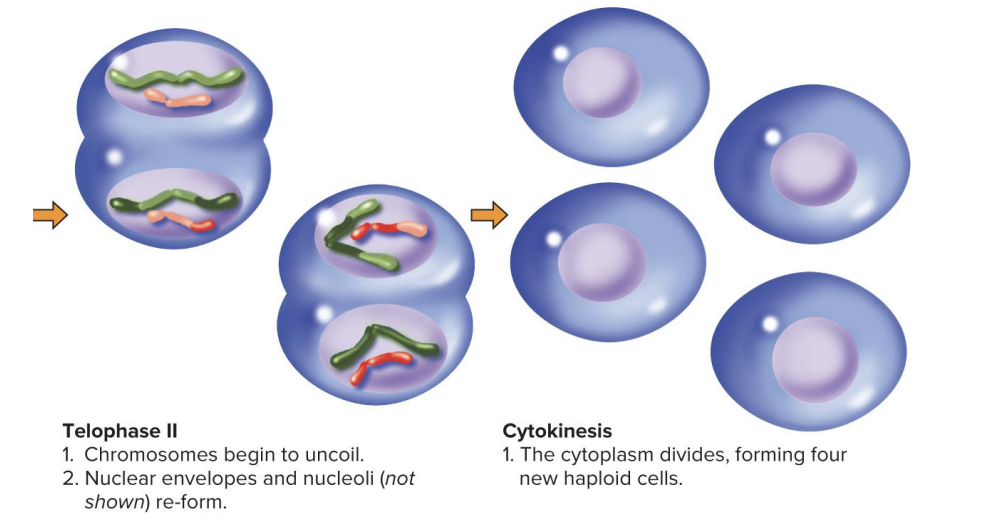
At the last stage, cytokinesis forms four new haploid cells
Nondisjunction
homologs of a chromosome pair do not segregate during meiosis I
• May result in inviable gametes or embryos
• Can also result in abnormal chromosome numbers in viable individuals (for example, trisomy 21, Down syndrome; or XXY, Klinefelter syndrome)
Meiosis contributes to genetic diversity in two ways
• Independent assortment of non - homologs creates different combinations of alleles across gametes • Law of independent assortment
• Crossing -over between homologs creates different combinations of alleles within each chromosome and segregation of the homologous chromosomes (Meiosis I) ensures each gamete carries one allele of each gene • Law of segregation

The actual reduction from diploid to haploid chromosome number
happens at which stage of meiosis?
A) Prophase I
B) Anaphase I
C) Anaphase II
D) Telophase II
b
Homologous chromosomes separate during Anaphase I, which
halves the chromosome number
summary of mitosis and meiosis

Nettie Stevens discovers sex chromosomes
A student of Thomas Hunt Morgan, Nettie Stevens noticed that in somatic cells of flour beetles:
Females contained 20 large chromosomes
Males has 19 large chromosomes and 1 small one
• 9 pairs of autosomes and 1 pair of unequal size
• The larger unmatched chromosome is the X chromosome
• The smaller unmatched chromosome is the Y chromosome
After meiosis in testes cells of male beetles:
• Half of sperm have 9 autosomes and 1 X chromosome
• Half of sperm have 9 autosomes and 1 Y chromosome
Concluded that X and Y chromosomes determine sex
The X and Y chromosomes determine sex in humans
• Children receive an X chromosome from their mother, but either an X or Y chromosome from their father
• Results in approximately 1:1 ratio of females-to-males
A small portion of the Y chromosome determines maleness in humans
The primary determinant of maleness is a single gene called SRY (sex determining region of Y)
Sex reversal (XX males and XY females) provided evidence implicating SRY
• SRY is always present in XX males
• SRY is always nonfunctional in XY females

Human sex chromosomes contain genes unrelated to sex
Some genes are present on both the X and Y chromosomes of humans , located at the ends of the Y chromosome called pseudoautosomal regions (PARs)
• Enable sex chromosomes to pair during meiosis I

Sex determination differs across organisms
Abnormal numbers of X or Y chromosomes have different effects in humans and flies
• In Drosophila, the ratio of X chromosomes to autosomes determines sex
• In humans, presence or absence of Y chromosome determines sex

Heterogametic sex vs Homogametic sex
• Heterogametic sex: sex with two different kinds of gametes (for example, XY males in humans, ZW females in birds)
• Homogametic sex: sex with one type of gamete (for example, XX females in humans, ZZ males in birds)
• In some species, sex is determined by environment (for example, temperature)

Germ line
specialized diploid cells set aside during embryogenesis
Gametogenesis
gamete formation
• Involves meiosis as well as specialized events before and after meiosis
• Different types of animals have variations on general aspects of this process
• In humans, oogenesis produces one ovum from each primary oocyte
• In humans, spermatogenesis produces four sperm from each primary spermatocyte
Oogenesis in humans
At puberty, one primary oocyte per month resumes meiosis at ovulation
• Completion of meiosis I produces a large secondary oocyte and smaller sister cell, the first polar body
• Secondary oocyte arrests in metaphase of meiosis II
At fertilization, meiosis II is completed and produces a mature ovum and second polar body

Spermatogenesis in humans
Four haploid sperm produced by symmetrical meiosis of each spermatocyte
• Mitosis and meiosis occur throughout adult life
• Entire process of spermatogenesis takes approximately 48 to 60 days
• Billions of sperm produced over lifetime
