BIOL 300 Genetics Quiz 4
 Call Kai
 Learn
Learn Practice Test
 Spaced Repetition
 Match
Match Flashcards
 Knowt Play
1/91

There's no tags or description
Looks like no tags are added yet.
Name | Mastery | Learn | Test | Matching | Spaced | Call with Kai | Chat |
|---|
No analytics yet
Send a link to your students to track their progress
92 Terms
what are two functions of DNA polymerase III?
synthesize DNA (catalyze)
acting as a nuclease and proofreading/editing dna from the 3' - 5' direction and catalyzing dna from the 5' to 3' direction
DNA replication happens during which phase of the cell cycle?
S phase of Interphase

what are two common mistakes that dna polymerase can make?
inserting or deleting the wrong nucleotide into the strand or mismatching base pairs (substitution) and causing a frameshift error
what is a replicase? which of dna polymerases are replicases?
replicase is the enzyme that can synthesize new nucleic acid sequences from an existing template (i.e. dna polymerase III)
when is dna shifted from the polymerization domain to the exonuclease domain?
when replicated DNA contains an error/mutation;
when dna pol detects an error
frameshift mutations are rare. why?
bc they mostly occur on repetitive dna and there’s proofreading and DNA editing
what is processivity?
the ability of dna polymerase to carryout synthesis without frequent dissociations
aka
how many nucleotides can get incorporated into a daughter strand without the polymerase falling off
rna polymerase makes more mistakes than dna polymerase. why?
bc rna polymerase has no proofreading exonuclease and cant correct its own mistakes but dna pol CAN
in which direction does dna polymerase III synthesize new strands?
5' - 3'
which way does dna polymerase III read the old strands?
3' - 5'
what is the direction of the exonuclease activity of dna polymerase III?
3' - 5'
which dna polymerase has 5' to 3' exonuclease activity?
dna polymerase I
what specific action of helicase leads to opening of the dna helix?
unwinds by melting hydrogen bonds
why is primase required for dna replication?
bc primase synthesizes rna primers which provide 4' OH to polymerase
what enzyme adds the primer?
DNA primase
what enzyme removes the primer?
dna polymerase I
what enzyme seals the end where the primer was?
dna ligase
what are four enzymes that required atp at the replication fork?
dna helicase, dna gyrase, dna ligase (but primase may as well? not sure), and dna polymerase III
what is the difference between leading and lagging strands?
leading strands requires 1 primer and can be continuously synthesized while lagging strands requires multiple primers and is discontinuously synthesized with okazaki fragments
what direction is the leading strand synthesized?
5' - 3'
what direction is the lagging strand synthesized?
5' - 3'
what is the name of the segment between two primers on the lagging strand where dna synthesis occurs?
okazaki fragments
are there two polymerases, one "going backward" on the leading strand and one "going forward" on the lagging strand?
no, there is only one polymerase doing replication (dna pol III), but it has two catalytic cores for each strand
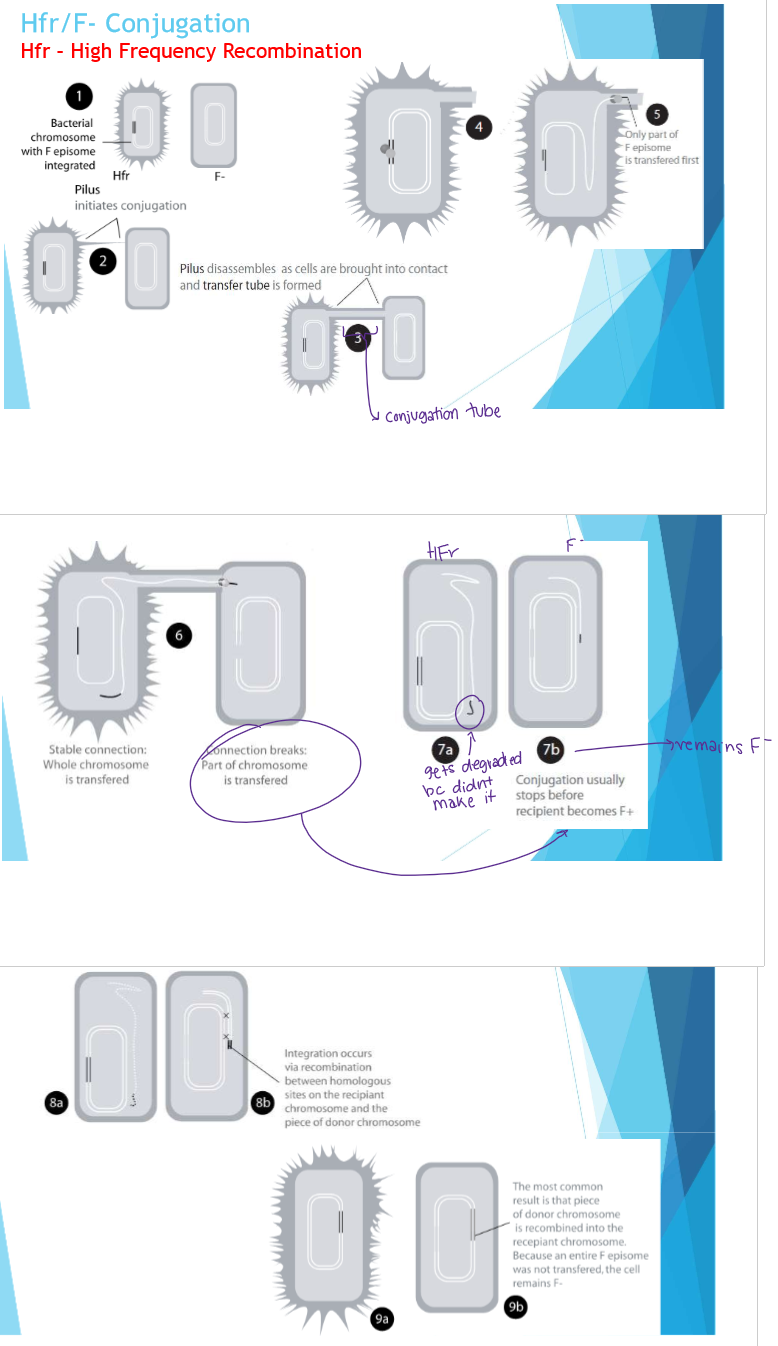
what is the difference between an F+ bacterial cell and an Hfr bacterial cell?
f+ contains a complete f plasmid wherase hfr is an f plasmid integrated into bacterial genome
can F+ cells conjugate with Hfr cells? can Hfr cells conjugate with F+ cells? can f+ cells conjugate with f- cells? can F cells conjugate with Hfr cells?
no; no; yes; yes
in what form is dna transported to the recipient cell, double- or single-stranded?
single stranded
where does the dna become double-stranded?
in conjugation: once it reaches the recipient cell
in replication: at the replication fork since DNA can be synthesized from the primers
what is the difference between a plasmid and episome?
all episomes are plasmids however not all plasmids ae episomes. this is because an episome is a plasmid that has the ability to integrate into the host chromosome
describe at least 2 tra genes and their function.
traM protein recognizes a mating pair traY protein binds near oriT and recruits traI
traA makes pili
traI makes nicks on oriT, covalently bonding to the 5’ end
when is a cell transformed from F+ or HFr?
when the F+ plasmid gets integrated into the host genome
how did Hfr get its name?
stands for "high frequency recombination"
explains how the plasmid integrates into the chromosome
what is the difference between a pilus and transfer tube?
a pilus establishes attachment. it’s a n extension that starts conjugation by touching and is hair-like
the transfer tube carries dna and is the actual connection bridge where transfer occurs
why are F+ cells more likely than Hfr to transfer genes required to convert F- to F+/Hfr cell?
during conjugation the connection is more likely to break since more dna (the whole chromosome) is being transferred
what part of the bacterial genome carries information that can transform a normal plant cell into a tumor cell?
the t-dna is carried on the Ti plasmid
what is one advantage that some transgenic plants have?
they are naturally resistant to some insects or pests that are harmful to them
what is agrobacterium unusual?
has Ti plasmid which causes tumors ; it can infect organisms of a different kingdom (plants) with its own DNA without entering the plant cell. it injects its own T-DNA into the plant cell
which vir genes are constitutively expressed (always transcribed)?
virA and virG
the 3D structure of DNA polymerase III (the dna bind domain) is analogous to what?
the right hand
the palm
provides the catalytic active site
fingers
position the template in active site
thumb
binds dna as it exits (processivity)
dna polymerase III exonuclease activity
resides in independent domain with its own catalytic site (3’-5’ exonuclease)
to proofread so remove nucleotides
dna polymerase III n terminal domain
spacer between catalytic and exonuclease domains
what are the four dna polymerase holoenzyme subcomplexes found within the dipolymerase replication model?
catalytic, dimerizing subunit, clamp, and clamp holder
dipolymerase: 2 catalytic subunits


catalytic α
subunit has dna polymerase activity
catalytic ε
subunit has 3' - 5' proofreading exonuclease activity
catalytic θ
subunit stimulates the exonuclease activity
dimerizing subunit τ
links two cores
clamp β
holds the catalytic core on the dna template
one holds leading & one holds lagging
clamp loader γ
complex consisitng of 5 proteins
opens the beta clamp to attach it to DNA strand
dna helicase
unwinds dna
1 ATP / bp of melting
melts H-bonds
releases strain on molecule
dna gyrase
releases strain on molecule
type of topoisomerase
single stranded binding proteins
(SSBP)
keeps ssDNA from re annealing
binding is cooperative
dna primase
synthesis primer which provides 3'OH to polymerase
primer is a short stretch of RNA
dna polymerase III
DNA polymerase synthesizes most of DNA
3’-5’ exonuclease (proofreading)
5’-3’ polymerase activity
dna polymerase I
removes primer (5' - 3' exonuclease)
same functions as dna pol III
3’-5’ exonuclease (proofreading)
5’-3’ polymerase activity
describe dna replication of both the leading and lagging strand using the 7 enzymes
1. leading and lagging strands are separated by dna helicase at a replication origin (ori). two repliction forks are formed at one ori, but only one will be followed here:
2. rna primers are synthesized on both strands by dna primase.
3. on the leading strands, dna polymerase III begins replication by extending the 3' end from the primer.
4. lagging strand is not replicated bc dna poly III is unable to extend a 5' end.
5. more primers are added on lagging strand.
6. replication continues on the leading strand.
7. replication begins from a second primer on the lagging strand since dna poly III now has an available 3' end and a dna template (discontinuous replication) creating okazaki fragments
8. another primer is added to the lagging strand by primase
9. older primers are removed by dna poly I and newer primers are added where the dna is unwound
10. steps 5-9 are repeated
two copies of dna molecules are completed
*during replication, dna gyrase functions to release the strain on the molecule and ssbp keeps the ssdna fro reannealing, ligase seals okazaki fragments, and it is semiconservative replication*

dna ligase
seals okazaki fragments
links nucleotides (okazaki fragments) together by forming phosphodiester bonds
plasmid vs episome
an episome is a plasmid that has the ability to integrate into the host chromosome. thus…
all episomes are plasmids, not all plasmids are episomes
f+ cell
contains a complete f plasmid (donor)

f- cell
does not contain the f plasmid (acceptor)

f' cell
contains part of the f plasmid or an f plasmid with other bacterial genes (donor)

Hfr cell
contains the f plasmid integrated into bacterial genome (donor)

traA product
pili are hollow hair like projects on surface 2-3 micro meters long
tra S and tra T products
surface exclusion proteins prevents donor cell from mating with another donor cell
12 other tra products
needed for modification and assembly of pili and to stabilize initial association between donor and f- cells
tra M
recognizes a mating pair
pili / pilus
initiates conjugation, but disassembles as cells are brought into contact and transfer tube is formed
tra Y
binds near oriT and recruits traI
tra I
nicks oriT and forms a covalent bond with the 5' end of the nick
Agrobacterium
tumor-forming plant pathogen
function: tumor formation in plants from bacterial species
what is the Ti plasmid of agrobacterium
tumor inducting plasmid where the plant cell will receive foreign gene but does not becomes transformed into a tumor
virA
activitates virG by phosphorylation
virG-PO4
bids to virB, C, D, E, F promoters and activates them
virB
encodes a channel
virD
encode endonuclease and initiates nicking at correct locations of T-DNA
virE
encodes ssbp and binds to excised tdna to form "T-complex"
T-DNA
contains genes to generate transformed tumor state and synthesize opines
opines
synthesized by plant to give bacteria source of N and C compounds
(what the bacteria eat)
virF
product that is created and confers plant specificity
disguises own DNA as plant matter
chv chvA, chvB, and pscA
chv chvA, chvB, and pscA codes for structures that are required for initial binding of bacteria to plant cell
Auxin
plant growth hormone
reponsible for making tumors along w/ cytokinin
Cytokinin
Plant hormone for rapid cell division
reponsible for making tumors along w/ auxin
Virulence Region
genes needed to inject T-DNA into plant cell
Transgenic plant & benefits
Plants that have been genetically modified to express new or impoved phenotypes through the introduction or overexpression of genes
BENEFITS:
increased resistance to insects
higher nutritional output and fruit yield
increased tolerance to environmental stressors (i.e., drought, heat, salinity, etc.)

Fidelity
how accurate the polymerase incorporates base pairs
DNA pol has ___ processitivity & ____ fidelity
high ; high
DNA polymerase alternates between what modes? draw models
polymerizing mode (catalyzing DNA 5’-3’)
DNA wll lie across the palm in a groove formed by fingers and a thumb. this positioning allows the thumb to ratchet dna through the complex one base at a time as new nucleotides are added. the 3’ end of the growing chain is anchored by the fingers and palm. the dna is held into position by contacts between amino acids and the phosphodiester backbone that allows bases to be added that are complementary to the template
editing mode (editing DNA 3’-5’)
As each new base is polymerized, it is checked for accuracy and fit. if the wrong base becomes incorporated, the strange conformation will not allow it to exit the polymerization site. instead, it is rotated into the exonuclease domain, and the incorrect base is removed by the 3’ to 5’ exonuclease activity. the DNA strand is then returned to the polymerizing site of the complex to try again.

plasmids:
circular extachromosomal entities in bacteria with accessory genes

F+/F- conjugation model

Hfr / F- model
Agrobacterium infection pathway model
