Module 10 - Part 2 - Conspiracy
 Call Kai
 Learn
 Practice Test
 Spaced Repetition
 Match
 Flashcards
 Knowt Play
1/16

There's no tags or description
Looks like no tags are added yet.
17 Terms
Conspiracy: Main Rule Statement
a mutual agreement, express or implied, between two or more persons to commit a crime (or a lawful act by unlawful means).
Conspiracy: Elements
Intent to agree
Intent to commit the crime (e.g. intent to murder)
The agreement itself (a handshake or nod suffices)
an overt act by any member, even a lawful one (buying gloves) - basically a step towards the crime
What is Agreement for Conspiracy?
Two genuine guilty minds
e.g. Sue wants to kill her husband, She hires a hitman. There’s a bilateral agreement between Sue and the hitman.
e.g. Sue hires a hitman who’s actually an undercover cop. There’s a unilateral agreement because only Sue is genuinely guilty.
What are the factors for proving Agreement in a Conspiracy?
association with co-conspirators
knowledge of the crime
presence
participation
Does the crime actually have to happen for Conspiracy liability?
No. Just a step towards the crime is enough.
Can Defendant be liable both for the crime and Conspiracy?
Yes, no merger
Commonwealth v. Azim:
Azim drove a car carrying passengers James and Robinson. Azim stopped the car near a university student, Jerry. Robinson called Jerry to the curb. James and Robinson got out of the car, assaulted and choked Jerry, and took his wallet when it fell to the ground.
Azim sat in the driver’s seat with the engine running, lights on, and car doors open.
Immediately after the robbery, Azim drove James and Robinson away from the scene in the same car. Azim and Robinson were tried together and convicted of simple assault, robbery, and conspiracy.
Is Azim liable for conspiracy?
Yes, Because conspiracies are secret, agreement may be inferred circumstantially from association with co-conspirators, knowledge of the crime, presence, and participation.
Commonwealth v. Cook:
After openly showing a 17-year-old girl their IDs, the Cook brothers walked her down a wooded path. Maurice raped her while Dennis encouraged him and held a belt.
Is Dennis liable for Conspiracy?
No. There was no prior planning or agreement. He participated as an accomplice.
People v. Swain:
Swain and Chatman did a retaliatory drive-by shooting that killed a 15-year-old.
Chatman admitted to firing shots from a van, and Swain later bragged about his shooting accuracy.
The jury was instructed on second-degree murder (depraved heart murder) and that if Chatman is found liable for 2nd degree murder, Swain is guilty of conspiracy to murder.
Result?
Swain is not liable for conspiracy because you cannot agree to kill unintentionally, so conspiracy to murder requires express malice.
People v. Foster:
Foster proposed robbing an elderly man to Ragsdale, who pretended to be in agreement and told police.
Is Ragsdale liable for Conspiracy?
No, there is no bilateral agreement.
What is Hub and Spoke (Wheel) Conspiracy?
A Mastermind (e.g. drug supplier) conceives the idea.
Independent actors (e.g. drug retailers) deal with the Mastermind, but not with each other. The independent actors may not know each other.
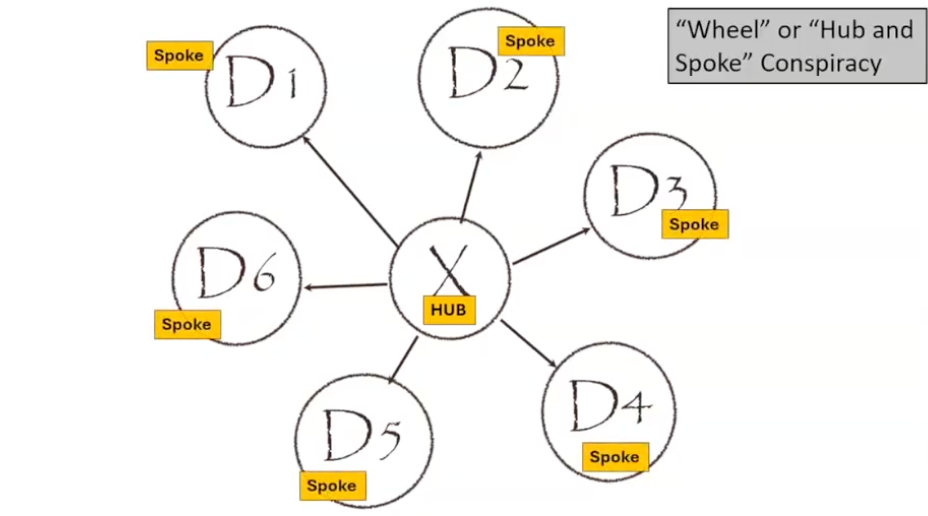
In a Hub and Spoke (Wheel) Conspiracy, who are the Independent Actors in conspiracy with?
The Mastermind. NOT always each other.
In a Hub and Spoke (Wheel) Conspiracy, How can ALL the Independent Actors be held liable for Conspiracy under the Pinkerton doctrine?
There must be a “rim” connecting the independent actors (e.g. Drug Retailer 1 knows Drug Retailer 2 exists and they share activities)
How long does a Conspiracy last?
It keeps going as long as the members still believe the plan is alive and keep working on it.
It ends when they realize it has failed.
Pinkerton Doctrine: Requirements
each conspirator is liable for co-conspirators’ crimes that were
in furtherance of the conspiracy
within its scope
reasonably foreseeable
D2 buys gloves for D1’s shoplifting. D1 kills a bystander who tries to stop him to escape with the goods. Thus, they are both in a conspiracy.
Is D2 liable for D1’s murder?
Yes, under the Pinkerton doctrine, D2 can be held liable for D1’s murder because it was a foreseeable consequence of the conspiracy's furtherance.
Pinkerton v. United States:
-