Microbiology: Bacterial Growth, Sterilization, and Cell Division Principles
 Call Kai
 Learn
Learn Practice Test
 Spaced Repetition
 Match
Match Flashcards
 Knowt Play
1/48

There's no tags or description
Looks like no tags are added yet.
Name | Mastery | Learn | Test | Matching | Spaced | Call with Kai | Chat |
|---|
No analytics yet
Send a link to your students to track their progress
49 Terms
What is sterilization?
The process of eliminating all forms of life, including bacteria, viruses, and spores, from a surface or medium.
What is an autoclave?
A device that uses steam under pressure to sterilize equipment and media at 121 degrees Celsius and 15 lb/psi.
What is the significance of pH in microbiology?
pH affects microbial growth; for example, human blood has a pH of 7.2, which is optimal for many pathogens.
What are common carbon sources for microbial growth?
Glucose, sucrose, and lactose are common carbon sources used by microbes to create biomolecules.
What is binary fission?
A method of asexual reproduction in bacteria where a single cell divides into two genetically identical daughter cells.

What is the lag phase in bacterial growth?
The initial phase where bacteria adjust to their environment, resulting in a lower count of cells.
What occurs during the log phase of bacterial growth?
Bacteria undergo rapid division, and this phase is critical for observing the first symptoms of infection.

What is the stationary phase in bacterial growth?
A phase where the rate of bacterial growth equals the rate of cell death, often due to nutrient depletion.
What happens during the death phase of bacterial growth?
The population of bacteria decreases at a logarithmic rate, often due to the release of hydrolytic enzymes.
What is the role of antibiotics in bacterial growth?
Antibiotics can inhibit bacterial growth by targeting DNA replication, cell wall synthesis, or protein synthesis.
What is the function of pili in bacteria?
Pili are hair-like structures that help bacteria adhere to surfaces and facilitate conjugation between cells.
What is the zone of inhibition?
The area around an antibiotic disk where bacterial growth is prevented, indicating the antibiotic's effectiveness.

What is the purpose of using a streak plate?
To isolate a specific bacterium from a mixture by spreading it across the surface of an agar plate.
What is the function of a promoter in gene expression?
A region of DNA that initiates transcription of a particular gene by allowing RNA polymerase to bind.
What is the significance of the EcoRI enzyme?
EcoRI is a restriction enzyme that cuts DNA at specific palindromic sequences, useful in genetic engineering.
What is the difference between eukaryotic and prokaryotic cells regarding introns?
Eukaryotic cells have introns that do not code for proteins, while prokaryotic cells lack introns, leading to a higher mutation rate.
What is the role of UV radiation in DNA damage?
UV radiation can cause thymine dimers in DNA, which distort the DNA structure and inhibit replication and transcription.
What is the primary method of asexual reproduction in yeast?
Yeast reproduce asexually through mitosis.
What is the ploidy of spores produced by meiosis in fungi?
Spores produced by meiosis in fungi are haploid (n).
What is the role of lysozyme in the human body?
Lysozyme is an enzyme found in tears that helps break down bacterial cell walls, providing a defense against infection.
What is the significance of temperature in microbial growth?
Microbial growth is often optimal at specific temperatures; for humans, the body temperature is approximately 37 degrees Celsius.
What is a colony-forming unit (CFU)?
A unit used to estimate the number of viable bacteria or fungal cells in a sample, where one CFU represents one colony.
What does it mean if a culture shows turbidity?
Turbidity indicates microbial growth in a culture, suggesting that bacteria are multiplying in the medium.
What is a facultative anaerobe?
An organism that can grow in both the presence and absence of oxygen.
What is the difference between viable but not culturable (VBNC) bacteria and actively growing bacteria?
VBNC bacteria are alive but do not grow or divide under standard laboratory conditions, often surviving in a dormant state.
What characterizes the cell division of microorganisms in the domain Archaea?
Their cells divide rapidly by binary fission.
Why are microorganisms belonging to the domain Archaea classified as prokaryotes?
They lack a nuclear membrane and membrane-bound internal organelles.
How do the cytoplasmic membrane lipids of Archaea differ from those of Bacteria and Eukarya?
They contain branched isoprenoid side chains joined by ether linkages.
What conserved genetic marker do archaea possess in their small ribosomal subunit?
16S rRNA.
Which DNA-packaging proteins are a hallmark feature of archaea shared with eukaryotes?
Histones.
What is a distinctive fact regarding the domain Archaea in clinical risk evaluation?
There are no confirmed human or plant pathogens belonging to domain Archaea.
In which extreme habitat was the archaeon Sulfolobus originally isolated?
Sulfur-rich, high-temperature, acidic volcanic fields.
Where is carbon primarily incorporated when bacteria utilize sugars in culture media?
Into the backbones of biomolecules including DNA, RNA, proteins, and lipids.
What common ingredients are added to laboratory culture media to supply organic nitrogen?
Peptone, tryptone, or powdered milk proteins.
Why are balanced concentrations of inorganic ions essential in microbial growth media?
To maintain membrane potential, enzyme activation, and osmotic pressure.
What happens to a non-halotolerant bacterial cell in a hypertonic salt solution?
Water leaves the cell by osmosis, causing plasmolysis, cell shrinkage, and metabolic arrest.
What occurs when a bacterial cell is exposed to an extremely hypotonic environment?
Water rushes into the cell, creating osmotic pressure and cell swelling.
Why is moisture strictly required for cultivating bacteria in the laboratory?
It prevents cellular desiccation and enables nutrient diffusion and enzyme metabolism.
Why are chemical buffers routinely added to bacterial culture media?
To prevent metabolic acids from shifting the pH out of the organism's viable growth range.
What happens if an autoclave cycle fails to reach 121°C?
Heat-resistant bacterial endospores may survive, resulting in contaminated media.
How should heat-sensitive substances be sterilized to avoid heat denaturation?
Membrane filtration using a 0.2 micrometer pore size filter.
Which sterilization method is suitable for empty heat-resistant glassware?
Hot-air oven at 160°C to 200°C.
Why is boiling water insufficient for true microbiological sterilization?
Boiling kills vegetative cells but does not reliably kill heat-resistant bacterial endospores.
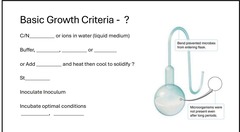
How did Louis Pasteur's swan-neck flask disprove spontaneous generation?
It allowed air to enter while trapping airborne dust and microbes in the bend.
Which chemical agent did Joseph Lister introduce for disinfecting surgical instruments?
Carbolic acid (phenol).
What does visible turbidity in a liquid broth after incubation indicate?
Bacterial cells have multiplied by binary fission and are scattering light.
What is a major limitation of relying solely on visual turbidity to assess bacterial cultures?
It cannot distinguish between viable (living) cells and dead cells.
What does an individual bacterial colony on an agar plate represent?
A visible mass of millions of cells originating from a single cell or CFU dividing by binary fission.
Why is thoroughly drying hands after washing essential in hospital infection control?
Wet hands transfer microbes to surfaces up to 1,000 times more efficiently than dry hands.