Economics: International Trade, Externalities, Public Goods, and Competitive Firm Decisions
 Call Kai
 Learn
 Practice Test
 Spaced Repetition
 Match
 Flashcards
 Knowt Play
1/77

Earn XP
Description and Tags
Comprehensive vocabulary flashcards covering the economic analysis of international trade, tariffs, externalities, public goods, common resources, and perfectly competitive firm decisions.
78 Terms
Domestic Demand Curve
A curve that shows the quantity of a product that all domestic consumers plan to buy at a given price.
Domestic Supply Curve
A curve that shows the quantity of a product that all domestic suppliers plan to provide at a given price.
No-Trade Equilibrium
The market outcome that occurs when there is no international trade, where the quantity demanded by domestic buyers equals the quantity supplied by domestic producers.

Consumer surplus with no trade
A
Tariff
A tax imposed on imported goods.

Government revenue
E

Deadweight loss
D+F

Transfer from domestic consumers to domestic producer
C

Pre-tarriff producer surplus
G

Post-tarriff producer surplus
G+C
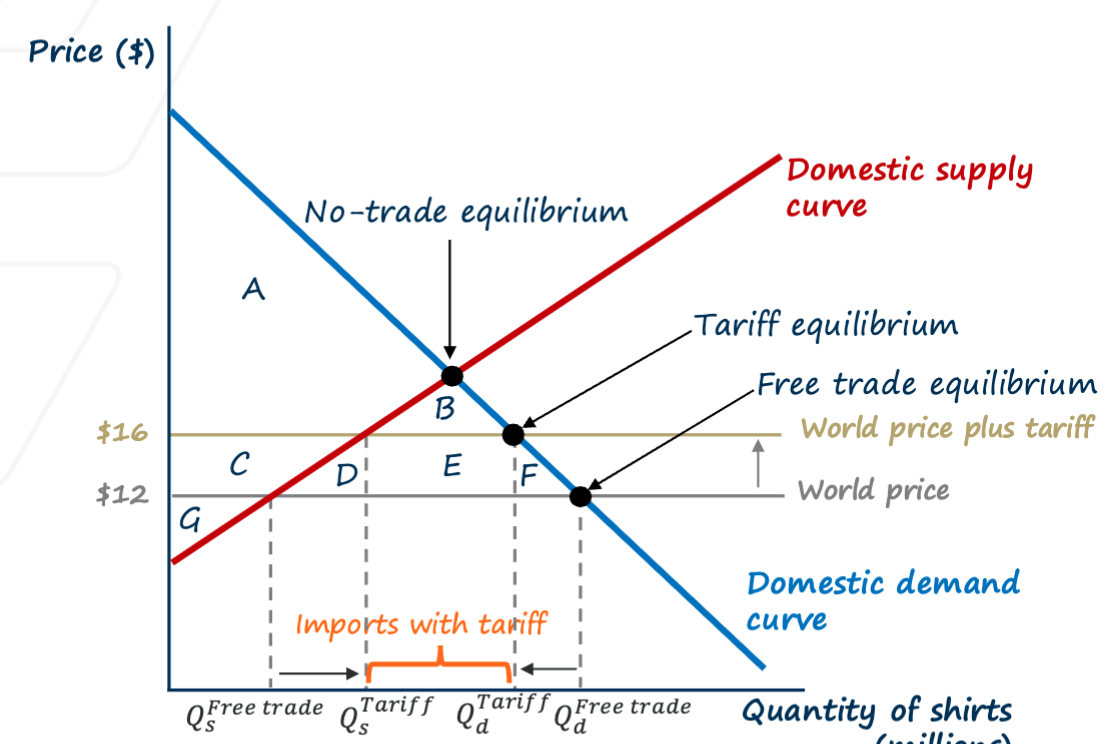
Pre-tarriff consumer surplus
A+C
Post-tarriff consumer surplus
A

Consumer surplus with trade
A+B+D
Import Quota
A limit placed on the quantity of a good that can be imported, which generates the same market outcome as a tariff but yields no government revenue.
National security argument
National security requires that we produce critically important goods ourselves
National security counterargument
Fears are overstated and prohibiting trade is a security risk as well
Infant Industry Argument
The rationale that governments can help establish new domestic industries by shielding fledgling businesses from international competition
Infant Industry Counterargument
Infant industries often fail to grow up
Dumping
The unfair trade practice where foreign firms temporarily charge extremely low prices to drive domestic competitors out of business, aiming to subsequently reduce supply and raise prices.
Dumping counterargument
It can be hard to tell if a firm is dumping, or if it is just highly efficient
Skirting regulations argument
Foreign firms can make cheaper goods by failing to comply to US ethical standards in pollution, fair pay, or child labor
Skirting regulations counterargument
Trading with poorer countries facilitates economic development that will make stricter labor and environmental standards more feasible in the long run
Private Cost
A cost directly paid by the consumer or producer participating in a market transaction.
Job Loss Argument
Restricting trade can preserve jobs in import-competing sectors that would otherwise leave the US
Job Loss Counterargument
Exporting industries will grow, people will retrain, and eventually, the job market will re-establish itself
External Cost
A cost imposed on bystanders who are neither the consumer nor the producer trading in the market.
Social Cost
The total cost borne by everyone in society, calculated as private cost plus external cost.
Private Benefit
A direct benefit received by the consumer or producer participating in a market transaction.
External Benefit
A benefit received by bystanders who are neither the consumer nor the producer trading in the market.
Social Benefit
The total benefit to everyone in society, calculated as private benefit plus external benefit.
Externality
An external cost or benefit that falls on bystanders not directly involved in the market transaction.
Negative Production Externality
An externality that occurs when a firm's production reduces the well-being of someone who is not compensated, leading the market to overproduce the good.
Negative Consumption Externality
An externality that occurs when an individual's consumption reduces the well-being of someone who is not compensated.
Positive Production Externality
An externality that occurs when a firm's production improves the well-being of someone without compensation to the firm, leading the market to underproduce the good.
Positive Consumption Externality
An externality that occurs when an individual's consumption improves the well-being of someone without that bystander compensating the consumer.
Marginal Private Cost (MPC)
The marginal cost curve of production paid by suppliers, representing the standard supply curve.
Marginal External Cost (MEC)
The extra cost imposed on bystanders from producing one additional unit of output.
Marginal Social Cost (MSC)
All marginal costs regardless of who pays them, defined by the formula MSC=MPC+MEC.
Social Surplus
The overall economic welfare generated in a market, calculated as consumer surplus plus producer surplus plus everyone else's surplus.
Efficient Quantity
The quantity of output that maximizes total social surplus.
Coase Theorem
The proposition that if transaction costs are low and property rights are clearly defined and enforced, private bargaining will lead to an efficient market outcome even in the presence of externalities.
Pigouvian Tax
A corrective per-unit tax set equal to the marginal external cost, forcing individuals or firms to internalize the negative externalities they create.
Pigouvian Subsidy
A corrective subsidy set equal to the marginal external benefit, inducing individuals or firms to fully internalize the positive externalities they generate.
Principle of Targeting
The policy principle stating that corrective taxes should be applied directly to the externality itself rather than to the activity or good that causes it.
Cap and Trade
A quantity regulation system where the government sets an overall limit on emissions, issues a matching number of permits (Q), and allows firms to trade them to achieve emissions reduction at lowest cost.
Command and Control
Direct laws, rules, and regulations that mandate specific behaviors or limits, often acting as a blunt and inflexible instrument compared to market-based policies.
Nonexcludable Good
A good for which it is difficult or impossible to prevent people who do not pay from using it.
Nonrival Good
A good where one person's consumption or use does not diminish the ability of others to use the same good simultaneously.
Private Goods
Goods that are both excludable and rival in consumption
Public Goods
Goods that are both nonexcludable and nonrival
Free Rider
A person who enjoys the benefits of a public good without contributing to or paying a share of its costs.
Forced Rider
An individual who is forced to pay a share of the costs of a public good through taxes but does not enjoy its benefits.
Club Goods
Goods that are excludable but nonrival
Common Resources
Goods that are rival in consumption but nonexcludable
Tragedy of the Commons
The tendency of any unowned, nonexcludable resource to be systematically overused and undermaintained.
Perfect Competition
A market structure characterized by many buyers and sellers each small relative to the total market, selling identical products, with no individual power to set prices.
Short Run
The time horizon in production before firms have the ability to enter or exit an industry.
Long Run
The time horizon sufficient for all existing firms to exit or new firms to enter an industry.
Sunk Costs
Past costs that have already been incurred, cannot be recovered or altered, and should be ignored in current decision-making.
Explicit Costs
Monetary expenses that require direct cash outlays by the firm.
Implicit Costs
Opportunity costs of production that do not involve an outlay of money.
Accounting Profit
A firm's total revenue minus its explicit costs Accounting Profit=TotalRevenue−ExplicitCosts.
Economic Profit
A firm's total revenue minus total economic costs, incorporating both explicit costs and implicit opportunity costs Economic Profit=TotalRevenue−TotalCosts.
Fixed Costs (FC)
Costs that do not vary with the quantity of output produced, such as rent and property upkeep.
Variable Costs (VC)
Costs that fluctuate directly with the quantity of output produced, such as raw material inputs.
Marginal Revenue (MR)
The change in total revenue gained from selling one additional unit of output, defined as MR=ΔQΔTR, which equals the market price (P) in a competitive firm.
Marginal Cost (MC)
The additional cost incurred by producing one additional unit of output, defined as MC=ΔQΔTC.
Profit Maximization Rule
The principle stating that a firm maximizes its profits by producing output up to the point where marginal revenue equals marginal cost (MR=MC).
Average Cost (AC)
The total cost of production divided by total quantity produced (QTC), used to determine per-unit profit via Profit=(P−AC)×Q.
Normal Profit
A zero economic profit state occurring where price equals average cost (P=AC
Shutdown Rule
The condition under which a firm should immediately cease production in the short run, triggered when total revenue is less than variable cost (TR<VC) or price falls below average variable cost (P<AVC).
What happens when imports are allowed?
Price declines to world price, quantity supplied domestically decreases, and domestic demand increases, and imports make the difference
What happens when exports are allowed
Price of exported goods tises to world price, quantity supplied domestically increases, and domestic demand decreases, and exports make the difference

Producer surplus with no trade
B+C
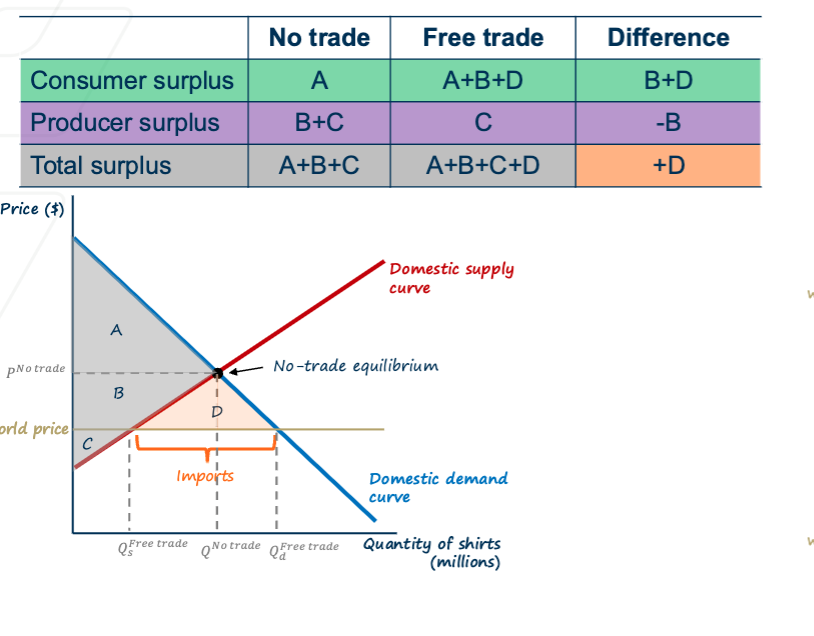
Producer surplus with trade
C

Total surplus with no trade
A+B+C
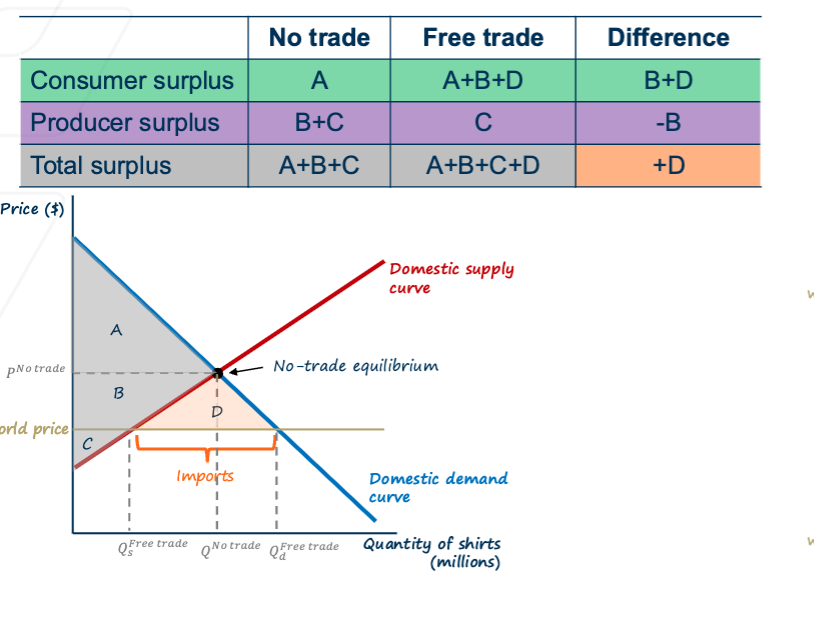
Total surplus with trade
A+B+C+D
Consumer surplus with no trade
A