what happens after you take a medicine - week 6

0.0(0)
Studied by 0 people
call kaiCall Kai
learnLearn
examPractice Test
spaced repetitionSpaced Repetition
heart puzzleMatch
flashcardsFlashcards
GameKnowt Play
Card Sorting

1/42

flashcard set

Earn XP

Description and Tags

what happens after you take a medicine

43 Terms

1
New cards

what happens after you take a medicine?

knowt flashcard image
2
New cards

ADME: four connected processes

knowt flashcard image
3
New cards

intravenous

  • IV enters blood directly


<ul><li><p>IV enters blood directly</p></li></ul><p></p>
4
New cards

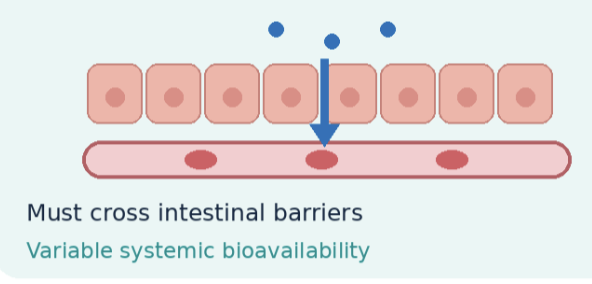
oral administration

  • extracellular route requires absorption

<ul><li><p>extracellular route requires absorption</p></li></ul><p></p>
5
New cards

ABSORPTION: reaching the bloodstream

Passive Diffusion

  • Many drugs cross biological membranes by passive diffusion.

  • Drugs move from high to low concentration.

  • Movement occurs down a concentration gradient.

  • No cellular energy (ATP) is required.


<p><span>Passive Diffusion</span></p><ul><li><p><span>Many drugs cross biological membranes by passive diffusion.</span></p></li><li><p><span>Drugs move from high to low concentration.</span></p></li><li><p><span>Movement occurs down a concentration gradient.</span></p></li><li><p><span>No cellular energy (ATP) is required.</span></p></li></ul><p></p>
6
New cards

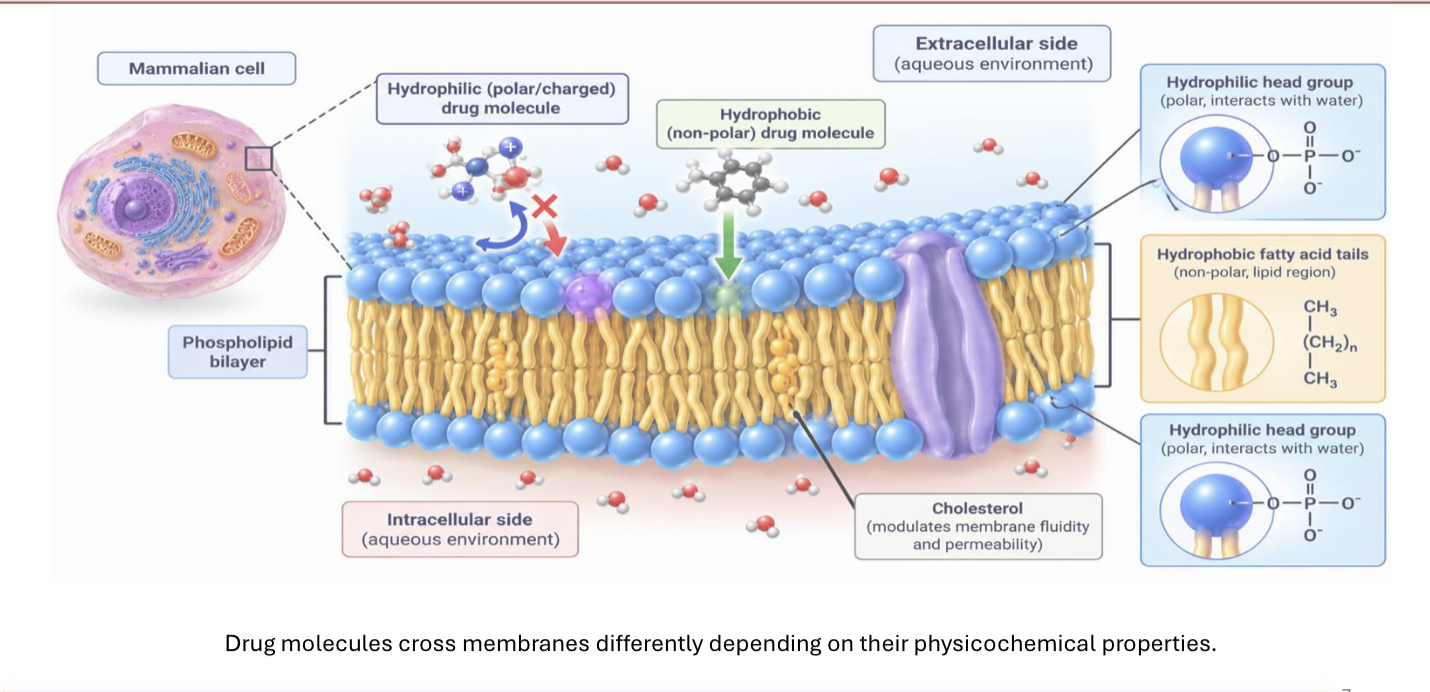
what is a biological membrane?

knowt flashcard image
7
New cards

hydrophilic and lipophilic

knowt flashcard image
8
New cards

drug properties and membrane passage

knowt flashcard image
9
New cards

what is LogP?

  1. How is it measured?

  • Mix the drug with octanol and water.

  • Allow the two layers to separate at equilibrium.

  • Measure the drug concentration in each layer.

  1. How do we interpret it?

  • Higher LogP: Greater preference for octanol.

  • Lower LogP: Greater preference for water.


Calculating LogP
Formula:
LogP = log₁₀(Cₒctanol / Cwater)


<ol><li><p><span>How is it measured?</span></p></li></ol><ul><li><p>Mix the drug with octanol and water.</p></li><li><p>Allow the two layers to separate at equilibrium.</p></li><li><p>Measure the drug concentration in each layer. </p></li></ul><ol start="2"><li><p>How do we interpret it?</p></li></ol><ul><li><p>Higher LogP: Greater preference for octanol.</p></li><li><p>Lower LogP: Greater preference for water.</p></li></ul><p></p><p><span><strong>Calculating LogP </strong><br>Formula:<br>LogP = log₁₀(Cₒctanol / Cwater)</span></p><p></p>
10
New cards

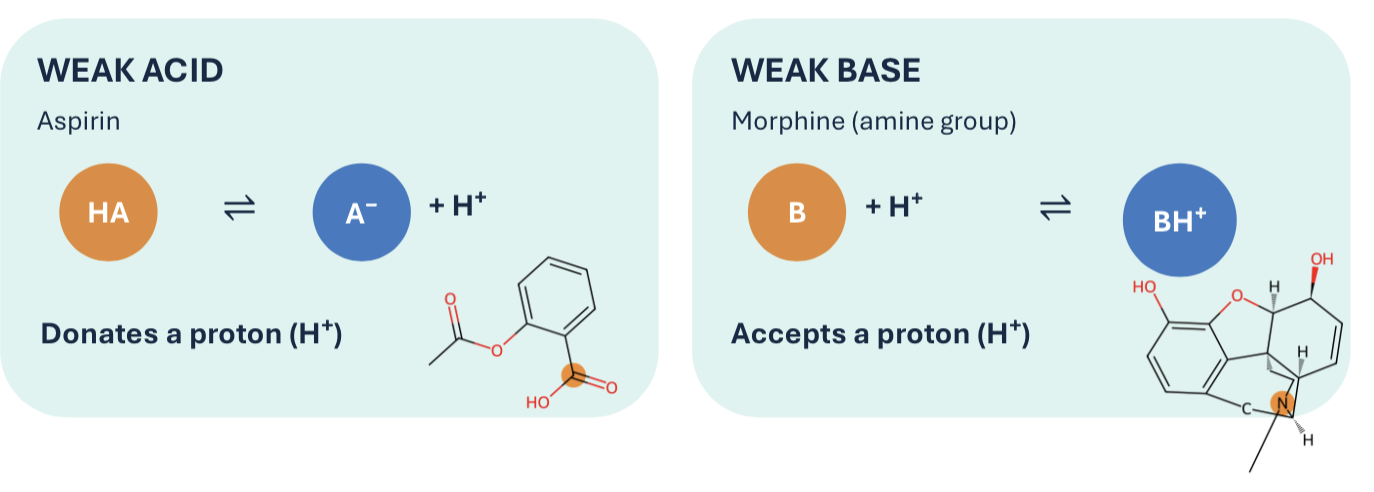
weak acids and weak bases

Key idea: Many drugs exist in both ionised (charged) and unionised (uncharged) forms. Their proportions depend on pH and pKa.
<p>Key idea: <span>Many drugs exist in both ionised (charged) and unionised (uncharged) forms. Their proportions depend on pH and pKa.</span></p>
11
New cards

what do pH and pKa tell us?

pH: Indicates how acidic or alkaline the surrounding environment is.
pKa: The pH at which 50% of a weak acid or base is ionised and 50% is unionized


<p><span>pH: Indicates how acidic or alkaline the surrounding environment is.<br>pKa: The pH at which 50% of a weak acid or base is ionised and 50% is unionized</span></p><p></p>
12
New cards

what is LogD?

LogD measures how a drug distributes between octanol and water at a specific pH, considering both ionised and unionised forms

<p><span style="font-size: calc(var(--scale-factor)*15.96px);">LogD measures how a drug distributes between octanol and water at a specific pH, considering both ionised and unionised forms</span></p>
13
New cards

what does LogP/LogD tell us about drug absorption?

Kep point: Higher lipophilicity does not always mean better oral absorption

<p>Kep point: <span>Higher lipophilicity does not always mean better oral absorption</span></p>
14
New cards

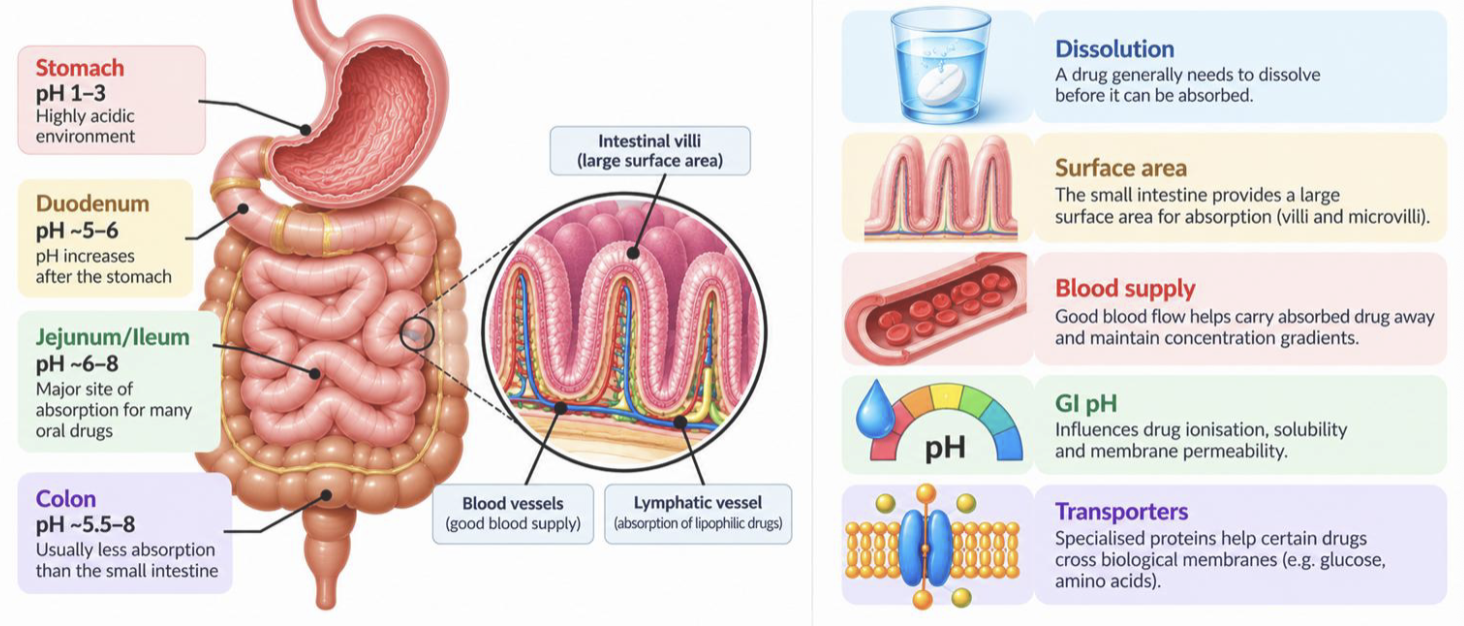
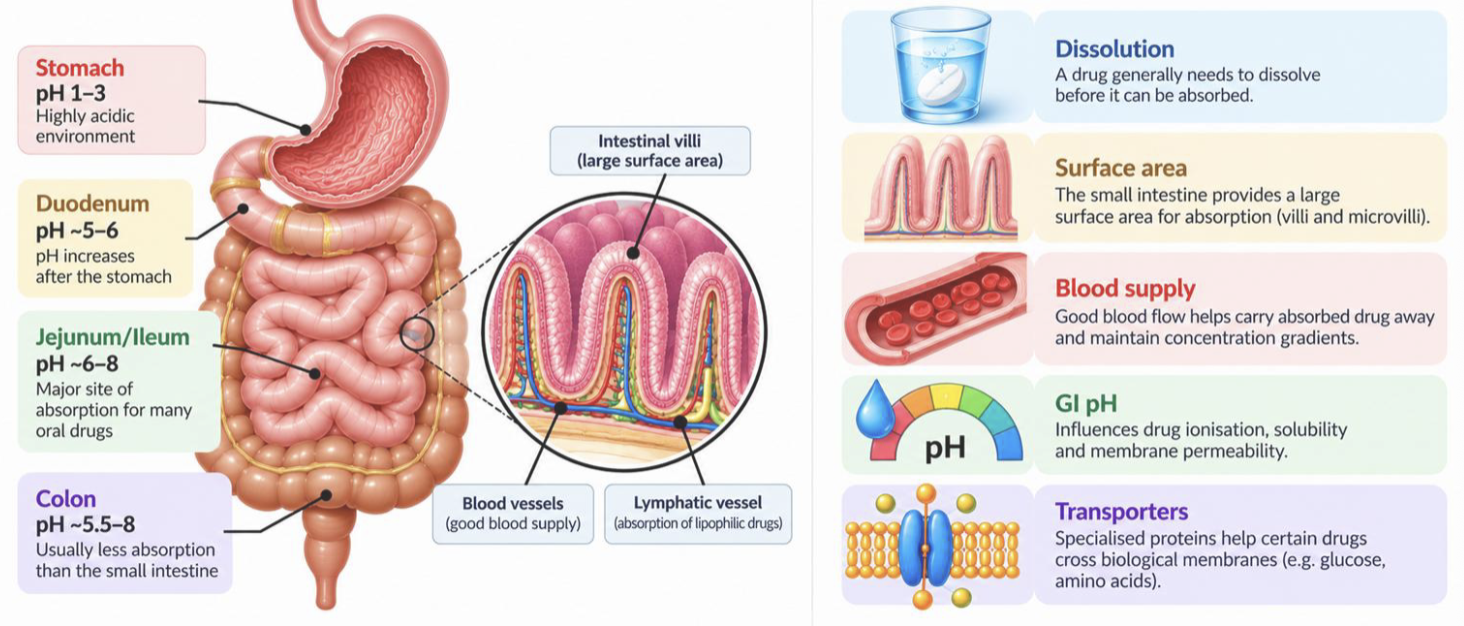
dissolution

A drug generally needs to dissolve before it can be absorbed

<p>A drug generally needs to dissolve before it can be absorbed</p>
15
New cards

surface area

the small intestine provides a large surface area for absorption (villi and microvilli)

<p>the small intestine provides a large surface area for absorption (villi and microvilli)</p>
16
New cards

blood supply

good blood flow helps carry absorbed drug away and maintain concentration gradients

<p>good blood flow helps carry absorbed drug away and maintain concentration gradients</p>
17
New cards

GI pH

influence drug ionization, solubility and membrane permeability

<p>influence drug ionization, solubility and membrane permeability</p>
18
New cards

transporters

specialized proteins help certain drugs cross biological membranes (eg. glucose, amino acids)
<p>specialized proteins help certain drugs cross biological membranes (eg. glucose, amino acids)</p>
19
New cards

pH of stomach

  • pH 1-3

  • highly acidic environment


<ul><li><p>pH 1-3</p></li><li><p>highly acidic environment</p></li></ul><p></p>
20
New cards

pH of duodenum

  • pH ~5-6

  • pH increases after the stomach


<ul><li><p>pH ~5-6</p></li><li><p>pH increases after the stomach</p></li></ul><p></p>
21
New cards

pH of jejunum/ileum

  • pH ~6-8

  • major site of absorption for many oral drugs


<ul><li><p>pH ~6-8</p></li><li><p>major site of absorption for many oral drugs</p></li></ul><p></p>
22
New cards

pH of colon

  • pH ~5.5-8

  • usually less absorption than the small intestine


<ul><li><p>pH ~5.5-8</p></li><li><p>usually less absorption than the small intestine</p></li></ul><p></p>
23
New cards

DISTRIBUTION: where the drug travels

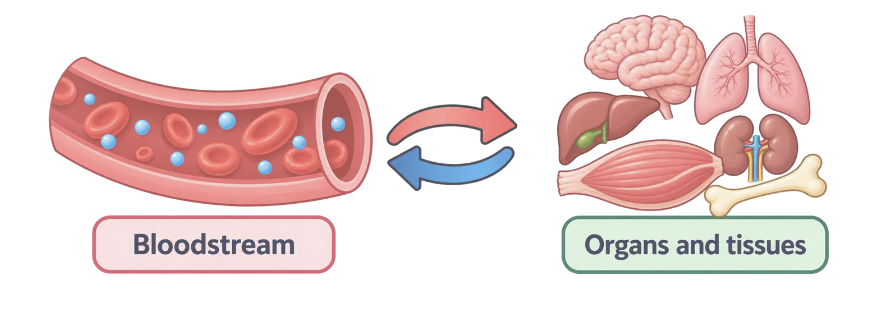
  • drug distribution is the reversible movement of a drug from the bloodstream into the tissues and organs of the body

  • blood carries the drug to different organs and tissues

  • some drug molecules lave the bloodstream and enter tissues

  • the drug may then reach its site of action

for example, Paracetamol is absorbed into the bloodstream after oral administration and then distributed to different tissues throughout the body.

<ul><li><p>drug distribution is the reversible movement of a drug from the bloodstream into the tissues and organs of the body</p></li><li><p>blood carries the drug to different organs and tissues</p></li><li><p>some drug molecules lave the bloodstream and enter tissues</p></li><li><p>the drug may then reach its site of action</p></li></ul><p>for example, <span style="font-size: calc(var(--scale-factor)*18.00px);">Paracetamol is absorbed into the bloodstream after oral administration and then distributed to different tissues throughout the body.</span><span><br></span></p><p></p>
24
New cards

factors that affect distribution

knowt flashcard image
25
New cards

affect of blood flow on distribution

Highly perfused organs (e.g., brain, liver and kidneys) generally receive drugs more rapidly than poorly perfused tissues.

<p><span style="font-size: calc(var(--scale-factor)*15.96px);">Highly perfused organs (e.g., brain, liver and kidneys) generally receive drugs more rapidly than poorly perfused tissues.</span></p>
26
New cards

free drug

  • Not bound to plasma proteins

  • Generally available to enter tissues and interact with receptors


27
New cards

protein-bound drug

  • Temporarily attached to proteins such as albumin

  • Generally unable to cross lipid membranes while bound


28
New cards

reversible binding

Bound drug can detach from proteins and replenish the free drug fraction

29
New cards

fraction unbound (fᵤ)

knowt flashcard image
30
New cards

albumin and acidic drugs

  • albumin is a major plasma binding protein for many acidic drugs


ALPHA-1-ACID GLYCOPROTEIN (AAG)

  • Binds many basic drugs

  • Example: Lidocaine


ALBUMIN

  • Binds many acidic drugs

  • Example: Warfarin (approximately 99% protein-bound)


KEY POINT: Protein binding is reversible, and unbound drug is generally available for pharmacological activity.


CLINICAL SIGNIFICANCE
Changes in protein binding may alter the free drug concentration and influence drug effects.

<ul><li><p>albumin is a major plasma binding protein for many acidic drugs</p></li></ul><p></p><p><span>ALPHA-1-ACID GLYCOPROTEIN (AAG)</span></p><ul><li><p><span>Binds many basic drugs</span></p></li><li><p><span>Example: Lidocaine</span></p></li></ul><p></p><p><span>ALBUMIN</span></p><ul><li><p><span>Binds many acidic drugs</span></p></li><li><p><span>Example: Warfarin (approximately 99% protein-bound)</span></p></li></ul><p></p><p><span style="font-size: calc(var(--scale-factor)*18.00px);">KEY POINT: Protein binding is reversible, and unbound drug is generally </span><span style="font-size: calc(var(--scale-factor)*18.02px);">available for pharmacological activity.</span></p><p><br><span>CLINICAL SIGNIFICANCE<br>Changes in protein binding may alter the free drug concentration and influence drug effects.</span></p>
31
New cards

blood-brain barrier (BBB)

What is the BBB?

A selective barrier formed mainly by tightly joined endothelial cells lining the brain capillaries. It controls which substances can enter the brain from the blood.

What determines drug entry?

  • Tight junctions: Seal the gaps between endothelial cells, restricting substances from passing between them.

  • Lipid solubility: Small, lipid-soluble drugs can cross the BBB more easily.

  • Transporters: Allow certain substances to enter the brain and can pump some drugs back into the blood.

Examples

  • Diazepam: Lipid-soluble, so it crosses the BBB easily and produces effects in the central nervous system (CNS).

  • Loperamide: Normally has limited entry into the brain because P-glycoprotein pumps it back into the blood.

Glossary – difficult terms

  • Endothelial cells: Cells that line the inside of blood vessels.

  • Tight junctions: Connections that seal the gaps between neighbouring cells.

  • Lipid-soluble: Able to dissolve in fats and oils.

  • Transporters: Proteins that move substances across cell membranes.

  • P-glycoprotein: A transporter that pumps certain drugs out of cells, limiting their entry into the brain.

  • CNS (central nervous system): The brain and spinal cord.


<p>What is the BBB?</p><p>A selective barrier formed mainly by tightly joined endothelial cells lining the brain capillaries. It controls which substances can enter the brain from the blood.</p><p>What determines drug entry?</p><ul><li><p>Tight junctions: Seal the gaps between endothelial cells, restricting substances from passing between them.</p></li><li><p>Lipid solubility: Small, lipid-soluble drugs can cross the BBB more easily.</p></li><li><p>Transporters: Allow certain substances to enter the brain and can pump some drugs back into the blood.</p></li></ul><p>Examples</p><ul><li><p>Diazepam: Lipid-soluble, so it crosses the BBB easily and produces effects in the central nervous system (CNS).</p></li><li><p>Loperamide: Normally has limited entry into the brain because P-glycoprotein pumps it back into the blood.</p></li></ul><p>Glossary – difficult terms</p><ul><li><p>Endothelial cells: Cells that line the inside of blood vessels.</p></li><li><p>Tight junctions: Connections that seal the gaps between neighbouring cells.</p></li><li><p>Lipid-soluble: Able to dissolve in fats and oils.</p></li><li><p>Transporters: Proteins that move substances across cell membranes.</p></li><li><p>P-glycoprotein: A transporter that pumps certain drugs out of cells, limiting their entry into the brain.</p></li><li><p>CNS (central nervous system): The brain and spinal cord.</p></li></ul><p></p>
32
New cards

membrane transporters - how drugs enter and leave cells

Membrane transporters are proteins embedded in cell membranes that help substances, including drugs, move into or out of cells.

Key terms:

ABC transporters: use energy from ATP hydrolysis to move various molecules across cellular membranes.

SLC transporters: family of membrane-bound proteins that control the movement of nutrients, ions, drugs, and other molecules across cell membranes

<p><span style="font-size: calc(var(--scale-factor)*18.00px);">Membrane transporters are proteins embedded in cell membranes that help substances, including drugs, </span><span style="font-size: calc(var(--scale-factor)*18.02px);">move into or out of cells.</span></p><p><span style="font-size: calc(var(--scale-factor)*18.02px);">Key terms:</span></p><p><span style="font-size: calc(var(--scale-factor)*18.02px);">ABC transporters: </span>use energy from ATP hydrolysis to move various molecules across cellular membranes<span>.</span></p><p><span>SLC transporters: family of membrane-bound proteins that control the movement of nutrients, ions, drugs, and other molecules across cell membranes</span></p>
33
New cards

METABOLISM: changing drug molecules

The chemical transformation of drugs by enzymes, mainly in the liver.

Key points

  • The liver is the principal organ responsible for the metabolism of most drugs.

  • Metabolism often makes drugs more water-soluble, so they can be eliminated from the body more easily.

  • Metabolism can:

    • Inactivate drugs: Make them inactive.

    • Activate prodrugs: Convert inactive drugs into their active form.

    • Produce active metabolites: Create breakdown products that still have a drug effect.

The two phases of metabolism

  • Phase I: Oxidation, reduction and hydrolysis.

  • Phase II: Conjugation reactions.


Glossary – difficult terms

  • Enzymes: Proteins that speed up chemical reactions.

  • Water-soluble: Able to dissolve in water, making elimination easier.

  • Prodrug: An inactive or less active drug that is converted into an active form.

  • Active metabolite: A drug breakdown product that still has an effect.

  • Oxidation: A chemical reaction that often involves adding oxygen or removing hydrogen.

  • Reduction: A chemical reaction that often involves adding hydrogen or removing oxygen.

  • Hydrolysis: Breaking a chemical bond using water.

  • Conjugation: Attaching another chemical group to a drug or its metabolite, often making it easier to eliminate.


<p>The chemical transformation of drugs by enzymes, mainly in the liver.</p><p>Key points</p><ul><li><p>The liver is the principal organ responsible for the metabolism of most drugs.</p></li><li><p>Metabolism often makes drugs more water-soluble, so they can be eliminated from the body more easily.</p></li><li><p>Metabolism can:</p><ul><li><p>Inactivate drugs: Make them inactive.</p></li><li><p>Activate prodrugs: Convert inactive drugs into their active form.</p></li><li><p>Produce active metabolites: Create breakdown products that still have a drug effect.</p></li></ul></li></ul><p>The two phases of metabolism</p><ul><li><p>Phase I: Oxidation, reduction and hydrolysis.</p></li><li><p>Phase II: Conjugation reactions.</p></li></ul><p></p><p>Glossary – difficult terms</p><ul><li><p>Enzymes: Proteins that speed up chemical reactions.</p></li><li><p>Water-soluble: Able to dissolve in water, making elimination easier.</p></li><li><p>Prodrug: An inactive or less active drug that is converted into an active form.</p></li><li><p>Active metabolite: A drug breakdown product that still has an effect.</p></li><li><p>Oxidation: A chemical reaction that often involves adding oxygen or removing hydrogen.</p></li><li><p>Reduction: A chemical reaction that often involves adding hydrogen or removing oxygen.</p></li><li><p>Hydrolysis: Breaking a chemical bond using water.</p></li><li><p>Conjugation: Attaching another chemical group to a drug or its metabolite, often making it easier to eliminate.</p></li></ul><p></p>
34
New cards

Cytochrome P450 (CYP) enzymes – drug metabolism

What are CYP enzymes?

A family of drug-metabolising enzymes found mainly in the liver.


Key points

  • Commonly involved in Phase I oxidation reactions.

  • Can produce:

    • Active metabolites: Still have a drug effect.

    • Inactive metabolites: No longer have a drug effect.

    • Toxic metabolites: Can cause harmful effects.

  • Changes in CYP enzyme activity can affect drug concentrations in the body and how patients respond to medicines.


Clinical example:

Codeine → CYP2D6 → Morphine (active metabolite)

CYP2D6 converts codeine into morphine, which produces the pain-relieving effect.


Key takeaway:

CYP enzymes influence how medicines are metabolised and how patients respond to them.

Glossary – difficult terms

  • Cytochrome P450 (CYP): A family of enzymes involved in breaking down drugs.

  • Phase I oxidation: A chemical reaction that modifies a drug, often making it easier to process further.

  • Metabolite: A substance produced when the body breaks down a drug.

  • CYP2D6: A specific CYP enzyme responsible for converting codeine into morphine.

  • Drug concentration: The amount of a drug present in the body.


35
New cards

EXCRETION: leaving the body

Kidney - urine

  • major route of excretion for many drugs and metabolites


liver/bile - faeces

  • some drugs and metabolites are secreted into bile and subsequently eliminated in faeces


lungs - exhaled air

  • eliminate volatile substances, such as some inhaled anaesthetics


36
New cards

how the kidney handles drugs?

knowt flashcard image
37
New cards

enterohepatic recycling

cyclical pathway where substances travel from the liver, into the bile and small intestine, get reabsorbed across the intestinal wall, and return to the liver via the portal vein

<p><span>cyclical pathway where substances travel from the liver, into the bile and small intestine, get reabsorbed across the intestinal wall, and return to the liver via the portal vein</span></p>
38
New cards

following a drug orally

knowt flashcard image
39
New cards

drug concentrations over time

pharmacokinetics helps us understand:

  • how much drug reached the bloodstream

  • how drug concentrations change over time

  • how long a drug remains in the body

  • how quickly the body eliminates a drug


overall, it helps guide safe and effective dosing


40
New cards

therapeutic window

knowt flashcard image
41
New cards

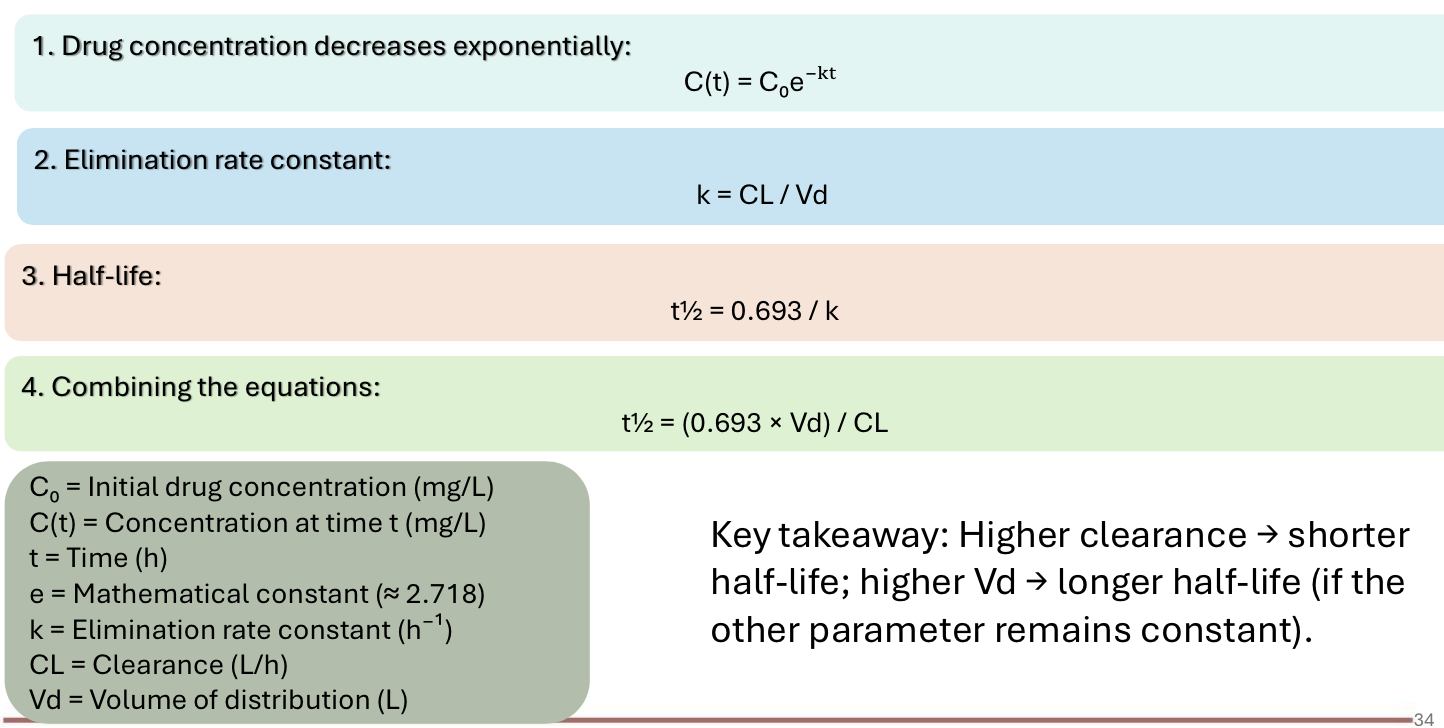
What Is Elimination Half-Life (t½)?

Elimination half-life is the time required for plasma drug concentration to decrease by 50% during the elimination phase.


Key takeaway: With first-order elimination, the same fraction (50%) is removed during each half- life.


Glossary – difficult terms

  • Elimination: Removal of a drug from the body.

  • Half-life (t½): Time taken for the drug concentration to decrease by half.

  • Plasma drug concentration: Amount of drug present in the blood plasma.

  • First-order elimination: A process where a constant fraction of the drug is eliminated per unit of time.

  • Elimination phase: The stage when drug concentration decreases as the body removes the drug.


<p><span style="font-size: calc(var(--scale-factor)*18.02px);">Elimination half-life is the time required for plasma drug concentration to decrease by 50% </span><span style="font-size: calc(var(--scale-factor)*18.00px);">during the elimination phase.</span></p><p></p><p><span style="font-size: calc(var(--scale-factor)*18.00px);">Key takeaway: With first-order elimination, the same fraction (50%) is removed during each half- </span><span style="font-size: calc(var(--scale-factor)*18.02px);">life.</span></p><p></p><p>Glossary – difficult terms</p><ul><li><p>Elimination: Removal of a drug from the body.</p></li><li><p>Half-life (t½): Time taken for the drug concentration to decrease by half.</p></li><li><p>Plasma drug concentration: Amount of drug present in the blood plasma.</p></li><li><p>First-order elimination: A process where a constant fraction of the drug is eliminated per unit of time.</p></li><li><p>Elimination phase: The stage when drug concentration decreases as the body removes the drug.</p></li></ul><p></p>
42
New cards

mathematics of drug half-life

knowt flashcard image
43
New cards

why does pharmacokinetics matter clinically?

renal impairment

  • reduced kidney function may decrease drug elimination and increase drug exposure


drug interaction

  • enzyme inhibition may slow metabolism and increase drug concentrations


repeated dosing

  • drug accumulation can occur when doses are repeated before the previous dose is fully eliminated