Lesson 1.0
 Call Kai
 Learn
 Practice Test
 Spaced Repetition
 Match
 Flashcards
 Knowt Play
1/23

There's no tags or description
Looks like no tags are added yet.
24 Terms
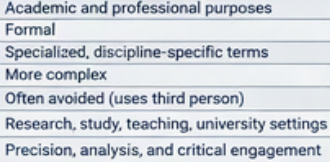
It is a specialized English language form utilized primarily in educational and scholarly contexts. Moreover, it is the genre of English used in research, study, teaching, and university settings characterized by formal and precise language that conveys ideas clearly and objectively.
Academic English
Academic English is often synonymous with…?
English for Academic Purposes
Key Characteristics of Academic English:
Formality
Complexity
Objective Tone
Cohesion and Structure
Critical Engagement
Discipline-Specific Vocabulary
Maintains a formal tone, avoiding colloquialisms, slang, and contractions
Formality
Uses more complex vocabulary and sentence structures for precise expression
Complexity
Emphasizes objectivity and impartiality, often using third-person or passive voice
Objective Tone
Well-organized with clear structures, strong topic sentences, logical flow, and appropriate linking words
Cohesion and Structure
Encourages critical thinking and evaluation of sources, synthesizing information and engaging with differing viewpoints
Critical Engagement
Each field has its own specialized terms and jargon essential for effective communication
Discipline-Specific Vocabulary
Nature of Academic English:
Purpose-Driven
Audience Awareness
Learning Context
Serves to inform, analyze, argue, or critique ideas rather than entertain
Purpose-Driven
Writers consider their audience’s familiarity with the subject and use appropriate technical terms
Audience Awareness
Used in writing, oral, presentations, discussions, lectures and seminars. Integral to all aspects of academic life
Learning Context
Importance of Academic English:
Effective Communication
Development of Critical Thinking
Enhanced Academic Performance
Preparation for Professional Success
Global Integration
Access to Scholarly Resources
Research and Knowledge Dissemination
Lifelong Learning
Enhances the ability to communicate complex ideas clearly and accurately
Effective Communication
Fosters analysis, evaluation, and synthesis of information
Development of Critical Thinking
Leads to higher grades and deeper understanding
Enhanced Academic Performance
Builds writing and analytical skills needed in the workplace.
Preparation for Professional Success
Facilitates communication across diverse cultures
Global Integration
Allows access to current research and theoretical frameworks
Access to Scholarly Resources
Enables contribution to scholarly dialogues and wider impact
Research and Knowledge Dissemination
Enhances personal development and problem-solving skills
Lifelong Learning

General English


Academic English