PSYC 1002 - mental ability
 Call Kai
 Learn
 Practice Test
 Spaced Repetition
 Match
 Flashcards
 Knowt Play
1/86

There's no tags or description
Looks like no tags are added yet.
87 Terms
mental ability
心智能力:the capacity to perform higher mental processes such as reasoning, remembering understanding and problem solving. 利用大脑完成高级心理活动的能力 (cognitive ability or cognitivefunctioning - intelligence )
intelligence and is it limited on academic skill
智力:a broad mental capacity involving reasoning, planning, problem-solving and learning. It is not limited to academic skills
3 example of mental abilities

what is construct in psychology?
理论构念:a theoretical concept construced from observation to explain behavour
what is the difference between latent and manifest variable?
latent variables are unobservable (intelligence), manifest variable are directly measureble (test score)
what does operationalising intellegence mean?
turn intelligence into something measurable, such as through an intelligence test.
what is the difference between implicit theory and explicit theory?
implicit theorie 内隐 are everyday beliefs; explicit theory are formal research based theories
how do entity and incremental differ?
entity theory view intelligence as fixed, where as incremental theory view intelligence as changeable
implicit theory - experiment: Blackwell
research question: will entity and incremental theory effect student performance?
Belief | Results |
|---|---|
Incremental theory | 成绩呈上升趋势 |
Entity theory | 成绩没有明显变化 |
Incremental theory 同时与以下表现相关:
Greater effort(更多努力)
More positive response to failure(更加积极地面对失败)
Conclusion(研究结论)
人们对于智力的信念能够预测学习表现和学习动机。
为什么这个结果有意义?因为学生对自己能力的信念,可能影响他们是否愿意继续努力以及遇到失败后的反应。
但这不代表该研究单独证明了改变信念一定能够提高智力或成绩。
Meta analyse
analyse combining multiple experiment.
what cultural difference did Costa and Faria’s meta analysis find?
asia / oceania: incremental belief positively associated with achievement
europe: entity belief positively associated
north america: entity beliefs negatively associated
how did Binet view intelligence?
the ability to judge, understand and adapt. intelligence is not fixed and can develop though education
what was the purpose of the Binet - simon scale?
Identify the children need additional educational support by assessing current performance, not cuases or permanent label. (practical, not theoretical)
what is a standardised test?
a test administered and scored consistently, allowing comparison between individual
what is mental age, and how does it differ from chronological age?
mental age is the age level reflect by task performance, and chronological age is the actual physical age
what is the difference between basal age and ceiling age?
basal age is the highest level where all test are passed. ceiling age is the level where all task are fail.
eugenics
优生学
definition for: xied biological trait, hereditary, sensory discrimination, visual acuity, auditory accuracy, tactile discrimination, reaction time
Vocabulary | 中文 |
|---|---|
Fixed biological trait | 固定的生物学特质 |
Hereditary | 可遗传的 |
Sensory discrimination | 感觉辨别能力 |
Visual acuity | 视觉敏锐度 |
Auditory accuracy | 听觉准确性 |
Tactile discrimination | 触觉辨别能力 |
Reaction time | 反应时间 |
how did Galton view intelligence?
a fixed, hereditary biological trait associated with sensory discrimination
how did cattell’s mental tests challenge calton’s theory?
sensory tests failed to predict academic performance
Binet vs UK/US Approach
Binet | Early UK/US approach | |
|---|---|---|
Nature of intelligence 智力本质 | Changeable | Fixed |
Role of genetics 遗传观 | 不将测试用于判定遗传原因 | 强调遗传 |
Role of education 教育作用 | Can develop intelligence | 强调智力的稳定性 |
Purpose of testing 测试目的 | Identify and support | Classify and select |
Interpretation of scores 分数解释 | Current performance | Underlying inherited ability |
Social implications 社会影响 | Educational support | Eugenics and exclusion |
How did Terman and Goddard contribute to early intelligence testing?
Terman developed the Stanford-Binet; Goddard applied culturally biased intelligence tests to immigrants. Both supported eugenics.
How did Binet's approach differ from the early UK/US approach?
Binet viewed intelligence as changeable and aimed to provide support. The UK/US approach emphasised fixed, hereditary intelligence, classification and eugenics.
What is the mixed legacy of intelligence testing?
Positive: educational support, clinical assessment and early identification. Negative: eugenics, racism, social hierarchies and discrimination.
what is the difference between reliability and validity?
reliability is measurement for consistency
validity is whether a test measures what is claims to measure
what are the three types of reliability?
test-retest: stability overtime 同一人在不同时间,结果是否稳定
inter-rater: agreement between evaluator 不同评分者对同一人的表现是否一样
internal: consistency across items 同一个测试中测量相同特制的题目之间是否一致
what are the three types of validity?
construct: measures the intended concept 是否测量目标数据
content: covers the full domain 是否覆盖该概念所包含的内容
predictive: predict relevant outcomes 能否能够预测相关结果
can a test be reliable without being valid?
yes, a test may consistently measure the wrong thing
ratio IQ & Deviation IQ
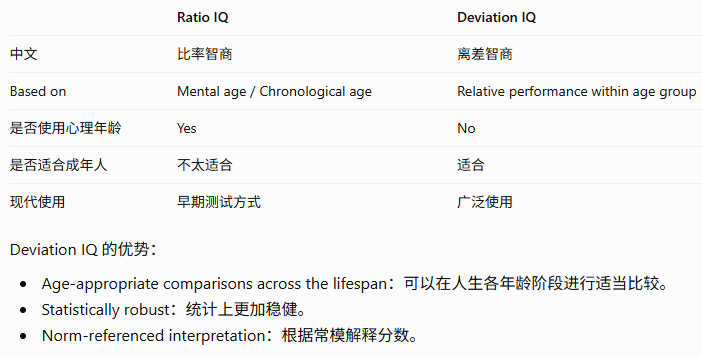
what is the difference between ratio IQ and deviation IQ?
ratio IQ calculated on individual performance with comparing mental age with chronological age, and deviation IQ is calculate with group performance in the same age
Why is ratio IQ problematic for adults?
age standars lose meaning after adolescence, and ratio IQ has uneven scaling
what is the mean and standard deviation of deviation IQ?
mean is 100, standard deviation is 15. An IQ of 115 is one SD above the mean, and 85 is one SD below.
what is Strenze’s meta-analysis finding about IQ and socioeconomic success
IQ is positively correlated / positively predicts academic success, occupational success, and income, in decreasing order of strength. academic > career/ocupational > income
via longitudinal study
Is IQ the only predictor of academic and occupational success?
No, SES also predicts these outcomes and correlation does not estabilish causation
what did the Scottish Mental Survey follow-up studies reveal about childhood IQ?
higher IQ level predicted lower mortality, longer life expantency and better health in later life.
Čukić et al. (2017) — PPT p.20
what may explain the association between higher IQ and better health?
healthier behaviours, including less smoking and excessive drinking, healthier diet and more exercise. causation remain uncertain. (healthier life style)
Čukić et al. (2017) — PPT p.20
Whitley et al. (2010)
Research Question
Does intelligence in early adulthood predict subsequent risk of unintentional injury?
成年早期的智力能否预测之后发生非故意伤害的风险?
Method
对超过 100 万名瑞典男性进行长期追踪,在成年早期测量其 IQ,并通过 Hospital admission data(医院入院数据)评估之后的意外伤害。
Results
Lower IQ was associated with increased risk of all studied injuries except drowning.
IQ can predict subsequent risk of unintentional injury.
智力测试分数对未来意外伤害风险具有一定预测作用。
这与认知能力可能影响 Risk assessment(风险评估)和 Decision-making(决策)的观点一致。不过,这些具体机制并未在 PPT 中得到确认,因此不能作为该研究已证明的结论。

Čukić et al. (2017) — PPT p.20
Research Question
Can childhood IQ predict mortality later in life?
儿童时期的 IQ 能否预测成年后甚至老年时期的死亡风险?
Method
研究者利用儿童在 11 岁时的 IQ 数据,对参与者进行长期追踪,分析 IQ 与之后几十年的存活情况之间的关系。
Results
Childhood IQ predicted the risk of dying over the following decades.
儿童时期的 IQ 能够预测之后几十年的死亡风险。
Conclusion
Higher childhood IQ is associated with lower mortality and longer life expectancy.
较高的儿童时期 IQ 与较低的死亡率和较长的预期寿命相关。
为什么这项研究重要?
因为 IQ 是在儿童时期测量的,而健康及死亡结果是在几十年后观察的。这表明早期的智力测试分数具有长期的 Predictive validity(预测效度)。

What did Whitley et al.'s large longitudinal study find about IQ and accidents?
Lower early-adulthood IQ was associated with greater risk of unintentional injuries, except drowning.
factor analysis
因素分析:a stastistical method for identifying common underlying factors among different test scores. 通过分析和分析不同测试结果之间的关系,寻找测试背后的共同因素。是一种统计方法

what is Spearman’s general intelligence(g)?
A signle underlying general mental ability that influences performance across cognitive tasks
What is the positive manifold, and how does it support g?
Cognitive test scores tend to be positively correlated, suggesting a common underlying general ability.
identify the primary mental abilities (PMAs): spatial ability, perceptual speed, numerical influency, verbal comprehension, verbal fluuency, memory, inductive reasoning
Primary mental ability | 中文 | 例子 |
|---|---|---|
Spatial ability | 空间能力 | 想象物体旋转 |
Perceptual speed | 知觉速度 | 快速寻找相同图案 |
Numerical fluency | 数字运用能力 | 快速进行计算 |
Verbal comprehension | 语言理解能力 | 理解文章 |
Verbal fluency | 语言流畅性 | 快速想出词语 |
Memory | 记忆能力 | 记住信息 |
Inductive reasoning | 归纳推理 | 从例子中发现规律 |
How does Thurstone's theory differ from Spearman's, and what is its limitation?
Thurstone proposed seven independent primary mental abilities, whereas Spearman proposed g. Thurstone's theory fails to explain the positive manifold.
What is a hierarchical theory of intelligence?
Intelligence is organised into layers: general intelligence (g) at the top, broad abilities in the middle, and specific abilities at the bottom.
comparing fluid and crystallised intelligence
Fluid intelligence (Gf) | Crystallised intelligence (Gc) | |
|---|---|---|
中文 | 流体智力 | 晶体智力 |
核心 | Solving novel problems | Acquired knowledge and skills |
主要能力 | 推理、发现规律 | 知识、经验、词汇 |
测试例子 | Abstract pattern reasoning | Vocabulary test |
年龄影响 | 通常随年龄增长而下降 | 下降较少,有时继续增长 |
文化影响 | 理论上希望不受文化限制,但实际仍存在文化偏差 | 依赖文化与教育经历 |
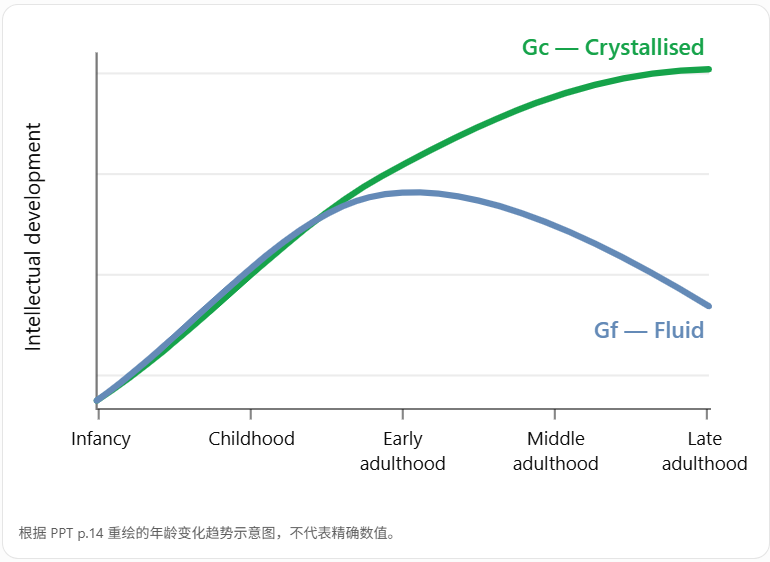
What is the difference between fluid (Gf) and crystallised (Gc) intelligence?
Gf is the ability to solve novel problems; Gc is acquired knowledge and skills. Gf helps in the acquisition of Gc.
How does aging affect fluid and crystallised intelligence differently?
Gf typically declines with age, whereas Gc declines less and may even improve.
What does research suggest about interventions for age-related cognitive decline?
Brain training lacks convincing evidence of everyday benefits. Exercise is linked to lower decline; nutrition plus exercise and musical training can improve cognitive functions.
Intervention | Key finding |
|---|---|
Brain training apps | 无令人信服的日常功能改善证据 |
Physical activity | 与较低认知衰退及失智症风险相关 |
Nutrition + exercise | 可以改善老年人整体认知功能 |
Musical instrument training | 可以改善部分 Gf 相关能力 |
What is Gardner's Theory of Multiple Intelligences?
Intelligence consists of distinct abilities to solve problems or create culturally valued products, beyond traditional intellectual skills.
What are Gardner's eight intelligence
Linguistic, logical-mathematical, spatial, musical, bodily-kinesthetic, interpersonal (others), intrapersonal (self), and naturalistic.
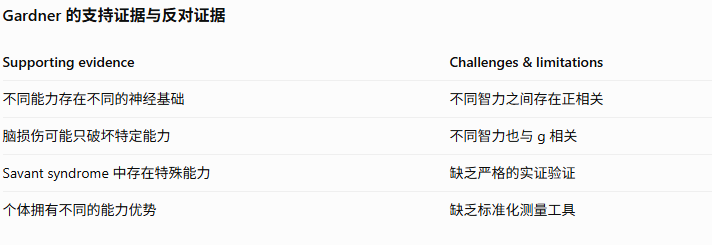
What evidence supports Gardner's Theory of Multiple Intelligences?
Distinct neural architecture, selective impairments after brain lesions, and exceptional abilities in savant syndrome.
What are the main criticisms of Gardner's Theory of Multiple Intelligences?
Intelligences correlate with each other and g, and the theory lacks rigorous empirical validation and standardised measurement tools.
Limitation | 中文解释 |
|---|---|
Lack of empirical validation | 缺乏足够严格的实证验证 |
No standardised measurement tools | 缺乏公认的标准化测量工具 |
Genotype vs Phenotype
Genotype | Phenotype | |
|---|---|---|
中文 | 基因型 | 表现型 |
含义 | Underlying genetic factors | Expression of underlying genetic factors |
例子 | 一个人的 DNA | 观察到的智力表现 |
What is heritability, and does it apply to individuals?
The proportion of population variation in a trait explained by genetic differences. It applies to populations, not individuals.
How do MZ and DZ twin studies provide evidence for genetic influences?
MZ twins share nearly 100% of genes, DZ twins about 50%. Greater MZ similarity suggests genetic influence.
Monozygotic twins (MZ) | Dizygotic twins (DZ) | |
|---|---|---|
中文 | 同卵双胞胎 | 异卵双胞胎 |
共享基因 | 约 100% | 平均约 50% |
另一个名称 | Identical twins | Fraternal twins |
How do adoption studies distinguish genetic and environmental influences?
Similarity among biological relatives raised apart suggests genes; similarity among unrelated relatives raised together suggests shared environment.
What is a concordance rate?
The percentage of pairs in which both individuals show the same trait.
What environmental factors are linked to intelligence?
Education, interventions, SES and nutrition, including breastfeeding.
Environmental factor | 中文 | 可能产生的影响 |
|---|---|---|
Education & interventions | 教育与干预 | 促进知识、技能和认知能力发展 |
Socioeconomic status (SES) | 社会经济地位 | 影响教育及生活资源 |
Nutrition | 营养 | 与儿童认知发展有关 |
Health knowledge | 健康知识 | 可能影响营养及健康行为 |
What does research suggest about breastfeeding and intelligence?
Meta-analyses show a positive association; a randomised breastfeeding-promotion trial provides stronger evidence for cognitive benefits.
Horta et al. & Hou et al. — Meta-analyses
Research Question
Is breastfeeding associated with improved intelligence in children?
母乳喂养是否与更好的儿童智力表现相关?
Method
通过 Systematic review 和 Meta-analysis 汇总多个研究的结果。
Results
Horta et al.:Breastfeeding 与较高的 Intelligence test performance 相关。
Hou et al.:母乳喂养超过六个月的儿童,在研究中表现出比从未接受母乳喂养或喂养时间较短的儿童更高的 IQ。
Conclusion
Breastfeeding is positively associated with childhood intelligence.
但这些关联不能单独证明母乳喂养导致智力提高。
例如,家庭 SES、健康资源和其他环境因素,也可能同时影响喂养方式和儿童认知表现。
Kramer et al. — Randomised Trial
Research Question
Can an intervention promoting breastfeeding improve children's cognitive development?
Method
在白俄罗斯的医院进行大规模 Randomised trial(随机试验),评估 Breastfeeding promotion intervention(母乳喂养促进干预),并在儿童成长后进行随访。
Results
Prolonged and exclusive breastfeeding appeared to improve children's cognitive development.
长期、纯母乳喂养似乎对儿童认知发展有积极影响。
Conclusion
这一研究为母乳喂养与认知发展之间可能存在因果关系提供了更有力的证据。
为什么比普通相关性研究更有说服力?
因为研究通过随机分配干预来减少部分 Confounding factors(混杂因素)的影响。
但是需要注意:随机分配的是母乳喂养促进措施,而不是直接随机决定婴儿是否接受母乳喂养。 因此不能认为所有可能的混杂因素都已经被排除。
The Flynn Effect
The Flynn Effect: The observed rise over time in standardised intelligence test scores.
弗林效应指在一段较长的历史时期内,人群在标准化智力测试中的表现逐渐提高。
历史研究发现智力测试分数曾以平均每十年约 3 分的速度增加。
你不需要背具体增长速度,但必须理解整体趋势。
Evidence — Pietschnig & Voracek Meta-analysis
Research Question
How have intelligence test scores changed over time, and do different cognitive abilities show the same degree of increase?
Method
对来自多个国家、数百万参与者的数据进行 Meta-analysis。
Results
研究发现,不同认知能力的分数增长幅度并不相同。
Flynn Effect — Relative Gains根据 PPT pp.23–24 的图表与结论总结
Fluid Intelligence (Gf)
Spatial Intelligence
Crystallised Intelligence (Gc)
仅表达相对增长顺序,不代表原始数据的精确比例。
记忆顺序:
Gf > Spatial > Gc
也就是说,Fluid intelligence 的历史增长幅度最大,其次是 Spatial intelligence,而 Crystallised intelligence 的增长相对较小。
为什么这一发现重要?
因为它说明 Flynn effect 并非所有智力能力等量提高,而是不同认知能力受到的影响不同。
这也为研究环境变化如何影响智力测试表现提供了线索。
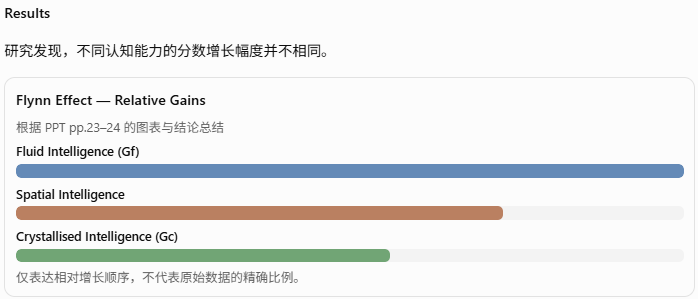
What is the Flynn effect, and which abilities show the greatest gains?
A historical rise in standardised IQ test scores, with gains generally greatest for Gf, then spatial ability, then Gc.
Why does the Flynn effect require IQ tests to be re-normed?
Population test performance changes over time, so age-based norms must be updated for meaningful comparisons.
What are the proposed explanations for the Flynn effect?
Environmental changes such as schooling, nutrition, technology and modernisation, especially greater familiarity with abstract thinking.
History of Hot Intelligence
Thorndike:理解他人并在人际关系中明智行动。
Moss & Hunt、Vernon:理解他人的感受、情绪和动机。
Wechsler:将一般智力应用到社会情境。
Gardner:Interpersonal 与 Intrapersonal intelligences。
How do cool and hot intelligence differ?
Cool: logical, analytical, emotionally neutral processing. Hot: processing emotional, social and personally significant information.
Goleman's Mixed Model
Component | 中文 | 含义 |
|---|---|---|
Self-awareness | 自我觉察 | Recognising your own emotions |
Self-regulation | 自我调节 | Managing emotions and impulses |
Motivation | 动机 | Using emotions to pursue goals |
Empathy | 同理心 | Understanding others' emotions |
Social skills | 社交技能 | Managing relationships effectively |
Mixed-models of EI
Definition: EI is a combination of personality traits, emotional competencies and social skills.
Mixed-model 不认为 EI 只是一种单纯的认知能力,而是把多种心理和行为特质结合起来。
主要包括:
Personality(人格特质),例如 Optimism
Emotional competencies(情绪能力),例如 Self-awareness、Empathy
Social skills(社会技能),例如 Relationship management
What is emotional intelligence (EI)?
The ability to recognise, understand, manage and use emotions effectively in oneself and others.
What are the five components of Goleman's mixed model?
Self-awareness, self-regulation, motivation, empathy and social skills.
Ability Model of EI(能力模型)
Definition: Emotional intelligence is a form of intelligence involving the processing of emotional information.
Ability model 将 EI 视为一种真正的心智能力,强调一个人是否能够准确地处理情绪信息。
例如,你是否能够根据他人的面部表情正确判断其情绪?
这与 Mixed model 中评价自己是否有同理心并不一样。
Mixed-models of EI(混合模型)
Definition: EI is a combination of personality traits, emotional competencies and social skills.
Mixed-model 不认为 EI 只是一种单纯的认知能力,而是把多种心理和行为特质结合起来。
主要包括:
Personality(人格特质),例如 Optimism
Emotional competencies(情绪能力),例如 Self-awareness、Empathy
Social skills(社会技能),例如 Relationship management
Assessment Methods: ability model and mix model
Mixed-model EI | Ability-model EI | |
|---|---|---|
中文 | 混合模型 | 能力模型 |
Core idea | Personality + emotional competencies + social skills | Emotional information-processing ability |
Assessment | Self-report | Performance-based tests |
Examples | Goleman, Bar-On EQ-i | Mayer-Salovey-Caruso |
Test | 评价自己的情绪能力 | 完成有实际表现要求的情绪任务 |
Mixed-model self-report:
问卷可能让你评价:“I understand other people's emotions well.”
也就是让你自己判断自己是否善于理解他人情绪。
Ability-model performance test:
给你一张人物表情图片,让你识别这个人最可能处于什么情绪状态。
前者评估一个人对自身情绪能力的看法,后者试图直接测试情绪信息处理表现。
因此,Self-report 不等于 Performance-based assessment。
How do mixed and ability models of EI differ in definition and assessment?
Mixed EI combines traits and competencies, assessed by self-report. Ability EI measures emotional processing using performance-based tests.
What are the four branches of ability EI?
Perceiving emotions, using emotions to facilitate thinking, understanding emotions, and managing emotions.
Ability EI as a Causal System
Step 1 — Perceiving Emotions
你发现对方沉默、表情沮丧,识别出他的情绪。
Step 2 — Understanding Emotions
你理解他是因为考试失败而失望,同时可能感到焦虑。
Step 3 — Managing Emotions
你选择适当的方式帮助他处理情绪,例如提供支持,而不是立即批评他。
Step 4 — Using Emotions
你们利用对情绪的认识,选择更适当的沟通方式或解决问题的方法。
最重要的是,这不是一个必须严格依次完成的四阶段流程,而是一个相互联系的系统。
例如,一个人如果不能准确识别情绪,就可能难以理解或管理这些情绪,也更难有效运用情绪信息。
这就是为什么老师称之为 Causal system(因果系统)。
How do the components of ability EI interact as a causal system?
perceiving, understanding and managing emotions interact to support the effective use of emotions.
MacCann et al. — EI & Academic Performance, Schutte et al. — EI & Health, Sánchez-Álvarez et al. — EI & Subjective Well-being
Subjective Well-being (SWB):主观幸福感。
研究发现:
Higher EI was associated with higher subjective well-being.而 Mixed EI tests 是 SWB 更强的预测指标。
Schutte et al. — EI & Health
Higher EI was associated with better mental and physical health.较高的 EI 与更好的心理和身体健康相关。
Mixed EI measures showed stronger associations with mental health than ability EI measures.也就是 Mixed EI 的测量结果与心理健康表现之间的关联更强。
MacCann et al. — EI & Academic Performance
EI is an important predictor of academic performance beyond cognitive intelligence.
为什么 EI 可能影响学业表现?
例如,一个人可能具有很好的认知能力,但如果考试焦虑很严重,或者无法管理学习压力,那么他的实际表现可能受到影响。
这属于合理的机制解释,但不能单凭相关性认定 EI 是直接原因。
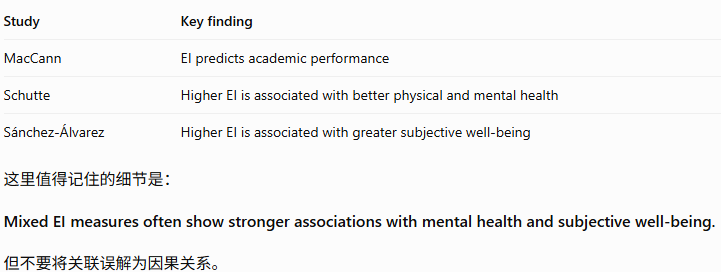
What did MacCann's meta-analysis find about EI and academic performance?
EI was an important predictor of grades, after cognitive intelligence and conscientiousness.
How is EI related to health and subjective well-being?
Higher EI is associated with better health and well-being; mixed EI measures often show stronger associations.
What are the three components of Sternberg's Triarchic Theory?
Analytical: logical reasoning. Creative: novelty and innovation. Practical: solving everyday problems.
Analytical Intelligence(分析智力)The ability to solve problems using logical reasoning and analysis.主要体现在逻辑分析、推理和学业任务中。传统 IQ tests 主要测量这一方面的能力。例如,解决逻辑题、数学题或分析复杂问题。
Creative Intelligence(创造智力)The ability to deal with novel situations using imagination, inventiveness and insight.即应对新情境、提出创新想法及创造解决方案的能力。例如,面对一种从未遇到过的问题,能够设计出新的解决方法。
Practical Intelligence(实践智力)Definition: The ability to solve everyday problems by adapting to, shaping and selecting environments.也被称为 Street smarts(生活智慧或处世能力)。
Practical vs Analytical 的考试陷阱
一个人获得很高的 IQ 分数,不代表他一定能很好地应对工作、人际关系和现实生活中的复杂问题。
Sternberg 强调,Intelligence 比传统学业能力更加广泛。例如,一个人虽然不擅长考试,但非常善于解决现实工作中的突发问题。
How does adaptive intelligence involve adapting to, shaping and selecting environments?
It involves adjusting to an environment, changing it, or choosing a more suitable one to function effectively.
Wisdom
Wisdom(智慧)Using abilities and knowledge for the common good while balancing different interests and applying positive ethical values.
即使用能力和知识,为共同利益(Common good)作出明智的决策,同时考虑个人、他人和更广泛社会的利益。
What is a major limitation of Sternberg's theory?
The lack of widely accepted standardised tests, particularly for adaptive intelligence and wisdom.
例如,如何通过客观、可靠的方式测量 Wisdom?
不同文化和社会环境对于何为明智的决定可能有不同看法,因此难以制定统一的标准化测量方法。