9.3 Electron Configurations: How Electrons Occupy Orbitals
 Call Kai
 Learn
 Practice Test
 Spaced Repetition
 Match
 Flashcards
 Knowt Play
1/37

There's no tags or description
Looks like no tags are added yet.
38 Terms
electron configuration
notation that shows the particular orbitals that are occupied by electrons in an atom

ground state
lowest energy state in an atom, ion, or molecule
ground
All electron configurations depict the atom in ______ state unless otherwise specified.
lowest
Electrons generally occupy the ______ (lowest/highest) energy orbitals available.
orbital diagram
diagram that gives information similar to an electron configuration but symbolizes an electron as an arrow in a box representing an orbital, with the arrow’s direction denoting the electron’s spin

spin
In an orbital diagram, the direction of the arrow represents the orientation of the electron’s ____.
50
In a collection of hydrogen atoms, the electrons in about __% of the atoms are spin up and the electrons in _% are spin down.
Pauli exclusion principle
principle that no two electrons in an atom can have the same four quantum numbers
2
By the Pauli exclusion principle, since two electrons occupying the same orbital have three identical quantum numbers (n, l, and ml), they must have different spin quantum numbers. Thus, the principle implies that each orbital can have a maximum of only __ electrons, with opposing spins.
degenerate
a term describing two or more electron orbitals with the same value of n that have the same energy (e.g. 3s, 3p, 3d orbitals in hydrogen atom)
n
In the hydrogen atom, the energy of an orbital depends only on _.
l, split
The orbitals within a principal level of a multielectron atom are not degenerate—their energy depends on the value of_. The energies of the sublevels are _____.
lower
In general, the lower the value of l within a principal level, the ______ (lower/higher) the energy (E) of the corresponding orbital. Thus, for a given value of n: E(s orbital) < E(p orbital) < E(d orbital) , E(f orbital)
electron spatial distribution: Coulomb’s law, shielding, penetration
Why does sublevel energy splitting occur in multielectron atoms?
Coulomb’s law
a scientific law stating that the potential energy (E) between two charged particles is proportional to the product of the charges q1 and q2 divided by the distance r that separates the charges

E = (1/4πε0)(q1q2/r)
Coulomb’s law equation
positive, farther apart
conclusions of Coulomb’s law
For like charges, the potential energy (E) is _________ (positive/negative) and decreases as the particles get _______________ (closer together/farther apart). Since systems tend to lower potential energy, like charges repel each other.
negative, closer together
conclusions of Coulomb’s law
For opposite charges, the potential energy (E) is _________ (positive/negative) and becomes more negative as the particles get _______________ (closer together/farther apart). Therefore, opposite charges attract each other.
increases
conclusions of Coulomb’s law
The magnitude of the interaction between charged particles __________ (increases/decreases) as the charges of the particles increase.
shielding
effect on an electron of repulsion by electrons in lower-energy orbitals that screen it from the full effects of nuclear charge
effective nuclear charge (Zeff)
actual nuclear charge experienced by an electron, defined as the charge of the nucleus plus the charge of the shielding electrons
penetration
phenomenon of some higher-level atomic orbitals having significant amounts of probability within the space occupied by orbitals of lower energy (e.g. the 2s orbital penetrates into the 1s orbital)
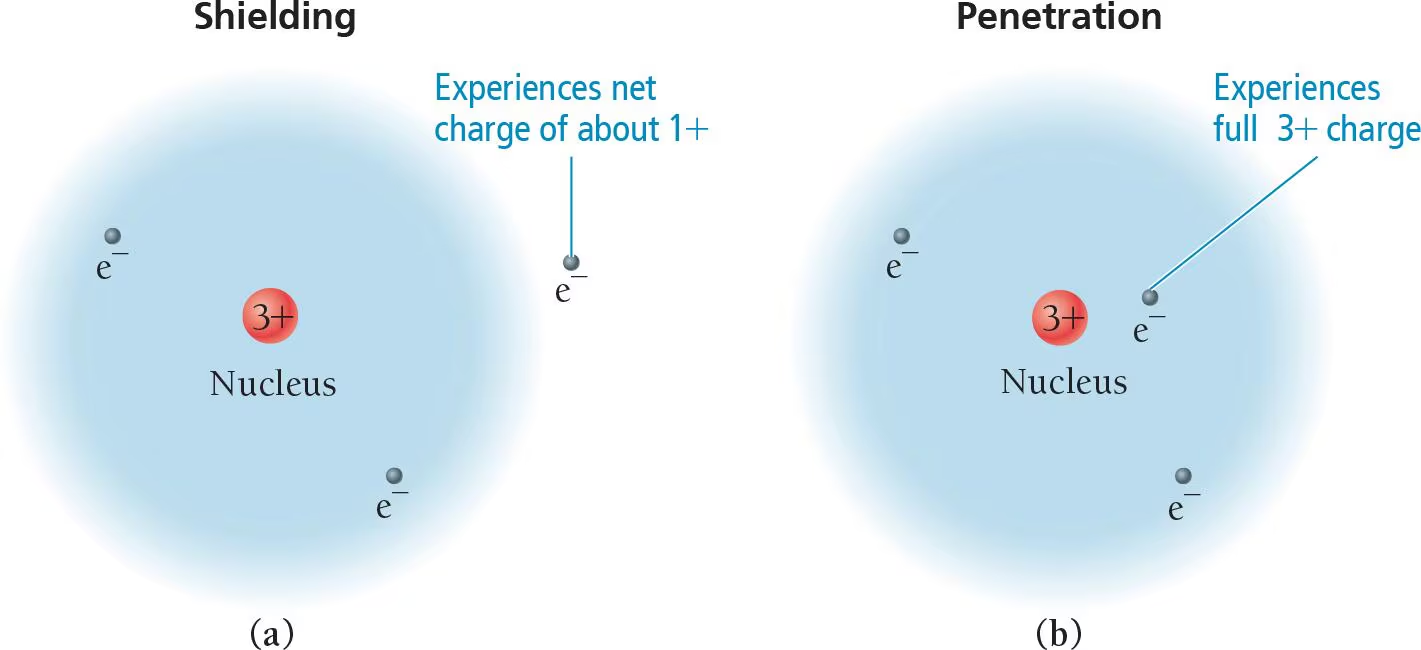
greater, lower
As the outer electron undergoes penetration into the region occupied by inner electrons, it experiences a _______ (lesser/greater) nuclear charge and therefore (according to Coulomb’s law) a ______ (lower/higher) energy.

penetrates
Despite an electron in a 2p orbital having a greater probability of being found closer to the nucleus than an electron in a 2s orbital, the 2s orbital is actually lower in energy (only when the 1s orbital is occupied) because a significant probability of the 2s orbital ___________ into the 1s orbital to experience more nuclear charge.

s, p, d
The ___ orbitals penetrate more fully than the ___ orbitals, which in turn penetrate more fully than the ___ orbitals.

are not
Because of penetration, the sublevels of each principal level ________ (are/are not) degenerate for multielectron atoms.
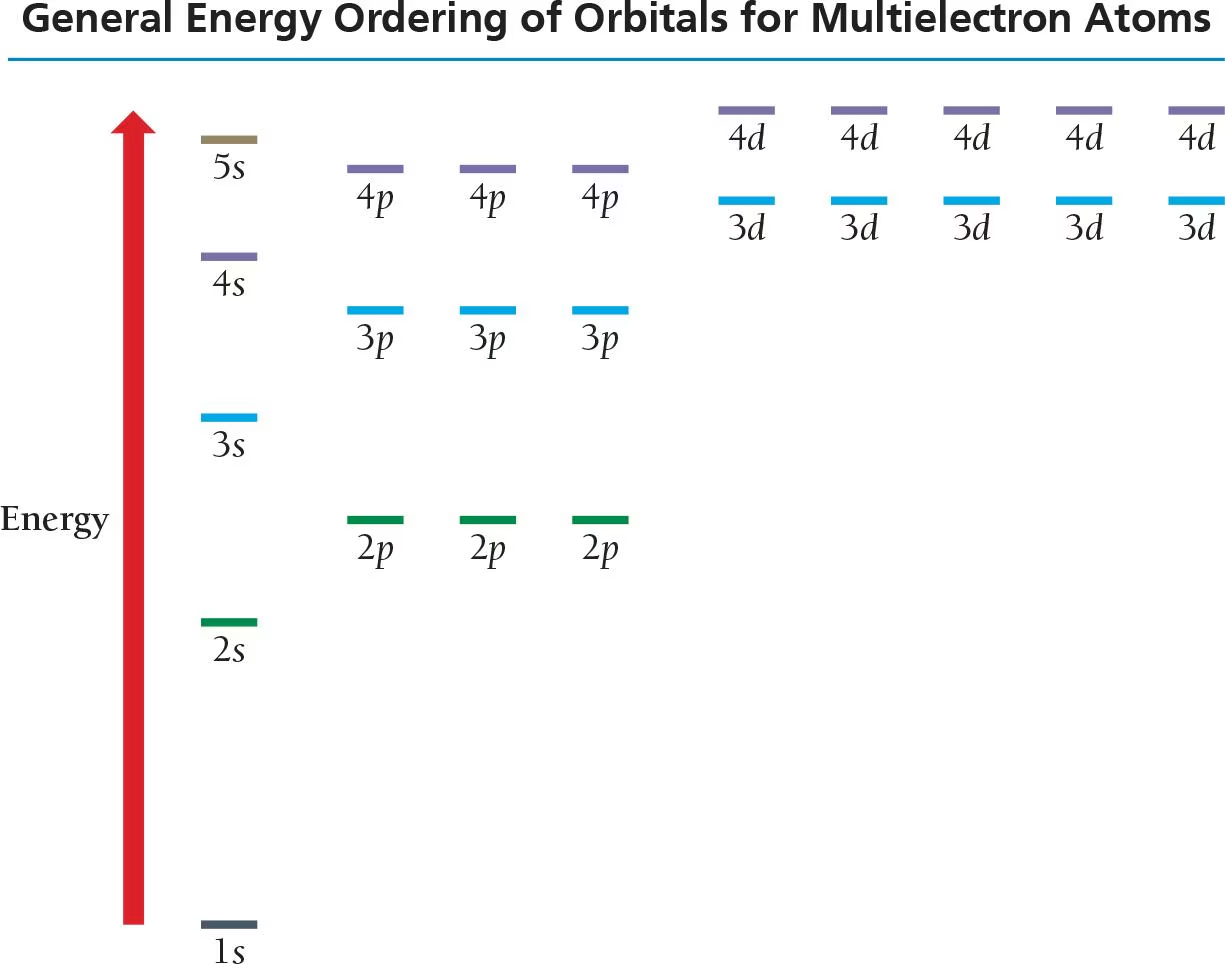
lower
In the fourth and fifth principal levels, the effects of penetration become so important that the 4s orbital lies ______ (lower/higher) in energy than the 3d orbitals and the 5s orbital lies ______ (lower/higher) in energy than the 4d orbitals.

smaller, can
The energy separations between one set of orbitals and the next become _______ (smaller/larger) for 4s orbitals and beyond, and the relative energy ordering of these orbitals ___ (can/cannot) vary among elements, resulting in irregularities in electron configurations of transition metals and their ions.

aufbau principle
the principle that indicates the pattern of orbital filling in an atom from lowest to highest energy
Hund’s rule
principle stating that when electrons fill degenerate orbitals, they first fill them singly with parallel spins
lower
Hund’s rule occurs as a result of an atom’s tendency to find the lowest energy state possible: when 2 electrons occupy separate orbitals of equal energy, repulsive interaction between them is ______ (lower/higher) than when they occupy the same orbital due to being more spread out over different regions of space.
minimizes
Electrons with parallel spins have correlated motion that _________ (minimizes/maximizes) their mutual repulsion.
lower, higher
Electrons occupy orbitals so as to minimize the energy of the atom; therefore, _____ (lower/higher)-energy orbitals fill before _____ (lower/higher)-energy orbitals.
inner electron configuration
electron configuration of the previous normal gas, can be abbreviated by placing the symbol for the noble gas in square brackets (e.g. [Ne])
s, 2
The ___ sublevel has only 1 orbital and can therefore hold ___ electrons.
p, 6
The ___ sublevel has 3 orbitals and can therefore hold ___ electrons.
d, 10
The ___ sublevel has 5 orbitals and can therefore hold ___ electrons.
f, 14
The ___ sublevel has 7 orbitals and can therefore hold ___ electrons.