PSY389 Lecture 13: Cognitive Processes, Self-Management and Self-Regulation
 Call Kai
 Learn
 Practice Test
 Spaced Repetition
 Match
 Flashcards
 Knowt Play
1/10

There's no tags or description
Looks like no tags are added yet.
11 Terms
Cognitive Processes
• Outcome expectancies (about drugs)
• Self-efficacy
• Self-regulation
• The importance of cognitive processes in understanding drug use behaviour and in treatment program
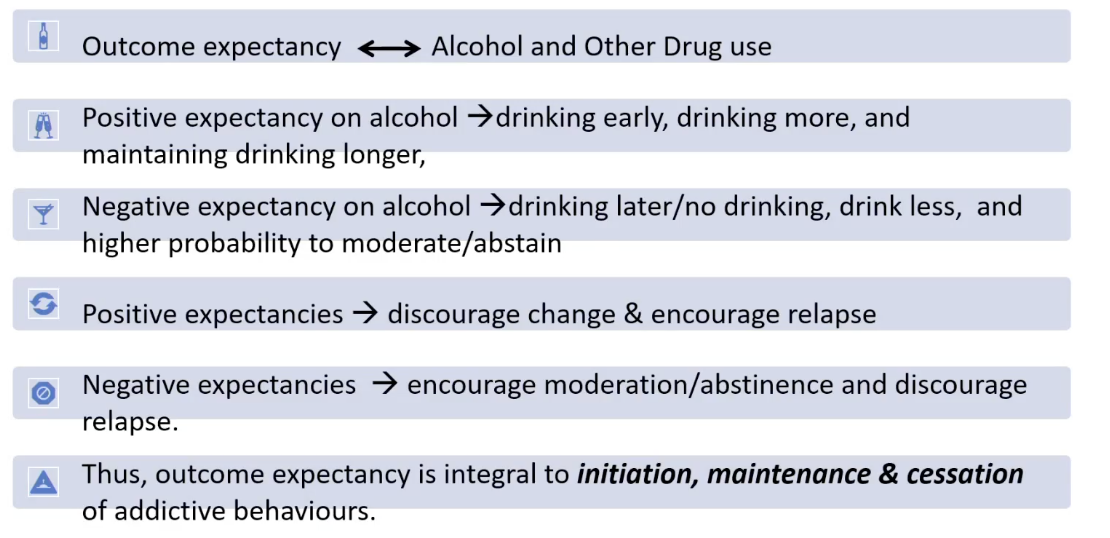
Outcome Expectancies
An anticipated outcome or consequence of a given behaviour (e.g., drug use), which is either positive or negative.
Self-efficacy (Bandura, 1999)
A conviction that one can execute a behaviour to produce a desired response (e.g. I can stop using drugs)
• Individuals with high → cope better with threatening/high risk situations than those with lower.
• depends on attributing success to self, not others
• grows when one overcomes challenges
• is important in maintaining a behaviour (avoiding relapse, maintaining abstinence)
• Thus, low (giving up easily) →more likely to relapse.
• needs to be moderate & realistic
• Too much may hinder treatment
Self-efficacy and Treatment Implications
Programs need to:
• Provide opportunities for building self-efficacy
• Teach skills for coping/managing high risk situations, planning and problem solving
• Focus on personal success rather than failures
• Attribute success to self and failure to environment or others
Self-regulation
Most human behaviours are learnt (e.g., driving, playing tennis, drug use) acquired by self-regulation.
To change a behaviour (e.g., practising parallel parking, tennis shots), self-regulation begins again
One needs to self-monitor oneself by interrupting the automaticity to self-control
One then compares one’s behaviour with the target goal
If goal is achieved then maintain the behaviour in the long-term (self-manage), and self-reward oneself for that achievement.
Think of drug use as a ‘skill’, which becomes automatic over time
To moderate/abstain, one needs to switch from automatic to control mode (selfcontrol), which requires self monitoring, self-management and self-regulation.
Self-Control (Kanfer’s Model of Self-control)
Occurs when:
costs and benefits of behaviour are about equal
prior to occurrence of behaviour, the individual does something to change its probability
Individual believes that behaviours are not controlled by environment, but self.
Behaviours requiring self control include addictive behaviours (e.g., eating, drug use, gambling, sex, internet gaming, social media) as they:
provide immediate gratification (are thus difficult to control)
are accompanied by a strong desire to indulge
induce discomfort when stopped.
Self-Regulation
Kanfer suggests that instead of being controlled by environmental events, an individual can change their own behaviour by:
monitoring their behaviour
controlling their own responses (by decreasing probability of behaviour or displacing the behaviour with more desirable behaviours).
Setting goal.
These 3 steps must be involved in self-regulation.
Ability to regulate oneself is related to:
self-efficacy (appraisal that new behaviour is possible for the individual), and
outcome expectancy (new behaviour is likely to produced desired outcome).
If one or more feasible courses of actions are found then the individual weighs up costs & benefits before choosing. Then, the individual checks progress of discrepancy.
Dependence/Addiction is a breakdown of this self regulatory mechanism or behaviours that require self control
Examples of ‘self-talk’ (Ludwig’s Self-Talk Framework)
May help self-regulation.
An internal, verbal conversation with oneself which may influence behaviour.
Some examples of Self-talk for alcohol dependence individuals
“Every time I get the urge to drink, I immediately think of being sick, vomiting, shakes and being miserable”
“I am a damn fool to drink, so I am not going to take a chance. For the simple reason that I got too much at stake. I have a new home now. I’ve got a wife and family – and one drink stands between me and all that.”
“I can stay sober if I want to. It’s my decision. A man has a responsibility, and he’s got to face it. A man has control over everything”
“I am really an alcoholic. I can’t really handle it. One drink is all it takes”
Stages of Self-Regulation (Miller & Brown, 1991)
1. Information input recognise that a behaviour (drug use) is problematic and that a change is required.
2. Self evaluation monitor current progress towards a personal goal
3. Instigation of change when discrepancy is detected, shift from automatic to controlled processing & re-formulate goal(s).
4. Search- search for alternative courses/actions to reduce discrepancy.
5. Planning-consider alternatives and choose best option, and develop a plan
6. Implementation - work according to the plan
7. Plan-evaluation-re-evaluate plan
SELF REGULATORY DEFICITS
1) Information input (e.g., insensitive to internal cues)
Treatment: self-monitoring, recognising cues
2) Self-valuation (e.g., positive expectancies, strongly motivated by external cues)
Treatment: education, feedback, cue exposure
3) Instigation to change (e.g., perseverate despite discrepancy)
Treatment: motivate change, and emphasise personal choice and control
4) Search (e.g., unable to search for alternative actions, poor coping skills, low self-efficacy)
Treatment: teach coping skills and relapse prevention
5) Planning deficits (e.g., unable to plan and make decision)
Treatment: teach planning and problem solving skills
6) Implementation deficits (e.g., unable to implement new actions, attention deficits, poor coping skills)
Treatment: teach self-control, coping, social skills and stress management
7) Plan-evaluation (e.g., impaired self-monitoring)
Treatment: follow-up interviews and progress monitoring
SELF MANAGEMENT TREATMENT
1. Self-Management treatment assumes that client:
a) genuinely seeks help,
b) is motivated to change,
c) Is committed to treatment,
d) Takes responsibility for one’s own behaviour and well-being
2. Self-management treatment requires client to engage in change because only the client can change their own behaviours.
3. Change program does not remove one’s difficulty but provides set of new skills.
4. Change requires development of motivation & goals, acquiring relevant skills and applying them