OMFPR 17 - Non-Plaque Induced Perio Diseases (Dr. Lerman)
 Call Kai
 Learn
 Practice Test
 Spaced Repetition
 Match
 Flashcards
 Knowt Play
1/89

There's no tags or description
Looks like no tags are added yet.
90 Terms
normal
Normal epithelium or epithelium with gingivitis?

gingivitis
Normal epithelium or epithelium with gingivitis?

Spongiotic gingivitis
What disease was first described in 2007 and formerly called "Localized Juvenile Spongiotic Gingiva Hyperplasia"?
Spongiotic gingivitis
What condition is the following?
- Not plaque-related
- Now recognized to develop multi-focally and in adults (20%)
- Fails to respond to improved oral hygiene
- Isolated patch of irritated junctional epithelium?
Spongiotic gingivitis
These are clinical findings of what?
- Small bright red velvety papillary alteration
- Often bleeds easily
- Can involve interproximal areas
- Can be sessile or pedunculated
maxillary facial gingiva
80% of spongiotic gingivitis affect what region?
Pyogenic granuloma or squamous papilloma
What is spongiotic gingivitis often mistaken for?
Spongiotic gingivitis
What condition?
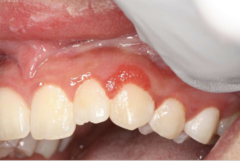
Spongiotic gingivitis
What condition?
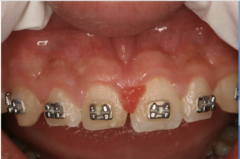
Spongiotic gingivitis
What condition?

Spongiotic gingivitis
What condition?

Spongiotic gingivitis
Which condition has this histology?
- Variably hyperplastic with papillary surface
- Prominent intercellular edema and exocytosis

- Conservative excision (scalpel or laser)
- Elimination also documented with cryotherapy
- Inconsistent response to corticosteroids
- Potential for spontaneous resolution
What is the treatment for spongiotic gingivitis?
6-28%
What is the recurrence range for spongiotic gingivitis?
plasma cell gingivitis
What condition?
- Atypical gingivostomatitis
- Distinctive pattern first seen during the late 1960s related to chewing gum component
plasma cell gingivitis
These are clinical signs of what condition?
-Rapid onset; sore mouth, intensified by toothpastes or hot/spicy foods
- Free and attached gingiva enlarged with bright erythema and loss of normal stippling
- Lips or tongue may be involved
plasma cell gingivitis
Patient recently switched toothpastes and now presents with this. What condition do you suspect?
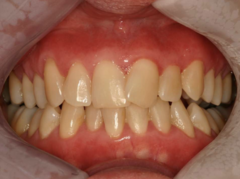
plasma cell gingivitis
What condition?

plasma cell gingivitis
What condition?

plasma cell gingivitis
What condition?

plasma cell gingivitis
Which condition has this histology?
- Psoriasiform hyperplasia, spongiosis, intense exocytosis, and neutrophilic microabscesses
- Dilated vascular channels
- Plasma cell infiltrate

plasma cell gingivitis
Which condition has this histology?

- Dietary history
- Allergy testing
- - Elimination diet may be necessary
- Steroids
- - Rinse (dexamethasone)
- - Gel (fluocinonide or clobetasol)
What is the treatment of plasma cell gingivitis?
Foreign body gingivitis
These are clinical signs of what condition?
- Female predilection
- Mean age 50
- Focal gingival erythema, sometimes associated with leukoplakia
Foreign body gingivitis
What condition?
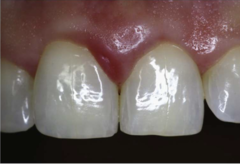
Foreign body gingivitis
What condition?

Foreign body gingivitis
Which condition has this histology?
- Well-formed granulomas with epithelioid histiocytes and multinucleated giant cells
- Epithelial atrophy in red variant
- Hyperorthokeratosis with or without dysplasia in white variant

Surgically excise foreign material
What is the treatment for foreign body gingivitis?
NO - it is a clinical description NOT a definitive diagnosis
Is desquamative gingivitis a diagnosis?
desquamative gingivitis
What is a clinical term to describe a manifestation of what is usually lichen planus, a hypersensitivity reaction, or mucous membrane pemphigoid?
desquamative gingivitis
What is gingiva that demonstrates superficial peeling of epithelium characterized by the formation and rupture of mucosal vesicles?
desquamative gingivitis
These are clinical signs of what condition?
- Most > 40-year-old female
- Diffuse, markedly erythematous gingiva
- Generally involves attached tissues
- Sensitivity to spicy foods
- Chronic onset
- Multifocal or generalized pattern
- Smooth erythema
- Vesicle/bulla formation filled with clear fluid or blood
- Areas of erosion
- Significant pain
- Nikolsky sign
Nikolsky sign (Manipulation of the affected area with object or compressed air can result in sloughing)
What can help identify desquamative gingivitis clinically?
desquamative gingivitis
What condition?

desquamative gingivitis
What condition?

desquamative gingivitis
What condition?

desquamative gingivitis
What is the erythematous patch?

desquamative gingivitis
What condition?

desquamative gingivitis
What condition?

desquamative gingivitis
What condition?

desquamative gingivitis
What condition?

- Biopsy mandatory for definitive diagnosis
- Perilesional incisional biopsy and direct/indirect immunofluorescence to confirm diagnosis
What is the treatment for desquamative gingivitis?
drug-related gingival hyperplasia
What condition?
- Abnormal growth of gingival tissues secondary to systemic medication
- Two concurrent medications can exacerbate hyperplasia
- Amount of hyperplasia correlated with level of oral hygiene and susceptibility
anticonvulsants
These are some examples of what type of medication that are associated with gingival hyperplasia?
- Carbamazepine
- Ethosuximide
- Ethotoin
- Felbamate
- Mephenytoin
- Methsuximide
anticonvulsants
These are some examples of what type of medication that are associated with gingival hyperplasia?
- Phenobarbital
- Phensuximide
- Phenytoin
- Primidone
- Sodium valproate
calcium channel blockers
These are some examples of what type of medication that are associated with gingival hyperplasia?
- Amlodipine
- Bepridil
- Diltiazem
- Felodipine
- Nicardipine
- Nifedipine
- Nimodipine
- Nitrendipine
- Verapamil
true
T/F: Cyclosporin, erythromycin and some oral contraceptives can cause gingival hyperplasia
drug-related gingival hyperplasia
What condition?
- Young more common
- Enlargement commences after 1-3 months
- Spreads from interdental area > anterior and facial surfaces
- Usually spares edentulous areas unless under major connector
- Firm, normal color, smooth, stippled or granular OR inflamed with dark red, edematous,
friable surface, bleeds easily
- Occasionally ulcerated
anterior and facial surfaces
Where is the more common locations for drug-related gingival hyperplasia to occur?

drug-related gingival hyperplasia
What condition?

drug-related gingival hyperplasia
What condition?

drug-related gingival hyperplasia
What condition?

drug-related gingival hyperplasia
What condition?
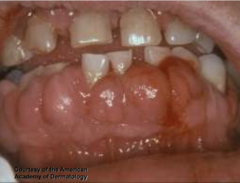
drug-related gingival hyperplasia
What condition?

drug-related gingival hyperplasia
What condition?

drug-related gingival hyperplasia
What condition?

drug-related gingival hyperplasia
What condition?

drug-related gingival hyperplasia
What condition has this histopathology?
- Elongation of rete ridges into lamina propria
- Increased collagen and extracellular matrix material

- Discontinue medication or substitute an alternative drug
- If medication cannot be altered:
- - Plaque control
- - Scaling
- - Gingivectomy
- - Chlorhexidine rinse
What is the treatment of drug-related gingival hyperplasia?
- "ANUG"
- "NUG"
What was necrotizing gingivitis formerly known as?
necrotizing gingivitis
What condition?
- Distinctive pattern of gingival pathology recognized for more than 100 years
- Frequently occurs in presence of psychological stress
necrotizing gingivitis
What infection frequently occurs in the presence of psychologic stress (increased frequency in military personnel-esp. in WW1)?
necrotizing gingivitis
These are clinical signs of what condition?
- Young to middle-aged adults
- Blunted interdental papillae
- Punched-out, crater-like necrosis
- Fetid odor, exquisite pain
- Spontaneous hemorrhage
- Occasional lymphadenopathy, fever, and malaise
necrotizing gingivitis
What condition?
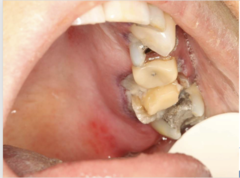
necrotizing gingivitis
What condition?

necrotizing gingivitis
What condition?

necrotizing gingivitis
What condition?

necrotizing gingivitis
Which condition has this histology?
- Nonspecific ulceration, inflammation, necrotic material, and bacteria
- Debridement with local anesthetic
- Rinses (Chlorhexidine, warm salt water, diluted hydrogen peroxide)
- Antibiotics if febrile (Metronidazole or penicillin)
What is the treatment of necrotizing gingivitis?
autosomal recessive
Papillon-Lefevre syndrome has what type of genetic inheritance pattern?
cathepsin C, 11
Papillon-Lefevre syndrome is caused by a point mutation of what gene on what chromosome?
- Periodontitis (Defects in neutrophil function and immune-mediated mechanisms)
- Palmoplantar keratoses
What oral and dermatologic manifestations does Papillon-Lefevre syndrome have?
Papillon-Lefèvre Syndrome
What condition has these clinical features?
- Prevalence= 1-4 per million
- - 2-4 per thousand carriers
- Skin findings manifest by age 3-4
- - Palmar-plantar keratosis spreads to dorsal surfaces
- - White, yellow, brown, or red plaques and patches develop crusts, cracks, or fissures
- Rare infections or calcification of falx cerebri/choroid plexus
both!
In Papillon-Lefevre syndrome, periodontitis is present in deciduous or permanent dentition?
Papillon-Lefèvre Syndrome
What condition has these clinical features?
- Develops soon after eruption of teeth
- Hyperplastic and hemorrhagic gingivitis
- Loss of periodontal attachment
- Mobility, migration, and exfoliation of teeth
Destruction of alveolar bone with radiographic appearance of teeth "floating-in-air"
What is a key feature of Papillon-Lefèvre Syndrome radiographically?
Aggregatibacter actinomycetemcomitans (A.A.)
What bacteria is associated with periodontal destruction of Papillon-Lefèvre Syndrome?
Oral manifestations of Papillon-Lefèvre Syndrome
What does this flow chart show?

Papillon-Lefèvre Syndrome
What condition?
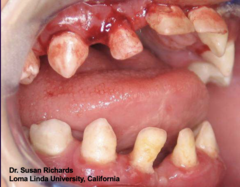
Papillon-Lefèvre Syndrome
What condition?

Papillon-Lefèvre Syndrome
What condition?

Papillon-Lefèvre Syndrome
What condition?

Papillon-Lefèvre Syndrome
What condition?

Papillon-Lefèvre Syndrome
What condition?

Papillon-Lefèvre Syndrome
What condition?

Haim-Munk syndrome
What condition?
- Similar to Papillon-Lefèvre
- Skin manifestations are more severe
- Periodontal disease is milder
- Palmoplantar keratosis, progressive recurrent periodontal disease, recurrent skin infections, and skeletal malformations
- Exhibits mutation of cathepsin C gene
cathepsin C
Haim-Munk syndrome has a mutation of what gene?
Keratoderma palmoplantar of Unna-Thost/ Meleda disease
What disease has similar cutaneous manifestations as Papillon-Lefevre syndrome in the absence of periodontal disease?
Papillon-Lefèvre Syndrome
Which condition has this histology?
- Non-specific findings similar to those of chronic periodontitis
- - Hyperplastic epithelium with exocytosis
- - Vascular connective tissue with mixed inflammatory cell infiltrate
- Skin lesions treated with retinoids
- Periodontal disease treated with...
- - Extraction of primary teeth
- - Antimicrobial clearance of A.A. with amoxicillin and metronidazole
What is the treatment of Papillon-Lefèvre Syndrome?