College Algebra Test #2
 Call Kai
 Learn
 Practice Test
 Spaced Repetition
 Match
 Flashcards
 Knowt Play
1/32

Earn XP
Description and Tags
Answer with terms
33 Terms
Polynomial Equations
An expression that has only whole number exponents and no variables in radicals or denominators.

Set the equation equal to 0
Factor
Polynomial equations steps
Radical Equations
An equation in which the variable occurs in the square root, cube root, or any higher root.

Isolated the term involving the radical on one side of the equation
Raise both sides of the equation to the nth power to eliminate the radical
Solve. If the equation contains a radical, repeat steps 1 and 2.
If we raise both sides of the equation by an even power, we MUST check the solutions. Extraneous solutions can occur.
How to solve radical equations

Isolate the expression with the rational exponent
Raise both sides of the equation to a power that is the reciprocal of the rational exponent.
If the denominator of the reciprocal is even, you must include the plus or minus symbol on the constant side. If it is odd, no plus or minus sign is needed.
How to solve equations with rational exponents
Absolute value
Denoted by | |, describes a number’s distance from zero on a number line

Isolate the term with absolute value bars.
Split the absolute value equation into two equations without absolute value bars.
If | u | = c, then u = c or u = -c
How to solve equations involving absolute value

() go with <, > symbols and indicate that the endpoint is NOT included
[ ] go with less/greater than or equal to symbols and indicate that the endpoint IS included
Plus or minus and infinity always use ()
Intervals always have the smallest value on the left and the largest value on the right
Rules for interval notation
Same as solving linear equations except when you multiply or divide by a negative number you MUST flip the inequality symbol
How to solve linear inequalities
Relation, domain, and range
Relation - set of ordered pairs
Domain - set of all x-values
Range - set of all y-values
Function
Special relation in which each element in the domain corresponds to exactly one element in the range.
The elements in the domain can’t repeat.
If the equation is solved for y and more than one value of y can be obtained for a given x, then the equation is not that of a function.
Vertical line test
If every vertical line running through the graph crosses only once, then the graph is a function
Domain - project the graph onto the x-axis (left to right)
Range - project the graph onto the y-axis (bottom to top)
How to find the domain and range on a graph
Relative maximum and relative minimum
The high and low points of a function.

Graph is folded along the y-axis and right and left sides match = symmetric with respect to the y-axis
Graph is folded along the x-axis and top and bottom sides match = symmetric with respect to the x-axis
Graph is rotated 180 degrees and the original graph appears = symmetric with respect to the origin
How to find symmetry
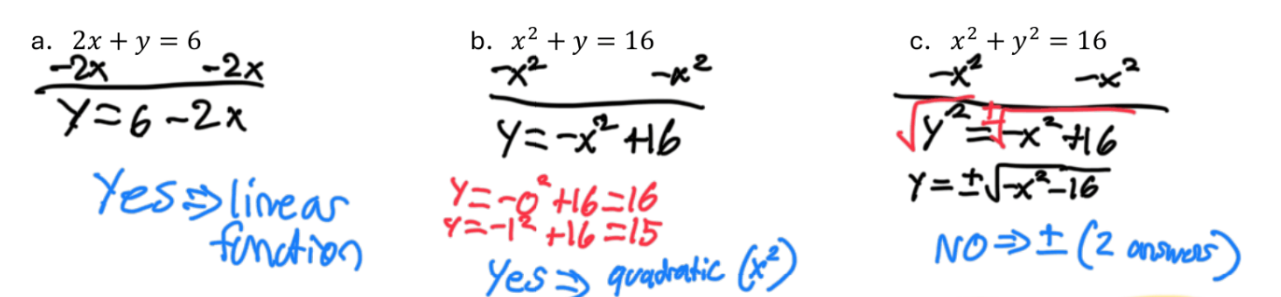
Test for y-axis symmetry = substitute -x for x
Test for x-axis symmetry = substitute -y for y
Test for origin symmetry = substitute both -x and -y for x and y
If the result is the original equation = symmetric
If an equation can be solved for y and more than one answer is given, it is NOT a function.
How to find symmetry in an equation
Exponents are odd = odd with symmetric to the origin
Exponents are even = even with symmetric to the y-axis
Exponents are both = no symmetry
How to find if functions are even and odd
Piecewise function
Function that is defined by two or more equations for different parts of the domain

f(x+h) - f(x) / h
Difference quotient

y2-y1 / x2-x1
Slope formula
Left to right
A line with a positive slope rises from…
Falls from left to right
A line with a negative slope….
horizontal
A line with a slope of 0 (m = 0) is
vertical
A line with an undefined slope is

y = mx + b
Slope-intercept form
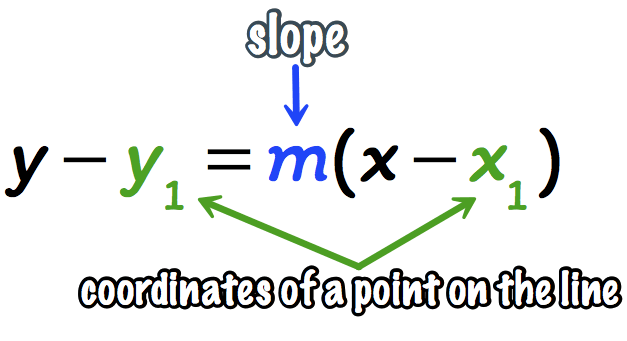
Point-slope form
same
Parallel lines have the ____ slope
opposite (negative reciprocals)
Perpendicular lines have slopes that are _____ of each other

Composition of f and g
All real numbers
The domain of a polynomial function is
All real numbers except for any number that makes the demoninator equal to 0
The domain of a rational function is
The set of x values that result in the radicand being greater than or equal to 0
The domain of a square root function is
Ax + By + C = 0
General form