13 - Glucose Metabolism
 Call Kai
 Learn
 Practice Test
 Spaced Repetition
 Match
 Flashcards
 Knowt Play
1/134

There's no tags or description
Looks like no tags are added yet.
135 Terms
primary fuel of the brain, in high demand
glucose
form glucose is stored in for plants
starch
form glucose is stored in for animals
glycogen
what is glycolysis
conversion of glucose to pyruvate
overall glycolysis equation

how many reactions in glycolysis? how many phases?
10 reactions, split into 2 phases
first phase of glycolysis rxns, name, what happens
reactions 1-5
energy investment phase
hexose is phosphorylated and cleaved in half
second phase of glycolysis rxns, name, what happens
reactions 6-10
energy payoff phase
three-carbon molecules are converted to pyruvate
glycolysis step 1 name
hexokinase reaction
what does hexokinase reaction look like
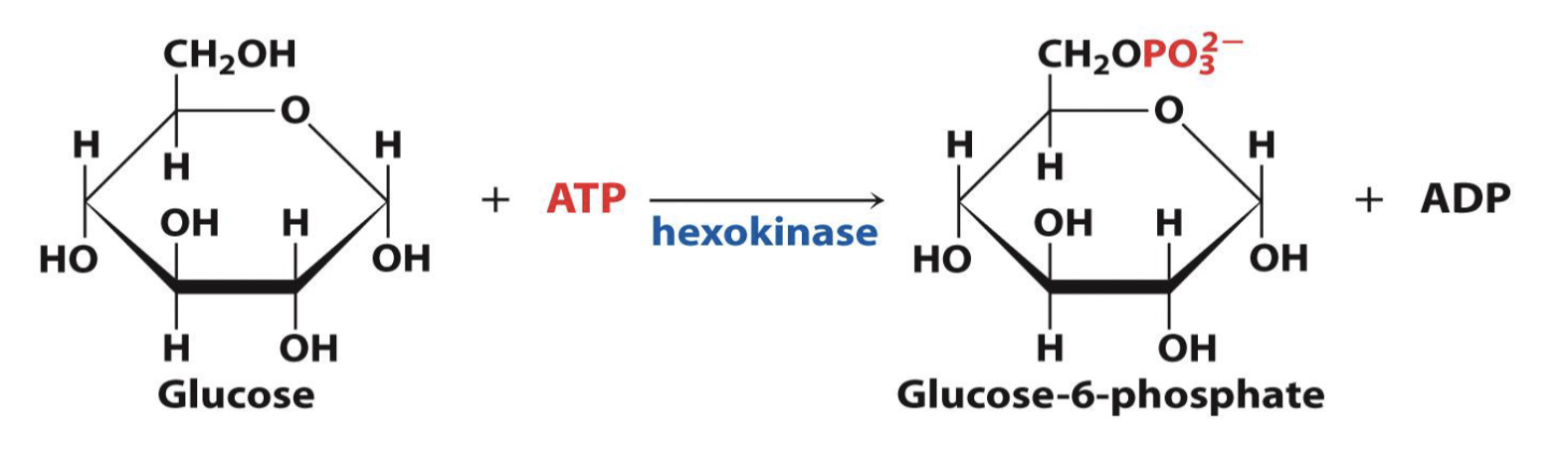
hexokinase reaction starting, ending compounds, how it gets there
glucose + ATP → glucose-6-phosphate + ADP
enzyme hexokinase transfers a phosphoryl group from ATP to the C6 OH group of glucose to form glucose-6-phosphate.
what is a kinase
an enzyme that transfers a phosphoryl group from ATP (or another nucleoside triphosphate) to another substance.
free energy change of hexokinase reaction
-16.7 kJ/mol
is hexokinase reaction reversible or irreversible?
metabolically irreversible → prevents glucose from backing out of glycolysis
glycolysis step 2 name
phosphoglucose isomerase reaction
what does phosphoglucose isomerase reaction look like

phosphoglucose isomerase reaction starting, ending compounds, how it gets there
glucose-6-phosphate → fructose-6-phosphate
via phosphoglycose isomerase
is phosphoglucose isomerase reaction reversible or irreversible, why
freely reversible → near-equilibrium reaction
free energy change for phosphoglucose isomerase reaction
2.2 kJ/mol but in vivo -1.4 kJ/mol → around 0, near equilibrium
glycolysis step 3 name
phosphofructokinase reaction
phosphofructokinase reaction starting, ending compounds, how it gets there
fructose-6-phosphate + ATP → fructose -1,6-biphosphate + ADP
via phosphofructokinase
is phosphofructokinase reaction reversible or irreversible
irreversible
what is free energy change for phosphofructokinase reaction
-17.2 kJ/mol
what compound activates phosphofructokinase (in mammals)? what does that do?
fructose-2,6-biphosphate
phosphofructokinase carries out step 3 of glycolysis to make fructose-1,6-biphosphate
in bacteria, how is phosphofructokinase activity regulated?
phosphoenolypyruvate (product of step 9) diminishes its catalytic activity, so when lots of phosphoenolpyruvate is being produced, it can act as a feedback inhibitor to slow down the pathway
citrate is also a feedback inhibitor
when is activity of phosphofructokinase-2 hormonally stimulated?
when the concentration of glucose in the blood is high
what does phosphofructokinase reaction look like

____ is the primary control point for glycolysis, why?
the phosphofructokinase reaction
slowest reaction of glycolysis therefore rate-determining reaction, and operates far from equilibrium (large negative free energy change)
the rate of the phosphofructokinase reaction can be altered by ___ but not by ___
allosteric effectors; fluctuations in the concentrations of its substrates or products
does kcat or Km indicate catalytic speed?
kcat
glycolysis step 4 name
aldolase reaction
aldolase reaction starting, ending compounds, how it gets there
fructose-1,6-biphosphate → dihydroxyacetone phosphate (& glyceraldehyde-3-phosphate)
via aldolase
what does aldolase reaction look like

aldolase reaction is the reverse of what kind of reaction? why does this matter?
it is the reverse of an aldol (aldehyde → alcohol) condensation
that’s why enzyme catalyzing reaction is called aldolase
under what conditions does the aldolase reaction actually occur, impact on free energy change
in vivo, delta G is actually less than zero (while technically it’s +22.8 kJ/mol) since products of the reaction are quickly whisked away by subsequent reactions
important aldolase residues
lysine forms a Schiffbase (imine) with the substrate
aspartate that acts as a base catalyst
cysteine residue
glycolysis step 5 name
triose phosphate isomerase reaction
triose phosphate isomerase reaction starting, ending products, how it gets there
dihydroxyacetone phosphate → glyceraldehyde-3-phosphate
via triose phosphate isomerase
triose phosphate isomerase is an example of a ____, why?
catalytically perfect enzyme; rate is limited only by the rate at which its substrates can diffuse to its active site
standard free energy change for triose phosphate isomerase reaction, why does reaction occur then?
it is slightly positive even under physio conditions (in vivo ~ +4.4 kJ/mol)
reactions proceeds because glyceraldehyde-3-phosphate is quickly consumed in the next reaction
what does triose phosphate isomerase reaction look like

ATP consumed/produced in energy investment & energy payoff
steps 1-5 consumed 2 ATP
steps 6-10 produces 4 ATP
net gain of 2 ATP
glycolysis step 6 name
GAP dehydrogenase reaction
GAP dehydrogenase reaction starting, ending products, how it happen
glyceraldehyde-3-phosphate + NAD+ + Pi → 1,3-biphosphoglycerate
via glyceraldehyde-3-phosphate dehydrogenase
GAP dehydrogenase reaction adds what to substrate?
inorganic phosphate
GAP dehydrogenase reaction is what kind of reaction, what happens?
oxidation-reduction reaction
glyceraldehyde-3-phosphate aldehyde group is oxidized and cofactor NAD+ is reduced to NADH
active site residue involved in GAP dehydrogenase reaction?
cysteine residue
is GAP dehydrogenase reaction reversible or irreversible
reversible
glycolysis step 7 name
phosphoglycerate kinase reaction
phosphoglycerate kinase reaction starting, ending materials, how it gets there
1,3-biphosphoglycerate + ADP → 3-phosphoglycerate + ATP
via phosphoglycerate kinase
free energy release of phosphoglycerate kinase reaction, and what it’s used for
large amount of free energy; used to drive formation of ATP as 1,3-biphosphoglycerate donates its phosphoryl group to ADP
phosphoglycerate kinase reaction looks like

glycolysis step 8 name
phosphoglycerate mutase reaction
phosphoglycerate mutase reaction starting, ending products, how it gets there
3-phosphoglycerate → 2-phosphoglycerate
via phosphoglycerate mutase
is phosphoglycerate kinase rev/irrev
reversible
is phosphoglycerate mutase reaction rev or irrev
reversible
phosphoglycerate mutase reaction what it looks like

phosphoglycerate mutase reaction mech requires enzyme active site that contains a ____
phosphorylated histidine residue
glycolysis step 9 name
enolase reaction
enolase reaction starting, ending materials, how it happens
2-phosphoglycerate → phosphoenolpyruvate + H2O
via enolase
enolase reaction enzyme active site includes ____, which can form a complex with ___ to inhibit the enzyme
Mg2+ ion; fluoride ion & Pi
enolase reaction what it looks like

glycolysis step 10 name
pyruvate kinase reaction
pyruvate kinase reaction starting, ending materials, how it gets there
phosphoenolpyruvate + ADP → pyruvate + ATP
via pyruvate kinase
2 steps of pyruvate kinase reaction
1) ADP attacks phosphoryl group of phosphoenolpyruvate to form ATP & enolpyruvate
2) tautomerization
what is tautomerization
isomerization through the shift of an H atom
which 3 of the 10 glycolysis reactions have large negative free energy changes
reactions catalyzed by hexokinase, phosphofructokinase, and pyruvate kinase
feed-forward activation
once a monosaccharide has entered glycolysis, fructose-1,6-biphosphate helps ensure rapid flux through the pathway
glycolysis reactions producing ATP
7 → phosphoglycerate kinase reaction
10 → pyruvate kinase
what substances can pyruvate be converted to
lactate
acetyl CoA
ethanol + CO2
oxaloacetate
which substance pyruvate is converted to depends on?
depends on the cell type and the need for metabolic free energy and molecular building blocks
During exercise pyruvate can be temporarily converted to
lactate (sort of metabolic dead end)
pyruvate in yeast
Regeneration of NAD+ via alcoholic fermentation
2 steps of alcoholic fermentation
First, pyruvate decarboxylase (an enzyme not present in animals) catabolizes the removal of pyruvate's carboxylate group to produce acetaldehyde.
Next, alcohol dehydrogenase reduces acetaldehyde to ethanol.
Pyruvate can be further oxidized and catabolized to___ via____
CO2 via intermediate of acetyl-CoA
pyruvate → acetyl CoA is substrate for __
citric acid cycle
acetyl CoA from pyruvate can be used to synthesize___
Fatty acids, the precursors of triacylglycerols and many membrane lipids, can be synthesized from the two-carbon units of acetyl-CoA derived from pyruvate
Pyruvate is also the precursor of ____, an intermediate in ____
oxaloacetate; the synthesis of amino acids.
oxaloacetate synthesized by action of ___?
pyruvate carboxylase
how is oxaloacetate synthesized by the action of pyruvate carboxylase?
The pyruvate carboxylase has a biotin prosthetic group that acts as a carrier of CO2. The biotin group is covalently linked to an enzyme lysine residue
what is gluconeogenesis
considered to be the reversal of glycolysis, that is, the conversion of two molecules of pyruvate to one molecule of glucose
gluconeogenesis used where/when?
used in liver to synthesize glucose; when all of liver’s glucose is exhausted, occurs in kidneys
which tissues rely on the liver to supply them with newly synthesized glucose
central nervous system and red blood cells, which burn glucose as their primary metabolic fuel
What enzymes play opposite role to pyruvate kinase, phosphofructokinase, and hexokinase?
Opposite to Hexokinase: Glucose-6-phosphatase
Opposite to Phosphofructokinase-1 (PFK-1): Fructose-1,6-bisphosphatase
Opposite to Pyruvate Kinase: Pyruvate carboxylase, Phosphoenolpyruvate carboxykinase
Pyruvate cannot be converted directly back to phosphoenolpyruvate because pyruvate kinase catalyzes an irreversible reaction, so how does this happen in gluconeogenesis?
pyruvate is carboxylated by pyruvate carboxylase to yield the four-carbon compound oxaloacetate.
Next, phosphoenolpyruvate carboxykinase catalyzes the decarboxylation of oxaloacetate to form phosphoenolpyruvate
pyruvate → oxaloacetate → phosphoenolpyruvate 2 reactions are energetically…? why?
costly
Pyruvate carboxylase consumes ATP, and phosphoenolpyruvate carboxykinase consumes GTP (which is energetically equivalent to ATP)
main sources of gluconeogenic precursors, why
Amino acids (except for leucine and lysine); they can all be converted to oxaloacetate
In mammals, can fatty acids serve as gluconeogenic precursors? why?
no; they cannot be converted to oxaloacetate
what happens in gluconeogenesis when it does glycolysis steps 4–9 in reverse order
Two molecules of phosphoenolpyruvate are converted to one molecule of fructose-1,6-bisphosphate in a series of six reactions that are all catalyzed by glycolytic enzymes
2 phosphoenolpyruvate → 1 fructose-1,6-biphosphate through 6 reactions, these reactions’ characteristics?
reversible because they are near equilibrium (ΔG ≈ 0), and the direction of flux is determined by the concentrations of substrates and products.
phosphoglycerate kinase reaction consumes ___ when it operates in the direction of gluconeogenesis
ATP
first of final 3 glyconeogenesis reactions
undoes the phosphofructokinase reaction (the irreversible reaction that is the major control point of glycolysis)
enzyme fructose bisphosphatase hydrolyzes the C1 phosphate of fructose-1,6- bisphosphate to yield fructose-6-phosphate.
reaction is thermodynamically favorable, with a ΔG value of −8.6 kJ ·mol−1
second of final 3 glyconeogenesis reactions
glycolytic enzyme phosphoglucose isomerase catalyzes the reverse of step 2 of glycolysis to produce glucose-6-phosphate(reversible reaction).
third/final of final 3 glyconeogenesis reactions
gluconeogenic enzyme glucose-6-phosphatase catalyzes a hydrolytic reaction that yields glucose and Pi
hydrolytic reactions catalyzed by fructose bisphosphatase and glucose-6-phosphatase undo the work of ___
two kinases in glycolysis (phosphofructokinase and hexokinase).
Gluconeogenesis is regulated at the ___ step
fructose bisphosphatase step (reaction3 of glycolysis)
regulatory cycle between fructose bisphosphatase (FBPase) and phosphofructokinase (PFK)
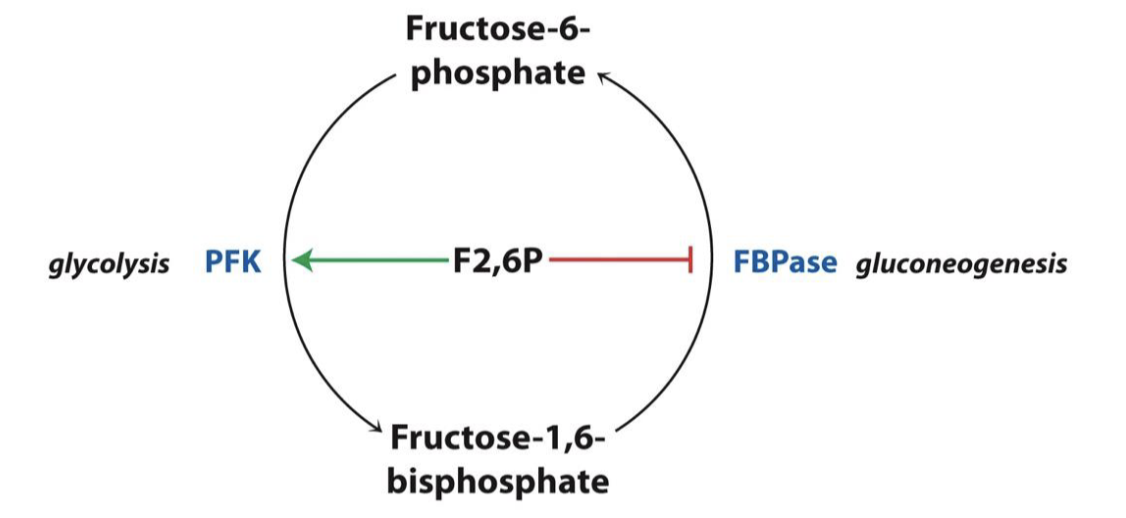
when the concentration of fructose-2,6-bisphosphate is high, glycolysis is
___ and gluconeogenesis is ___ and vice versa.
stimulated; inhibited
futile cycle, in relation to glycolysis/glyconeogenesis
When both fructose bisphosphatase (FBPase) and phosphofructokinase (PFK) are active, the net result is the hydrolysis of ATP, so many cells that do not carry out gluconeogenesis do contain the gluconeogenic enzyme fructose bisphosphatase.
dual regulatory effects of glycolysis/glyconeogenesis with PFK/FBPase results in…
greater possible range of net flux than if the regulator merely activated or inhibited a single enzyme (~car’s speed easier to regulate if it has an accelerator and brake)