Membrane Transport
 Call Kai
 Learn
 Practice Test
 Spaced Repetition
 Match
 Flashcards
 Knowt Play
1/39

There's no tags or description
Looks like no tags are added yet.
40 Terms

What are the four properties of cell membranes?
Selective (semipermeable)
Dynamic (fluid)
Flexible
Asymmetric

Rank O2, H2O, glucose, and Na+ from highest to lowest permeability through a pure lipid bilayer with no transport proteins.
O2 > H2O > glucose > Na+
Small uncharged nonpolar molecules cross most readily
Ions cross extremely poorly
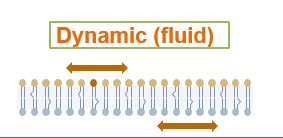
Which fatty-acyl tails best preserve membrane fluidity at low temperature?
Cis-unsaturated tails
Their kinks prevent tight packing, helping the membrane stay fluid

Do lipids need to break covalent bonds for a membrane to form a vesicle?
No, a bilayer can bend and self-seal through noncovalent lipid interactions
Lipids rearrange without breaking covalent bonds

Why do oligosaccharides protrude from the outer surface of the cell membrane?
Membrane carbohydrates on glycolipids and glycoproteins face the extracellular side
They contribute to membrane asymmetry and participate in recognition and interactions outside the cell

What are the four main mechanisms of transport across cell membranes?
Simple diffusion
Facilitated diffusion through channels or carriers
Primary active transport
Secondary active transport
What is influx vs efflux?
Influx: net movement of a substance into a cell or compartment
Efflux: net movement of a substance out of a cell or compartment.
What is a concentration (chemical) gradient?
A difference in solute concentration across a membrane
For an uncharged solute, it is the chemical driving force for diffusion
What is an electrochemical gradient?
The combined effect of a concentration gradient and an electrical gradient on an ion’s movement across a membrane.
What does ΔGt < 0 mean for transport?
Transport is exergonic and thermodynamically favorable in that direction
It can occur spontaneously, although its rate may still be slow
What does ΔGt > 0 mean for transport?
Transport is endergonic and thermodynamically unfavorable in that direction
It requires an energy input or coupling to a favorable process
For a small nonpolar molecule moving down its concentration gradient, what are the energy and transporter requirements?
Net movement is thermodynamically favored
No energy input is required
ΔGt < 0
No transporter is required
What happens if a molecule is moved up its concentration gradient?
The movement has ΔGt > 0 and is thermodynamically disfavored
It requires energy input directly or indirectly through coupling
Can individual O2 molecules cross a membrane in both directions?
Yes - thermal motion moves individual molecules both ways
If O2 is more [ ] outside the cell, spontaneous net movement is inward, but some individual molecules can still cross outward
Molecules move randomly in both directions
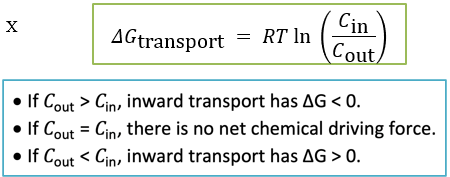
For an uncharged solute moving from outside to inside, what determines the sign of ΔGt?
The concentration ratio
Movement from higher concentration to lower concentration gives a negative ΔGt and is favorable
Movement from lower to higher concentration gives a positive ΔGt.
How does increasing temperature affect the rate of simple diffusion through a lipid bilayer?
It makes diffusion faster because molecules have greater kinetic energy and move more rapidly.
How does increasing molecular size affect the rate of simple diffusion through a lipid bilayer?
It makes diffusion slower because larger molecules cross the bilayer core less easily.
How does increasing hydrophobicity affect simple diffusion through a lipid bilayer?
It generally makes diffusion faster because hydrophobic molecules interact more favorably with the nonpolar membrane core.

How does O2 move during gas exchange for cellular respiration? What about photosynthesis?
Cellular respiration: O2 diffuses from air → alveoli and blood, then blood → tissue cells while CO2 diffuses from blood → alveoli and leaves with exhaled air
Photosynthesis: CO2 enters through stomatal pores and diffuses to photosynthetic mesophyll cells while O2 diffuses from leaf cells through stomata → air
What is osmosis?
The net movement of water across a selectively permeable membrane toward the side with a higher concentration of solutes that cannot cross the membrane.
Water moves passively across a cell membrane (no E input needed)
[Slide 13] What is the difference between a solute and a solvent?
Solute is the substance being dissolved
Solvent is the substance that does the dissolving
[Slide 14] What are aquaporins?
Membrane transport proteins that increase water permeability
They speed water movement but do not change the direction favored by osmosis
How does glucose usually cross a cell membrane?
By facilitated diffusion through glucose transporters when moving down its concentration gradient
Ex: GLUT1 and GLUT4
Facilitate passive glucose movement down it’s [ ] gradient w/o ATP hydrolysis

What does it mean that GLUT1 is selective? Reversible? Passive?
Selective: GLUT1 recognizes D-glucose and certain related sugars rather than transporting every molecule equally well
Reversible: glucose can move in either direction through GLUT1
Passive: net direction follows glucose concentration gradient and no ATP needed
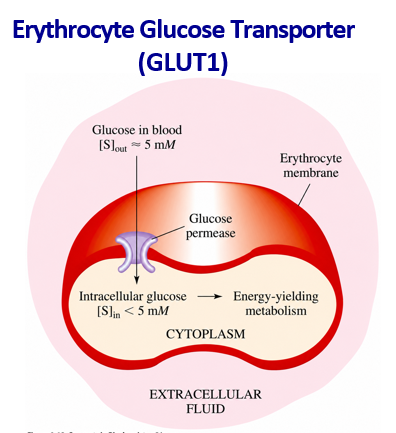
What does saturation mean for GLUT1 transport?
At high glucose concentration, all available carriers can become occupied, so transport approaches a maximum rate, Vmax.
What does alternating access mean for a carrier such as GLUT1?
The carrier changes shape so its glucose-binding site faces one side of the membrane at a time
Outward-facing, occluded, or inward-facing
It never forms a continuously open pore through the membrane
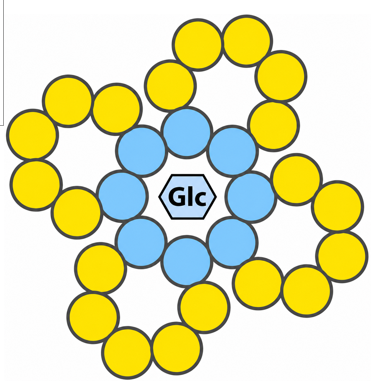
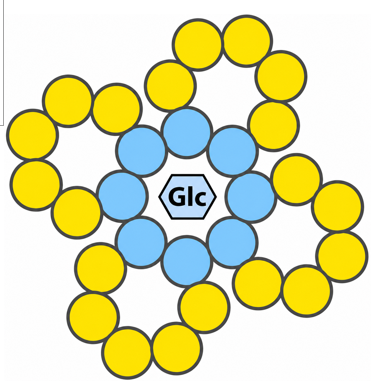
How can polar side chains help form a transporter pathway?
Polar side chains line the pathway or binding site, allowing a polar solute such as glucose to interact favorably within the hydrophobic membrane environment.

What is the major barrier to glucose crossing a lipid bilayer directly?
Glucose would face unfavorable interactions in the hydrophobic bilayer core and would have to lose favorable interactions with water despite being very polar
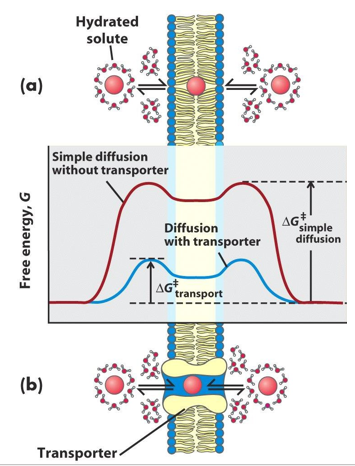
How does a glucose transporter help glucose cross without changing the overall driving force?
It provides a polar pathway and lowers the activation free-energy barrier
It does not change the glucose concentration gradient or the overall ΔGt for transport

Does the hydrophobic effect significantly drive GLUT-mediated glucose transport?
No, the important issue is avoiding unfavorable passage of a very polar molecule through the hydrophobic bilayer core
The concentration gradient provides the thermodynamic driving force
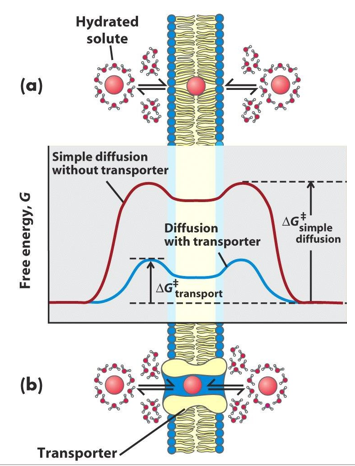
Does GLUT1 change the kinetics, the thermodynamic favorability, or both of glucose transport?
It changes kinetics only
GLUT1 lowers the free-energy barrier and increases transport rate, but it does not change ΔGt when the concentration gradient is unchanged

What is primary active transport?
Transport driven directly by an energy-releasing reaction, usually ATP hydrolysis
ATPases use this energy to move ions against their gradients
Ex: Na+/K+-ATPase or the sarcoendoplasmic reticulum Ca2+-ATPase (SERCA)

What is secondary active transport?
Transport driven by an ion gradient that a primary active transporter previously established
ATP provides energy indirectly by maintaining that ion gradient
Ex: SGLT (sodium-glucose cotransporter) in intestinal cells or sodium-amino-acid cotransporter in renal tubules

What defines a P-type ATPase?
It forms a transient phosphorylated intermediate during its transport cycle
ATP-dependent phosphorylation and dephosphorylation drive conformational changes that move the substrate
Ex: SERCA (sarcoendoplasmic reticulum calcium ATPase)
Describe the Na+/K+ Ion Pump
Moves 3 Na+ out and 2 K+ into the cell
Intracellular [ ]s: Low Na+; high K+
Maintains the resting membrane potential
ATP driven antiport system (opposite directions)
Net electrical potential difference across the membrane (- inside; + outside)
Important for nerve impulse generation
Drives secondary active transport
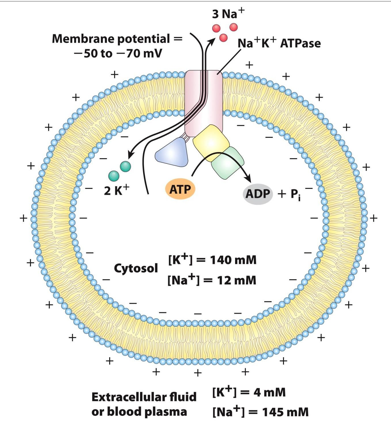
Why can the Na+/K+-ATPase consume a large amount of energy in humans at rest?
Cells continually use ATP to maintain Na+ and K+ gradients despite ion leak across membranes
This can account for about 25% of resting human energy consumption
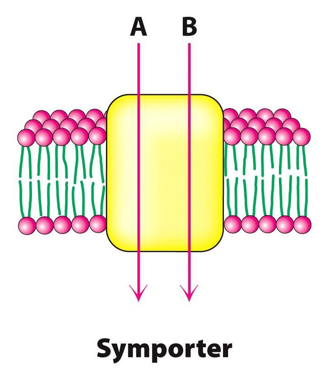
What is a symporter?
A secondary active transporter that couples movement of one molecule down its concentration gradient to movement of another molecule against its gradient
Both move in the same direction

What is an antiporter in secondary active transport?
A transporter that couples one molecule moving down its concentration gradient to another moving against its gradient
Molecules are moving in opposite directions

How do primary and secondary active transport work together in intestinal glucose uptake?
The Na+/K+-ATPase uses ATP to pump Na+ out and build a Na+ gradient
Na+ then enters down its gradient through SGLT, providing energy for glucose to enter against its gradient

Why does secondary active transport use ATP indirectly?
The cotransporter itself does not hydrolyze ATP
Rather it uses the potential energy stored in an ion gradient that an ATP-driven pump created