chemistry exam #3
 Call Kai
 Learn
 Practice Test
 Spaced Repetition
 Match
 Flashcards
 Knowt Play
1/68

Earn XP
Description and Tags
chem 1400; 6-5, unit 7, 8-1~8-4, unit 9
69 Terms
when do resonance structures occur?
when a molecule has a positive or negative charge next to a double/triple bond, leading the charage to bounce back and forth
what are the rules we use to generate a structure with resonance?
draw the valence electrons according to lewis dot rules
for molecules with a negative charge, add 1 electron to the MOST ELECTRONEGATIVE ELEMENT (add one electron at a time)
place the first element in a formula in the middle of the molecule; expand the octet if necessary
how do you determine bond order?
draw out each resonance structure and identify the bond of interest
count the bonds; a single bond has a bond order of 1, double = bond order of 2, triple = bond order of 3
ex. if the bond is a single bond in one instance and a double bond in two instances, it will be AT LEAST 1 (single every bond is at least a single bond), 1 + 2/3 = 1.66
VSEPR theory
valence shell electron pair repulsion; theory that attempts to explain the repulsive and attractive features of electron domains in bonding
molecular geometry
shape produced by the atoms surrounding the central atom
electronic geometry
shape produced by the atoms AND lone-pairs surrounding the central element
hybridization
a reorganization of the valence shell to create BONDING ORBITALS
what hybrid orbital is produced by a linear molecule?
two electron domains, so 2s and 2p orbital hybridize to create 2 sp orbitals
which hybrid orbital is produced by a molecule with three electron domains (trigonal planar)?
three sp2 orbitals
what is the bond angle for a trigonal planar molecule?
120 degrees
what hybrid orbital is formed by a molecule with four electron domains (atoms)?
the 2s and 2p orbitals combine to form four sp3 orbitals
which hybrid orbitals form from a molecule with 5 electron domains (attached atoms)?
the 3s, 3p, and (empty) 3d orbitals combine to form 5 sp3d orbitals (and four remaining 3d orbitals)
which hybrid orbitals form from a molecule with 6 electron domains (attached atoms)?
the 3s, 3p, and 3d orbitals combine to 6 sp3d2 hybridized orbitals
which hybridized orbitals are formed by an element with three electron domains (including one lone pair)?
still forms 3 sp2 hybridized orbitals, except lone electrons occupy one of the hybridized orbitals
which hybridized orbital is formed from an (electronic) tetrahedral shape?
sp3 hybridized orbital
which hybridized orbital is formed from an (electronic) trigonal bipyramidal shape?
sp3d hybridized orbital
which hybridized orbital is formed from an (electronic) octahedral shape?
sp3d2 hybridized orbital
which positions do lone pairs occupy in an (electronic) trigonal bipyramidal shape?
the equatorial axis (trigonal planar shape because distance is maximized)
which positions do lone pairs occupy in an (electronic) octahedral shape?
the axial axis (north/south)
what is the bond angle for a bent molecule (with a lone pair)?
less than 120 degrees
what is the bond angle for a tetrahedral molecule (no lone pairs)
109.5 degrees
what is the bond angle for a trigonal pyramidal shape?
less than 109.5 degrees
what is the bond angle for a bent molecule (with two lone pairs)?
less than 109.5 degrees (~105)
what is the bond angle in a trigonal bipyramidal shape?
90 degrees btwn axial and equatorial, 120 degrees btwn equatorial
what is the bond angle for a see-saw shape?
90 degrees between equatorial and axial, 120 degrees between equatorial
what is the bond angle for a t-shaped molecule?
less than 90 degrees (where lone pairs are both in the equatorial plane)
what is the bond order for a linear molecule (with three lone pairs)?
180 degrees
what is the bond angle for an octahedral molecule?
90 degrees between all planes
what is the bond angle for a square pyramidal molecule?
90 degrees between equatorial; less than 90 degrees between equatorial and axial
what is the bond angle for a square planar molecules?
90 degrees between equatorial
molecular dipoles
the sum of the individual bond-dipole vectors (vector = magnitude with direction)
what are the 8 physical properties?
boiling point, melting point, heat of vaporization, heat of fusion, viscosity, surface tension, capillary action, and vapor-pressure
boiling point
the temperature at which a molecule changes from liquid to gas; the point at which vapor pressure = atmospheric pressure
melting point
the temperature at which a molecule changes from solid to liquid
heat of vaporization
the
vapor pressure
the amount of a liquid that is in a gaseous state; increases with increasing temperature
how does vapor pressure change in relation to IMF?
the higher the vapor pressure, the lower the boiling point—higher vapor pressure means lower IMF
what are the 5 forces of attraction?
electrostatic, network covalent, hydrogen bonding, dipole-dipole, and dispersion
electrostatic force of attraction
occurs between cation and anion; considered strong due to the large crystal lattice
what are the rules for ranking electrostatic IMFs?
the greater the charge, the greater the force
if the charge is the same, the smaller ions have the greater electrostatic force
what are the rules for ranking the strength of network covalent IMFs?
the greater the molar mass, the greater the network covalent force
network covalent IMFs
large 3d array of covalent bonds found in very large molecules; the greater the molar mass, the greater the network covalent force
why does network covalent IMF increase with molar mass?
hydrogen bonding IMF
an attraction between the lone pairs on oxygen (or nitrogen) and a partially-positive hydrogen atom
why sub-groups engage in hydrogen bonding?
hydroxyl groups (alcohols), carboxyl groups (carboxylic acid), amino groups (amines) and
how does the magnitude of most physical properties relate to IMF?
the greater the force, the greater the magnitude of the physical property (save for vapor pressure)
rank IMFs in order from strongest to weakest
electrostatic + network covalent → hydrogen bonding → dipole-dipole → dispersion
what is an indication that a molecule has a greater hydrogen bonding IMFs than another?
if it has more h-bond groups (ex, more hydroxyl groups)
dipole-dipole IMF
an attraction between the dipole of one molecule and the dipole of another
what is an indication that a molecule has greater dipole-dipole IMFs than another?
it has a greater molar mass
why does molar mass increase the magnitude of dipole-dipole IMFs?
dispersion IMFs
attractive forces that are present in all molecules due to instantaneous dipoles created by the movement of electrons; strongest for molecules with no dipole
what is an indication that a molecule has a greater dispersion IMF than another?
it has a greater molar mass
or, if they have the same molar mass, it has a greater surface area
in which case is a dispersion IMF greater than a dipole-dipole IMF?
if the molecule with the dispersion IMF has a molar mass that is 3x greater than the other molecule
when you label the IMF of a molecule with multiple IMFs, which one do you pick?
the strongest IMF
sigma bonds
bonds that form from hybridized orbitals; equal to a single bond
pi bonds
bonds that form from non-hybridized orbitals and produce a second/third connection
which bonds does a double bond consist of?
1 sigma and 1 pi bond
which bonds does a triple bond consist of?
1 sigma and 2 pi bonds
molecular orbital theory
an energetic model that uses linear combinations of atomic orbitals to create bonding and anti-bonding orbitals
deconstructive interference
an increase in energy due to wave functions being out of sync with each other
constructive interference
a reduction in energy from wave functions (orbitals) being in sync with each other
bond order formula
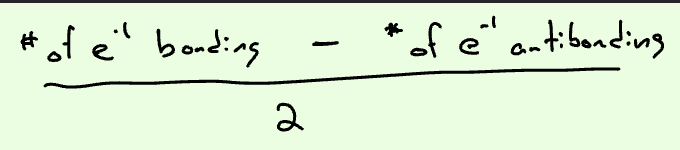
what does a bond order greater than 0 indicate?
the molecule CAN exist (there is a net lowering of energy)
it would be energetically favourable for this molecule to exist
what does a bond order of 0 mean?
the molecule can’t exist (there is no net lowering of energy)
what is s-p mixing?
the interaction of s and p orbitals that occurs within molecular orbital theory for Lithium → Nitrogen
these are “large” elements, so they don’t hold their 2s orbital as closely and have a hourglass molecular orbital diagram
reactions
the breakage and creation of bonds
chemical change
a change in the structure of molecules in going from reactants → products
physical change
no change in structure, just a change in phase