exam 3 Botany
 Call Kai
 Learn
 Practice Test
 Spaced Repetition
 Match
 Flashcards
 Knowt Play
1/136

There's no tags or description
Looks like no tags are added yet.
137 Terms
Dispersal mechanism
Fruit is ______ _______.
Intraspecific competition
Animals swallow the seeds in which it spreads through its feces where it can germinate
This is done to avoid ________ ______.
Endosperm (pic)
What is 1?

Embryo (pic)
What is 2?

Seed coat (pic)
What is 3?

Pericarp (pic)
What makes up 5, 6, and 7?

Endocarp
What is 5?

Mesocarp (pic)
What is 6?

Exocarp (pic)
What is 7?

Pericarp
old ovary wall from flower becomes _____
Usually the edible part of a fruit
Can be homogenous or divided
Simple fruits
result from a simple or compound ovary in a flower with only one pistil
Fleshy and dry
What are the two subcategories of simple fruit?
Simple fleshy fruits
Aggregate, berry, drupe, and pome are ______ _____
Berries
Several to many seeds
From a compound ovary
Three kinds of _____
Regular
Pepo
Hesperidium
Regular berry
thin pericarp
Occur in many families
Type of berry
Pepo berry
thick hardening pericarp
Occur in cucurbitceae (pumpkins, gourds, melons, squash)
Type of berry
Hesperidium berry
type of berry
Leathery, oily pericarp
Occur in rutaceae (the citrus fruit)
Drupe
simple fleshy fruit
Fleshy layer pericarp
One seed in the middle
Typically protected by hardened endocarp

Pome
Accessory fruit
the ovary plus some other structure makes up the edible part
The ovary per se is the core
Other edible portion derived from enlarged hypanthium
Apples, pears
Accessory fruit
Some or part of the edible “fruit” is not derived from ovary tissue
It is the receptacle part of the berry (edible)
Each one is an ovary with a seed inside
dry fruits
Achenes, legum, follicle, and Samaras are examples of _______.
Indehiscent
Does not split open at maturity
Dehiscent
Splits open at maturity
Simple dry fruits characteristics
Dehiscent
One of two types of simple dry fruits
Split open (dehiscent) to release seeds at maturity
We tend to eat them when very immature
Legume
from a simple ovary (1 carpel)
Dehisces along two sutures
Ex. Beans and peas
Follicle
from a simple ovary (1 carpel)
Dehisces along along one suture
Ex. Milkweed fruits
Dehiscent
Capsule
from a compound ovary
Dehisces in one of three ways
Septicidal
Loculicidal
Poricidial
Septicidal
Splits at carpel walls
one of the three ways of Dehiscent
Loculicidal
Splits between carpel walls
one of the three ways of Dehiscent
Poricidial
Develops a pore somewhere on the carpel, seeds escape through it
one of the three ways of Dehiscent
Simple dry dehiscent fruits
Legume, follicle, capsule
Simple Indehiscent fruits
Samara, Achene, caryopis, nut
Samara
Indehiscent
Any fruit with a winglike growth
Dispersed by wind
simple dry fruit
Samara
Indehiscent
Any fruit with a winglike growth
Dispersed by wind
simple dry fruit
Nut
thick, stony wall
Typically of deciduous forest trees
Ex. Acorns, pecans, walnuts, etc.
simple dry fruit
Caryopis
grains
Fruits of poaceae (the true grasses)
By far the most economically important fruit type
Ex. Wheat, barely, rye, corn, rice
Aggregate fruits
Form from single flowers with unjoined, multiple pistils
Each pistils forms a fruitlet (drupe, achene, etc.0
Collectively called an etaerio
Multiple fruits
forms from a cluster of flowers (inflorescence) but mature into a single mass
Agents of fruit dispersal
Wind, water, animals.
Wind
winged and plumed fruits (samaras) and seeds
Some plants that break off and are spread by the _____
Tumbleweed
Some grasses
Water
fruits or seeds that float
Ex. Inflated perigynia of carex coconuts
Animals
Endozoochory- animal eats fruit, transports seed, defeecates it someplace else
Fruits become sweeter, larger, more sweet smelling, nutritious
Becomes brightly colored
Ectozoochory- animal transports fruit on fur, skin, clothes, etc.
spines, hooks, etc.
Endozoochory
Animal eats fruit, transports seed, defecates it someplace else
fruits become sweeter, larger, more sweet smelling, nutritious
Becomes brightly colored
Ectozoochory
Animal transports fruit on fur, skin, clothes, etc.
spines, hooks, etc.
Scarification
Seed coats breaks from mechanical stress
Penetration
Water enters through seed coat through _________.
Epicotyl
What is 1?
(Shoot of the plant)

Hypocotyl
What is 2?
(Includes radicle)

Radicle
What is 3?

Seed coat
What is 4?

Cotyledon
What is 5?

Embryo
What is 6?

Eudicot
This is an example of which type of seed germination?

Cotyledon (corn)
What is 1?
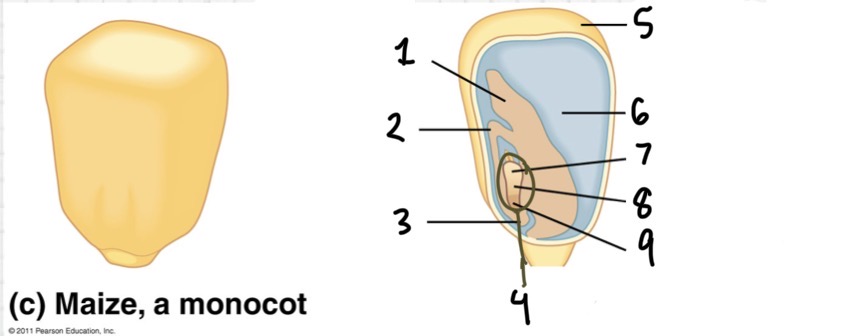
Coleoptile (corn)
What is 2?

Coleorhiza (corn)
What is 3?

Embryo (corn)
What is 4?

Pericarp fused with seed coat (corn)
What is 5?

Endosperm (corn)
What is 6?

Epicotyl (corn)
What is 7?

Hypocotyl (corn)
What is 8?

Radicle (corn)
What is 9?

Monocot
This is an example of what type of seed germination?

Increased crop efficiency
____________ led to thousands of technological breakthroughs
3500-10,000
Almost every plant we now use for food was domesticated ___________ years ago
Wheat, rice, corn, potato, sweet potato, manioc
80% of human calories come from 6 crops:
Alphonse De Candolle
1882- origin of cultivated plants
Used a modern, consilient approach to track down the places where crop plants were native or first introduced
Nikolai Vavilov
denoted to improvement of cereal crops for Soviet Union
Also established many places of origin of crop plants (esp. Those of Asia and Eastern Europe)
Soviet agronomist/geneticist
Trofim Lysenko
Proponent of Lamarckism
Ruthlessly used politics to stamp out those who disagreed with him
Arrested Lysenko while on a botanical expedition in Ukraine
Intensive tillage
Leaves less than 15% of ground in-tilled per acre
also leads to soil degradation, erosion, and nutrient runoff
Monoculture
The cultivation of a single crop in an area
Maximizes crop production per unit area
Takes a LOT of preparation and maintenance
All other biota are regularly eliminated
Sometimes even down to soil microbes/nematodes
Energetically expensive – it takes ~9 kcal of energy to put 1 kcal on the table.
Frequently leads to overuse of the soil
Dwarfed, disease resistance, cross-breeding-“triticale”
1940’s Borlaug developed many improved crops (3 things)
Monoculture, shuttle breeding, extensive chemical use, etc.
What techniques did Norman Borlaug develop?
Nitrogen fertilizer
Nitrogen extracted from air and converted to ammonia
allowed humans to go beyond the limiting nutrients
Irrigation improvements
Irrigation systems covering (usually) >3000 hectares (7,400 acres)
Spray or sprinkler systems covering
Rarely drip systems
Four tiered approach to pest management
Set action thresholds
Monitor and identify pests
Prevention
Control
Set action thresholds
Step one of four tiered approach to pest management
identify population levels of pests which are likely to have economic impact
Monitor and identify pests
Second step of Four-tiered approach to pest management
many insects and “weeds” are innocuous or beneficial
Prevention
Third step of Four-tiered approach to pest management
manage crops without chemicals if possible—crop rotation, different crop varieties, etc.
Control
Last step of four tiered approach
start with less risky approaches (pheromone treatment, etc.)
Totipotency
Plant cells that have the capacity to transform into other types of cells under specific chemical treatments
manipulation of hormone regimes
Especially auxins and cytokines
F.C. steward
Developed a way to regenerate entire plants from a single cell
started by using carrot calluses in coconut water
Laid groundwork for genetic modification
Genetic modification
A set of modern tools building off traditional selection and cross-breeding
Gene editing
Using advanced genetic techniques like CRISPR/CAS9
to edit in specific genes (knock genes out!)
American chestnut project
Hydroponics
Growth in a circulating nutrient bath
Aeroponics
Nutrients are sprayed directly on root systems
Aquaponics
Nutrient source is waste of large numbers of fish raised in the hydroponic water
Primary metabolites
Molecules made of all plants which are involved in growth and development
Sugars/ polysaccharides
Amino acids/proteins
Fatty acids/lipids
Nucleotides/DNA/RNA
Macronutrients
secondary metabolites come from these pathways
Sugars/ polysaccharides
Amino acids/proteins
Fatty acids/lipids
Nucleotides/DNA/RNA
Secondary metabolites
Molecules made by posting-processing one or more primary metabolites
highly species specific - define entire genera or families
Involved in chemical defense
Secondary metabolites
Molecules made by posting-processing one or more primary metabolites
highly species specific - define entire genera or families
Involved in chemical defense
Alkaloids, phenolic, terpenoids
Three major chemical classes
Proteins and amino acids
Alkaloids are derived from
Carbohydrates (hydrophilic)
Phenolic are made up of
Fat and lipids (hydrophobic)
Terpenoids are derived of
Alkaloids
Mostly alkaline nitrogen-containing molecules
Structurally diverse
Widespread in plants
True alkaloids and pseudoalkaloids
Two major group of alkaloids
True alkaloids
Amino acid derived
Contain N in the heterocycle
Many major derivative groups
Always contain a nitrogen
Ex. Atropine, nicotine, coniine

Atropine
pupil dilation
Increase of heart rate
True alkaloid

Nicotine
vasoconstriction
Increase of heart rate, stimulant
Two heterocyclic ring
True alkaloid
