A&P Anatomy of Articulation and Resonance cont part 2
 Call Kai
 Learn
 Practice Test
 Spaced Repetition
 Match
 Flashcards
 Knowt Play
1/134

There's no tags or description
Looks like no tags are added yet.
135 Terms
What is velopharyngeal dysfunction (VPD)?
A general term for a disorder of the velopharyngeal valve that implies faulty velopharyngeal closure.
What is velopharyngeal insufficiency?
A structural problem that prevents proper velopharyngeal closure.
What can cause velopharyngeal insufficiency?
A short palate, deep pharynx, or changes following adenoid removal or pharyngeal tumor resection
What is the typical treatment for velopharyngeal insufficiency?
Surgical reconstruction.
What is velopharyngeal incompetence?
A functional problem involving reduced movement or poor function of the structures responsible for velopharyngeal closure.
What can cause velopharyngeal incompetence?
Reduced soft palate movement, pharyngeal hypotonia, velar paralysis, or paresis
How can velopharyngeal incompetence be treated?
Surgery, prostheses, or speech therapy.
What is velopharyngeal mislearning?
Faulty articulation that results from learned speech patterns.
How is velopharyngeal mislearning treated?
Speech therapy
what are Resonance Disorders?
Opening, inconsistent movement, or obstruction that changes the way air flows through nasal and oral cavities during speech
happen when sound vibrations in the voice tract are blocked or fail to balance properly between the mouth and nose during speech
Resonance Disorders
What causes resonance disorders?
Caused by some type of Velopharyngeal Dysfunction (VPD)
Types of resonance disorders:
hypernasality
hyponasality
cul-de-sac resonance
What is HYPERnasality?
Too much nasal resonance.
What is an example of a condition associated with hypernasality in the slides?
Submucous cleft
What is HYPOnasality?
Too little nasal resonance
What is an example of a condition associated with hyponasality in the slides?
Hypertrophic adenoids
What is cul-de-sac resonance?
Sound becomes trapped in one of the cavities: oral, nasal, or pharyngeal
Which speech sounds are most affected by Velopharyngeal Dysfunction (VPD)?
Sounds that require buildup of intraoral pressure: stops, fricatives, and affricates.
What are common speech issues associated with Velopharyngeal Dysfunction (VPD)?
Hypernasality, nasal air emission, and replacement of oral consonants with other sounds.
What sounds may replace oral consonants in Velopharyngeal Dysfunction (VPD)?
Mid-palatal stops, glottal stops, pharyngeal fricatives, or nasal fricatives.
Which places of articulation are most affected by Velopharyngeal Dysfunction (VPD)?
all places possible
structure (anatomical problem)
Insufficiency
function (physiological problem)
Incompetence
learned articulation (treated with speech therapy)
Mislearning
Which professionals may be part of the cleft care team?
Craniofacial and plastic surgeons, orthodontists, ENT physicians, pediatricians, nurses, audiologists, psychologists, social workers, nutritionists, and SLPs
What is the SLP's role during infancy?
Feeding and swallowing
What is the SLP's role during childhood?
Ongoing evaluation and treatment of articulation and resonance
What is important during adolescence for patients with cleft conditions?
Surgeries, orthodontic work, and other treatments may continue
What may be addressed during adulthood?
Velopharyngeal dysfunction
What does the SLP evaluate in a patient with VPD?
The presence, nature, and extent of VPD
What does the SLP help determine about VPD?
Its probable cause and whether the abnormality is structural or functional.
How does the SLP help with surgery?
Collaborates with other specialists during surgical planning
What does the SLP assess after surgery?
The effectiveness of surgical procedures for speech.
What speech issues does the SLP treat in cleft palate care?
Speech and resonance issues
Bones of the Cranial Skeleton
Frontal
Parietal
Temporal
Occipital bones
Ethmoid
Sphenoid
Which cranial bones lie over brain lobes with the same names?
Frontal, parietal, temporal, and occipital bones

Is the frontal bone paired or unpaired?
Unpaired
Which suture forms the boundary between the frontal and parietal bones?
Coronal suture

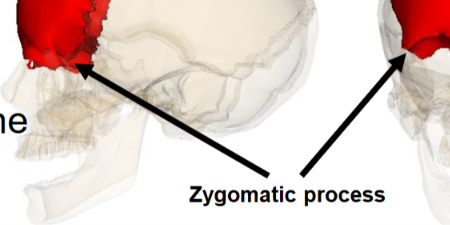
Which bone articulates with the frontal bone at its zygomatic process?
Zygomatic bone
Are the parietal bones paired or unpaired?
Paired.
What does the sagittal suture join?
The left and right parietal bones.
Which suture forms the boundary between the parietal and occipital bones?
Lambdoidal suture.

What does Coronal suture forms boundary with ? (think parietal)
frontal bone
Is the occipital bone paired or unpaired?
Unpaired

Lambdoidal suture forms boundary with (think occipital)
parietal bones
What does the occipital bone form?
The base of the skull.
What is the foramen magnum?
An opening that allows the medulla and spinal cord to exit the skull.

What are the occipital condyles?
Surfaces that articulate with the atlas bone.
Are the temporal bones paired or unpaired?
Paired.
Which suture forms the boundary between the temporal and parietal bones?
Squamosal suture
What are the four portions of the temporal bone?
Squamous, tympanic, mastoid, and petrous portions.
What are the important landmarks of the temporal bone?
Mastoid process, styloid process, and zygomatic process
What does the squamous portion of the temporal bone include?
The lower margin of the external auditory meatus (EAM) and the zygomatic process
What does the tympanic portion of the temporal bone include?
The anterior and inferior walls of the external auditory meatus and the styloid process.
What does the mastoid portion include?
The posterior part of the temporal bone and the mastoid process
What does the petrous portion of the temporal bone house?
The cochlea, semicircular canals, and internal auditory meatus
Is the ethmoid bone paired or unpaired?
Unpaired

What does the word 'ethmos' mean?
Sieve
What does the cribriform plate of the ethmoid bone do?
Separates the nasal cavities from the brain.
What does the perpendicular plate of the ethmoid bone form?
Part of the bony nasal septum.
What structures are associated with the ethmoid bone?
Crista galli, cribriform plate, perpendicular plate, and nasal conchae
Is the sphenoid bone paired or unpaired?
Unpaired.
What shape is the sphenoid bone?
Butterfly-shaped.

What are the main parts of the sphenoid bone?
Corpus, greater wings, lesser wings, and pterygoid plates.
What is the function of the fossae between the medial and lateral pterygoid plates?
They house attachment points for muscles of mastication and the tensor veli palatini.
What are the two types of joints found in the cranial and facial bones, excluding the TMJ?
Sutures and synostosis
What are sutures?
Joints that connect the bones of the skull.
What are sutures made of at birth?
Soft connective tissue.
What happens to sutures as we age?
They gradually ossify, or turn into bone.
What is synostosis?
The ossification of a suture, making the joint immobile.
What is craniosynostosis (craniostenosis)?
A rare condition in which cranial sutures ossify too early
What type of joint is the temporomandibular joint (TMJ)?
A synovial joint, which is a mobile joint
What is the main difference between the other cranial and facial joints and the TMJ?
Most cranial and facial joints are sutures or synostoses, while the TMJ is a mobile synovial joint.
What are sinuses?
Air-filled cavities in the skull.
What lines the sinuses?
Respiratory epithelial cells and mucous membranes.
What do the mucous membranes in the sinuses produce?
Mucus
How is mucus cleared from the sinuses?
Through ciliary action.
Where do the sinuses drain?
Into the nasal passages.
How many major pairs of paranasal sinuses are there, and what are they called?
Four pairs: frontal, maxillary, ethmoid, and sphenoid.
Which is the largest sinus?
Maxillary sinus
Which sinus is located in the forehead?
Frontal sinus
Which sinus consists of a honeycomb of small air spaces?
Ethmoid sinuses
Where are the ethmoid sinuses located?
Posteromedial to the inner corner of the eye.
Where are the sphenoid sinuses located?
Posterior to the ethmoid sinuses
What are the six main functions of the sinuses?
Mechanical protection and filtering
Immune function
Humidifying inhaled air
Warming inhaled air
Lightening the weight of the skull
Cushioning against facial trauma
Enhancing voice resonance
Sinuses provide mechanical __________ and __________.
Protection and filtering
Sinuses help with __________ function
Immune
Sinuses __________ and __________ inhaled air.
Warm and humidify
Sinuses help __________ the weight of the skull.
Lighten
Sinuses provide a __________ against facial trauma.
Cushion
Sinuses enhance voice __________.
Resonance
Where are teeth located?
Within the alveoli of the maxillae and mandible.
What are the two dental arches?
Upper and lower dental arches.
What are the two main parts of a tooth?
Root and crown.
How many types of teeth are there, and what are their functions?
Incisors
8;Cutting
How many types of teeth are there, and what are their functions?
Cuspids (canines)
4, Tearing
How many types of teeth are there, and what are their functions?
Bicuspids (premolars)
8, Cutting
How many types of teeth are there, and what are their functions?
Molars
12; Grinding and pulverizing
What do the 12 molars include?
Wisdom teeth