Week 2, Lecture 2: Social Pleasure
 Call Kai
 Learn
 Practice Test
 Spaced Repetition
 Match
 Flashcards
 Knowt Play
1/26

There's no tags or description
Looks like no tags are added yet.
27 Terms
what do carrots and sticks have to do wtih social connection
evolution
stick = social pain , feel bad when our social connections are threated motivates us
carrot = social pleasure ; motivate us in a postive way towrds social connection
what are teh key brain regions in the reward system?
winning money = the stimulus
ventral striatum = deep in the brain, bottom,
na. = nucleus accumbens, the heart of the VS
coronal slcie 1/3 of face from front to back, near corpus callosum
ventromedial prfrontal cortex (vmPFC)
bottom most part of the medial prefrontal cortex
recall the dmPFC (DMN)
how do the ventral striatum and the vmPFC differ?
recall study == winning money
in the anticipation phase, you learn how much you might be able to win on that trial, 5 cents, 5$
outcome pahse = find what you actually got
anticipatiion, more money = more VS activate
vmPFC not activate
outcoem, get money, vmPFC activates alongside VS
vmPFC more active during outcome than anticipation, and vice versa
how does the reward system respond to losses
if you compare winning 5 USD with losing 5, the VS and the vmPFC are activated
same response with comparing gains with no change
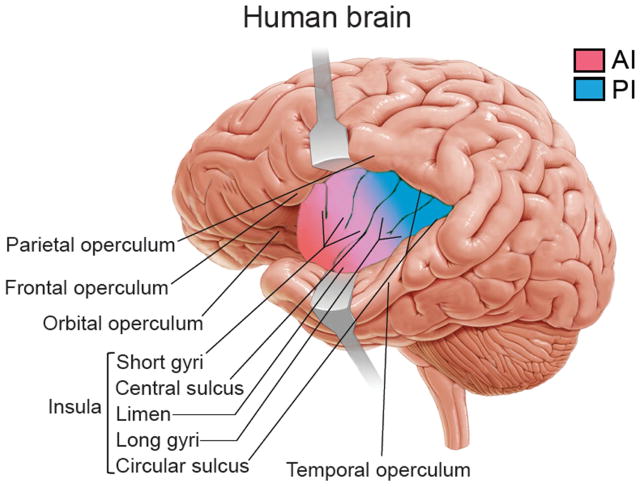
but if compare a loss vs no change, you see the cingulate and the anterior insulation taking us back to distress
VS is actually more active for a loss than no change
ie, it is tracking how far you are deviating from 0 in either direction, prefers gains to loss, more sensitive to loss than no change at all
where is the cingulate
higher in the brain, not right on the corpus callosum
where are homeostaatic concerns
right on the corpus callosum
hunger, thirst, pain
what is corpus callosum
a thick, C-shaped bundle of roughly 200 million nerve fibers (axons) located deep in the middle of the brain that connects the left and right cerebral hemispheres.
Interhemispheric Communication: Acts as a neural bridge allowing the left and right sides of the brain to share sensory, motor, and cognitive information
Coordinated Movement: Integrates signals so both sides of the body and mind work together smoothly during tasks like writing, driving, or playing sports

heuristic for vmPFC and VS
The VMPFC follows a simple linear reward function: the more you get, the more it responds, and it cares about getting more than about anticipating.
The ventral striatum has a curved pattern: it responds least to no
change, responds to both losses and gains, and responds more to gains than to losses.
How does the brain decide whether it would rather have a cookie or a mug?
The VMPFC seems designed to put things that are very different from each other on a
common value scale of how much they matter to us. I am very confident in saying theVMPFC is the reason money exists. Money is the manifestation in the world of a
common currency for translating between cookies and mugs,
What are the two kinds of social reward?
1. Receiving positive social regard. This is finding out that another person, or people in general, like, love, respect, and value you. It feels good.
DMN, thinking about other ppl think about you
reward system (VS, vmPFC) bc being liked is rewarding as money and food
2. Helping others. This is the positive feeling that comes from helping or benefiting
someone else. (More on this starting with Q11.
What did the first study of social reward find?
social pain studies earlier 2000s, social reward late 2000s
Izume, The question was whether any part of the brain responds similarly to monetary rewards
(a stand-in for physical rewards) and social rewards. There was: the ventral striatum
Alarge monetary reward produced a strong ventral striatum response, a small one less,
and none produced nothing. Being called trustworthy produced the same amount of
ventral striatum activity as the large monetary reward. Even being called modest
produced quite a bit of response. And the ventral striatum did not respond when you
saw someone else called trustworthy or modest. So it has nothing to do with seeing the
word “trustworthy”; it has everything to do with someone telling you they think you are
trustworthy.
What did the ultimatum game study show about fairness?
In the typical version, one person, the proposer, is
given $10 to split with a second person, the responder, in any whole-dollar split they
like: 5–5, 9–1, 10–0. The responder can accept or reject the offer. If the responder
rejects it, both people get nothing.
ppl dont accept the 1-9 offers, comparing 5/10 and 5/20, ppl dont accept 5/20
being treated fairly = accepted, respected, communicity, cares abut you, vlaues you
sublte social reward
What happens in the brain when people you care about tell you why you
matter to them?
The second expressed why the participant mattered to them, with statements
like “I could not live my life if you were not in it” and “You are the only person who has
ever cared for me more than for yourself.Reading the statements from the 2nd letter activated the ventral striatum much more than reading the factual statements.
simialr study, stranger understood where youre coming from, also activated VS
Why would we be built to find social regard rewarding?
social rewards are signs taht we are valued by other people and by the group we are in
we;re cared for now and in the future
survival going foeward is more likely with this signals
also a sign that you live in a high quality group
higher interpersonal trust and a higher quality of group life
what does thsi mean???
How does helping others connect to meaning in life?
Maslow’s hierarchy of needs: but I break it
into three tiers: the bottom two layers are about physical needs, the next two are about
social needs, and the top one, which Maslow called self-actualization, is really about
having meaning in your life. Maslow thought of these as capital-N Needs. For physical
needs, money is a good proxy: with money, you can get good doctors, good food, and a
good roof over your head. Social needs are about social regard—knowing that you are
liked, valued, respected, and loved—which is what the first half of the lecture covered.
That leaves meaningThink for yourself about the one or two things in your life that give you the greatest
sense of meaning. When I asked the class whether their answer involved helping or
benefiting others in some way, a lot of hands went up. Not always, but increasingly aswe get older, the things that give us meaning involve helping others, directly or
indirectly. Art counts, too: plenty of people say Taylor Swift’s music helped them get
through middle school. If nobody ever saw a piece of art or felt moved by it, there would
probably be a lot less art in the world. We do these things because they speak to other
people.For me, the biggest surge of meaning came when I first had a son. I suddenly knew
what my life was for: making sure he has the best life possible. My life got really simple
and straightforward once that felt true, and it was all about helping someone else. I think
we are built to help others, and that is a large source of our meaning.
What is the axiom of self-interest?
philosopher David Hume put forward what I would call the axiom of self-
interest: people have no other end in all their actions than their private self-interest.
A familiar example is a man on a date who leaves a massive tip. He looks generous, but
what he is really doing is signaling to his date that he has money to spend, hoping she
will want to spend more time with him.
What is the prisoner’s dilemma?
Whatever the other person chooses, you personally
always get more money by defecting: $5 instead of $3 if they cooperate, $1 instead of
$0 if they defect.One study added conditions in which you found
out what the other person chose before making your own choice. If you learned that
they defected, nobody cooperated—just like rejecting an unfair offer in the ultimatum
game. But if you learned that they had cooperated, you now had the power either to
maximize the group’s payout or to maximize your own, and people became much more
likely to cooperate.
2 reasons
genuinely rewarding to cooperate
to have reputation and follow the norms
Q14: What does the brain show when people cooperate?
fMRI study of the prisoner’s dilemma looked at trials where the other person had
already cooperated, so you could either do the nice thing for them or the really nice
thing for yourself. The ventral striatum was more active when you both cooperated than
when you defected and took the $5.Instead, the brain’s primitive reward
system preferred getting less money while there was more money in the pot overall,
along with the social cohesion and trust that comes with cooperating.Here, sacrificing personal gain for the group’s well-being
is what the brain treats as more rewarding.
Q15: What is inequity aversion?
stuyd, —- loterry 50USD before the thing
if you had won 50USD, you prefer them closing the gap thru the game
When there is an inequity to begin with, your brain responds more positively to the other person winning money at your expense.
Q16: Is giving support to someone you love rewarding?
participants could tangibly give support to someone
they care about: they held the arm of their boyfriend or girlfriend while that person was
in the scanner, sometimes receiving electric shocks.people showed the most reward
activity when they held their partner’s arm while the partner was in distress—when the
partner needed it most, and when it was a little unpleasant for the participant.
Q17: What does the Dalai Lama have to do with all of this?
dalai lama, “If you would like to be selfish, you should do it in a very intelligent way.”
In his view, the stupid way to be selfish is seeking happiness for ourselves alone, which makes us more and more miserable.
The intelligent way is to work for the welfare of others, because when you do something for others, they benefit—and so do you. That is a good summary of what the brain data in this lecture suggest.