Human Physiology: Renal System Part I
 Call Kai
 Learn
 Practice Test
 Spaced Repetition
 Match
 Flashcards
 Knowt Play
1/31

Earn XP
Description and Tags
Vocabulary practice flashcards covering renal anatomy, nephron structure, Starling forces, GFR regulation, tubular reabsorption, tubular secretion, and renal clearance calculations from Dr. Joseph F. Welch's Renal System Part I lecture.
32 Terms
Renal
A term meaning pertaining to the kidneys, which are key structures of the urinary system.
Primary Function of the Kidneys
To filter blood plasma and return water and solutes back to the bloodstream.
Gluconeogenesis (Renal)
The metabolic process by which the kidneys synthesize and produce glucose during periods of prolonged fasting.
Erythropoietin (EPO)
A hormone produced by the kidneys that controls and stimulates erythrocyte (red blood cell) production.
Nephron
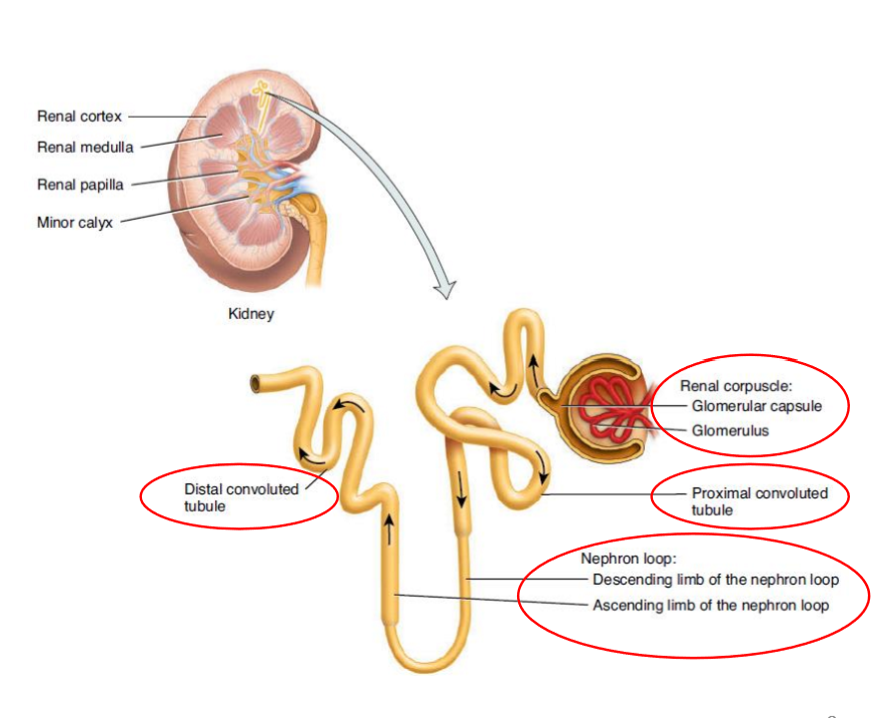
The functional unit of the kidneys (numbering greater than 1 million per kidney), composed of a renal corpuscle and a renal tubule.
Renal Corpuscle
The filtering structure of the nephron, consisting of the glomerular (Bowman's) capsule and the glomerulus (capillary network).
Renal Tubule
The conduit portion of the nephron that processes filtrate, consisting of the proximal convoluted tubule, nephron loop (loop of Henle), and distal convoluted tubule.
Juxtaglomerular apparatus
contains 2 key cell types;
Juxtaglomerular cells - Mechanoreceptor cells wrapped around the afferent arteriole that sense stretch (blood pressure) and secrete the enzyme renin when blood pressure falls (reduced stretch).
Macula Densa Cells - Tall, closely packed cells in the distal tubule sensitive to Na+ and Cl− that act as receptors in the negative feedback regulation of glomerular filtration via nitric oxide (NO).

Glomerular Filtration
A passive renal process where hydrostatic pressure forces blood plasma/fluids and dissolved solutes through the (glomerular capillary) membrane into Bowman's space. filtration across cappilaies is determined by opposing starling forces (hydrostatic v osmotic)
low conc of water in glomerulus and so cause movement of water in by osmosis

Tubular Reabsorption
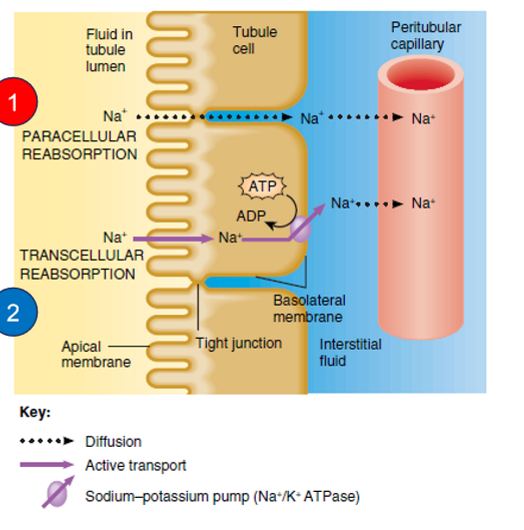
The renal process where filtered water, ions, and solutes are reclaimed from the renal tubule lumen back into the peritubular capillaries and returned to the blood. filtrates are reabsorbed by 2 methods:
passive diffusion - paracellular reasborbtion + occurs between epithelial (tubulee) cells (leaky tight junctions) + ions move from high to low conc
active transport - transcellular reabsorbption + occurs across epithelial cells (apical and/or basement memebrane) + requires participation of transport proteins (na+k+ pump) and atp
Tubular Secretion
The movement of substances (predominantly H+ and K+, as well as wastes and drugs) from the peritubular capillaries into the tubular lumen to be excreted in urine. can occur via passive diffusion or active transport
2 important outcomes:
secretion of H+ regulates blood ph
detection of pathology (diabetes), doping (steroids, epo), alcohol or illegal drugs via urine sample

Urinary Excretion Equation
The mathematical formula determining urinary excretion: Amount excreted=Amount filtered+Amount secreted−Amount reabsorbed.

Renal Handling of Substances X, Y, and Z
Three primary patterns of renal processing: Substance X is filtered and secreted without reabsorption (waste/foreign substances); Substance Y is filtered and partially reabsorbed (ions like H+ maintained homeostatically); Substance Z is filtered and completely reabsorbed (vital nutrients like glucose).
Glomerular Blood Hydrostatic Pressure (GBHP)
The fluid pressure within the glomerular capillaries (55mmHg) that promotes filtration by forcing water and solutes into Bowman's capsule.
Capsular Hydrostatic Pressure (CHP)
The hydrostatic pressure exerted by fluid inside Bowman's space (15mmHg) that opposes glomerular filtration.
Blood Colloid Osmotic Pressure (BCOP)
The osmotic pressure (30mmHg) generated by non-filtered proteins remaining in the capillary blood plasma that draws water back into the capillaries, opposing filtration.
Net Filtration Pressure (NFP)
The total pressure driving fluid across the filtration membrane, calculated as: NFP=GBHP−CHP−BCOP=55mmHg−15mmHg−30mmHg=10mmHg.
Glomerular Filtration Rate (GFR)
The volume of filtrate formed by both kidneys per unit of time; approximately 20% of renal plasma flow is filtered, producing ≈120mL/min, 7.2L/hour, or ≈173L/day.
Myogenic Mechanism
An intrinsic autoregulatory mechanism where increased blood pressure stretches vascular smooth muscle fibers in afferent arteriole walls, causing them to contract, narrow the lumen, and decrease GFR.
Tubuloglomerular Feedback
A homeostatic negative feedback response where macula densa cells detect elevated Na+, Cl−, and water delivery caused by high GFR, triggering a decrease in nitric oxide (NO) release from the JGA to constrict the afferent arteriole and reduce GFR.
Neural Regulation of GFR
Regulation mediated by increased sympathetic nerve activity releasing noradrenaline (norepinephrine), which activates α1 receptors to constrict afferent arterioles and decrease GFR.
Hormonal Regulation of GFR (Angiotensin II)
Regulation initiated by low blood volume or pressure, stimulating juxtaglomerular cells to release renin; renin leads to the formation of angiotensin II, which constricts afferent and efferent arterioles to decrease GFR.
Paracellular Reabsorption
A passive diffusion process in which filtered ions and solutes pass between adjacent renal tubular epithelial cells across leaky tight junctions down their concentration gradients.
Transcellular Reabsorption
An active transport process in which substances move through tubular epithelial cells across the apical and basolateral membranes using transport proteins (such as the Na+/K+ ATPase pump) and ATP.
Renal Plasma Clearance (C)
The volume of plasma that is completely cleared of a substance by the kidneys per unit time, quantified by the formula C=PU×V˙, where U is urine concentration, V˙ is urine flow rate, and P is plasma concentration.
Inulin Clearance
inulin is an inert polysaccharide used as a diagnostic marker to measure glomerular filtration rate (GFR)—how well the kidneys filter waste from the blood.
A clinical benchmark measurement for GFR (120mL/min), because inulin freely passes glomerular filtration and is neither reabsorbed nor secreted along the renal tubules.

Glucose Clearance
A renal clearance value that equals 0mL/min under normal physiological conditions because glucose is completely reabsorbed along the tubules (Uglucose=0mg/mL).

what are the 5 renal functions?
regulation of blood: ionic composition, ph and volume/pressure (water loss and production of enzyme renin)
removal of waste
removal of forgein substances
production of glucose during prolonged fasting
production of hormones that stimulate RBC synthesis and enzymes like renin
structure of kidney and urinary system
nephron is the main functional unit of the kidney

nephrons
functional unit of kidney
consist of 2 parts: renal corpuscle (filter) and renal tubule (conduct)
renal corpusle contain glomerlus and bowmans capsule
renal tubule contains proximal and distal convoluted tubule and loop of henle
tubule facts
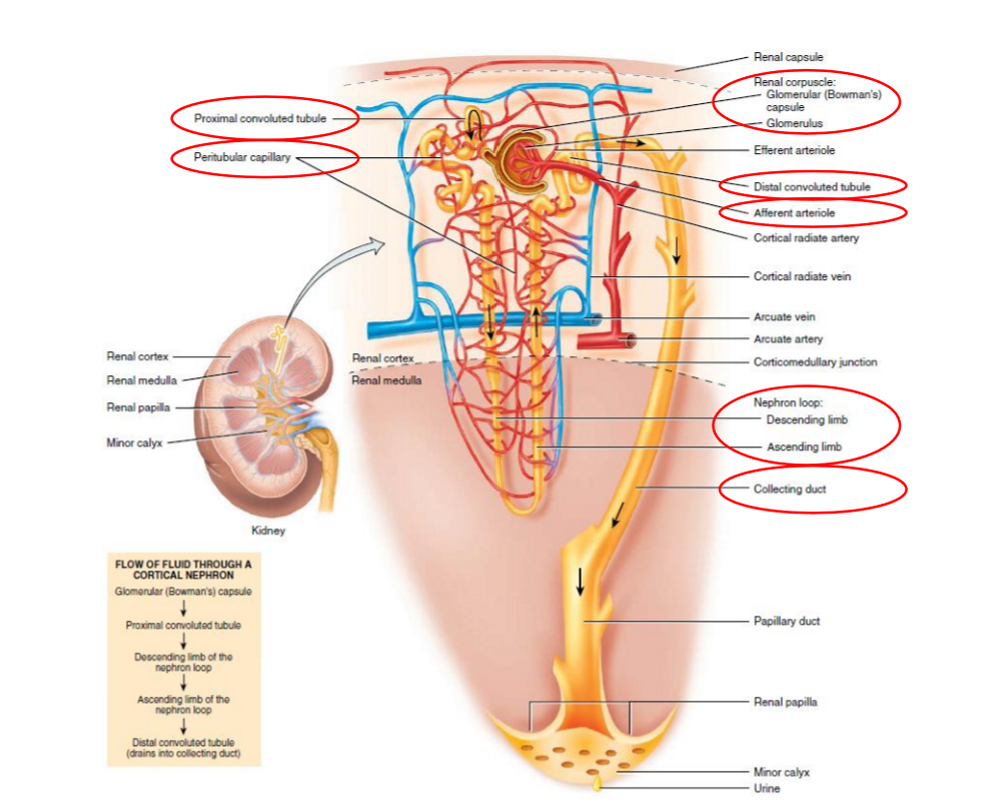
all renal tubule are surrounded by the peritubular capillaries
more of blood plasma will be absorbed back into the tubule from the peritubular capillary
everything that passes through tubule is excreted as urine
what does nitric oxide do?
its a vasodilator and macula densa cells will inhibit or stimulate release of this