Electrons (Lectures 2-4)
 Call Kai
 Learn
 Practice Test
 Spaced Repetition
 Match
 Flashcards
 Knowt Play
1/33

There's no tags or description
Looks like no tags are added yet.
34 Terms
What is the name of the model that tells us the shape of molecules and how does it work?
VSEPR - Valence shell electron pair repulsion model
The lowest energy structure will have the negatively charged electron pairs as fair apart as possible
Molecule shapes (All bonding pairs and no lone pairs)
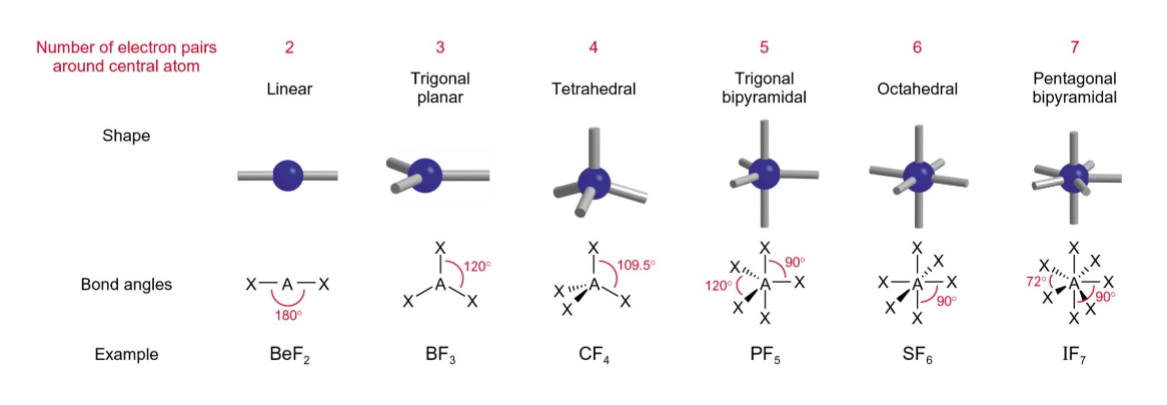
How can we find the central atom in a molecule?
It is often the element in the earlier group
When elements are in the same group, the larger and least electronegative element is central
The exception is H which is always almost terminal
When will different molecules have the same shape and what is the term for this?
Many molecules will have the same shape (isostructural) when the valence electron count is the same (isoelectric)
How does repulsion change between LP-LP, LP-BP and BP-BP repulsion
LP-LP > LP-BP > BP-BP
Where will lone pairs move in molecules in order to reduce repulsion?
The move to the least crowded sites
This means they go where there is the smallest angles and the least interactions

More molecules shapes

Why do elements when heated emit different coloured lights?
Electrons can be excited to higher energy levels
When they drop back down to lower energy levels they emit light of specific energies/wavelengths
Equations for the excitement of H atoms

What is the equation for frequency involving the speed of light and wavelength?
Frequency = the speed of light/wavelength
Frequency - Hz
Speed of light - ms-1
Wavelength - m

Equation for energy involving Planck’s constant and frequency of radiation
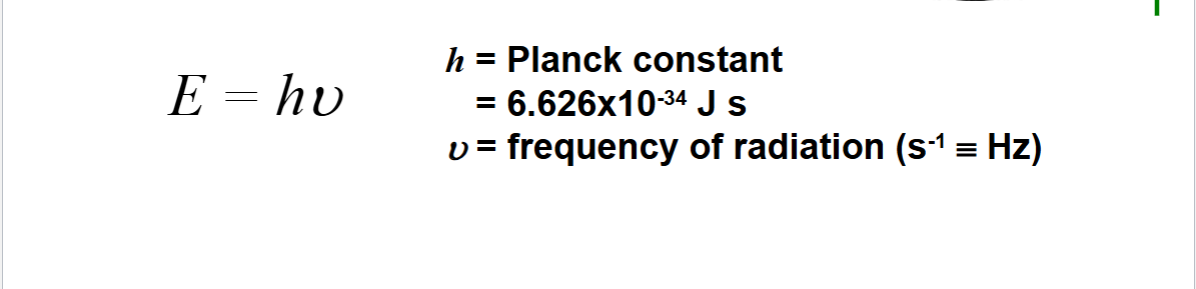
Equation for energy involving Planck’s constant, the speed of light and wavelength
Energy = Planck’s constant x Speed of light / Wavelength
What is the equation formula that gives the position of all lines of the hydrogen emission spectrum involving wavelength, the Rydberg constant and quantum numbers n?
The energy of light emitted by the hydrogen atom is restricted to transitions between integer values of n1 and n2
n1 and n2 are just placeholders, it can be any 2 energy levels

What does n being a quantum number mean?
The value is fixed rather than being a spectrum of values
So, principle energy levels have fixed values of n=1, 2, 3 and so on making them discrete rather than n=1.5 which does not exist
How is r (the radius of an energy level) and E (The energy of that energy level) proportional to the quantum number n?
The constants cancel out and Z is just the nuclear charge of the atom so that cancels out too
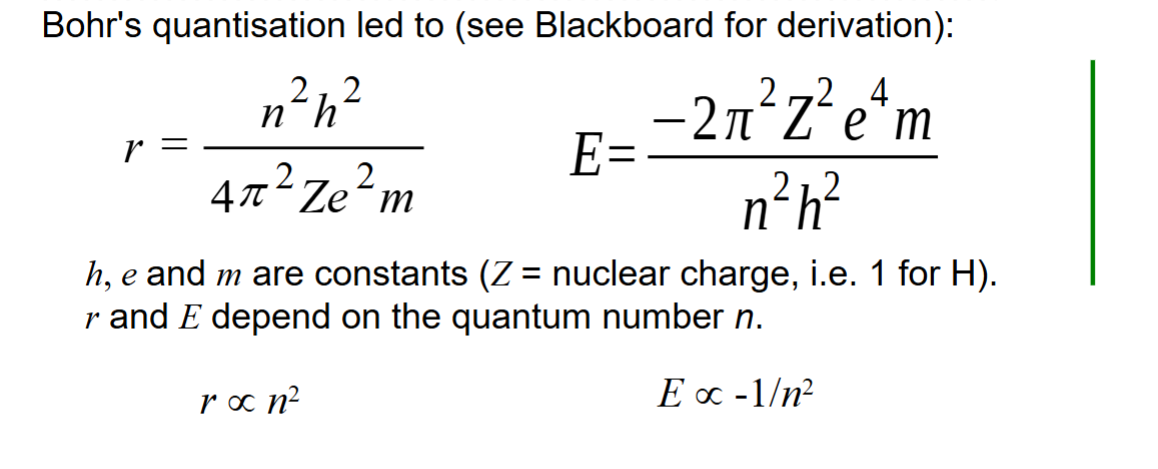
What is the Bohr Radius?
The lowest orbit/energy level an electron can inhabit
5.29×10⁻¹¹ m or 52.9 pm
At what energy level is an electron said to ‘escape’ the pull of the nucleus and what process does this correspond to?
n = infinity
This corresponds to ionisation
Equation for finding the difference between two energy levels of a specific atom?
RH = Rydberg Constant (2.18 × 10⁻¹⁸ J but can also be expressed in KJ, Hz, m-1)
n = quantum number
ΔE = Change in energy / Energy emitted upon transition (J/KJ)
Z = nuclear charge
Note that the value and units of the Rydberg constant may have to be altered to fit the equation/answer
Works for 1 electron atoms

Equation for the energy of a specific energy level
RH = Rydberg Constant (2.18 × 10⁻¹⁸ J)
n = quantum number
E = Energy (J/KJ)
Z = Nuclear charge
Works for one electron atoms

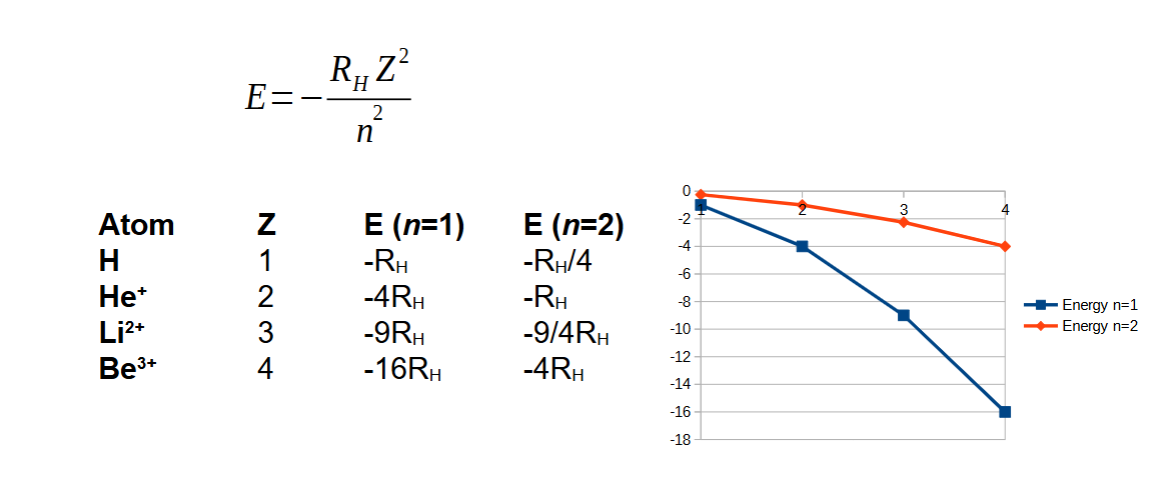
What does the data from this graph show about the effect of increasing nuclear charge on the stability of energy levels?
As nuclear charge increases, the electrons are pulled in tighter towards the nucleus due to electrostatic forces of attraction
When the nuclear charge increases, the energy of each energy level decreases/becomes more negative
This means that as nuclear charge increases, the stability of energy levels also increases
What is the quantum number, n, and how was it found?
The is the principal quantum number (“shell”)
The quantisation of the angular momentum of electrons within a fixed orbit of the nucleus allowed for this quantum number to be found
What are two problems with the Bohr model of the atom and what can we conclude from this?
When light energy is emitted, more lines appear on the visible light spectrum than expected - There is a fine structure
More lines appear when there is an external magnetic field present - The Zeeman effect
More than one orbit can have the same energy (same n)
What properties are required to define the principal quantum number, n?
The size and energy of the orbit
What properties are required to define the orbital quantum number, l and why?
Arnold Sommerfeld allowed orbits to be non-circular
This requires an additional quantum number to determine the shape of the orbit
This can also be referred to as the secondary quantum number
What property required to define the magnetic quantum number and why does this property arise?
The orientation of the orbit
The orientation is also quantised and can only lie at certain angles w.r.t a define axis
The Bohr model assumed a spherical shape which has no preferred orientation
The Bohr-Sommerfeld model with non-circular orbits can have different properties in different orientations

How can we find the principal, orbital and magnetic quantum numbers?
Principal - The energy level of an electron
Orbital - For a given value of l, an orbit can range for l=0 to n-1 (so for example if n=3, l can be 0 → 2 in integer steps)
Magnetic - For a given value of l, the value of ml can be +l to -l (so if l = 3 then ml can be from +3 → 0 → -3 in integer steps)
Each unique set of n, l and ml defines an allowed orbit
How does the fine structure of a visible light spectrum arise due to the n, l and ml values?

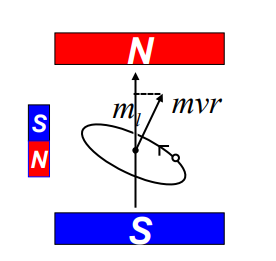
How does the fine Zeeman effect occur on a visible light spectrum arise due to the n, l and ml values?
A moving charge generates a magnetic field and as such, electrons have an associated magnetic field (magnetic moment)
This will interact with an external magnetic field
In this field, it has a preferred orientation (an orientation where it has a lower energy)
States with different ml values have different energies in a field
When no field is present, all 3 transitions are at the same energy (they are degenerate)
In a magnetic field, the orbits (and therefore the transitions) split

Equation for energy involving mass and the speed of light?
E = mc2
E - Energy in J
m - Mass in Kg
c - Speed of light in ms-1
What equation shows the way in which an electron can act as both a particle and a wave and how do we find this? What does this then tell us about matter and the properties of electrons?
All moving objects (velocity v) have a wavelength - matte is both wave-like and particle-like
h (Planck’s constant) is tiny, so this is only important for very small objects like electrons
The equation Wavelength = Planck’s constant / mass x velocity shows this as larger objects would give a wavelength so small that it would not be possible to measure their wavelength
However for electrons, this would produce a wavelength on the nanometre scale which is actually relative to the size of atoms and can be measured

What is the wavelength, amplitude, phase and node of a wave?
The amplitude is the height of the wave
The wavelength is the distance between two of the same points on the wave (like two peaks)
The phase of a wave can be positive, negative or zero
An area of 0 amplitude is called a node

What does a wave having more nodes tell us about the frequency and energy?
The more nodes, the higher the frequency as the wave is changing phases more often over the same distance
An increased frequency means a higher energy
How does diffraction and interference of electrons being observed show us about electrons
Waves undergo diffraction and interference
This shows electrons have both wave and particle like properties
How can we calculate ionisation energy?
Using the equation in the image, we can replace n2 with infinity because n = infinity corresponds to ionisation
1/infinity = 0 so we can just put this into the equation and solve for the change in energy
