Lab 3 Bryophytes & Pteridophytes + lecture notes
 Call Kai
 Learn
 Practice Test
 Spaced Repetition
 Match
 Flashcards
 Knowt Play
1/67

There's no tags or description
Looks like no tags are added yet.
68 Terms
Bryophyte
the free-sporing plants that lack vascular tissue
Pteridophytes
the free-sporing plants that have vascular tissue
What vascular tissue does it mean when it is lacking in an organism?
It does not have phloem and xylem
Bryophyte Characteristics
No (true) vascular tissue
No true leaves, stem, or roots
No seeds or pollen → have spores
Sporophyte is nutrient dependent on gametophyte
Gametophyte generation is dominant
Gametophyte is large (relative to Pteridophytes)
Gametophyte has simple dichotomous branching
Water dependent for growth and reproduction
What does dominant mean in the plant world?
the life phase where plants spend most of their lifetime in
Pteridophytes Characteristics
Vascular tissue present (Xylem & Phloem)
Free-sporing so no seeds or pollen
Gametophyte very small, inconspicuous, short-lived, at or just below soil surface
Sporophyte dominant, large, photosynthetic
Require external water for fertilization
Most species have leaves and roots
Why pteridophytes need water for fertilization?
sperm must swim through water on surface of gametophyte to fertilize egg in archegonium
Bryophytes major phyla:
Marchantiophyta
Anthocerotophyta
Bryophyta
What is Marchantiophyta’s common name
Liverwort
What is Anthocerotophyta’s common name
Hornwort
What is Bryophyta’s common name
Moss

What part of the lifecycle is A?
Zygote

What part of the lifecycle is B?
Sporangium
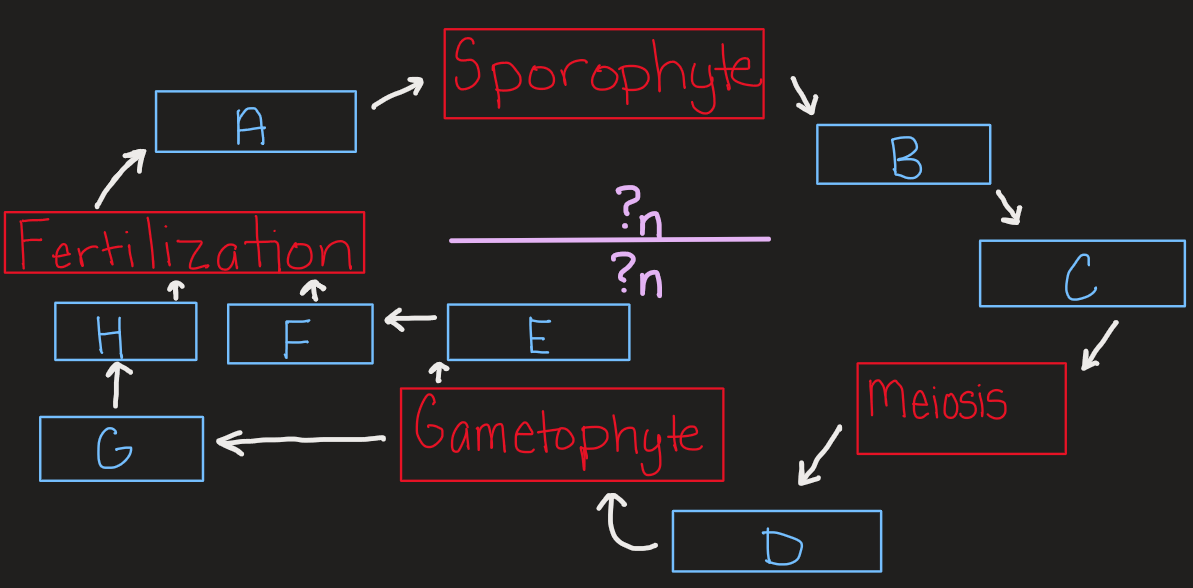
What part of the lifecycle is C?
Sporocyte

What part of the lifecycle is D?
Spores
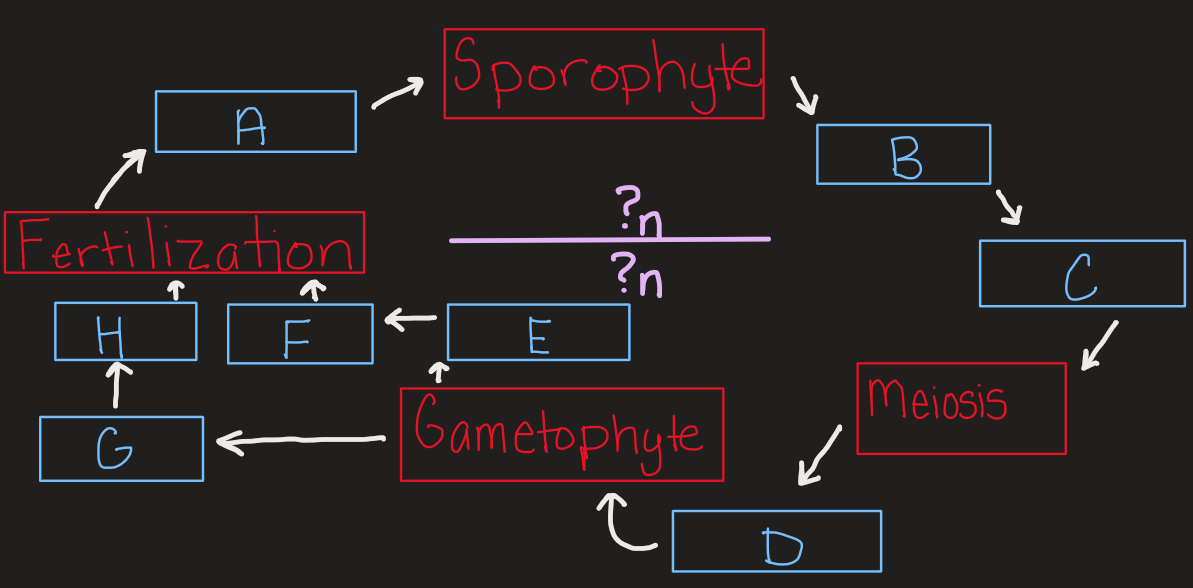
What part of the lifecycle is E?
Antheridium

What part of the lifecycle is F?
Sperm
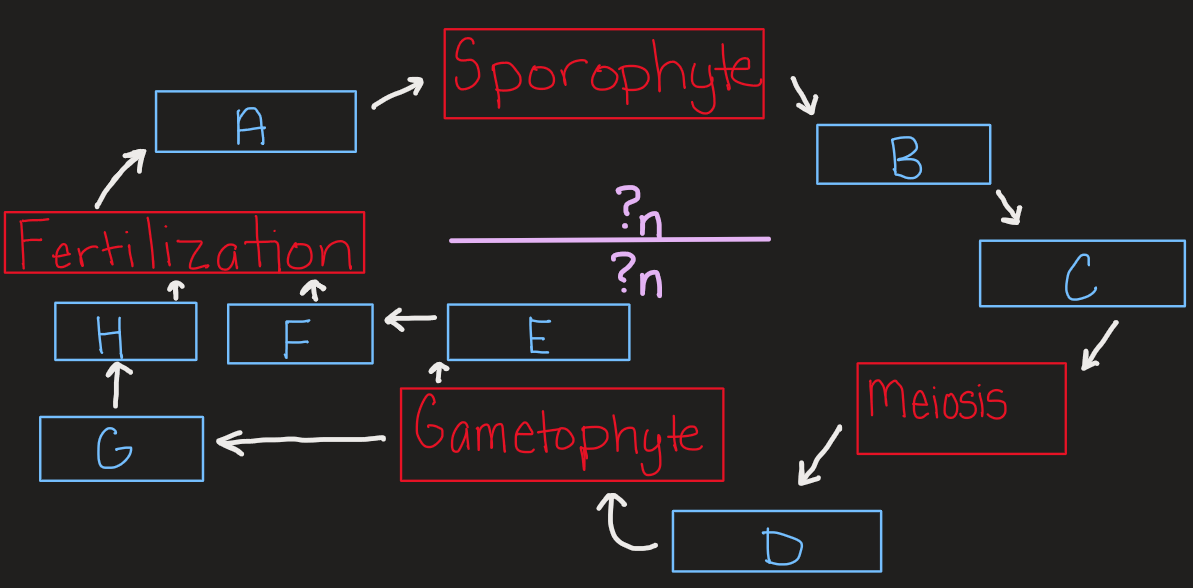
What part of the lifecycle is H?
Egg
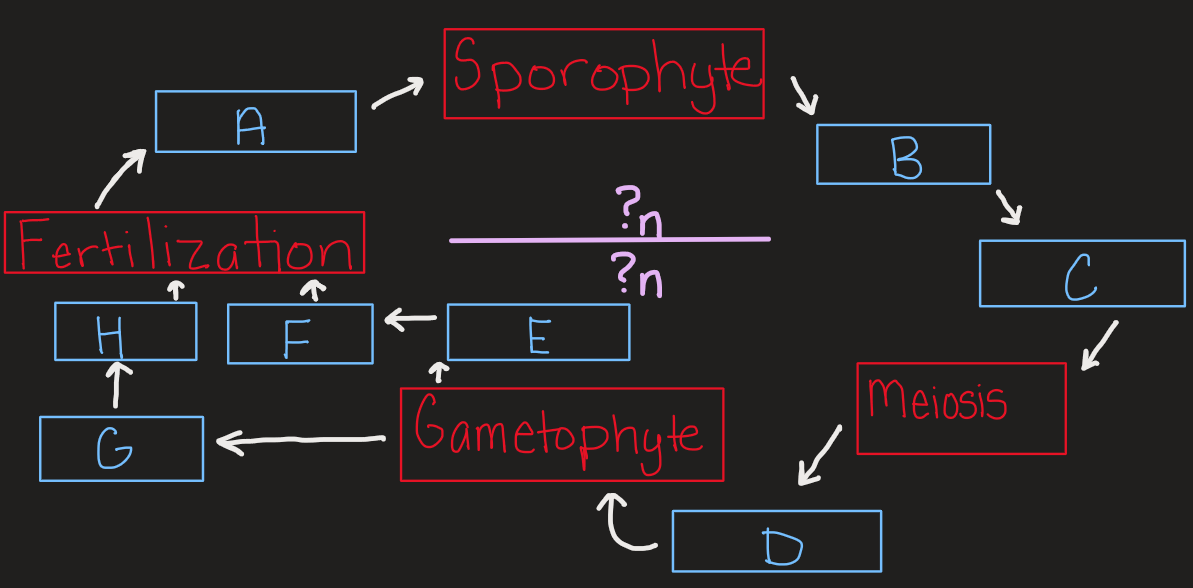
What part of the lifecycle is G?
Archegonium

What does the first ?n represent?
2n (diploid)

What does the 2nd ?n represent?
n (haploid)
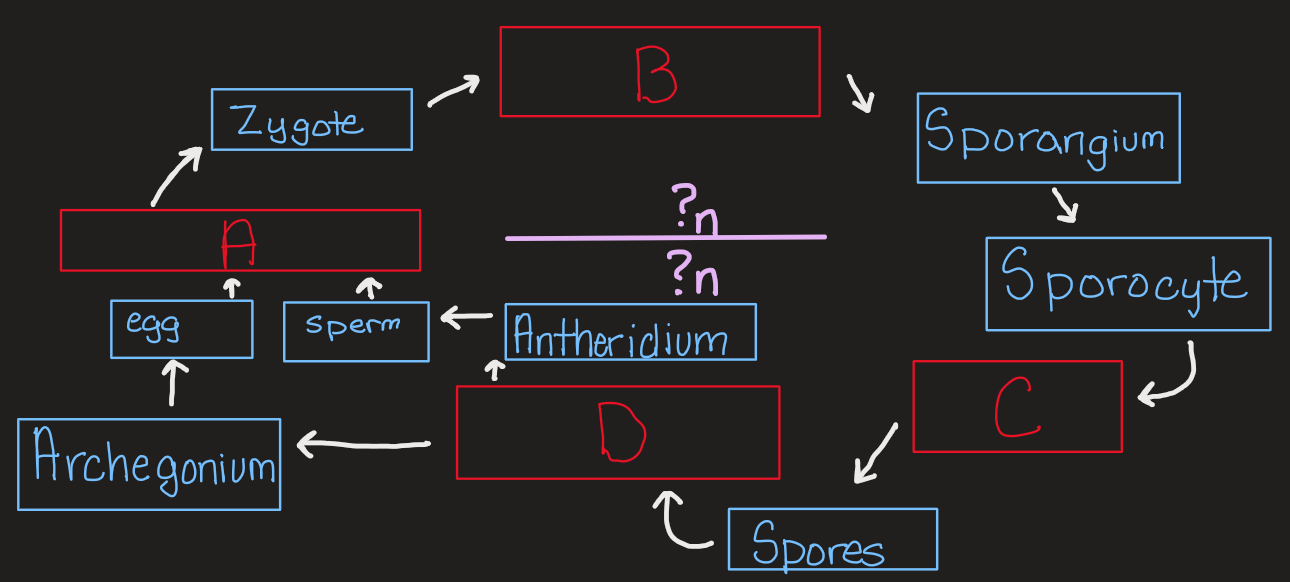
What part of the lifecycle is A?
Fertilization

What part of the lifecycle is B?
Sporophyte

What part of the lifecycle is C?
Meiosis

What part of the lifecycle is D?
Gametophyte
Unique characteristics of Liverwort?
Archegoniophore and Antherogoniophore
Unique characteristics of Mosses?
Protonema
Unique characteristics of True Fern?
Frond, Sorus (Sori)
Unique characteristics of Horsetail?
Strobilus
Unique characteristic of Whisk Fern?
Synangia
Thalloid Liverworts
No vascular tissue
Thallus body → lacks tissue differentiation
Simple body plan (dichotomous)
Leptoids
Hydroids
Requires water for viablity
Chambers
Liverworts’ Thallus Body
Chambers
body cell sections that can do photosynthesis
not compact
pores
open 24/7
unable to close
Rhizoids
outside chamber at bottom
hair like structures that stick out
like a root BUT not
Sexual Reproduction of Liverworts
Antheridophore
Archegoniophore
Antheridiophore what is it
male (sperm) of liverworts

What does this structure show
Liverwort’s antheridiophore
Archegoniophore what is it
female (egg) of liverworts

What does this structure show?
Archegoniophore in liverworts
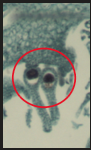
What is the circle showing
Archegonium

What does A show
Antheridium

What does B show
Spermatongenous tissue
What does C show
Stalk
Liverwort Sporophyte
Diploid generation → multicellular
Produces Sporangium → the site of meiosis → produces spores
Liverwort Sporophyte physical organization
Elaters
Spores
Seta (stalk)
Foot
Paraphyses
Elaters
holds spores then shoots it out when dry
Paraphyses
Hair like extensions to keep high humidity on sporangium
Liverwort Asexual Reproduction
Gemma Cups
What is Gemma Cups
Genetic clones → haploid (n)
Water dispersal

What is this
A gemma cup from a Liverwort’s asexual reproduction
Hornworts Anthrocerotophyta
Thallus Base → gametophyte gen
Extension (stalk/horn) → sporophyte
Sporangium is larger than in liverworts
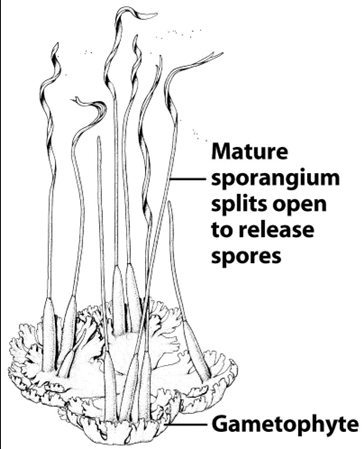
What organism does this show
Hornwort
Moss Gametophyte physical structure
haploid (n)
Enations
rhizoids
stalk
Moss Sporophyte
Diploid (2n)
Foot
Seta
Capsule (with sporangium)

What does this structure show and how is it important to moss
The structure is Protonema it is unique to moss
Moss Antheridium
Part of gametophyte
Haploid (n)
Site of sperm production → via mitosis

What does this show
Moss Antheridum

what does this show?
Moss Archegonium
Moss Archegonium
Part of gametophyte
haploid (n)
site of egg production → via mitosis

What does this show
Moss Sporophyte
Moss Sporophyte
Diploid (2n) generation
Includes sporangium
Site of meiosis
Produces spores → via meiosis
What is an example of real moss
Peat moss
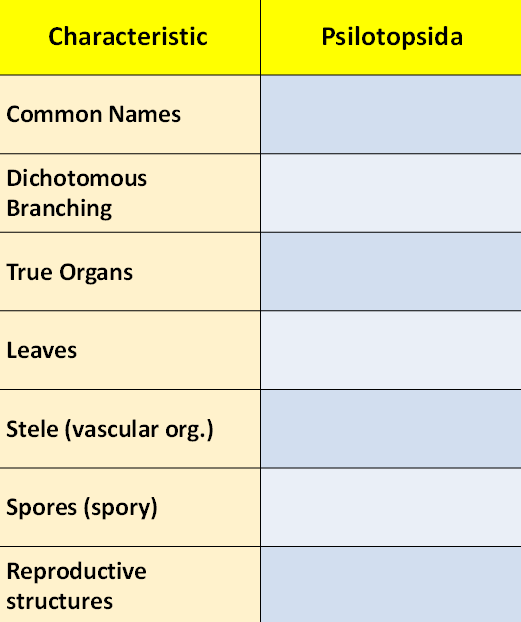
What are the characteristics of Psilotopsida?
Common name: Whisk Fern
Dichotomous: Yes (best example of it)
True Organs: Stem only
Leaves: Enations
Stele (vasc. org.): Protostele
Spores (spory): Homospory
Reproductive Structures: Syangium
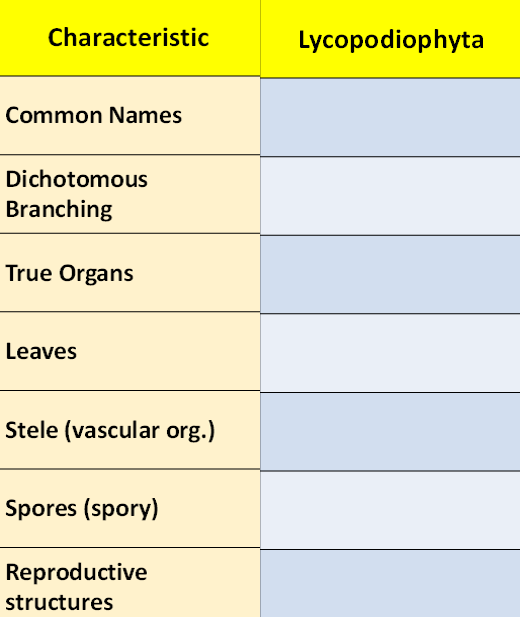
What are the characteristics of lycopodiophyta?
Common name: Club Moss
Dichotomous: Some
True Organs: True roots, stem, and leaves
Leaves: Microphyll
Stele (vasc. org.): Protostele
Spores (spory): Homospory
Reproductive Structures: Strobilus

What are the characteristics of Equisetopsida?
Common name: Horsetails
Dichotomous: Some
True Organs: True roots, stem, and leaves
Leaves: Microphyll
Stele (vasc. org.): Protostele
Spores (spory): Heterospory
Reproductive Structures: Strobilus

What are the characteristics of Polypodiopsida?
Common name: True Ferns
Dichotomous: None
True Organ: True roots, stem, and leaves
Leaves: Megaphylls
Stele (vasc. org.): Siphonostele (Proto)
Spores (spory): Homospory
Reproductive Structures: Strobilus
Homospory
1 kind of spore type produced
Heterospory
2 or more kinds of spores produced
Strobilus on Lycopodiacea (Club Mosses)
Sporangium on sporophyll
Sporocytes in sporangium
Meiosis of sporocytes
Spores produced
Spores disperse
Which one is Heterospory
Selaginellaceae (Spike Moss)