Communicable Diseases and Infection
 Call Kai
 Learn
 Practice Test
 Spaced Repetition
 Match
 Flashcards
 Knowt Play
1/62

There's no tags or description
Looks like no tags are added yet.
Name | Mastery | Learn | Test | Matching | Spaced | Call with Kai | Chat |
|---|
No analytics yet
Send a link to your students to track their progress
63 Terms
Communicable Disease
caused by an infectious agent or its toxic products and can pass from one person to another either
directly (contact with an infected person) or
indirectly (contaminated objects, vectors, food, or water).
Examples are influenza, tuberculosis, and measles.
influenza, tuberculosis, and measles.
Example of Communicable Disease
Infectious Disease
any disease caused by the invasion and multiplication of microorganisms (bacteria, viruses, fungi, or parasites) that damage or alter the host’s normal functioning.
ok
All communicable diseases are infectious, but not all infectious diseases are easily communicable. For example, tetanus is
infectious but not communicable because it does not spread from person to person.
Infection
The entry and multiplication of an infectious agent in or on the tissue of a host.
Colonization
The agent is present but does not injure the host’s cells or tissues.
Symptomatic Infection
The pathogens multiply and cause clinical signs and symptoms.
Pathogen
An organism that can cause disease.
Nonpathogenic Organism
An organism that does not cause disease.
Virulence
A measure of how likely an organism is to cause disease.
Contact
Any person or animal in close association with an infected person, animal, or freshly soiled materials.
Habitat
The place where an organism is usually found.
Reservoir
One or more species of plant or animal in which an infectious agent lives and multiplies to survive, and from which it can be transmitted to humans.
Carrier
A person who harbors the organism and can transmit it to a susceptible host, often without showing symptoms (asymptomatic).
Types: incubatory, convalescent, intermittent, and chronic.
Incubatory
Convalescent
Intermittent
Chronic
Types of Carriers
Susceptibility and Pathogenecity
Reasons for Infection
pathogenicity
susceptibility of the host
environment
Whether an infection becomes a disease depends on the
_______ of the microorganism (its ability to cause disease)
__________ (how vulnerable a person is), and the
________ The following factors explain why infections persist:
Antibiotic Resistance
Reasons for Infections: Susceptibility and Pathogenicity
Some bacteria develop resistance to commonly used antibiotics, which makes treatment difficult and prolongs infection.
Viral Variability
Reasons for Infections: Susceptibility and Pathogenicity
Some viruses, like influenza, have many strains and mutate often, so one vaccine cannot give full protection.
Resistance to Antiviral drugs
Reasons for Infections: Susceptibility and Pathogenicity
Many viruses are naturally resistant to antiviral medicines, which limits treatment options.
Emergence of New Agents
Reasons for Infections: Susceptibility and Pathogenicity
New infectious diseases, such as HIV and coronaviruses, appear from time to time and threaten global health.
Microbial Localization
Reasons for Infections: Susceptibility and Pathogenicity
Some microbes live in hard-to-reach areas of the body, such as the bones or central nervous system, and are harder to treat.
Opportunistic Infections
Reasons for Infections: Susceptibility and Pathogenicity
Organisms that are normally harmless can cause disease in
immunocompromised people (e.g., those with HIV/AIDS or undergoing chemotherapy).
Lack of Vaccination
Reasons for Infections: Susceptibility and Pathogenicity
People who are not vaccinated remain vulnerable to preventable diseases.
Global Travel
Reasons for Infections: Susceptibility and Pathogenicity
Air travel lets pathogens spread across long distances within hours, causing outbreaks in crowded areas.
Bioterrorism and Biologic Warfare
Reasons for Infections: Susceptibility and Pathogenicity
The intentional release of pathogens, such as anthrax or plague, threatens public safety.
Medical Intervention
Reasons for Infections: Susceptibility and Pathogenicity
Immunosuppressive drugs and invasive procedures increase the risk of infection, as does belonging to a high-risk group (the very young and the elderly).
Incubation period
Prodromal period
Period of Clinical Illness
Convalescence period
An infectious disease develops in four stages:

Incubation Period
The time between exposure to the pathogen and the first symptoms. The organism multiplies silently.
Prodromal period
A short phase of vague, nonspecific symptoms that signals the start of illness.
Period of Clinical Illness
Active disease with rapid pathogen multiplication, peak symptoms, and the highest risk of transmission.
Convalescence period
The recovery phase, when the host regains strength and returns to baseline health.
epidemiological triad of agent, host, and environment
Disease occurrence is best explained by the _____________
ok
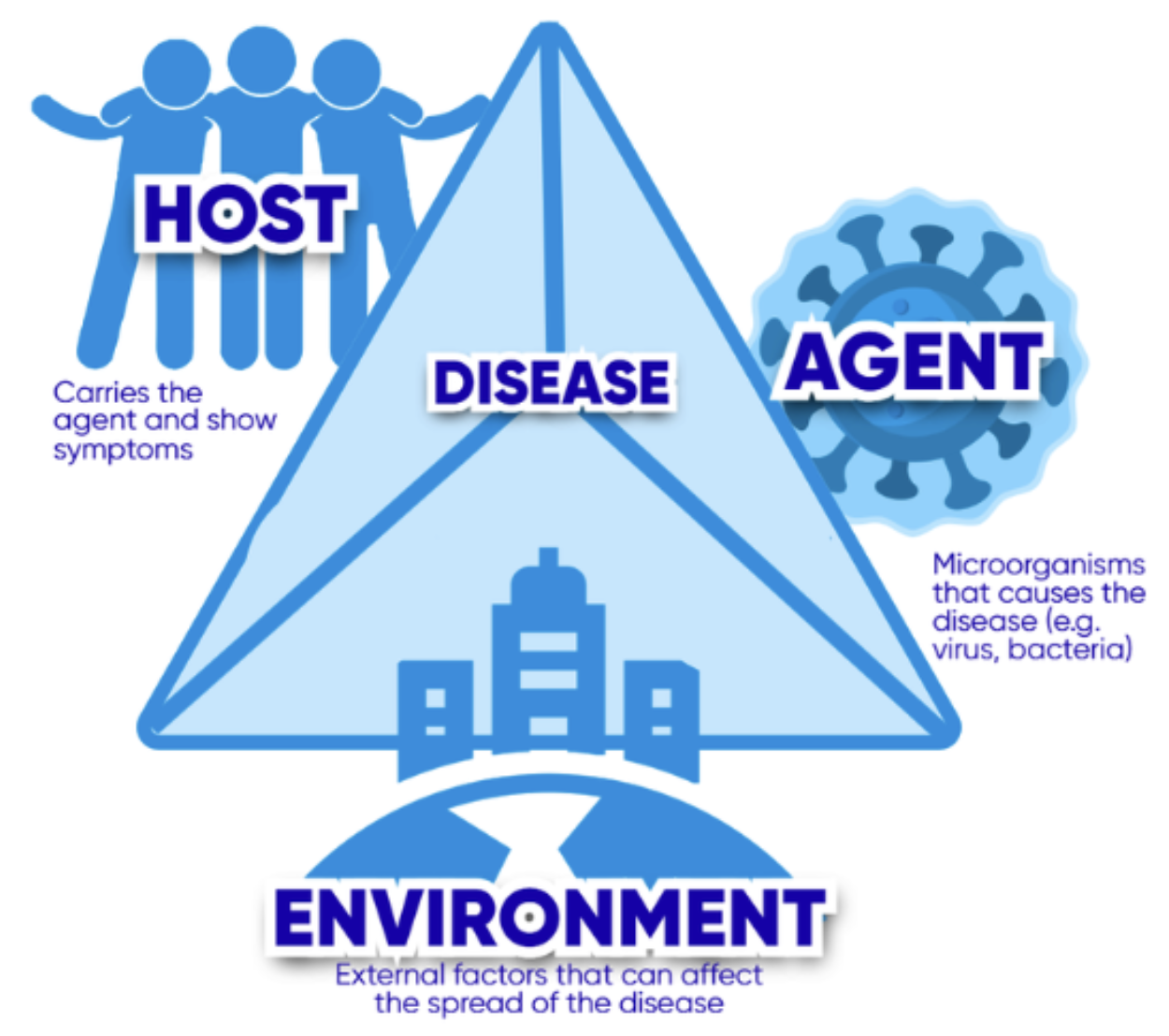
Agent
The infectious microorganism, described by its pathogenicity,
infectivity, virulence, and infective dose.
Host
Susceptibility depends on age, sex, genetic makeup, immune status, and comorbidities. A host may be a patient, a carrier, a suspect, or a contact.
Environment
External factors that affect disease occurrence:
physical (climate, geography),
biological (plants, animals), and
socio-economic (poverty, sanitation, access to health care).
Chain of infection
Infection spreads through a series of linked steps called the____
Infectious agent
Reservoir
Portal of exit
Mode of Transmission
Portal of entry
Susceptible host
Chain of Infection
Infectious agent
Chain of Infection
Microbes that can cause disease (e.g., bacteria, viruses, fungi,
parasites, amoeba).
Reservoir
Chain of Infection
Where the agent lives and multiplies: humans (including
carriers), animals, or the environment.
Portal of exit
Chain of Infection
How the agent leaves the reservoir: through the
respiratory,
gastrointestinal, or
genitourinary tract, the
skin, or the
placenta.
Mode of transmission
Chain of Infection
The link that is easiest to break. It includes
direct or indirect contact,
droplet, airborne,
vehicle-borne, vector-borne, and vertical transmission (mother to child).
Portal of entry
Chain of Infection
The same routes as the portals of exit, now allowing the agent to
invade a new host.
Susceptible host
Chain of Infection
A person who can be infected, determined by
immunity,
nutrition,
health status, and
environmental exposures.
Example: malnourished children are susceptible to infections.
ok
Infections differ in source, manifestation, and how they are acquired. Knowing these differences supports diagnosis, prevention, and control.
Subclinical / Asymptomatic
Latent
Exogenous
Endogenous
Healthcare associated infections (HAIs) / Iatrogenic
Types of Infection
Subclinical / Asymptomatic
The person is infected (confirmed by laboratory tests) but has no signs or symptoms. Such individuals may still spread the disease unknowingly.
asymptomatic carriers of COVID-19, Hepatitis B, or HIV.
Latent
The microorganism stays dormant in the host, sometimes for years, without causing illness. It may reactivate and cause disease when triggered (e.g., by weakened immunity).
herpes simplex virus, tuberculosis.
Exogenous
Caused by microorganisms that enter the body from outside sources such as contaminated food, water, air, or contact with infected people.
Example: Salmonella infection from contaminated food.
Endogenous
Occurs when normally harmless microorganisms (normal flora) inside the body become pathogenic because of an imbalance or weakened immunity.
Example: urinary tract infection (UTI) caused by E. coli from the gut.
Healthcare Associated infections (HAIs) / Iatrogenic
Formerly called nosocomial infections. These are acquired by patients while receiving care in hospitals or other healthcare facilities, often from invasive procedures, prolonged hospitalization, or cross-infection between patients and staff.
Examples: MRSA (methicillin-resistant Staphylococcus aureus)
ventilator- associated pneumonia.
Endemic
Epidemic
Pandemic
Sporadic
Classification of Disease by Distribution
Endemic
Constantly present in a particular geographic area or population group.
Example: malaria in tropical countries; schistosomiasis in Samar and Leyte (Philippines).
Epidemic
Cases rise suddenly above the expected number in a specific area or community.
Example: a cholera outbreak in an evacuation site after a typhoon.
Pandemic
An epidemic that spreads across several countries or continents and affects many people.
Example: COVID-19; HIV/AIDS.
Sporadic
Occurs irregularly and infrequently, with only a few cases and no predictable pattern.
Example: tetanus, gas gangrene.
Emerging infectous diseases
are illnesses that have recently appeared in a population or are rapidly increasing in number or geographic range, often because of newly identified pathogens or known agents spreading to new areas (e.g., HIV, SARS, COVID-19).
Re-emerging infectious diseases
________ had declined because of control measures such as vaccination and treatment but are now returning because of
drug resistance,
vaccine hesitancy, or
environmental change
e.g., tuberculosis, dengue, measles, polio).
ok
In short, emerging diseases are new threats, while re-emerging diseases are old threats returning.
crowded urban living and demographic shifts
international travel and migration,
socio-economic problems,
environmental and climate change,
misuse of antibiotics, and vaccine hesitancy.
Emerging & Re-emerging Infectious disease
Both are driven by
___(5)