ABD: Mock Registry Exam E24
 Call Kai
 Learn
 Practice Test
 Spaced Repetition
 Match
 Flashcards
 Knowt Play
1/169

There's no tags or description
Looks like no tags are added yet.
170 Terms
Which of the following can lead to a false positive diagnosis of stones in the biliary system?
a. decreased color doppler gain
b. improperly decreased TGC settings
c. shadowing from surgical clip in portal hepatis
d. rejection setting too high
c
The average measurement of the normal spleen is:
a. 6-10 mm
b. 6-10 cm
c. less than 12 cm
d. 5-8 cm
c
Which of the following liver abnormalities can be related to the use of oral contraceptives?
a. Budd Chiari syndrome and hydatid disease
b. hydatid disease and schistomiasis
c. liver metastasis and hepatic adenoma
d. hepatic adenoma and Budd Chiari syndrome
d
Increasing the size of the field of view will _______ the frame rate.
a. cause a 50% decrease
b. have no effect on
c. increase
d. decrease
d
How can a hepatic adenoma be differentiated from FNH on contrast enhanced ultrasound?
a. FNH lesions demonstrate no contrast uptake while adenomas demonstrate significant contrast uptake
b. FNH lesions usually demonstrate centrifugal enhancement while adenomas demonstrate centripetal enhancement
c. FNH lesions demonstrate significant contrast uptake while adenomas demonstrate no contrast uptake
d. FNH lesions usually demonstrate centripetal enhancement while adenomas demonstrate centrifugal enhancement
b
Which liver disorder leads to the sonographic appearance of hepatomegaly with decreased echogenicity and scattered bright portal reflections within the parenchyma?
a. cirrhosis
b. chronic viral hepatitis
c. acute viral hepatitis
d. hydatid disease
c
Which of the following describes splenomegaly?
a. the spleen extends below the lower pole of the left kidney
b. the spleen extends below the upper pole of the left kidney
c. the spleen extends to a position immediately adjacent to the pancreatic tail
d. the spleen extends below the mid pole of the left kidney
a
The development of scar tissue and fibrous plaque formation involving the tunica albuginea of the penis describes:
a. peyronie disease
b. penile fracture
c. priapism
d. squamous cell carcinoma of the penis
a
What biliary anomaly is suspected if jaundice persists more than 14 days after birth?
a. choledochal cyst
b. biliary atresia
c. ectopic GB
d. agenesis of the GB
b
A patient presents with a recent history of histoplasmosis infection. The referring doctor would like to evaluate the abdomen for residual effects from the infection. Which sonographic findings in the abdomen would be consistent with this type of infection?
a. mild to moderate ascites and splenomegaly
b. multiple echogenic foci in the liver and/or spleen parenchyma
c. dilated ductal system of the liver with inflammation (cholangitis)
d. significant amount of loculated ascites in the bilateral paracolid gutters
b
Which of the following is associated with echogenic debris/calcifications in the renal pyramids?
a. hydronephrosis
b. AML
c. papillary necrosis
d. hyperthyroidism
c
A 56 y/o male presents with acute onset epigastric pain that had persisted for 2 days. His lab results demonstrate elevated amylase and lipase. Multiple mobile echogenic foci are present in the GB with a wall thickness of 2.4 mm. The CBD measures 6 mm and appears patent. The pancreas is mildly enlarged with posterior enhancement. Which of the following best describes these findings?
a. adenomyomatosis w/ cholelithiasis and cholecystitis
b. cystic fibrosis with cholelithiasis
c. chronic pancreatitis wiht cholelithiasis
d. acute pancreatitis with cholelithiasis
d
While performing color doppler on a routine renal US, extreme turbulence is noted at the RRA origin. How should your exam change to evaluate the finding?
a. use PW doppler to record a flow pattern in the area of turbulence
b. advise the patient that they may have to return for an additional exam because of the suspected renal stenosis
c. have the patient perform the Valsalva maneuver and reassess the vessel for changes
d. turn off color doppler and activate power doppler instead to remove the aliasing
a
Which of the following liver disorders will result in increased levels of iron stored in the liver?
a. hemochromatosis
b. amyloid disease
c. Wilson disease
d. glycogen storage disease
a
The _______ is located within the inferior margin of the falciform ligament.
a. left hepatic vein
b. middle hepatic vein
c. ligamentum teres
d. ligamentum venosum
c
What is epiploic appendagitis?
a. inflammation of the thick fatty strands that attach to the serosal surface of the colon
b. perforated appendix with pericolic fluid
c. a fatal type of diverticulitis
d. another term to describe Crohn disease
a
_________ abscesses are most commonly found in countries outside the US. ________ abscesses are most commonly seen in immunosuppressed patients.
a. pyogenic, amebic
b. amebic, fungal
c. fungal, amebic
d. fungal, pyogenic
b
What organ produces sodium bicarbonate?
a. pancreas
b. parathyroid gland
c. adrenal gland
d. kidneys
a
A patient presents for a liver ultrasound with contrast to evaluate a tumor. Which of the following lists the correct machine settings needed for the exam?
a. low mechanical index, harmonic imaging off, and focal zone at abdominal wall
b. low mechanical index, harmonic imaging on, and focal zone placed at area of interest
c. highest output power settings available, harmonic imaging on, and at least 3 focal zones surrounding the area of interest
d. mechanical index over 1.5, harmonic imaging off, and focal zone at abdominal wall
b
A disorder that affects the pancreas by causing it to excrete a thick mucus-like substance that inhibits the exocrine function is called:
a. pancreatitis
b. insulinoma
c. tuberculosis
d. cystic fibrosis
d
Congestive splenomegaly is an expected finding in patients with:
a. CHF and splenic thrombosis
b. lymphoma and leukemia
c. autosomal dominant polycystic kidney disease
d. multicystic kidney disease
a
When scanning the pancreas, which of the following techniques will assist in reducing the gas artifact around the pancreas?
a. ask patient to perform the Valsalva maneuver
b. scanning the patient while they are prone
c. ultrasound contrast injection
d. deep inspiration or drink water
d

Use your mouse to place your cursor over the sternocleidomastoid muscle and click to mark the structure.

The proximal superior mesenteric vein is normally located _______ the proximal superior mesenteric artery in the abdomen.
a. superior to
b. to the right of
c. to the left of
d. posterior to
b
Alcoholic fatty liver disease demonstrates what difference in lab values from nonalcoholic causes?
a. alcoholic fatty liver disease demonstrates a much smaller increase in LFT levels with an AST/ALT ratio <1
b. alcoholic fatty liver disease demonstrates a much greater increase in AFP levels
c. alcoholic fatty liver disease demonstrates a much greater increase in LFT levels with an AST/ALT ratio >2
d. alcoholic fatty liver disease demonstrates no effect on the AST level, but the ALT level is markedly increased
c
How are the gain settings adjusted to the proper level for evaluation of abdominal structures?
a. the liver echogenicity should be set to a medium gray level at the start of the exam
b. the spleen echogenicity should be set to a medium gray level at the start of the exam
c. the anterior abdominal fat should appear as a medium gray level throughout the exam
d. a normal GB or IVC should look anechoic throughout the exam
d
The term “splanchnic arteries” describes which of the following vessels?
a. celiac, SMA, and IMA
b. hepatic, renal, splenic, and celiac arteries
c. renal, suprarenal, splenic, and gastric arteries
d. all arterial branches of the abdominal aorta from the diaphragm to the umbilicus
a
You are performing a renal artery doppler exam for renal stenosis. The mid aortic peak velocity is 70 cm/s. The RRA peak velocity is 140 cm/s and the LRA peak velocity is 240 cm/s. What is the RAR for the right kidney?
a. 3.4
b. 0.3
c. 2.0
d. 0.5
c
Which of the following is not a layer of the scrotal sac?
a. tunica vaginalis
b. Dartos muscle
c. detrusor muscle
d. epithelial/skin
c
Which of the following is a resonance artifact only seen with a gas/tissue interface?
a. posterior shadowing
b. ring down
c. mirror imaging
d. misregistration
b
Which of the following sonographic characteristics is most suggestive of acute renal vein thrombosis?
a. diastolic flow reversal in the renal arteries
b. atrophied kidney with mottled echogenicity
c. hyperarterial flow within the kidney
d. increased corticomedullary definition
a
The renal pyramids are found in the:
a. medulla
b. cortex
c. sinus
d. calyces
a
Cholelithiasis without cholecystitis is most likely to be seen in a patient with:
a. a history of recent abdominal surgery
b. AIDS
c. sepsis
d. a history of prolonged low fat diet
d
A 65 y/o female presents for a neck ultrasound with a script that states hypophosphatemia and hypercalcemia. What do you expect to find on the exam?
a. enlarged parathyroid glands
b. atrophied thyroid gland
c. papillary thyroid cancer
d. medullary thyroid cancer
a
The diameter of the _______ will be relatively unaffected by hepatic congestion.
a. MPV
b. LHV
c. RHV
d. hepatic artery
d

Use your mouse to place your cursor over the gastroduodenal artery and click to mark the vessel. If the vessel is not demonstrated on the image, mark the purple box that says “Not demonstrated on the image.”


Which acoustic artifact is demonstrated on the image?
a. comet tail
b. mirror imaging
c. posterior shadowing
d. range resolution
b
Which structure is visualized posterior and medial to the left lobe of the thyroid gland?
a. esophagus
b. left sternocleidomastoid muscle
c. left longus colli muscle
d. left omohyoid muscle
a
Which of the following describes a tardus parvus waveform?
a. low velocity with late systolic peak
b. high velocity with sharp peak
c. low velocity with diastolic flow reversal
d. high velocity with diastolic flow reversal
a
Which of the following abnormalities would benefit the most from the administration of a water enema during the ultrasound evaluation?
a. pancreatic adenocarcinoma (head)
b. distal abdominal aorta
c. adenocarcinoma of the descending colon
d. gastric sarcoma
c

What structure is indicated by #3?
a. IVC
b. CBD
c. splenic vein
d. MPV
d
Hepatic fibrosis and portal HTN are seen with which of the following?
a. juvenile ARPKD
b. acute hydronephrosis
c. multicystic dysplastic kidney disease
d. perinatal ARPKD
a
A 35 y/o male patient presents for a RUQ ultrasound due to pain, increase alkaline phosphatase and conjugated bilirubin. You identify dilated intrahepatic ducts in both lobes of the liver, while the CBD and GB appear within normal limits. Which of the following describes the cause for these findings?
a. stone in right hepatic duct
b. stone in left hepatic duct
c. biliary atresia
d. stone in common hepatic duct
d
Which of the following describes the most common sonographic appearance of a hepatoma?
a. solid mass that may be more or less echogenic that liver parenchyma
b. usually causes multiple diffuse solid mass formation
c. most commonly demonstrates diffuse coarse liver texture in the affected lobe
d. echogenic mass with a central scar
a
__________ usually presents as multiple target lesion in the liver.
a. Klatskin tumor
b. metastasis
c. fungal abscess
d. hydatid disease
b
Which of the following is a contraindication to placement of a TIPS shunt?
a. portal thrombosis
b. cirrhosis
c. splenic varices
d. hepatic artery aneurysm
a
When evaluating a patient with an aortic endograft, an increase in the aortic sac size of _____ or more, suggests an endoleak is present.
a. 0.6 cm
b. 0.9 cm
c. 1.5 cm
d. 0.2 cm
a
Reduced glycogen storage in the liver usually causes the liver parenchyma to have a sonographic appearance similar to:
a. cirrhosis
b. steatosis
c. polycystic disease
d. acute viral hepatitis
d
Which of the following requires health care providers and organizations to develop and follow procedures that ensure the safety and confidentiality and security of protected health information?
a. ALARA principle
b. Stark Law
c. health insurance portability and accountability act
d. informed consent
c
What is the most accurate sonographic predictor of pyloric stenosis?
a. cross-sectional diameter
b. muscle wall thickness
c. channel length
d. gastric volume
b
The patient presents with a history of choledocholithiasis. How will you assess the common bile duct for a presence of a stone?
a. demonstrate a longitudinal view of the main portal vein and look for the CBD anterior to it
b. demonstrate a transverse view of the pancreatic head and look for the CBD entering the anterior aspect
c. demonstrate a long axis gallbladder image and look for the CBD superior to it
d. locate the main portal vein and look for the CBD posterior to it
a
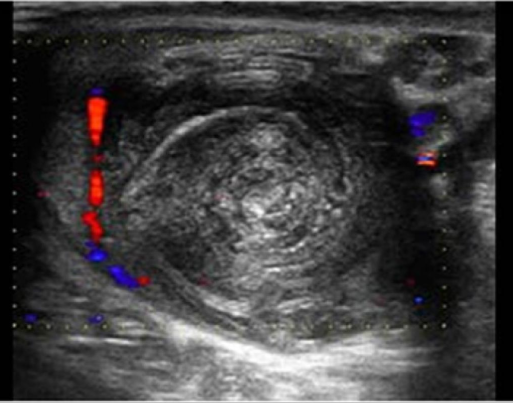
A patient presents with a palpable lump in the RT testicle. Lab values are normal and there is no fever. What is the most likely diagnosis for the abnormality in the image?
a. dilated rete testis
b. yolk sac tumor
c. seminoma
d. epidermoid cyst
d
Which of the following describes carpal tunnel syndrome?
a. compression of the median nerve by the carpal sheath causing numbess, weakness, and pain
b. compression of the blood vessels as they enter/exit the wrist causing thrombus formation and emboli
c. damage to the cartilage between the carpal bones of the wrist causing swelling and pain with motion
d. damage to the median nerve by chronic compression between the metacarpal bones of the palm
a
An asymptomatic patients presents for a renal US for size evaluation due to chronic systemic HTN. The RT kidney demonstrates a 1 cm rounded hyperechoic mass within the renal cortex. There is no posterior enhancement or shadowing noted within the mass. Which of the following can be used to describe the US findings?
a. AML or lipoma
b. adenoma or fibroma
c. oncocytoma
d. hepatoma
a
Which of the following is an expected sonographic finding with complete duplication of the collecting system of the kidney?
a. circumferential cortex at the lower pole
b. circumferential cortex at the mid pole
c. circumferential cortex at the upper pole
d. circumferential cortex at the upper and lower poles only
b
Which of the following describes the sonographic appearance of FNH?
a. single or multiple hypoechoic rounded masses with mild posterior shadowing within the liver parenchyma
b. a single mass <5 cm with a central scar and prominent central and radial vascularity
c. diffuse echogenic nodules or foci scattered throughout the liver parenchyma
d. a single hyperechoic mass most commonly found adjacent to the porta hepatis
b
Which of the following are clinical findings related to pheochromocytoma?
a. palpitations and skin discoloration
b. increased adrenaline and anxiety
c. hirsutism and bilateral pedal edema
d. bradycardia and fatigue
b
Which of the following describes how to differentiate tumefactive sludge from GB carcinoma?
a. ask the patient to perform the Valsalva maneuver
b. use color doppler over the area of interest
c. give the patient a fatty meal and rescan
d. turn off harmonic imaging
b
Which of the following doppler information is necessary to calculate the resistive index?
a. peak systolic velocity and peak diastolic velocity
b. peak systolic velocity and end diastolic velocity
c. peak systolic velocity, average flow velocity, and end diastolic velocity
d. peak systolic velocity only
b
Gamna-Gandy bodies result in:
a. hypothyroidism
b. aneurysm formation in the splenic artery
c. splenic calcifications
d. aneurysm formation in the aorta
c
Weakened gastrosplenic and splenorenal ligaments can lead to:
a. polysplenia
b. situs inversus
c. asplenia
d. wandering spleen
d

What major branch of the celiac axis is not visible on the image?
a. splenic artery
b. SMA
c. hepatic artery
d. left gastric artery
d
Increased hematocrit levels are associated with which of the following?
a. esophageal varices
b. hemorrhagic cyst of the liver
c. dehydration
d. sickle cell anemia
c
What biliary abnormality is a common finding in patients with hemolytic anemia?
a. cholecystitis
b. adenomyomatosis
c. cholelithiasis
d. GB carcinoma
c
A patient presents with a history of high fever, HTN, nausea, and vomiting. Lab results indicate the presence of WBCs, pus, and bacteria in the urine. A small, shrunken, misshapen left kidney with no evidence of shadowing or fluid collection and a normal right kidney are documented on the US exam. What are these findings most suggestive of?
a. acute renal failure
b. chronic pyelonephritis
c. acute glomerulonephritis
d. emphysematous pyelonephritis
b
Serpiginous vessels are identified on the examinations of patients with:
a. renal or liver transplants
b. situs inversus and organ agenesis
c. portal HTN and testicular varicoceles
d. renal artery and mesenteric artery stenosis
c
The retrorenal spleen is an important consideration when planning:
a. AAA repair
b. a left renal biopsy
c. treatment for portal HTN
d. the point of entry for a paracentesis
b
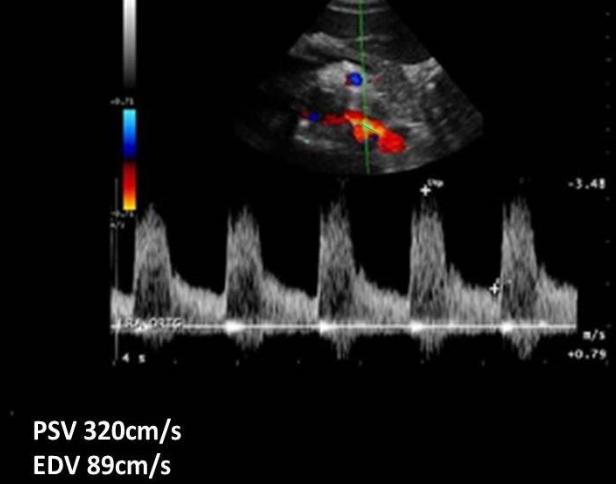
Which of the following is true regarding the doppler tracing from the renal artery?
a. normal flow pattern and velocity are demonstrated but incorrect doppler angle is used to assess the flow causing aliasing to occur
b. according to RAS diagnostic criteria, stenosis >60% is demonstrated
c. the renal to aortic ratio is most likely below 3.5
d. normal flow pattern and velocity are measured with correct doppler angle
b
Which statement best describes the location of the ligamentum venosum?
a. it forms the posterior border of the right lobe
b. it lies between the right and left lobes of the liver
c. on ultrasound, it appears as a thick, triangular, echogenic foci in the left lobe of the liver
d. it forms the anterior border of the caudate lobe
d

Which of the following statements is true regarding the image displayed?
a. the gallbladder has a normal variant called a phrygian cap near the neck
b. the gallbladder has a normal variant called a phrygian cap near the fundal area
c. the gallbladder has a septation within the fundus
d. the gallbladder has a normal variant called Hartmann pouch near the fundal area
b
A 10 y/o presents for an abdominal US with a palpable RUQ mass. He has no history of liver disease and alpha-fetoprotein levels are normal. You identify a 9 cm mass in the RT lobe that demonstrates punctate calcifications and a central scar. These findings are most suggestive of?
a. metastasis
b. hepatoma
c. fibrolamellar carcinoma
d. hepatoblastoma
c

Which of the following is the least likely complication of the pathology demonstrated on the ultrasound image?
a. deep vein thrombosis
b. embolism
c. Blue Toe syndrome
d. rupture
a
What penile structure is usually fractured with penile trauma?
a. corpus spongiosum
b. glans penis
c. corpus cavernosum
d. pampiniform plexus
c
Which of the following would normally present as a hypoechoic renal mass?
a. oncocytoma
b. AML
c. mycetoma
d. milk of calcium cyst
a

The foreign body on the image is located in what tissue layer of the upper arm?
a. dermis
b. epidermis
c. muscle
d. hypodermis
c
An incidentaloma is:
a. an aggressive adrenal carcinoma
b. an aggressive splenic carcinoma
c. always a critical finding
d. an unexpected mass on an imaging exam
d
___________ is the most common renal tumor in neonates, while _______ is the most common renal tumor in pediatric patients.
a. mesoblastic nephroma, AML
b. nephroblastoma, mesoblastic nephroma
c. nephroblastoma, neuroblastoma
d. mesoblastic nephroma, nephroblastoma
d
This vessel arises from the anterior aorta and courses inferiorly, parallel to the aorta:
a. superior mesenteric vein
b. common hepatic artery
c. splenic artery
d. superior mesenteric artery
d
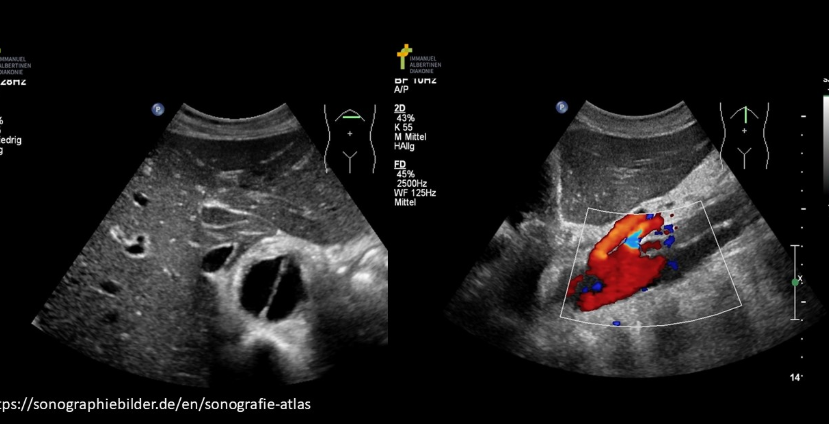
A patient presents with epigastric pain. The findings on the image are most suggestive of:
a. pseudocyst
b. duplicated AO
c. fusiform aortic aneurysm
d. aortic dissection
d
Unintended weight loss is a common symptom in patients with:
a. hyperglycemia
b. carcinoma
c. hypothyroidism
d. ascites
b
Which renal condition is always fatal?
a. unilateral renal agenesis
b. horseshoe kidney
c. ADPKD
d. ARPKD
d
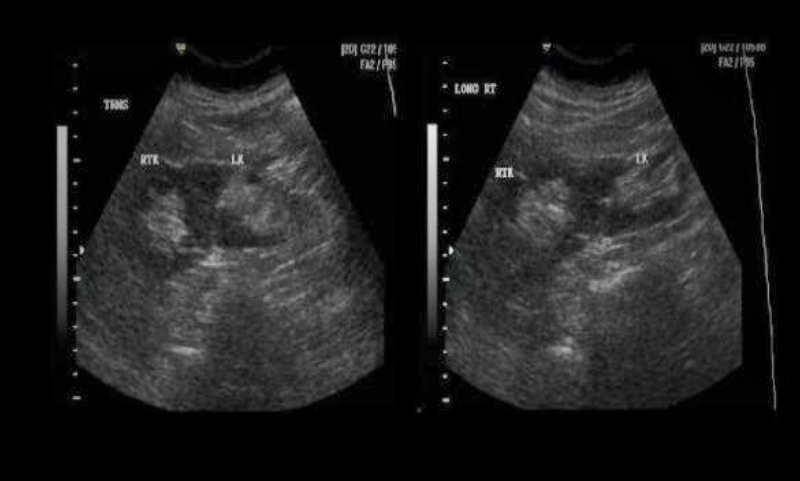
Which of the following statements is true regarding the displayed images from a renal US?
a. the LT kidney is fused to the RT kidney on the RT side of the body
b. renal function will be increased due to fusion of the kidney tissues
c. the images represent the surgical connection of the kidneys in an effort to increase renal function
d. a duplicated collecting system is present
a
Which of the following is normally identified in the urine?
a. minimal amount of RBC
b. protein
c. glucose
d. creatinine
d
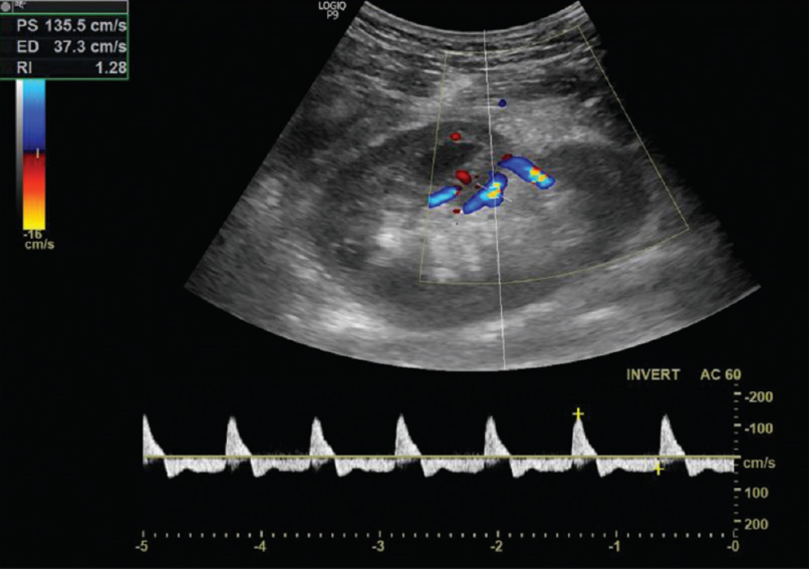
The image demonstrates the doppler evaluation of a transplant kidney. The findings on the image are most suggestive of:
a. renal vein thrombosis
b. renal artery stenosis
c. normal flow
d. hydronephrosis
a
An obese patient has a known hepatoma in the posterior aspect of the RT liver lobe. Which probe would you use to assist the radiologist in performing a biopsy?
a. 5 MHz, short focus
b. 2.25 MHz, short foxus
c. 2.25 MHz, long focus
d. 3.5 MHz, long focus
c
A 55 y/o female presents with a fever, leukocytosis, and LLQ pain. She states she suffers from Crohn disease. The exam demonstrates a 2.7 cm ill-defined hypoechoic mass in the LLQ that is surrounded by a small amount of ascites. There is no flow within the mass and no movement of peristalsis. These findings are most suggestive of:
a. retroperitoneal lymphadenopathy
b. intussusception
c. abscess
d. appendicitis
c
The _____ separates the caudate lobe from the left lobe of the liver.
a. falciform ligament
b. ligamentum teres
c. ligamentum venosum
d. main lobar fissure
c
Alanine aminotransferase levels are:
a. used to evaluate the degree of jaundice and monitor hepatitis and cirrhosis
b. the primary indicator for hepatocellular carcinoma
c. decreased with hepatitis, cirrhosis, liver tumors, biliary obstruction, and Reye syndrome
d. the most sensitive indicator for alcoholism
a
Increased thyroid volume is associated with:
a. thyroxine treatment
b. chronic renal failure
c. radioactive iodine treatment
d. chronic hepatitis
b
Patients with _______ have significantly increased risk of developing a seminoma.
a. diabetes
b. cryptorchidism
c. hydrocele
d. varicocele
b

Which of the following statements is true regarding the doppler evaluation of the liver vasculature displayed?
a. the hepatic artery and PV are demonstrated with normal flow directions
b. the hepatic artery is hepatopetal and the PV is hepatofugal
c. the hepatic artery is hepatofugal and the PV is hepatopetal
d. the PV flow is normal but the hepatic artery demonstrates increased resistance
b
The blue dot sign is a clinical finding of:
a. torsion of the testicular appendage
b. bladder calculi
c. testicular varicocele
d. thyroid adenoma
a
Jaundice is not a clinical symptom of:
a. RBC destruction
b. fatty infiltration
c. hepatocellular disease
d. ductal obstruction
b
A patient presents for a post-transplant evaluation of the pancreas. Where is the most common location for the allograft?
a. right iliac fossa
b. LLQ
c. periumbilical area
d. epigastric area
a
You are scanning through the liver and note the caudate lobe is nearly the same size as the right lobe. The surface of the liver appears lobulated or nodular. Which of the following is the most likely diagnosis of these findings?
a. FNH
b. cirrhosis
c. hepatitis
d. HCC
b
When inflammation from pancreatitis extends into the tissues surrounding the pancreas, this is called:
a. biloma
b. cystadenoma
c. phlegmon
d. pseudocyst
c

Which of the following adjustments would reduce the aliasing displayed on the image while maintaining the diagnostic quality?
a. reducing the color doppler gain is the preferred method to remove the appearance of color aliasing on the image
b. repositioning the patient and scanning through the anterior abdominal wall will reduce or eliminate the color aliasing
c. increase the color scale velocity setting is the preferred method to reducing the aliasing in the renal artery
d. increasing the color priority settings is the preferred method to reduce the aliasing in the renal artery
c
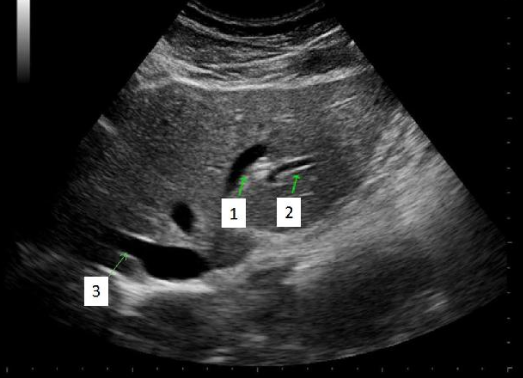
Which of the numbered vessels is a part of the portal system?
a. 1
b. 2
c. 3
d. 1 and 3
b
Which of the following is true regarding a liver hemangioma?
a. most hemangiomas demonstrate some level of posterior shadowing
b. fluid and debris levels are commonly present in a hemangioma
c. color doppler is a valuable tool in evaluating this highly vascular mass
d. a hemangioma is composed of an abnormal concentration of vascular tissues within the liver
d
Which of the following describes the best technique to differentiate a polyp in the GB wall from a stone within the lumen?
a. roll the patient into LLD
b. have the patient drink water and rescan the GB
c. ask the patient to perform the Valsalva maneuver
d. apply color doppler
a