Biological molecules
 Call Kai
 Learn
Learn Practice Test
 Spaced Repetition
 Match
Match Flashcards
 Knowt Play
1/69

Earn XP
Description and Tags
70 Terms
Why is starch a good storage molecule?
large - so it does not diffuse out of membranes
compact so good for storage
insoluble so does not affect the water potential of cells
amylopectin is densely branched, so glucose molecules can be released quickly as enzymes can act simultaneously at branches
when hydrolysed, forms alpha glucose, which is easily transportable, and used in respiration.
Structure of amylose
Long, unbranched chain of alpha-glucose; has a coiled structure, making it compact and good for storage
structure of amylopectin
Long, branched chain of alpha-glucose, side branches allow the enzymes that break the molecule down to access the bonds easily, meaning glucose can be released quickly
Test for starch
Iodine solution
-Positive:Blue black
-Negative:Orange yellow
how is starch held together?
OH groups form hydrogen bonds, which hold the helices together
general formula of monosaccharides
(CH2O)n
what is the structure of glucose
hexose monosaccharide
How is a dissacharide formed?
Two monosaccharides join in condensation reaction forming a 1-4 glycosidic bond
glucose + glucose
maltose + H2O
glucose + fructose
sucrose + water
glucose + galactose
lactose + water
what is the difference between alpha and beta glucose?
the hydroxyl group on Carbon 1 in beta glucose is inverted
How is a glycosidic bond broken?
A hydrolysis reaction where water is added
function of glycogen
energy storage in animals
where is glycogen found?
liver and muscles in granules
Structure of glycogen
straight chain of alpha-glucose (1,4-glycosidic bond) with side branches (1,6-glycosidic bond)
which is more densely brached, amylopectin or glycogen?
glycogen
Why is glycogen a good storage molecule?
very compact, more densely branched than starch, meaning that alpha glucose molecules can be released quickly when hydrolysed, large so does not diffuse out of membranes, insoluble so doesn't effect water potential of cells.
why is it important that glycogen is more densely branched than starch?
animals have a higher metabolic rate than plants, so require the quicker release of glucose molecules for respiration.
monomer of cellulose
beta glucose
what properties of cellulose give it strength?
- every other monomer is inverted to give it high tensile strength
- hydrogen bonds form between adjacent long straight chains.
- OH groups occur on both sides of the molecule so it can form H bonds on both sides
- chains group together to form microfibrils, which form fibres.
how does cellulose prevent the cell from bursting?
exerts inward pressure that stops any further influx of water
how does the cell wall increase the surface area for photosynthesis
makes the cells turgid by inserting inward pressure
Test for reducing sugars
Benedict's test. A blue solution, add a few drops to your solution. Heat in a water bath and if reducing sugars are present the benedict's will turn brick red
Test for non-reducing sugars
Test for non-reducing sugar
Heat with Benedict's
If negative (stays blue), hydrolyse substance with HCl and neutralise with NaOH. (or hydrolyse with an enzyme)
Heat with Benedict's Brick red precipitate indicates non- reducing sugar.
what causes the colour change in Benedicts
the reducing sugars cause Cu2+ ions to change to Cu+, which have a red colour
Results of Benedict's Test
green- very low, yellow- low, orange- medium, red- high
Role of lipids
source of energy due to high proportion of C-H bonds compared to C atoms, waterproofing- insoluble in water,
insulation, slow conductors of heat and electricity, so used as insulation around myelin sheath of nerve cells, protection of delicate organs
Why do saturated fats have higher melting points than unsaturated fats?
because there are no C--C bonds in saturated fats, so the chains are long and straight, so can pack more tightly together, so the inter molecular forces are stronger
what bond is formed in a triglyceride
ester bond
how many fatty acids bond to a glycerol molecule in a triglyceride?
3
how are unsaturated fatty acids found
as oils
why are lipids good storage molecules?
-insoluble in water- does not effect the water potential of cells
-high ratio of C-H bonds to C atoms
-high ratio of hydrogen to oxygen atoms so an important source of water
-low energy to mass ratio
how are phospholipids different from triglycerides?
one fatty acid group is swapped out for a phosphate group
which section of a phospholipid is hydrophobic and which is hydrophillic?
tail- hydrophobic, head- hydrophyllic
Why is the head of a phospholipid hydrophilic?
Due to the negatively charged (polar) phosphate group attached to the head
Why is the tail of a phospholipid hydrophobic?
the tail is composed of fatty acids, which are naturally non-polar
what do phospholipids form in a membrane and why?
form a bilayer as the hydrophobic tails face inwards to avoid the liquid cytoplasm, whilst the hydrophillic heads face out.
what is the formula of a glycerol molecule?
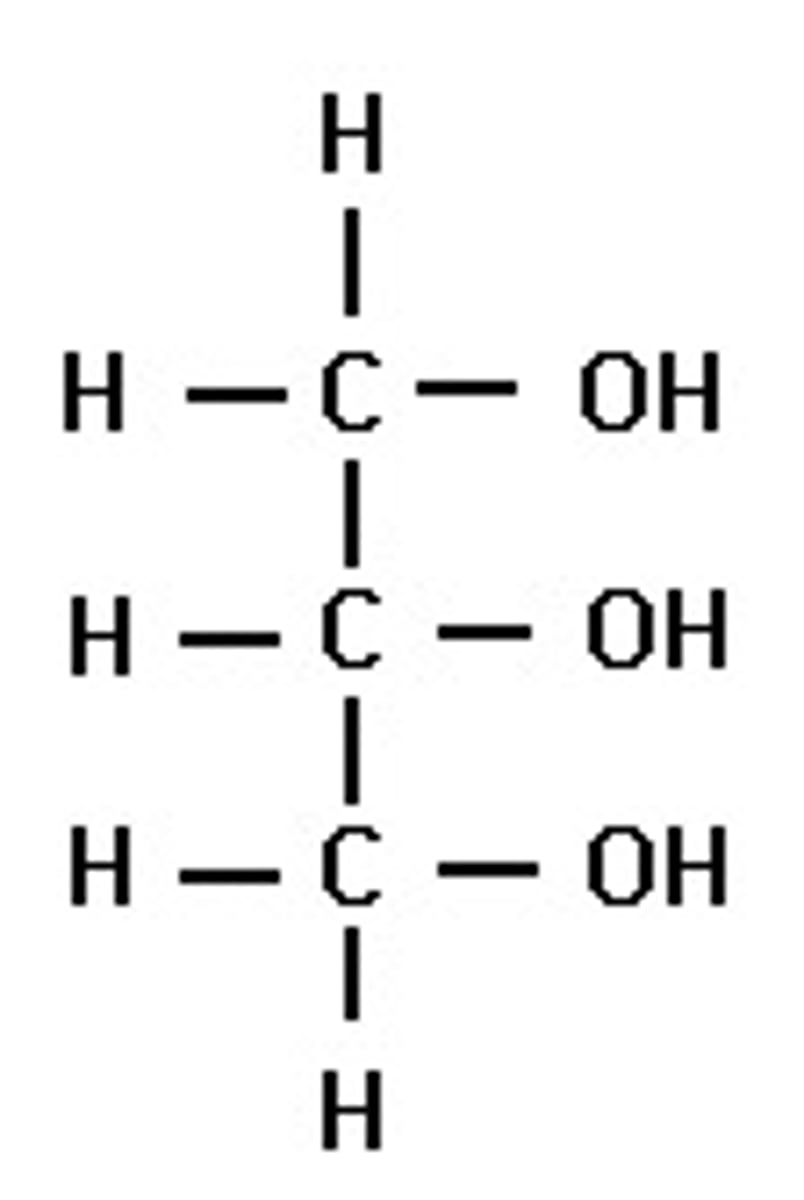
monomer of proteins
amino acids
How many amino acids are there?
20
what compounds are proteins and why?
amphoteric compounds becuase the amine group is basic, whilst the carboxyl group is acidic.
What elements make up proteins?
carbon, hydrogen, oxygen, nitrogen, and sometimes sulfur
what do two amino acids form?
a dipeptide, connected by a peptide bond in a condensation reaction, which also produces water
from which groups does the water molecule formed in the condensation of amino acids come from?
H from the amine group, OH from the carboxyl group
Where does protein synthesis occur?
ribosomes
how are polypeptide chains broken?
hydrolysis reactions
What is the primary structure of a protein?
sequence of amino acids in a polypeptide chain
What is the secondary structure of a protein?
folding of chain to form alpha helix or beta pleated sheet
What is the tertiary structure of a protein?
folding of a polypeptide chain due to interactions between side chains of amino acids that lie in different regions of the primary sequence
What is quartenary protein structure?
protein consisting of more than one amino acid chain
give an example of a quartenery structure
haemoglobin
where does oxygen bind in haemoglobin?
to the Fe2+ ions contained in the haem group of haemoglobin
What bonds are in the tertiary structure?
hydrogen, ionic, disulphide
globular proteins
spherical, water-soluble proteins.
Why are globular proteins soluble?
The hydrophobic R groups clump together pushing the hydrophilic R groups to the outside of the molecule allowing them to interact with a solvent
what are the ionic bonds in a tertiary structure formed between?
between carboxyl and amino groups not involved in peptide bodning
Why are fibrous proteins insoluble?
they contain a high proportion of hydrophobic R-groups
example of globular protein
haemoglobin, insulin, enzymes
Test for lipids (emulsion test)
1. Shake the test substance with ethanol (one min).
2. Mix solution with water
Positive test = white emulsion formed as a layer on top
Negative test = stays clear
why is an emulsion formed in the emulsion test?
lipid i finely dispersed as bonds broken between molecules.
Test for protein
Buriet solution
-Positive:Purple
-Negative:No change
what is buiret made up of?
sodium hydroxide and copper sulfate
structure of collagen
triple helix
what does collagen form that makes it strong?
helixes form fibrils, which form fibres.
where and how is starch found?
in plants, in the form of granules
what is starch made up of
amylose and amylopectin
what are amylose and amylopectin polymers of?
alpha glucose
how are saturated fats usually found
as fats
What is a prosthetic group?
A non-protein component that forms a permanent part of a functioning protein molecule