Genomes & Yeast
 Call Kai
 Learn
Learn Practice Test
 Spaced Repetition
 Match
Match Flashcards
 Knowt Play
1/35

Earn XP
Description and Tags
Module for CAPS
Name | Mastery | Learn | Test | Matching | Spaced | Call with Kai | Chat |
|---|
No analytics yet
Send a link to your students to track their progress
36 Terms
Intracellular Processes Studied
Meiosis, Mitosis, DNA Replication, Cell Cycle, Protein Synthesis, etc.
Yeast
Unicelullar eukaryotes that are classified as fungi. They are model organisms that can be applied across many complex organisms due to their basic genetic structure. They can be found in nature and can be grown in a liquid culture or an agar plate if growth requirements are defined.
Auxotrophic
A mutant organism that reqires a particular nutrient in order to survive.
Haploid
one copy each of chromosome. There are 2 mating types: a or α.
Diploid
two copies of each chromosome
Analysis on Cells
analysis is done on colonies of cells rather than individual cells.
Model Organisms
Reducing complexity
Functional conservation
Universal properties
Easy to manipulate
Short lifespan
Cost-effective
Widely and abudantly available
Specific properties
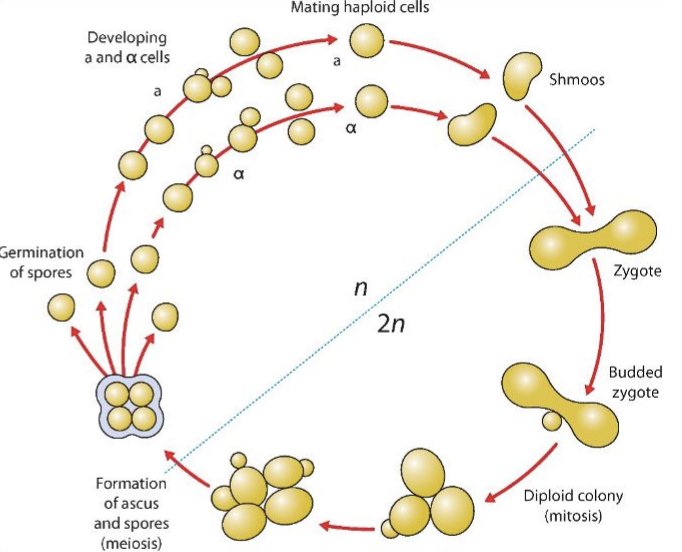
Simplified Yeast Cell Cycle
Haploid (n): Germination of Spores, Developing mating cells, Mating haploid cells, Shmoos
Diploid: Zygote, Budded zygote, Diploid colony (mitosis), Formation of Ascus and Spores (meiosis)
Yeast can live as..
Haploid or diploid.
Evolution
The change in heritable characteristics of populations over successive generations (Phenotype). The change in allele frequencies over successive generation (Genotype).
Genes
Functional unit of heredity; responsible for the characteristics of organisms
Alleles
Specific versions of genes that an individual possesses.
Allele Frequencies
The relative proportions of each allele in a gene pool. Represented by decimals.
Phenotype
Observable physical characteristics an individual shows
Genotypes
The genetic characteristics that an individual possesses. They are responsible for the phenotype of an organism.
Mutation
Deviations in DNA that stray from the alleles commonly found in a population. They can create new alleles.
Gene pool
all the alleles found in a population
Population
group of individuals that share similar genes
Genetic Drift
Change in allele frequencies in a population due to its size. It results in loss of alleles and reduces variation in a population, this is called fixation.
Fixation occurs
quickly when a population size is small; slowly when a population size is large
Examples of Genetic Drift
Founder effect, Bottleneck effect
Founder effect
when a smaller population migrates away from a larger population to a new environment. Results in less genetic variation and different allele frequencies.
Bottleneck Effect
when the original population is affected by outside factors resulting in high mortality strikes in the population. Reduces geenetic variability and change in allele frequencies.
Selection
differential fitness as a result of heritable variation in a trait; causes beneficial alleles to increase in frequency. Genetic drift can “help” or “hinder”.
Fitness
measurable success in survival and reproduction
Karyotype
A display of all chromosomes from a cell
Exons
coding sequences of DNA
Introns
noncoding sequences of DNA
Aneuploidy
Deviation from the normal karyotype. An abnormal amount of chromosomes.
Euploidy
Normal karyotype; there is an exact multiple of haploid number of chromosomes
Why aneuploid cells are better at drug resistance than euploid cells:
They have genetic heterogeneity and are susceptible to genetic changes. The diversity in the number of chromosomes in the population of cancer cells increases their likeliness to develop drug resistance.
Chromothripsis
the complex rearrangement of one or a few select chromosomes after they break apart.
Chromosomal Instability (CIN)
Persistent role of chromosome mis-segregation which results in losses and gains randomly.
Cancer
Common human disease due to somatic aneuploidy.
Aneuploidy occurs..
when there are errors in the precise mechanisms to replicate cells
Hardy-Weinberg Equilibrium
Requirements:
Random mating
No natural selection
No migration
No mutation
Large population