Physics revision
 Call Kai
 Learn
 Practice Test
 Spaced Repetition
 Match
 Flashcards
 Knowt Play
1/52

There's no tags or description
Looks like no tags are added yet.
53 Terms
Wave properties
All waves transfer energy.. higher energy = taller wave
A wave involves the transfer of energy without the net transfer of matter.

What is a mechanical wave?
Mechanical wave = a disturbance that travels through matter; energy carries from one place to another / one particle to the next.
Particles themselves don't travel along the wave
Two types of mechanical waves: transverse and longitudinal.
What is a transverse wave?
Where each point on the wave, the particles or fields vibrate 90° (perpendicular) to the direction the wave is travelling (moving wave)
In transverse, wave points vibrate (oscillate) along the mean/resting position up&down / left&right, while energy moves forward.
e.g. water surface waves

What is a wave pulse?
A single, short disturbance which passes through a medium. Particles carrying energy are displaced for a short time before returning to mean position.

What is a continuous wave?
An uninterrupted signal; there is a repetitive oscillation motion at the wave source; energy is carried away from the source in the form of a continuous wave.
e.g. morse code radio
Name some features of a wave?
Refer to diagram

What is a longitudinal wave?
A wave where particles of the medium vibrate back and forth in a parallel direction that the wave travels.
e.g. Sound waves: when playing music, the air particles vibrate in the same direction as the sound moves.
What is rarefaction and compression?
refer to diagram.. Both features of a longitudinal wave
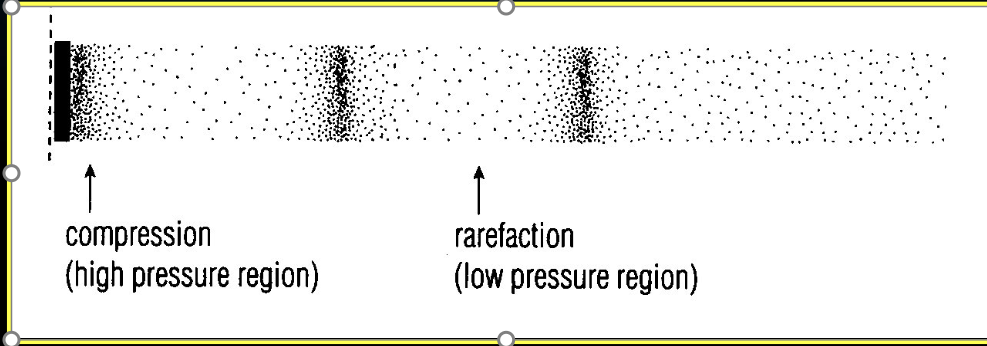
How is a wave produced?
A wave is produced by a disturbance/vibration that transfers energy from one place to another through matter or space. The energy in a wave comes from an initial work that transfer energy into a medium.
What are periodic waves and what are their 5 characteristics?
Waves that are continuously produced
Described with
Wave speed: speed of wave
Wave length: length of 1 wave (cm, m, etc…)
Frequency: How often is it? (hertz, Hz)
Amplitude: size; height of wave measured from the mean
Period: total time to complete 1 wave cycle
What is frequency (f)?
Is the number of waves generated by the source per second, or how often a repeating wave happens in a specific amount of time.
Frequency is measured in Hertz (Hz) or 1Hz
One cycle per sec
What is period (T)?
Period of a wave is the time taken for one complete cycle to pass through a certain point.
Is measured in seconds. Period = 1/frequency

What is amplitude (A)?
The maximum displacement of a point in the wave from the mean measured from its highest peak or lowest valley.
The larger the amplitude, the more energy the wave carries.
What is sound like in space?
Sound needs a medium to travel in. Space has such a low density of particles that the sound energy can't be transmitted.
The sounds heard on Earth are a series of compressions and rarefactions traveling through the air.
What is wave speed (v)?
Distance traveled per second is the speed of a wave measured in meters per second.
Speed = distance travelled / time taken
Light travels at 3x10^8ms^-1
Sound travels at about 340ms^-1
Speed of sound: liquids>gases, solids>liquids
Speed of light: liquids<gases, liquids>solids
What is wavelength (λ)?
Wavelength (lambda) is the distance between 2 Crest or two throughs, or a distance between two points on neighboring waves
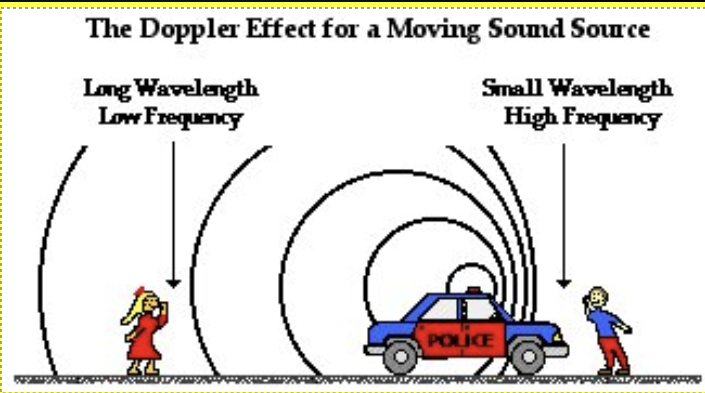
explain the ‘Doppler Effect’
Is the change in frequency/wavelength of a wave when an observer moves closer or further from a source.
The received frequency is higher during the approach, lower during the withdrawal.
Explain light energy
Light is a form of energy that the eye can deflect; light energy transmits to your eyes, and your brain is interpreting these images.
Light is made up of electromagnetic waves that carry energy through space.
Important source of light = vibrating atoms in hot objects when substance is heated; vibrating particles give off energy in the form of electromagnetic radiation.
How are light and sound comparable?
Light is similar to sound in that it travels as waves with measurable wavelengths. Wavelengths determine the light's color and sound's pitch.
The difference is that light doesn't need a medium to travel through
What is the spectrum?
The range of radiation energy
Travels at the speed of light, about 300,000 kilometers per second in space.
Visible light = light that the human eye can deflect; it's tiny parts of the electromagnetic spectrum.
What is infrared light?
Below red, longer wavelengths than red light, feels like heat
All warm and cool objects give off infrared radiation.
What is UV?
Beyond Violet, wavelengths are short and tight
Main source is sun
Helps our body make vitamin D
Too much damages our skin and eyes.
What is convention?
Is the transfer of heat through physical movement
the flow of particles in a heated liquid or gas
Usual method for heat to travel in liquid and gases
How does convention work to heat up a room?
Heated air expands, becomes less dense, and rises.
Cooler air moves towards the heater to take the place of the warmer air that rises
Convention will continue until all air is at the same temperature.
When convention occurs in the atmosphere, warm air rises and cool air sinks

What is thermal radiation?
Heat can travel through regions where there are no particles.
Thermal radiation is the transfer of heat energy through space using electromagnetic waves. Doesn't need any physical matter or medium.
Heat radiation can travel through empty spaces, (like in a vacuum, e.g. space)
The body emits thermal radiation. Energy is in infrared region, meaning eyes cannot deflect it
How does heat from the sun hit us? + extra facts
Heat from the sun reaches us via radiation.
Moves at the speed of light
This radiation is electromagnetic radiation (light, or infrared)
When rays strike an object, its particles gain energy and vibrate faster.
Black services absorb radiation better versus white because white surfaces tend to be shiny and reflect radiation.
If an object absorbs more thermal energy than it emits, its temperature will increase.
If an object emits more energy than it absorbs, its temperature will decrease.
What are microwaves?
Longer wavelength between ordinary radio waves and infrared light.
'Microwaves' use microwaves
Water and fat molecules in food absorb microwaves, which make the vibrate to produce heat.
(Causes heat)
What are radio waves?
Very long wavelength, low frequency.
End of EMR spectrum and carries radio signals great distances.
(Causes heat)
What are X-rays?
End of EMR spectrum, very short wavelengths.
Can penetrate flesh, but not teeth or bones.
What are Gamma Rays?
Shortest wavelength in all EMR spectrum.
Therefore, carries the highest amount of energy.
List the EMR spectrum from longest wave length to shortest.
Radio waves
Microwaves
Infrared
Red
Orange
Yellow
Green
Blue
Violet
UV
X-rays
Gamma Rays
LONGEST WAVELENGTH, hot, low frequency, less energy
Visible light, harmless!
SHORTEST wavelength, can damage DNA & cells, highest energy and frequency
What is rectilinear propagation?
Continuous waves which travel in straight lines, doesn't bend on its own.
What is some background info on reflection?
Light that enters your eyes has come either directly from a source (e.g. light bulb) or has come from a source that has been reflected off an object, then into your eye.
Colored objects reflect their color.
White light is made up of all colors of the rainbow.
What is it for light to diffuse?
Light that is scattered in many different directions after reflecting on a surface.
This occurs on uneven, fibrous, powdery, or translucent materials
The page isn't smooth, so the light is scattered on a reflection; we can see the page, but not the other things reflected on this page.
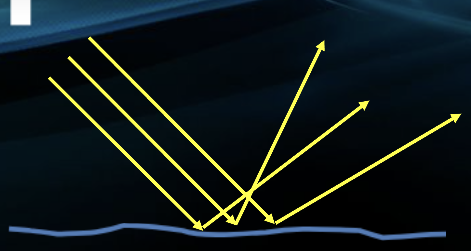
What is specular light?
Direct, uniform reflection of light that bounces off a smooth reflector, reflects in a single uniform manner, and creates a mirror-like image.
Light hits the mirror which reflects the same angle it arrived

What are the 2 types of rays?
Incident Ray: the ray that hits the surface.
Reflected Ray: the ray that bounces away.
I=r
The normal is an imaginary straight line, this starts where the incident ray hits and is 90° from surface.
Sound + light also obey the law of reflection

Where are the 2 angles in the law of reflection?
Angle of Incidence = between incident ray and normal
Angle of reflection = between reflected ray and normal
What is transmission?
When light waves passed through a medium without stopping. (from incident ray)

How do different materials transmit, absorb or reflect light?
Transparent: light passes straight through the material, produces clear image (e.g. glass, air)
Opaque: light can't pass through, absorbs or reflects light, casts a shadow (e.g. wood, metal)
Translucent: light passes through but is diffused, produces a blurry image. (e.g. frosted glass, wax paper)
What is refraction?
Is when light bends as it passes through 1 transparent material to another.
Occurs because light travels at different speeds when traveling between different media. When light hits a new material at an angle, one part of the light wave slows down, causing the change of direction.
Lightspeed is faster in air and slower in solids.
Refraction is only noticeable if the angle of incidence is other than 0°.
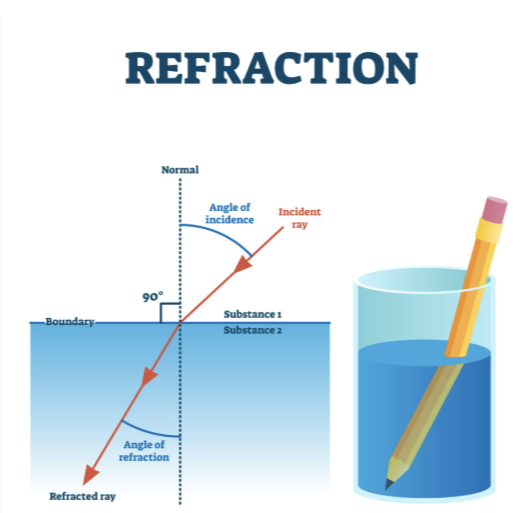
What happens when light hits a thicker material?
When a light ray passes through a thicker (denser) material, it bends (refracts) towards the normal.
It slows down, gets shorter wavelengths, direction bends, but frequency stays the same.

What happens when light hits a thinner material?
When light ray passes through a thinner material, it bends (refracts) away from the normal. Its speed increases, increases angle and bends away from the perpendicular line.

What is dispersion?
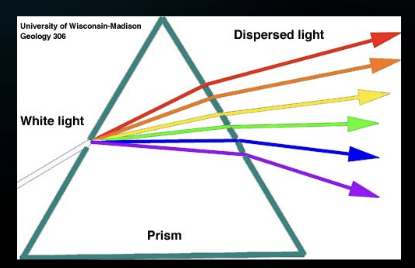
Is when white light passes through a prism and splits into the visible light spectrum (the rainbow). Occurs because each colour moves at different speeds, and energy levels allow them to be refracted by the prism.
Colors like Violet are refracted the most because of their shorter wavelengths, red the least
What is the total internal reflection?
When light moves from a dense material into a thinner material, the light bounces back instead of going through.
Refraction doesn't occur at every angle of incidence. As the angle of incidence increases, so does the angle of refraction.
What is the critical angle?
Is when a denser material's angle of incidence results in a refractive angle of 90° in a thinner medium. This is called a critical angle; it won't give an angle of refraction. Refer to diagram for equations.

What happens when light is totally internally reflected?
When the angle of incidence becomes greater than the critical angle, there is no reflected beam at all. Instead, the incident ray is totally internally reflected.

Who was James Prescott Joule?
Found that all substances are made up of particles that are in constant motion and have forces of attraction and repulsion between them.
How does kinetic energy occur?
Tiny particles/molecules move at different speeds because of the energy of movement they possess.
How does heat energy work?
If an object is hotter than its surroundings, heat energy flows from the object to its coldest surrounds.
If an object is colder then heat energy will flow from the surrounds to the object.
What is conduction?
Is the movement of heat through a material via direct contact without carrying any of the material with it.
What is one good conductor?
Metal is a great conductor of heat
They have free electrons that move more independently along the metal atoms and rapidly transfer energy by collisions with other atoms and free electrons.
What is some bad conductors?
Wood, glass, plastic, fabrics, liquids, and gases.
How does conduction work as a method of heat transfer?
Conduction as a method of heat transfer involves the transfer of heat via particle collision. This occurs when faster moving particles in a warm object bump into slower moving particles which transfer kinetic energy between them.