Audio-Week 8
 Call Kai
 Learn
 Practice Test
 Spaced Repetition
 Match
 Flashcards
 Knowt Play
1/36

There's no tags or description
Looks like no tags are added yet.
37 Terms
What is acoustic Immittance?
Describes the ease or difficulty with which sound energy is transmitted through an acoustic system
What does immittance measure help with?
Helps evaluate the condition and function of the external and middle ear
What are some common clinical tests of acoustic immittance?
Tympanometry
Acoustic reflex threshold testing
Acoustic reflex decay testing
What is Acoustic Admittance?
How readily acoustic energy flows through a system
Easy of energy flow
What is Acoustic Impedance?
How much the system opposes acoustic flow
Blockage of energy
What is tympanometry?
Helps asses the mechanical response of the tympanic membrane and middle ear system under different pressure conditions
What does tympanometry not tell us?
It does not directly measure hearing thresholds or establish a complete diagnosis by itself
What is the three tympanometry measurements?
Ear Canal Volume
Peak Pressure
Peak Admittance
Tympanogram Reading
Y Axis- Peak Admittance
X Axis- Peak Pressure

226 Hz vs 1000 Hz age diff?
226 tympanometry is typically used for older infants, children, and adults
1000 for young infants (younger than 6 months)
Why is 1000 Hz used?
Works better in young infants because of the physics of the infant middle ear and how it responds to different sound frequencies
How is the infant middle ear mechanically different to adults?
Ear Canal walls are softer and more flexible
TM and surrounding tissues behave differently from those older children and adults
Flexible ear canal and immature middle ear can alter the low-frequency measurement
Tympanogram measurement values for children
Peak Pressure = -150 to +50 daPa
ECV = 0.4 - 1.0 cm
Compliance/Admittance = 0.2 - 1.6 mmho
Tympanogram measurement values for Adults
Peak Pressure = -100 to +50 daPa
ECV = 0.6 - 1.5 cm
Compliance/Admittance = 0.3 - 1.6 mmho
What are all of the tympanogram types?
A
As (shallow)
Ad (deep)
B (flat)
C
What are the peak pressures for all tympanogram types?
A = normal
As (shallow) = normal
Ad (deep) = normal
B (flat) = No Peak
C = Negative
What are the peak admittances for all tympanogram types?
A = Normal
As (shallow) = Reduced
Ad (deep) = Increased
B (flat) = No peak
C = Normal
What are the Ear Canal Volumes (ECV) for all tympanogram types?
A = normal
As (shallow) = normal
Ad (deep) = normal
B (flat) = Check it: small = wax or probe problem; normal = middle ear effusion; large = perforation or patent tube
C = Normal
What do all tympanogram types suggest? (what do they mean)
A = Normal TM movement and middle ear function (hearing may still be abnormal)
As (shallow) = Stiff TM or ossicular system, e.g. otosclerosis, tympanosclerosis
Ad (deep) = Hypermobile or thin TM, ossicular discontinuity, healed perforation. A high peak alone does not prove discontinuity
B (Flat) = Depends on ECV
C = Eustachian tube dysfunction, URI. Does not automatically mean effusion
What is the acoustic reflex?
The acoustic reflex is an involuntary contraction of the stapedius muscle in response to loud sound
It stiffens the middle ear system in response to intense sounds
The reflex that occurs in the ear where the stimulus is presented is called?
Ipsilateral reflex
The reflex that occurs in the ear opposite to where the stimulus is presented is called the?
Contralateral Reflex
What is the acoustic reflex threshold?
The lowest stimulus level, under a specified test protocol, at which a reliable acoustic reflex response is detected
What does the acoustic reflex depend on?
Stimulus Frequency and Level
Hearing Status
Middle Ear Status
Why do we test acoustic reflexes?
To asses the reflex pathway
To support interpretation of other findings
To help investigate auditory nerve, brainstem, or facial nerve abnormalities
Always interpret with the audiogram, tympanogram and clinical context
What does the acoustic reflex pathway involve?
Sound reaching the cochlea
Auditory Nerve Activation
Processing through auditory brainstem pathways
Activation of facial nerve motor pathways
Stapedius Muscle contraction
What is the order of the ipsilateral pathway?
Stimulated ear: middle ear, cochlea (inner ear)
Auditory nerve (VIII)
Cochlear nucleus (same side)
Superior olivary complex (same side)
Facial nerve nucleus (same side) and facial nerve (VII)
Stapedius muscle in the same ear contracts

What is the order of the contralateral pathway?
Stimulated ear: middle ear, cochlea
Auditory nerve (VIII)
Cochlear nucleus
Superior olivary complex, then crosses to the opposite side
Facial nerve nucleus and facial nerve (VII) on the opposite side
Stapedius muscle in the opposite ear contracts (this is where the probe sits)
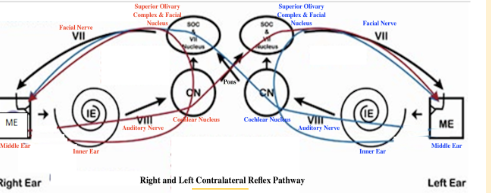
Where does the pathway cross to the opposite side?
At the Pons
What is the normal hearing rule of thumb for the acoustic reflex?
a reflex appears about 70+ dB above hearing threshold. Normal hearing (10 dB HL) gives a reflex around 80 dB HL
What is the SNHL application in acoustic reflex?
reflex depends on degree and configuration. 40 dB HL SNHL gives about 110 dB HL or NR; 60 dB HL SNHL gives NR.
What is the CHL application in acoustic reflex?
reflex is typically absent in the ear with the probe, even with a relatively mild loss.
What happens when reflex at 75dB but patient reports hearing only at 90dB?
a reflex cannot occur below hearing threshold, so the behavioral responses are unreliable. Think possible non-organic (functional) hearing loss.
What is the Elevated or absent reflex with normal hearing response in acoustic reflex?
possible auditory nerve problem. Triggers a medical referral.
Are people missing reflexes more prone to noise-induced hearing loss?
Yeah
What tympanometric findings would you expect based on the type of hearing loss?
Normal - Type A
SNHL - Type A
CHL - Abnormal in affected ear: B (fluid, wax, perforation), C (negative pressure)
MHL - Abnormal (B, C, As or AD)
How would the acoustic reflexes be expected on the type of hearing loss?
Normal - Present around 70-85 dB above threshold (about 80-90 dB HL)
SNHL - Present if loss is mild; elevated or NR as loss gets larger (about 40 dB HL: elevated/NR; 60 dB HL: NR)
CHL - Absent with probe in the affected ear; stimulating the affected ear may also be absent or elevated if the loss is big enough
MHL - absent or elevated