Asymmetric information
 Call Kai
 Learn
 Practice Test
 Spaced Repetition
 Match
 Flashcards
 Knowt Play
1/19

There's no tags or description
Looks like no tags are added yet.
20 Terms
Asymmetric information
Asymmetric information means one side knows something relevant that the other side does no
Hidden characteristics
Existing characteristics relevant to the price of the good (ability or quality)
Can lead to adverse selection as the goods are less or more good quality than customers know. Buyers cannot distinguish good products from bad ones, so they offer a price based on expected quality..
Hidden actions
Effort that is being put into a task
Moral hazard as the informed side of the market, knowing that the other side of the market cannot see the effort, will put in low effort, which negatively influences the result.
What is the impact of hidden characteristics on price?
There is one price for all goods that is an average of the price would pay for high quality goods and the price they would pay for low quality. This mean that P* < P_hq and P* > P_lq. Therefore, although the price may not attract high quality sellers, it will for sure attract low quality sellers, leading to adverse selection.
Why do hidden characteristics not attract high quality sellers?
Because the price buyers offer may be too low for someone selling a high-quality product. High-quality goods have higher MC than low-quality goods, so require a higher price to make selling worthwhile. That is adverse selection: the common price attracts low-quality sellers while potentially driving high-quality sellers away. This is failure of the market for high quality goods.
With full information, can good and bad products sell at different prices?
Yes, there is a high quality price P+ and a low quality price P_.
P+>P_
Meanwhile, with asymmetric information, buyers cannot distinguish quality, so they offer a common price P*, where P+ > P* > P_.
High-quality sellers may withdraw if P* does not cover their minimum acceptable price (MC). Low-quality sellers are eager to sell. This can leave only low-quality goods: adverse selection. There is a welfare loss because some worthwhile trades in high-quality goods disappear.
What happens after adverse selection?
A) High-quality sellers leave completely. The price offered is too low for them, so, no high-quality goods are traded. DWL comes from the beneficial trades that disappear.
B) Both qualities are initially traded, but sellers shift toward low quality. They receive the same price for either quality, while low quality costs less to produce. Therefore, too little high quality and too much low quality are produced compared with the efficient outcome.an
Why is it efficient if the price is pushed to the maximum willingness to pay?
Buyers value each care more than the seller’s minimum price, so all possible trades happen.
How does knowledge of quality change buying?
Buyers are risk-neutral, they value this uncertain good at its expected value. So, initially the most they will pay for a car of unknown qualityis the EV = CE. However, this adverse selection: the common price attracts bad quality goods and drives good quality goods away. Once buyers understand that good-quality sellers will not accept the EV as only bad-quality sellers will accept it, the buyers’ max willingness to pay falls to that for bad-quality goods. Bad-quality sellers still accept this, and now only the bad quality sellers sell. So the EV is not a sustainable market price, as at that price, the assumed mix of good and bad quality goods would not remain available. The market loses the beneficial trades in good-quality goods, creating DWL which is the difference in minimum price sold at and max willingness to pay x quantity not sold that could have been sold for the high-quality good.
If producers can choose quality how does this affect the quality of the goods?
If producers can choose quality, producing bad quality goods earns more. They therefore have an incentive to switch toward bad cars.
Full information: people with higher risk of losing and lower risk of losing out
With full informations each group pays its own fair premium, depending on their risk of losing, lower for those with a lower risk of losing, higher for those with a higher risk of losing. All risk-averse people in each group buy insurance. The total surplus is the sum of the two triangles between demand and the respective supply curves.
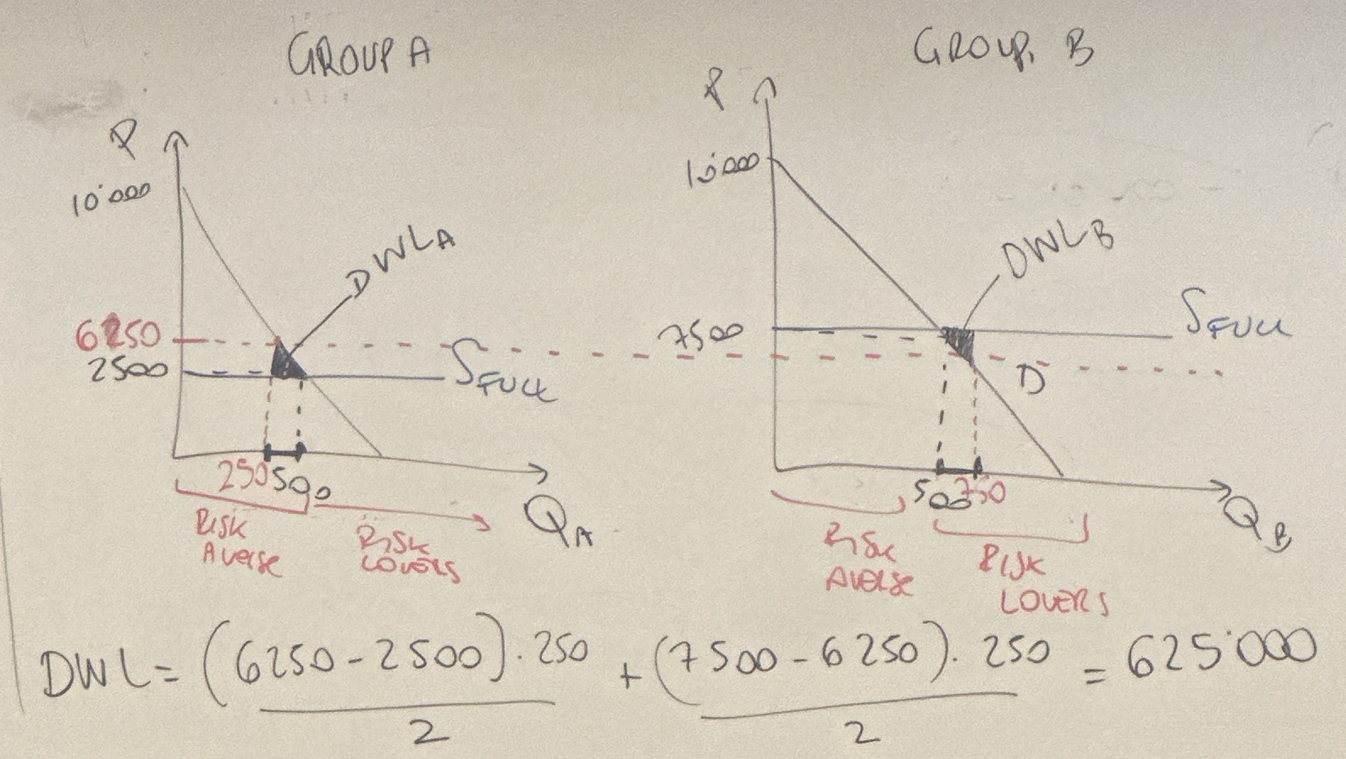
How do you find quantity traded for two different risk groups?
P = prob loss (A) x P_A + prob (B) x P(B)
then use price to find quantity using the individual quantity demanded curves.
How does hidden risk affect the premium?
Hidden risk means the insurer cannot tell how likely each customer is to suffer a loss. The customer knows more about their own risk than the insurer does. The insurer knows that there are different types of risk groups but cannot identify which type a particular applicant is. So, in this model, it charges everyone the same premium.
How does insurers choose a premium if there is hidden risk?
It calculates the average expected cost of the customers who buy. P = customers A / total customers x (premium low risk) + customers B / total customers (premium high risk). The insurer does not know which individual is low-risk or high-risk, but can estimate the proportions of each type among its customers. So each customer is charged the average.

How do we find out how many people from each group actually buy with hidden risk?
You use demand equation and the set price for all from EV, to find quantity demanded by each group.
Do high-risk people make up a larger share of insurance buyers than low-risk or the other way around?
High-risk people make up a larger share because they are more willing to pay for insurance.
Why is there a welfare loss with hidden risk in insurance?
The lower-risk group pays too much and stop buying even though insuring them would create surplus. The higher-risk group pays too little, as the extra high-risk customers buy even though their willingness to pay is below the expected cost of covering them. Therefore there is DWL and low-risk customers effectively subsidise high-risk customers. As low-risk customers withdraw, the insured pool becomes riskier, raising the average cost that the premium must cover.
Why does lower-risk buyers subsidising higher-risk buyers in hidden-risk insurance create DWL?
The extra high-risk trades reduce total surplus, while some beneficial low-risk trades are lost. Those are the two DWL triangles in your diagram. The customer values the insurance less than its expected cost, so providing it reduces total surplus.
Hidden characteristics - employers cannot identify workers’ ability
A high-ability worker generates more revenue for the employer than a low-ability worker does. Marginal revenue product of labour. Therefore, higher-ability workers are paid higher wages than lower-ability workers. However, with hidden ability, employers can only offer one common wage, which is the average productivity of the people willing to work. The probabilities represent the proportions among participants.
Why do hidden characteristics in the labour market create inefficiency?
High-ability employment falls: some workers who produce at high-ability do not work.
Low-ability employment rises: some workers whose minimum acceptable wage exceeds their productivity of 60 enter.
The common wage underpays high-ability workers and overpays low-ability workers relative to productivity, changing who participates and creating DWL.