Bio 1101 Exam 2 - Chromosomes, DNA, RNA
 Call Kai
 Learn
Learn Practice Test
 Spaced Repetition
 Match
Match Flashcards
 Knowt Play
1/74

There's no tags or description
Looks like no tags are added yet.
Name | Mastery | Learn | Test | Matching | Spaced | Call with Kai | Chat |
|---|
No analytics yet
Send a link to your students to track their progress
75 Terms
What does DNA stand for?
Deoxyribonucleic acid.

What major cellular structure is DNA a component of?
Chromosomes.

What is the general structure of DNA?
DNA is usually double-stranded and twisted into a double helix.

Where is most DNA found in a eukaryotic cell? Why?
In the nucleus. Keeps it safe in there

What does a double helix describe?
Two complementary DNA strands twisted around each other.

What does complementary mean for DNA strands?
The sequence of one strand determines the matching bases on the other strand.

What type of bonds connect complementary DNA bases?
Hydrogen bonds.

What is a nucleotide?
The individual monomer/unit that makes up DNA or RNA.
What are the three parts of a DNA nucleotide?
Deoxyribose sugar, a phosphate group, and one nitrogenous base.

What sugar is found in DNA?
Deoxyribose.
D in DNA is for Deoxyribose - De meaning no, oxy meaning oxygen
It is ribose with no oxygen (one less oxygen)
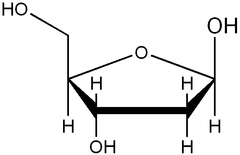
What are the four DNA nitrogenous bases?
Guanine, Cytosine, Adenine, Thymine - GCAT!

What does A stand for in DNA?
Adenine.
What does T stand for in DNA?
Thymine.
What does C stand for in DNA?
Cytosine.
What does G stand for in DNA?
Guanine.
Which DNA base pairs with adenine (A)?
Thymine (T). GCAT
Which DNA base pairs with thymine (T)?
Adenine
Which DNA base pairs with cytosine (C)?
Guanine
Which DNA base pairs with guanine (G)?
Cytosine (C). GCAT
What is a mutation?
Any molecular change in DNA.
Where does an individual's DNA come from?
It is inherited from their parents.
What does antiparallel mean in DNA?
The two DNA strands run in opposite directions.

Why are the normal DNA base pairings important for helix shape?
They help keep the double helix a uniform width rather than bending or bowing.

What does RNA stand for?
Ribonucleic acid.
Is RNA usually permanent or temporary?
Temporary
Is RNA usually single-stranded or double-stranded?
Single-stranded.
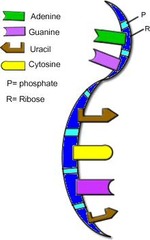
Where can RNA be found in a cell?
Throughout the cell.
What are the three basic classes of RNA?
mRNA, tRNA, and rRNA.
What does mRNA stand for?
Messenger RNA.
What does tRNA stand for?
Transfer RNA.
What does rRNA stand for?
Ribosomal RNA.
What is the main role of mRNA?
It carries a copy of DNA information out of the nucleus.

What is the main role of tRNA?
It carries amino acids and helps build proteins according to mRNA.

What is the main role of rRNA?
It is part of the ribosome, the site where tRNA functions during protein synthesis.

What is the monomer of RNA?
A nucleotide
What are the three parts of an RNA nucleotide?
Ribose sugar, a phosphate group, and one nitrogenous base.
The only differences from a DNA nucleotide are the sugar and uracil instead of thymine

What sugar is found in RNA?
Ribose.

What are the four RNA bases?
Guanine, Cytosine, Adenine, Uracial - GCAU!
What does U stand for in RNA?
Uracil.
Which RNA base pairs with DNA adenine (A)?
Uracil (U). GCAU
Which RNA base pairs with DNA thymine (T)?
Adenine (A). GCAU
Which RNA base pairs with DNA cytosine (C)?
Guanine (G). GCAU
Which RNA base pairs with DNA guanine (G)?
Cytosine (C). GCAU
What are chromosomes composed of?
DNA and protein.

Where are chromosomes located in eukaryotic cells?
In the nucleus.
What is a karyotype?
An organized display of an individual's chromosomes.

A chromosome is condensed DNA. How exaclty is the chromosome packed together?
DNA is packaged with proteins and coiled into a chromosome.

What proteins does DNA wrap around during chromosome packaging?
Histone proteins.
What is a maternal chromosome?
A chromosome inherited from the female parent. (I remember it by looking at the first two letters - ma-dre is mom in spanish)
What is a paternal chromosome?
A chromosome inherited from the father
How much of a child's nuclear chromosome set comes from each parent?
About half from the mother and half from the father.
What is a sister chromatid?
One of the two identical copies of a duplicated chromosome.
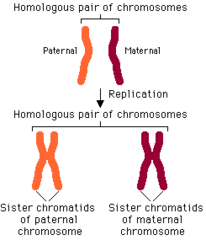
What holds sister chromatids together?
The centromere.

What is a centromere?
The chromosome region that holds sister chromatids together.

Does an X-shaped duplicated chromosome count as one chromosome or two?
One chromosome.
What does diploid mean?
Having two sets of chromosomes. (Di prefix meaning two)

Which human cells are generally diploid?
All body cells except gametes (sex cells).
What is the human diploid chromosome number?
46 chromosomes
What does haploid mean?
Having one set of chromosomes.

Which human cells are haploid?
Gametes (sex cells).
What is the human haploid chromosome number?
23 chromosomes.
What is polyploidy?
Having many sets of chromosomes.
What does tetraploid mean?
Having four sets of chromosomes.
What are homologous chromosomes?
A matched pair of chromosomes that carry the same genes. One from the mother and one from the father

Where do the two members of a homologous chromosome pair come from?
One is maternal and one is paternal.
Do homologous chromosomes carry the same genes?
Yes, at corresponding loci (locus points)
Are homologous chromosomes normally the same size and shape?
Yes, except the X and Y sex chromosomes in males are not the same size and shape.
What is a gene?
A stretch of DNA that encodes information for a specific trait.
What is the general relationship between genes and proteins?
A gene contains information to make a protein.
What is a gene locus?
The physical location of a gene on a chromosome.

What is a dominant gene/allele?
An allele that is expressed when present.
What is a recessive gene/allele?
An allele expressed only when no dominant allele for that gene is present.
What is an allele?
A different version of the same gene. For any given gene there are several types of alleles. You may have the GREEN eye color allele for the eye color gene
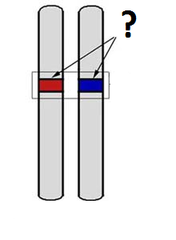
What is the difference between a gene and an allele?
A gene is a DNA region associated with a trait; an allele is a particular version of that gene.
What is the difference between a gene and a locus?
A gene is a DNA sequence; a locus is its physical location on a chromosome.