Cognition - Chapter 3: Perception
 Call Kai
 Learn
 Practice Test
 Spaced Repetition
 Match
 Flashcards
 Knowt Play
1/88

There's no tags or description
Looks like no tags are added yet.
89 Terms
Sensation
The process by which our sensory receptors and nervous system receive and represent stimulus energies from our environment.
Sensation’s process
It involves the raw, bottom-up detection of physical stimuli (such as light) by the sensory organs (such as eyes) and converting these stimuli into neural signals
Perception
Conscious, subjective, experience(s) that results from stimulation of the senses after sensation occurs
Vision stimulation
Seeing
Audition stimulation
Hearing
Somatosensation stimulation
Touching
Gustation stimulation
Tasting
Vestibular stimulation
Balacing
Proprioception stimulation
Bodily self-awareness
The principles that can be involved in perception
Changes in perceived stimuli
Reasoning or problem-solving processes
Automatism in processing
Conjunction with other actions
Organizing the actions that occur as we interact with the environment
Machine learning
A form of A.I that uses algorithms and statistical models, enabling computers to perform specific tasks by learning from data and improving their performance over time without explicit instructions.
Machine learning (con’t)
Has seen great improvements and resolution of issues in the last 5 - 10 years
Deep learning
A form of A.I that uses neural networks with many layers to model complex patterns in large datasets.
Deep learning (con’t)
Its algorithms are particularly powerful for tasks involving high-dimensional data
e.g. Image and speech recognition and natural language processing
Why might a computer mistake an object for something else?
It doesn’t have the huge storehouse of information about the world that humans begin accumulating as soon as they are born.
e.g. If a computer has never seen a toothbrush, it identifies it as something with a similar shape
Inverse projection problem
Task of determining the object that caused a particular image on the retina.
Inverse projection problem (con’t)
It involves starting with the retinal image and extending guides out from the eye
Occlusion
The process by which something is obscured from view.
Viewpoint invariance
The ability to recognize an object seen from different viewpoints.
What must be done for computers to process high-level info scenes?
Informational cues (such as context clues) would need to be painstakingly programmed into a computer with great detail
Bottom-up processing (data-based processing)
Direct processing that starts with information received at the “bottom” or beginning of the system when environmental energy stimulates the receptors
Top-down processing (knowledge-based processing)
Constructive processing that originates in the brain, at the “top” of the perceptual system involving a person’s knowledge or expectations
Top-down processing (knowledge-based processing) [con’t]
It enables people to rapidly identify objects and scenes, and also to go beyond mere identification of objects to determining the story behind a scene
Speech segmentation
The process of perceiving individual words within the continuous flow of the speech signal
e.g. Listeners familiar with either English or Spanish can receive identical sound stimuli but experience different perceptions, meaning that each listener’s experience with language influences their perception
Speech segmentation and bottom-up processing
The continuous sound signal enters the ears and triggers signals that are sent toward the speech areas of the brain
Speech segmentation and top-down processing
If a listener understands the language, their knowledge of the language creates the perception of individual words
Transitional probabilities
The likelihood that one speech sound will follow another within a word during speech
e.g. In English, it is likely that pre and ty will be in the same word (pre-tty) but less likely that ty and ba will be in the same word (pretty baby)
Statistical learning
The process of learning about transitional probabilities and about other characteristics of language
Statistical learning (con’t)
Also occurs for vision, based on learning about what types of things usually occur in the environment.
Likelihood principle
Part of Hermann von Helmholtz’s theory of unconscious inference that states we perceive the object that is most likely to have caused the pattern of stimuli we’ve received
Unconscious inference
Helmholtz’s idea that some of our perceptions are the result of unconscious assumptions or inferences that we make about the environment, to even past experiences
Gestalt psychologists
A group of psychologists who proposed principles governing perception
e.g. Laws of organization, and a perceptual approach to problem-solving involving restructuring
Gestalt psychologists (con’t)
They realized perception is based on more than the pattern of light and dark on the retina
Apparent movement
An illusion of movement perception that occurs when stimuli in different locations are flashed one after another with the proper timing.
e.g. When one light flashes on the left, then a period of darkness follows, which is then followed up by a flash of light on the right

Principles of perceptual organization
Heuristics that explain how small elements of a scene or a display become perceptually grouped to form larger units
Principles of perceptual organization (con’t)
Perception’s determined by specific organizing principles, not just light and dark stimuli activating the retina
Principles of perceptual organization origin
Max Wertheimer describes these principles as “intrinsic laws,” which implies that they are built into the system
The principle of good continuation
When connected points form straight or smoothly curving lines, they’re seen as belonging together, and the lines tend to follow the smoothest path.
e.g. A rope
The principle of good continuation (con’t)
Objects that are overlapped by other objects are perceived as continuing behind the overlapping object.
Principle of good figure /simplicity (Law of pragnanz)
Every stimulus pattern is seen in such a way that the resulting structure is as simple as possible.
e.g. The Olympics logo

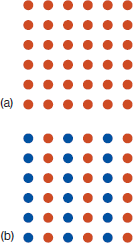
Principle of similarity
Similar things appear to be grouped together
Principle of closure
Perceiving something as a whole unit instead as a bunch of parts

Regularities in the environment.
Characteristics of the environment that occur frequently.
e.g. Blue is associated with a clear sky, landscapes are often green, and vertical and horizontal lines are often associated with buildings
Physical regularities
Regularly occurring physical properties of the environment
e.g. There are more vertical and horizontal orientations in the environment than oblique (angled) orientations within human-made “carpentered” environments
Oblique effect
The finding that vertical and horizontal orientations can be perceived more easily than other (slanted) orientations
e.g.The Müller-Lyer illusion

The light-from-above assumption
A heuristic where we assume light comes from above, which can influence how we perceive three-dimensional objects that are illuminated.
e.g The sun and lightbulbs where light usually come from

Why can humans perceive and recognize objects and scenes better than computer-guided robots?
Our system is adapted to respond to the physical characteristics of our environment
e.g. The orientations of objects and the direction of light
Semantic regularities
The characteristics associated with the functions carried out in different types of scenes
e.g. Food preparation, cooking, and perhaps eating occur in a kitchen.
Scene schema
A person’s knowledge about what is likely to be contained in a particular scene which can help guide attention to different areas of the scene
e.g Knowledge of what is usually in an office may cause a person to look toward the desk to see the computer
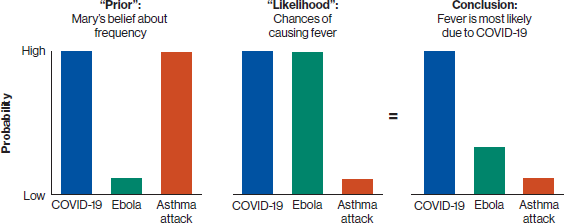
Bayesian inference
The idea that our estimate of the probability of an outcome is determined by both the
Prior probability (initial belief)
Likelihood (the extent to which the evidence is consistent with the outcome)
Prior probability (prior)
A person’s initial belief about the probability of an outcome.
Likelihood
The extent to which the available evidence is consistent with the outcome within Bayesian inference
Theory of natural selection
Characteristics that enhance an animal’s ability to survive, and therefore reproduce, will be passed on to future generations
Theory of natural selection (con’t)
Might be a reason why there more neurons that respond to horizontals and verticals instead of oblique orientations
e.g. Organisms whose visual systems contained neurons that fired to important things in the environment (like verticals and horizontals, which occur frequently in the forest) would be more likely to survive
Greebles
Families of computer-generated “beings” that all have the same basic configuration but differ in the shapes of their parts (just like faces).

Movement and perception
Movement can also help us perceive objects in the environment more accurately.
e.g. When going into grab a cup of coffee, a person will
Perceiving and recognizing the cup
Reach for it
Grasp and pick it up
Brain ablation
The study of the effect of removing parts of the brain
Object discrimination problem
A problem in which the task is to remember an object based on its shape and choose it when presented with another object after a delay
Landmark discrimination problem
A problem in which the task is to remember an object’s location and to choose that location after a delay
What are both the object and landmark discrimination problems associated with?
They’re associated with research on the what processing stream.
Object discrimination problem and brain ablation
The problem became very difficult for monkeys when their temporal lobes were removed
Object discrimination problem and brain ablation (con’t)
It indicated that the neural pathway that reaches the temporal lobes is responsible for determining an object’s identity
“What” pathway
A neural pathway that’s associated with perceiving or recognizing objects
e.g. The initial perception of a cup
“Where” pathway
A neural pathway associated with neural processing that occurs when people locate objects in space
e.g. Determining the location of something
“Perception” pathway
A neural pathway associated with perceiving or recognizing objects
“Perception” pathway (con’t)
Corresponds to the what pathway.
“Action” pathway
A neural pathway extending from the visual cortex to the parietal lobe that’s responsible for controlling behaviours toward objects
“Action” pathway (“How pathway”) [con’t]
Corresponds to the where pathway
Which lobes do the what, where, and perception pathways extend from?
They all extend from the occipital lobe to the temporal lobe
Dorsal
Refers to the back or the upper surface of an organism
e.g. The dorsal fin of a shark or dolphin is the fin on the back that sticks out of the water
Dorsal pathway
Travels from the occipital lobe (back of the brain) to the parietal lobe (top of the head)
Dorsal pathway (con’t)
Pertains to “where” information
Ventral
Refers to the lower part or side of the brain
Ventral pathway
Travels from the occipital lobe (back of the brain) to the temporal lobe (side of the brain)
Ventral pathway (con’t)
Relates to “what” information and that the pathway is on the side/bottom of the brain
Mirror neurons
Neurons in the premotor cortex (originally discovered in monkeys) that respond both when a monkey observes someone else acting and when the monkey itself carries out the action
e.g. When a monkey observes someone else grasping an object such as food on a tray and when the monkey itself grasps the food
Mirror neurons (con’t)
They’re called that because the neuron’s response to watching the experimenter grasp an object is similar to the response that would occur if the monkey were performing the same action
Mirror neuron system (MNS)
A network of neurons in the brain that have mirror neuron properties.
The purpose of mirror neurons
They might be involved in determining the goal or intention behind an action
Size-weight illusion
When a person is presented with two similar objects that are the same weight but different sizes; the larger one seems lighter when they are lifted together
e.g. When we’re given two cubes varying in size, we may assume the bigger one’s heavier even though both cubes are the same weight
Why does the Ames Room’s illusion work?
Its ceiling is slightly slanted
Its shape, floor plan, back wall, and windows are all trapezoidal
How does current computer vision work?
They work by translating and breaking down the visual world into a few key words

A drawback of how current computer vision works
It’s limiting, as a picture’s worth a thousand words
Supervised learning
When someone goes in and annotates the content(s) seen in a photo or video for viewing by an A.I model
Supervised learning (con’t)
It can introduce more bias from the annotations
Self-supervised learning
When models can understand the world directly from raw data
e.g. Making holes in an image, and having the computer fill in said holes, based on other information seen in the image
Self-supervised learning (con’t)
It gets rid of all the bias introduced in supervised learning’s annotations
Computers and navigation
Navigation’s a challenge as computers are less able to generalize due to having fixed datasets that get frozen
Test-time training
When faced with a new piece of data, that data is used to adapt the model