331 exam 2
 Call Kai
 Learn
 Practice Test
 Spaced Repetition
 Match
 Flashcards
 Knowt Play
1/48

There's no tags or description
Looks like no tags are added yet.
49 Terms
Mitochondria
major energy production (most of the cells ATP)
oxidative metabolism of:
carbs
lipids
amino acids
Endosymbiotic Theory Evidence
their own, circular, DNA
their own, different, ribosomes
different translation
double-membrane
Mitochondria Anatomy
Outer membrane - contains porins (channel proteins)
allows communication with cell
Inner membrane - rich in cardiolipin, folded into cristae
site of ETC
Intermembrane space - contains proteins & several factors that regulate cell death
Matrix - site of oxidative metabolism, mtDNA, other expression genome stuff

Ribosomes
what do they do?
where are they found?
what are they made of?
when do they assemble
membrane?
Protein-synthesizing organelles
found in:
cytoplasm
mitochondria (+chloroplast)
NOT membrane enclosed
Made of: PROTEIN & RNA
large & small subunit
*ONLY assemble when protein synthesis begins
prokaryotic ribosome (70s) is smaller than eukaryotic ribosomes (80s)
Endoplasmic Reticulum
extends throughout cytoplasm
constitutes 50% of membrane in cell
continuous with perinuclear space
(ER lumen merges with nuclear intermembrane space)

Smooth ER
Lacks attached ribosomes
Stores Calcium (important for cell signaling)
Lipid Synthesis
Detox lipid-soluble compounds
Rough ER
Associated with many ribosomes
Synthesis of Transmembrane + Secreted Proteins (such as insulin) & proteins found in lumens of organelles along secretory pathway
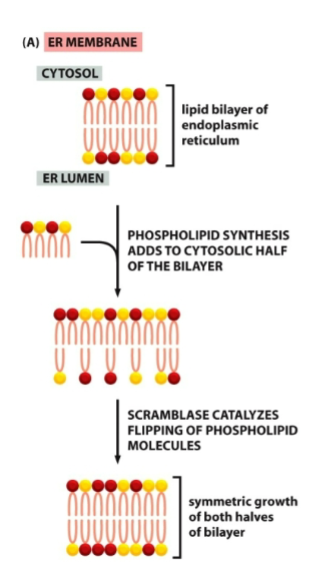
Scramblase
THE EQUALIZER
Moves phospholipids between inner and outer layer.
It can help balance the distribution of lipids when a membrane is being made or remodeled
both ways
down concentration gradient
no ATP
ER membrane
Flippase
Selectively moves certain phospholipids from one leaflet to the other
usually outer → inner
maintains asymmetry
Plasma membrane
ATP required
ONE direction
What is Glycosylation
modification of ER synthesized proteins by adding a sugar chain.
N-linked Glycosylation
steps
function of sugar chain
Cell attaches the sugar to the N of (Asparagine)
1.) protein enters the ER lumen
2.) a sugar chain is attached ALL @ ONCE
3.) sugar chains allows proper folding & checks for mistakes
4.) exported to Golgi where it is further modified

Golgi Apparatus
Central Sorting Station
synthesis site for most cellular carbs
series of flattened disks: Cisternae (isolated compartments with different environments)
CIS face: closest to ER, receives vesicles containing ER-synthesized proteins
TRANS face: furthest from ER, exit of Golgi
PROTEIN MODIFICATION:
N-linked oligosaccharides are trimmed and further
processed by addition of other sugars
O-linked glycosylation

O-linked Glycosylation
Sugar is attached to O of Serine or Threonine
Sugars are added one at a time
Occurs in Golgi
The Central Dogma
Information in all cells DNA → RNA → Protein
Information content: DNA → mRNA → Proteins
high regulation, high fidelity, cell invests energy!
*except telomerase

RNA Transcription
what is it
where does it occur
which direction
by whom?
eurkaryotes vs prokaryotes
Generation of single-stranded RNA molecule that is complementary to the DNA template strand.
Occurs in the Nucleus!
Synthesized: 5’ - 3’ (read 3 - 5) by RNA polymerase
Euk have 3 (make diff types of RNA) & Prok have 1

Transcription Initiation
prokaryotes v eukaryotes
Starts at DNA sequences called: Promoters
polymerase binds directly in prokaryotes
requires general transcription factors & other proteins in eukaryotes
Transcription Elongation
Elongation Factors use GTP hydrolysis to help polymerase move along
Transcription Termination
RNA polymerase encounters terminator (pro) / polyadenylation signal (euk)
most eukaryotic RNA requires post-transcriptional modification before it is functional
mRNA modifciation
1.) addition of 5’ (7-methylguanosine) cap to pre-mRNA
2.) RNA splicing
done by spliceosome (made of small nuclear RNAs snRNA & proteins)
directed by RNA sequences @ intron boundary
assembles on pre-mRNA while it is still being
transcribed
3.) Poly-A Tail added to 3’ end AFTER transcription
Poly-A binding proteins bind to the tail – important for
export from the nucleus and later protein synthesis.
mRNA export
nucleus → cytosol
Mature mRNA binds to nuclear export receptor, which
guides it through the nuclear pore complex into the cytosol
rRNA
80% of RNA in cell
ribosomal RNA
forms ribosome, catalyzes protein synthesis
assembled in nucleolus by RNA pol 1 & 3
Codon
3 nucleotides
3 is the minimum to accommodate 20 amino acids (4×4×4)
Degenerate Genetic Code
For a given protein sequence, there may be more than one RNA sequence
tRNAS
Transfer RNAs
Since aa’s can’t interact with RNA
tRNAs match aa with codon (aa covalently attaches to 3’ end of tRNA)
Each tRNA contains a loop with an “anticodon” that is
complementary to the appropriate amino acid’s codon

How is the amino acid attached to the tRNA
Aminoacyl-tRNA synthetase
each aa has a distinct synthetase
attatched aa & tRNA
proofreads for accuracy

Protein Translation
Direction
Addition
N - C
New aminoacyl tRNA replaces old tRNA, extending the
chain by one residue

What direction does the ribosome read mRNA
5’ → 3’
Translation Initiation
AUG (met) codon
has special initiator tRNA
Translation Elongation
Elongation Factors use GTPase to:
allow proofreading
to speed up ribosome translocation

Translation Termination
Ribosome encounters STOP codon
instead of tRNA, Release Factor binds = hydrolysis of peptidyl tRNA = release of completed protein.

Polyribosome
A single mRNA that is being translated by multiple ribosomes simultaneously
Primary Structure
determined by
stabilized by
Linear sequence of aa residues
determined by mRNA code
held together by peptide bonds
1ary structure + environment determines 2ary, 3ary, 4aru structure
Secondary Structure
how is it driven
examples
Folding & Twisting of the Peptide Backbone
held together by weak H-BONDS between C=O & N-H
alpha helicies
beta sheets
Alpha Helix
ridgid cylindrical structure
H-bonding of aa’s that are 4 aa’s APART
clockwise coiling

Beta Sheet
Flat, Sheet-like structure
H-bonding between c=o + n-h on ADJACENT polypeptide chains

How does proline impact 2ary structure
Ridgid: insert a “kink" in a protein’s backbone & DISRUPTS 2ary structure
often found @ turns & bends
Tertiary Structure
how is it driven
how is it stabilized
ALL amino acids are involved
3D arrangement of 2ary structure
Driven by: ENTROPIC HYDROPHOBIC EFFECT
Mostly held together by non-covalent attractions between:
R-groups
between R-groups & surrounding environment (hydrophillic/phobic)
E.G.:
h-bonds
ionic interactions
van der waals
disulfide bonds
PROTIENS FOLD INTO LOWEST ENERGY STATE POSSIBOLE
Unstructured loops
random coils of peptides link 2ary structures together

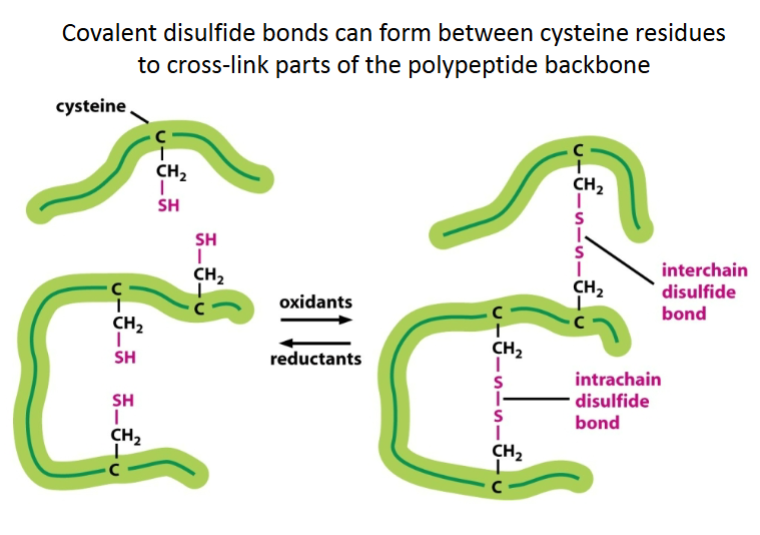
Covalent Di-Sulfide bond (3ary structure)
OXIDATION rxn between two cysteine residues
cross-link two parts of backbone
STABLIZE 3ARY STRUCTURE
NOT NECESSARY FOR FOLDING !!!!
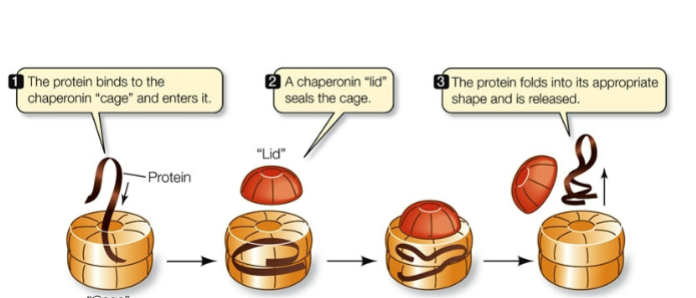
Chaperonins
Not all proteins fold spontaneously
molecular chaperones provide an isolated chemical environment in which they can fold
(can also hydrolyze ATP/ add energy!)
What are Prions
PROTEIN-based infectious diseases
abnormally folded protein that converts normal protein to alternative state = LETHAL to neurons
transferred via BRAINS
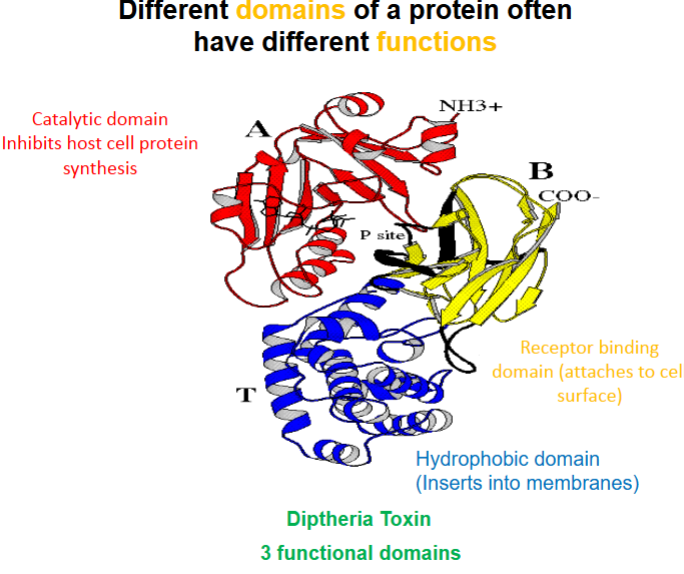
What is a Protein Domain
An independently-folding region of a protein
(can have one or multiple)
represents functional region
Quaternary Structure
different types
het v homomers
arrangement of multiple 3ary structures
DRIVEN by: hydrophobic fx
held together by:
H-bonds
some Disulfide bonds
Homomers
Identical subunit polypeptides
Heteromers
1+ different subunit polypeptides
What is a DNA-binding motif?
Similar domains which occur in many related proteins
Structural feature of a protein that enables it to recognize and bind specific DNA sequences.
What are Post Translational Modifications
COVALENT modification of aa side chains.
changes their chemical properties
A given protien can have diffwrent modifications sites which may or may not all be used at the same time.
Proteolytic Cleavage
removes an amino acid
Covalent Protein Modification:
Phosphorylation
what it is
who dunnit
what it do?
add - Phosphate to R group of NP aa:
Ser, Thr, Tyr
catalyzed by PROTEIN KINASE
reversible via phosphatase
can drive major structural changes, solubility, activity
can create new recognition sites
What is:
Kd?
Vmax?
Kd = disassociation constant (how likely two molecules are to come apart)
Vmax = fastest rate that enzyme can create a product
What is Ubiquitylation?
COVALENT attachment of Ubiquitin (small protein) to protein @K (reversable)
Serves as a tag:
marks for degradation
directs protein to specific location in the cell