8.1.6 Manage child presenting with anomaly of BV
 Call Kai
 Learn
 Practice Test
 Spaced Repetition
 Match
 Flashcards
 Knowt Play
1/30

There's no tags or description
Looks like no tags are added yet.
31 Terms
What is near esotropia, and how is it managed?
Unrelated to refractive error or accommodation
No amblyopia as BSV is present at distance
Management: squint surgery
What is convergence excess esotropia, and how is it managed?
Caused by a high AC/A ratio causing excessive accommodative convergence
Loss or reduced BSV at near
Management: bifocals or surgery
What is cyclic esotropia, and how is it managed?
Present at regular time intervals
Patients/parents may notice strict daily pattern
Unlikely to cause amblyopia as BSV for periods of time
Often decompensated into constant esotropia
Management: surgery (medial rectus recession)
What is distance esotropia, and how is it managed?
Possible suppression at distance
BSV is usually functioning at near
Management: full cycloplegic refraction or surgery
Differentiating near vs convergence excess ESOT
Perform a cover test at 33cm with a +3.00D lens in front of each eye.
A near ESOT won’t change size behind a +3.00D.
The purpose is to relax accommodation, thereby reducing accommodative convergence.
What is full accommodative esotropia, and how are they managed?
Caused in infants with +3.00D to +6.00D hyperopia
Management:
Full correction eliminating need for accommodation.
Treat any pre-existing amblyopia
No surgery! It will develop into EXO deviation later
Differentiating intermittent distance esotropia vs cranial nerve VI palsy
Distance esotropia will have full motility, whereas CN VI palsy will result in limited abduction
Distance esotropia will induce suppression whereas CN VI palsy will cause acute onset horizontal diplopia
CN VI palsy often presents esotropia for near fixation
What are the characteristics of constant esotropia with an accommodative element?
Onset: 18 months - 3 years
Expected refraction of +3.00D to +6.00D
Large angle at all distances but bigger at near
Can be reduced but not fully resolved with correction.
Suppression will develop
How is constant esotropia with an accommodative element managed?
Full correction
Prisms
Treat amblyopia
Squint surgery
What are the characteristics of constant esotropia without an accommodative element?
Onset: 4 months
Large angle greater than 30∆
Not associated with refractive error.
Similar size at distance and near
Usually alternates
What are the associations of constant esotropia without an accommodative element?
Overacting inferior obliques
(Elevation of each eye when adducted)
Cross fixation
Esotropic eye is used to look in direction of deviation. (Will appear like there is limited abduction in the normal eye)
How is constant esotropia without an accommodative element managed?
Correct refractive error
Treat any amblyopia
Surgery is unpredictable as patient may prefer to converge.
What is sensory esotropia, and how is it managed?
- Result of severe visual impairment in visual development
Management:
Botulinum toxin
Surgery
What is consecutive esotropia, and how is it managed?
Surgical overcorrection of exotropia
Management:
Prisms
Surgery
What is Brown Syndrome, and what are the clinical signs in primary gaze, elevation in adduction and elevation?
Primary gaze
It will appear there is no deviation
Elevation in adduction
Affected eye will adduct and slightly depress
Elevation
Exo V-pattern will be observed.
Superior rectus appears to be overacting causing eyes to abduct
What are the congenital causes of Brown Syndrome?
Short anterior superior oblique tendon
Tight superior oblique tendon
Swelling at superior oblique tendon
What are the acquired causes of Brown Syndrome?
Injury to the trochlea
Rheumatoid arthritis may give rise to a nodule on the tendon
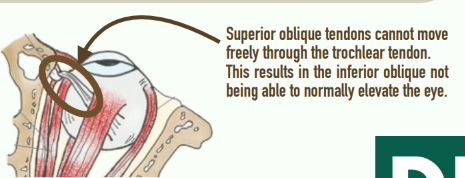
What causes the restricted elevation in Brown Syndrome?
Superior oblique tendons cannot move freely through the trochlear tendon. This results in the inferior oblique not being able to normally elevate the eye.
How is Brown Syndrome managed?
Treat amblyopia
(Amblyopia is present in up to 15% of patients)
If acquired:
2/3 resolve spontaneously
NSAIDs / steroids
Surgery after 12 months when stable
Surgery
(Most patients don’t require surgery - the symptoms become less noticeable as the child gets taller)
Tendon spacer to lengthen the tendon
What is Duane Syndrome?
Retraction of the globe on attempted adduction (co-contraction of lateral and medial rectus), resulting in narrowing of palpebral fissure.
Aetiology
CN VI nucleus is missing
CN III innervates the lateral rectus (inappropriately) and medial rectus
Onset at birth
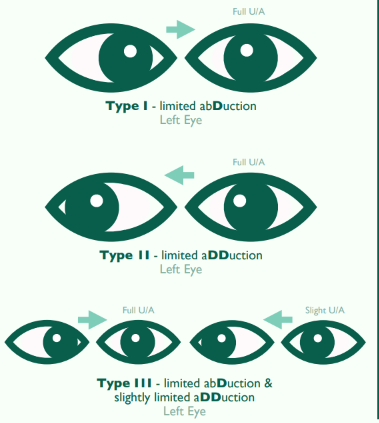
What are the three classifications of Duane Syndrome?
Classifications (count the D’s to determined the Type)
- Type 1 (most common) - limited abDuction
Esotropia in primary position, mostly straight
- Type II - limited aDDuction
Exotropia in primary position
- Type III - limited abDuction and aDDuction (less)
Esotropia in primary position
What is the significance of an abnormal head posture (AHP) in Duane Syndrome?
AHP to the SAME side of the deviation is common.
This aims to have straight eyes in primary gaze
Reduces likelihood of amblyopia
Duane syndrome
Hallmark
Retraction of the globe on attempted adduction (co-contraction of lateral and medial recti), resulting in narrowing of palpebral fissure.
Duane syndrome
Management
Prisms
Surgery
(Type I) - Ipsilateral MR recession or bilateral MR recession
(Type 2) - Recession of LR or Bilateral LR recession
What is the referral guidance regarding amblyopia and the critical period?
You should be aware of the critical period for amblyopia development and ensure prompt treatment.
You should refer children that you do not feel competent to manage or whose visual acuity does not improve after a suitable period of time.
What should you consider when referring children for orthoptic or amblyopia treatment?
If you refer the patient for orthoptic or amblyopia treatment, you should tell the patient about the likely treatment options.
An isolated finding of reduced stereopsis alone does not warrant referral into the HES, as there is no specific treatment for this.
Longstanding strabismus should be referred routinely, especially in the absence of amblyopia.
How should suspected amblyopia from ametropia or accommodative esotropia be managed in practice?
Suspected amblyopia from ametropia or accommodative esotropia should be attempted to be managed in practice with 3 month follow ups to check progress.
If no vision progress is seen with full cycloplegic refraction then a referral to HES orthoptic should be made for occlusion therapy.
What is occlusion therapy, and how much patching is recommended according to visual acuity?
Vision:
6/9 - 6/24 → 2 hours of patching
Below 6/24 → 6 hours of patching
What is optical penalisation, how is it achieved, and what are the different types?
Optical Penalisation
Blurs VA in better eye sufficient to make the worse eye work for those who can’t tolerate occlusion therapy.
Achieved with alteration of spectacle correction or cycloplegic drugs.
Near penalisation → encourage use of amblyopic eye for close work
- Instil cycloplegia usually atropine in good eye, give +3.00 ADD to amblyopic eye for monocular clear vision
Distance penalisation → encourage amblyopic eye for distance
- Add +3.00DS to good eye, this is the optimum amblyopic correction
Constant penalisation → encourage use of amblyopic eye at all distances
- Strong convex lens addition. Atropine alone does not work for severe amblyopia
What are the advantages and disadvantages of optical penalisation?
Advantages to penalisation | Disadvantages to penalisation |
|---|---|
Cosmetically better | Interaction with systemic medication (Not to be used with heart defect!) |
Good for manifest latent nystagmus | Cannot be used in severe amblyopia |
Used when occlusion therapy doesn’t work | Not suitable for older strabismic amblyopes |
How should patients undergoing amblyopia treatment be reviewed?
See patient at least every 3 months, you’re patients reviewed more regularly, more occlusion reviews more regularly.
Once VA stable for 2 consecutive visits consider stopping / tapering off occlusion.