Gonad and Sex Differentiation
 Call Kai
 Learn
 Practice Test
 Spaced Repetition
 Match
 Flashcards
 Knowt Play
1/50

There's no tags or description
Looks like no tags are added yet.
51 Terms
Male Anatomical Structures

Female Anatomical Structures

Developmental Timing of Reproductive Organs in Humans and Lifestock
Sometimes happen even before women recognize they’re pregnant

Disruptions During Early Fetal Development Can Have Major Implications
Environmental exposures to a pregnant female can alter the development of offspring and the gametes that form the grand offspring!
can impact not only the offspring, but bc the cells that are developing in the offsprings ovary or testes will produce the grandchildren of this individual that’s carrying the fetus, need to think about all the things that you might interact with during early stages of pregnancy that can impact not only child that’s being carried, but also the grand offspring of that individual

Sexual Differentiation Has 3 Phases (not gender, talking about biological sex)
Chromosomal (Genetic)
(X or Y chromosome)
Gonadal
(initiated by SRY expression in the bipotential embryonic gonad)
Phenotypic (ultimately, will differentiate into a phenotypic sex)
(induced by sex steroids)
Genetic Sex Determination (determined by DNA)
The individual is genetically MALE
There is one X and one Y chromosome
ultimate determination of genetic sex
Chromosomes in Gametogenesis (how chromosomes are divided)
Gametogenesis: production of germ cells (spermatozoa or oocytes)
Reduction of chromosomal number by half during meiosis
Somatic cells have homologous chromosome pairs and one pair of sex chromosomes (diploid)
Germ-cell precursors (germ-line stems cells; spermatogonia or oogonia) are mitotic and diploid
Meiosis in germs cells consists of two special divisions where homologous chromosome pairs segregate to individual chromatids in the resulting daughter cells (haploid gamete)
Meiosis is the mechanism for genetic diversity through homologous recombination and independent assortment of homologous chromosomes
haploid containing sperm cells will either have an X or Y
Haploid gametes (sperm and oocyte) fuse at fertilization to form a diploid embryo and becomes mitotic again
father is going to give you a sperm cell that has either an X or a Y chromosome

Chromosomal (Genetic) Sex Determination
Sex chromosome pairs are XX (homogametic) in female, and XY (heterogametic) in males
Meiosis in XX females always produces oocytes with an X chromosome
Meiosis in XY males results in half of the sperm carrying an X chromosome and half carrying a Y chromosome
At fertilization, the sex chromosome of the sperm determines the chromosomal (genetic) sex of the embryo
from mom’s side, we can only get a single X bc woman have two X chromosomes, whereas men have an X and a Y

Genetic Sexual Determination
Under normal physiological conditions:
If a Y chromosome is present, the individual is genetically and phenotypically male, no matter how many X chromosomes are present
when you receive a Y chromosome from your father, that individual will become a phenotypic male
If there is no Y chromosome, the individual is genetically and phenotypically female
It is not uncommon for development to occur under non-normal physiological conditions
Terminology of Sex Differentiation
Sex-determining Region of the Y-chromosome (SRY) = Testis Determining Factor (TDF)
Anti-Mullerian Hormone (AMH) = Mullerian Inhibiting Substance (MIS) = Mullerian Inhibiting Factor (MIF)
SRY-High Mobility Box containing gene 9 (SOX9)
Fibroblast Growth Factor 9 (FGF9)
Wingless-related MMTV integration site 4 (Wnt4)
Paramesonephric ducts = Mulllerian ducts
Mesonephric ducts = Wolffian ducts
Basis of Phenotypic Sex is Genetic (but in rare cases not chromosomal) (based on Y chromosome, not just Y itself)
Y chromosome carries SRY, the testis determining gene
when SRY is present on Y chromosome (99.99%), the gonadal sex & the phenotypic sex will differentiate this early gonad into male
SRY normally leads to male gonadal and phenotypic sexual differentiation of the bipotential indifferent gonad
early gonad into male
Sex determination occurs specifically by the presence of SRY, not the Y chromosome itself
are instances where SRY gene gets translocated to another chromosome or the X chromosome
SRY gene turns on
even though you don’t have a Y chromosome, you can still be phenotypically male
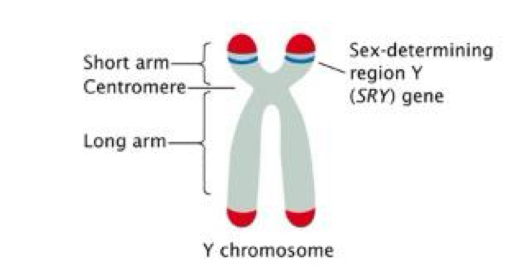
SRY Starts the Process of Producing a Male
The SRY gene codes for a transcription factor that binds to DNA and affects DNA function (turns gene on or off)
SRY protein binds to specific genes in the genome
Male-determining genes are turned ON
A major male-determining gene is SOX9
SOX9 is also a transcription factor and binds in multiple regions of the genome
SOX9 is a major gene that SRY turns on
major sex-determining gene is male fetuses
Binding of SOX9 turns on more genes associated with maleness (male development)
Mutations in SOX9 can alter phenotypic sex
Sertoli Cell Differentiation Initiates Gonadal Sex Determination
The genes turned on by SOX9 affect epithelial cells of the indifferent gonad
bi-potential (can either be male or female), doesn’t know yet
These cells differentiate to the male cell type, Sertoli cells
defining moment when bi-potential gonad becomes unipotential & starts going down the male pathway
The presence of Sertoli cells induces the cells around them to develop along male lines
Germ cells → spermatogonia
primordial germ cells that had entered into bi-potential gonad
Mesenchymal cells → Leydig cells
in bi-potential gonad
The indifferent gonad becomes a testis
have now developed gonadal sex
went from genetic sex → gonadal sex bc of this change in gene expression & the differentiation of Sertoli cells
Sertoli Cell Differentiation Initiates Gonadal Sex Determination 2
Sertoli cells are the first cells in the bipotential gonad to differentiate in response to SRY expression
becomes a testis
Sertoli cells support the development of male germ cells
Sertoli cells differentiate intrinsically though a genetic, SRY initiated, cascade
In the absence of SRY, ovarian differentiation occurs


Molecular Pathway to Sex Differentiation
process is stepwise
default is female

Male vs Female Sexual Differentiation from Sherwood
understand both diagrams

Gonadal Sexual Differentiation
Embryonic timing is for the mouse

Gonadal Sex Differentiation 2
Sertoli cells express Mullerian Inhibiting Substance (MIS/AMH), which induces Leydig cell differentiation and testicular organization though paracrine signaling
Ovarian organization occurs in the absence of SRY induced testicular development (default pathway)

How Do These “Male-determining” Genes Make a Phenotypic Male??
Presence of a proper functioning testis, and the hormones it secretes, induces the fetus to develop into a male
Phenotypic Sexual Differentiation is Dependent on Endocrine Signaling
Once gonadal sex is established, the Leydig cells of the testis become to produce testosterone
we’ve gone through genetic & gonadal sex development
what’s the next steps that will force us to have complete phenotypic male genitalia versus female?
really driven by hormone testosterone

We are all the same, until we’re not. Phenotypic Sex Differentiation (can’t tell difference b/w male & female phenotypically at these early stages)
Reproductive tract precursors for both sexes are formed and exist simultaneously before gonadal sex differentiation
After gonadal sex determination (formation of the testes), either the male (Wolffian), or female (Mullerian) ducts will differentiate while the other will degenerate
leydig cells begin to produce testosterone
what whole process is driven by (what ducts?)
phenotype will begin to change
Hint for remembering the names: Latin word for woman: mulierem, Portuguese word for woman: mulher, Spanish word for woman: mujer

Phenotypic Sex Differentiation Relies on Hormones from Newly Developed Testes
Sertoli cells secrete Mullerian Inhibiting Substance (MIS or AMH)
MIS causes degradation of Mullerian ducts
MIS induces Leydig differentiation
Leydig cells produce Testosterone
Testosterone promotes survival of the Wolffian duct (forms internal ductal system) (in a male fashion)
Testosterone is converted (DHT) in the target organ (in external genitalia)
Induces differentiation of external genitalia (penis, scrotum, etc.)
male development is all driven by the production of testosterone & subsequently the conversion of testosterone to dihydro… will develop the phenotype of a male

Testosterone and DHT are Powerful Hormones Directing Phenotypic Sex Differentiation
Urogenital sinus produces bladder, urethra, prostate, and bulbourethral glands
last 2 are male

Female is the Default Pathway for Phenotypic Sex Differentiation
Absence of androgens (& testosterone, DHT) and MIS leads to Wolffian duct regression
Mullerian ducts differentiate into oviducts, uterus, cervix, and upper vagina
External genitals form clitoris and labia
Urogenital sinus forms the bladder, urethra, and lower vagina
Sexual differentiation is independent of female hormones such as estrogen which are high in fetal environment of the maternal uterus for both sexes
cannot depend on estrogen, everything would be single sex (female)
dependent on fetus testicle-derived testosterone
fetus in uterus
being drowned in estrogens, progesterone from mom
lipophilic hormones, can pass from mother to fetus easily


Sexual Differentiation Requires Proper Development of Gonads and Associated Ducts and Tissues

External Genitalia Differentiate from Common Precursors (all the same until we’re not, externally)
Before gonadal sex determination, external genital precursors are also the same in male and female embryos. External genitalia of both sexes arises from common precursors

Androgens Drive Differentiation of External Genitalia
Male sex hormones (androgens) masculinize the reproductive system

Not everything goes as planned…
Disorders of Sexual Development (DSD)
Broad range of abnormal male or female development ranging from true hermaphroditism (evidence of both sexes, have both an ovary & a testi developing at the same time) to minor hypospadias (urethral opening forms on the underside of the penis rather than the tip (problems with sex chromosomes being too many or not enough)
Sex Chromosome DSDs (XX/XY mosaicism, XO Turners syndrome, XXY Klinefelter syndrome, SRY mutation/translocation)
Ovotesticular DSD (rare, ~1:20,000 births)
True hermaphroditism (can occur in XX or XY individuals)
XY DSDs
Certain male-determining genes (Sox9, MIS, 5-alpha reductase, etc.) are non-functional
Ambiguous external genitalia and phenotypes ranging from simple infertility to intersexuality
XX DSDs
Ovaries present but external genitalia appear male or mixed. The internal female reproductive glands are usually normal
Chromosomal Disorders of Sexual Development (DSD)

Ovotesticular DSD: True hermaphrodite

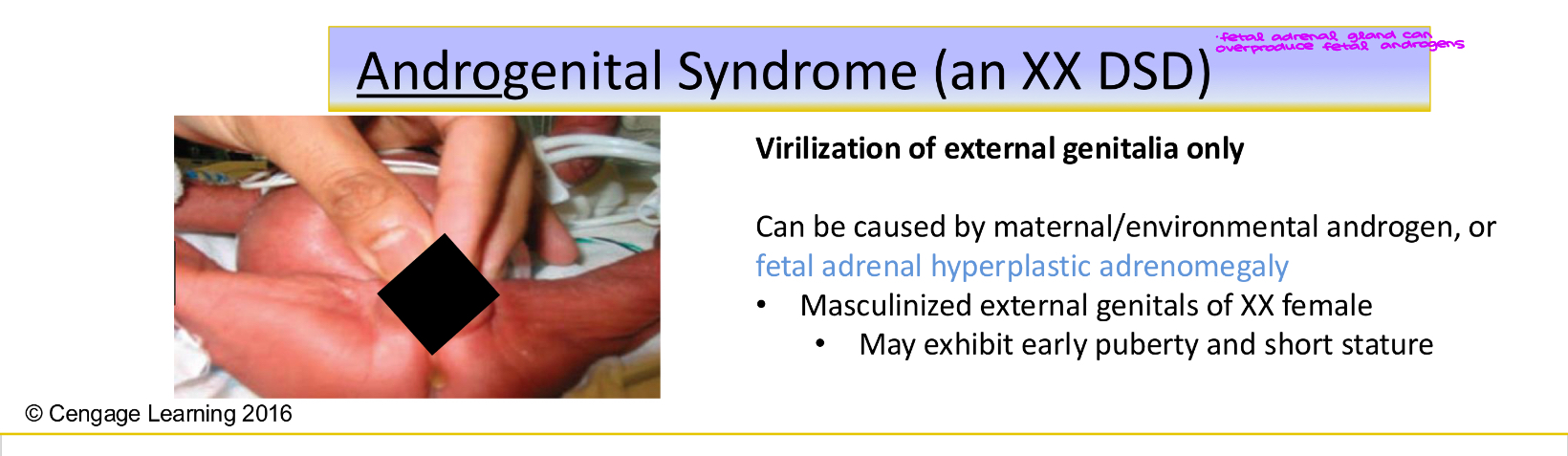
Androgenital Syndrome (an XX DSD) (fetal adrenal gland can overproduce fetal androgens)
Virilization of external genitalia only
Can be caused by maternal/environmental androgen, or fetal adrenal hyperplastic adrenomegaly
Masculinized external genitals of XX female
May exhibit early puberty and short stature
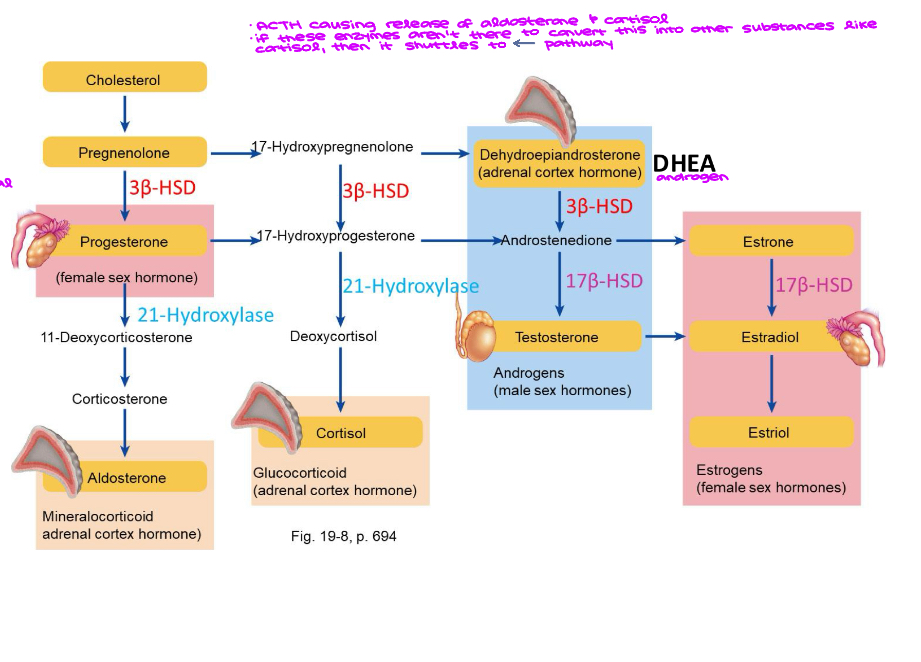
Adrenal Associated Disorders of Sexual Development (have a dysfunction of one or more enzymes in pathway, this is when fetal adrenal gland can cause some problems)
Adrenogenital = Androgenital Syndrome: Masculinizing condition in XX females due to the excess fetal adrenal DHEA production
Common form is a 21-hydroxylase deficiency
all these precursors will funnel into DHEA & you produce too much androgen
an XX female fetus producing too much androgen will then ultimately produce too much testosterone bc this pathway is getting overloaded & it can cause an unusual phenotype
Less common DSDs due to enzymatic deficiencies:
3-beta hydroxysteroid dehydrogenase (HSD) deficiency = salt wasting and DSD in both sexes
17-beta HSD deficiency = XY DSD and amenorrhea in XX females
Disorders of Sexual Development: 5-𝛂 Reductase Deficiency (when pathways are non-functional, things happen)
5-𝛂 reductase deficiency in gonadal males prevents adequate conversion of testosterone to DHT
Lack of DHT prevents fetal development of external male genitalia
male genitalia appear female or ambiguous at birth
have gonadal sex of testis
Internal genitalia are normal male (testis, Wolffian Duct, seminal vesicles, epididymus, vas deferens)
Female external genitalia and female phenotype: pseudohermaphroditism
At puberty, increase in testosterone from testes causes virilization (increased growth of phallus and scrotum, male hair and muscle growth and male phenotype begins)
most individuals (if severe enough) get raised as females until they hit puberty
start to develop secondary sex characteristics of a male
“guevedoce” = penis at 12
huge amount of testosterone will start to convert clitoris to looking more like a penis

Disorders of Sexual Development: Testicular Feminization Syndrome = Androgen Insensitivity Syndrome (failure of androgen receptor)
Androgen insensitivity at the target organ tissue leads to feminization in genetic (XY) males
Caused by an androgen receptor defect, severity of receptor mutation correlates with phenotype
Testes are present and produce testosterone, the lack of functional receptor prevents the typical male external and internal phenotypic sexual differentiation
fetus is male, producing testosterone, but receptor for testosterone is defective
have a functioning testis that’s producing testosterone, but none of rest of it can be recognized
both external & internal phenotype appear to be female
individuals are sterile, have testis & female reproductive parts, but this is true form of XY phenotypic female
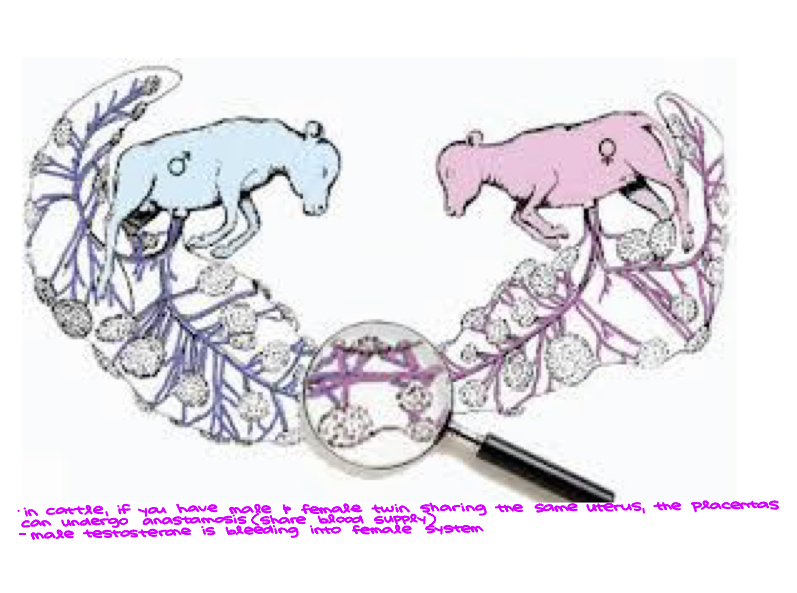
Altered Sex Differentiation Can Be External to the Fetus (in livestock production, can happen when we have twins)
Freemartin (condition name)
Most common intersex condition in cattle
Very rare in small ruminants
Dizygotic twins where one is male and the other is female
Anastomoses of placental vasculature
Androgens and AMH from male twin masculinizes the female twin
Creates a somatic chimera
About 90-95% of female calves born to a male twin will be sterile
Abnormalities in External Male Genitalia
Odd external genitalia
Abnormalities in External Female Genitalia
We still eat the, not good for repro
ICQ #1: The failure of ___ ___ to convert ___ into ___ would most likely result in altered ___ genitalia
Leydig cells, estrogen, testosterone, external
Target tissue, testosterone, DHT, external
Leydig cells, testosterone, estrogen, internal
Sertoli cells, estrogen, testosterone, internal
Sertoli cells, estrogen, testosterone, internal
None of the above are likely
ICQ #2: In the XY chromosome bearing fetus, genetic sex is determined by the expression of a specific gene on the Y chromosome. If this gene is present but has an inactivating mutation, what is the most likely result?
Sox9 and other male determining genes will still activate and the offspring will appear male
Wnt4 will activate FGF9 and other male determining genes and the offspring will appear male
Sox9 will not be expressed properly, no activation of other male determining genes and the offspring will appear female
Sertoli cells of the XY fetal testes will make testosterone regardless of the gene mutation and the offspring will appear male
If the male determining genes are not expressed, 5-alpha reductase will strill produce DHT from adrenal andorgens and the offspring will appear male
Gonadal Sex is Not Yet Determined When Germ Cells Arrive at Primitive Gonad
During primordial germ cell (PGC) generation and proliferation, phenotypic sex is still undetermined
Same process occurs in males and females
PGCs originate at a very early stage (gastrula, ~2 weeks)

Somatic Cells Play a Crucial Role in Germ Cell Development
From an evolutionary perspective, the sole role of all somatic cells is the generation, proliferation, protection, and dissemination of germ cells
somatic cells help germ cells make next generation
eyes, ears, skin cells
purpose is to make sure you can deliver a gamete to next generation
make sure gametes are produced properly
Somatic cells provide the microenvironment or “stem cell niche” conducive to primordial germ cell survival
Germ cells are responsible for generating genetic diversity through meiosis and transmitting DNA to subsequent generations
Microenvironment of the Developing Testes Transforms Primordial Germ Cells to Spermatogonia
PGCs begin to line up on tubules & begin to differentiate into spermatogonia in the male
microenvironment of the testis transforms a primordial germ cell

Microenvironment of the Developing Ovary Transforms Primordial Germ Cells to Oogonia
PGCs spread out in cortex of developing ovary
microenvironment will allow oogonia to continue mitosis & ultimately convert them into meiotic oocytes

Germ Cells of the Fetal Gonad
Males
Mitotic germ cells (spermatogonia) embed in seminiferous tubule along Sertoli cells
Spermatogonia are then quiescent until puberty (after they form in fetus)
~12-14
spermatogonia go to sleep after they’re developed
Females
Germ cells (oogonia) continue with mitosis (continue to divide)
Enter meiosis during fetal development and become meiotically quiescent (oocytes are in meiotic arrest until puberty)
Primordial Germ Cells Differentiate to Oogonia in the Ovary
Oogonia proliferate via mitosis (generate large # of oocytes)
Enter first phase of meiosis and then become quiescent (meiotic arrest)

And now we wait until puberty…
Hypothalamus and Pituitary Control Many Endocrine Functions

Reproductive Hormones to Know
what these hormones do, where they come from, what is their basic fxn
understand how these things work together & how the feedback mechanisms are working in order for us to have a fxn

Reproductive Hormones to Know 2

Summary
Gonadal development occurs early in gestation any errors or external environmental effects can have profound impacts on the offspring and the subsequent generations
Genetic sex is determined by the Y chromosome and subsequent expression of SRY under normal conditions. In the absence of SRY expression, female is the default sex
Sex determination requires more than SRY expression. Subsequent gene expression, enzyme and hormone activity are critical for proper development gonadal and phenotypic sex
Abnormalities in gonadal and phenotypic sex development are common
Primordial germ cells enter an undifferentiated gonad, but the influence of somatic cells determines their differentiation into either spermatogonia or oogonia