Limbic System (Sep 29)
 Call Kai
 Learn
 Practice Test
 Spaced Repetition
 Match
 Flashcards
 Knowt Play
1/69

There's no tags or description
Looks like no tags are added yet.
Name | Mastery | Learn | Test | Matching | Spaced | Call with Kai | Chat |
|---|
No analytics yet
Send a link to your students to track their progress
70 Terms
What is the limbic system structurally?
Series of nuclei (grey matter) connected via white matter tracts
What does the limbic system govern?
(HOME) Homeostasis, Autonomic, + Neuroendocrine Control. Olfaction. Memory (episodic). Emotion + behavioural responses, + Social Processing
What are the 2 types of memory?
Long term memory and not-long memory.
What are the divisions of not long-term memory?
[Image]
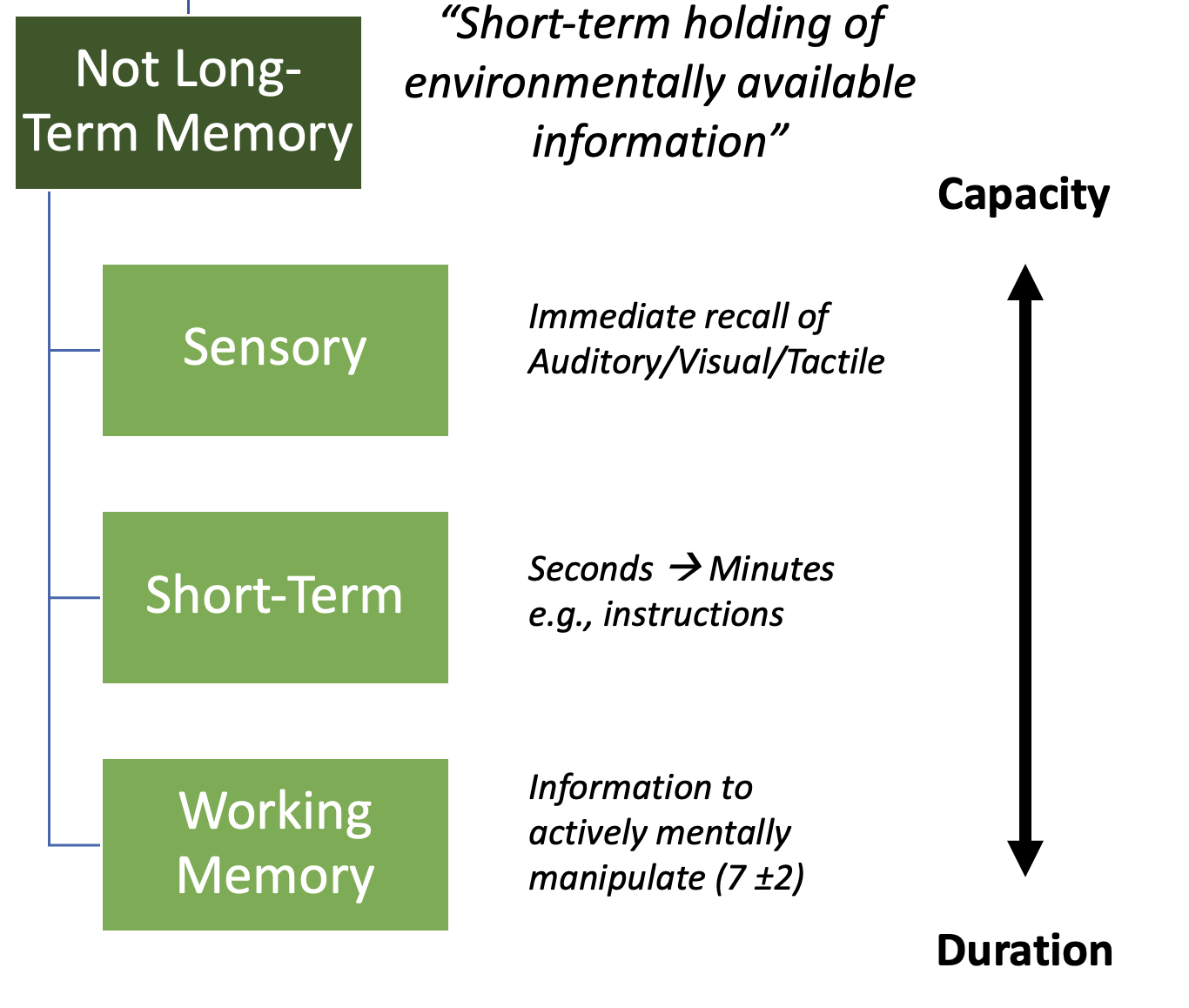
What are sensory, short-term, and working memory?
(1) Immediate recall of auditory/visual/tactile. (2) Seconds to minutes. (3) Information to actively mentally manipulate (7+-2)
What are the 2 types of long-term memory?
Declarative (explicit): conscious access to. Nondeclarative (implicit): minimal conscious awareness of + automatic.
What are examples of declarative (explicit) memory?
Episodic (important autobiographical events). Semantic (Things you’ve learned but may not have linked to an event).
What is an example of nondeclarative (implicit) memory?
Procedural (motor skills + abilities).
What is short-term memory?
Acquisition + short-term storage of declarative (events or facts) memories.
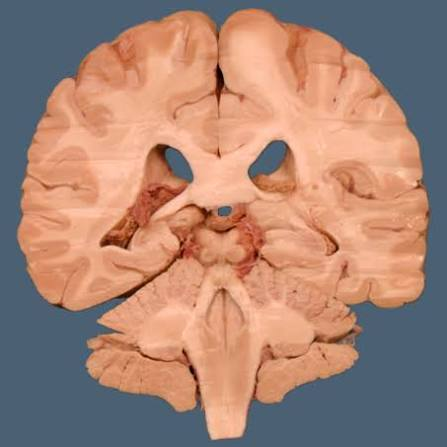
What is the location of short-term memory?
Medial temporal lobe (limbic system - thalamus, amygdala, hippocampus). [Image]


What is the location of declarative memories?
Neocortex - surface grey matter (somatosensory, visual, etc. cortex). [Image]


What is the location of procedural memories?
Cerebellum + basal nuclei. [Image]

What is the process of long-term memory storage?
Acquire + organize, encode + consolidate, store + retrieve.
Locationally, what is the process of long-term memory storage?
(1) Frontal lobe (attention). (2) Hippocampus, fornix, diencephalon, loop of Papez (limbic system). (3) Cortex.
What does the fornix do?
White matter tract
What does the thalamus do?
Relay to cortex
What do the mamillary bodies do?
Relay to thalamus.
What does hippocampal formation do?
Memory.
What does amygdala do?
Fear, emotional regulation.
What does the hypothalamus do?
Endocrine + ANS.
What does the olfactory bulb do?
Smell

Diagram of subcortical structures [Image]?
[Image]

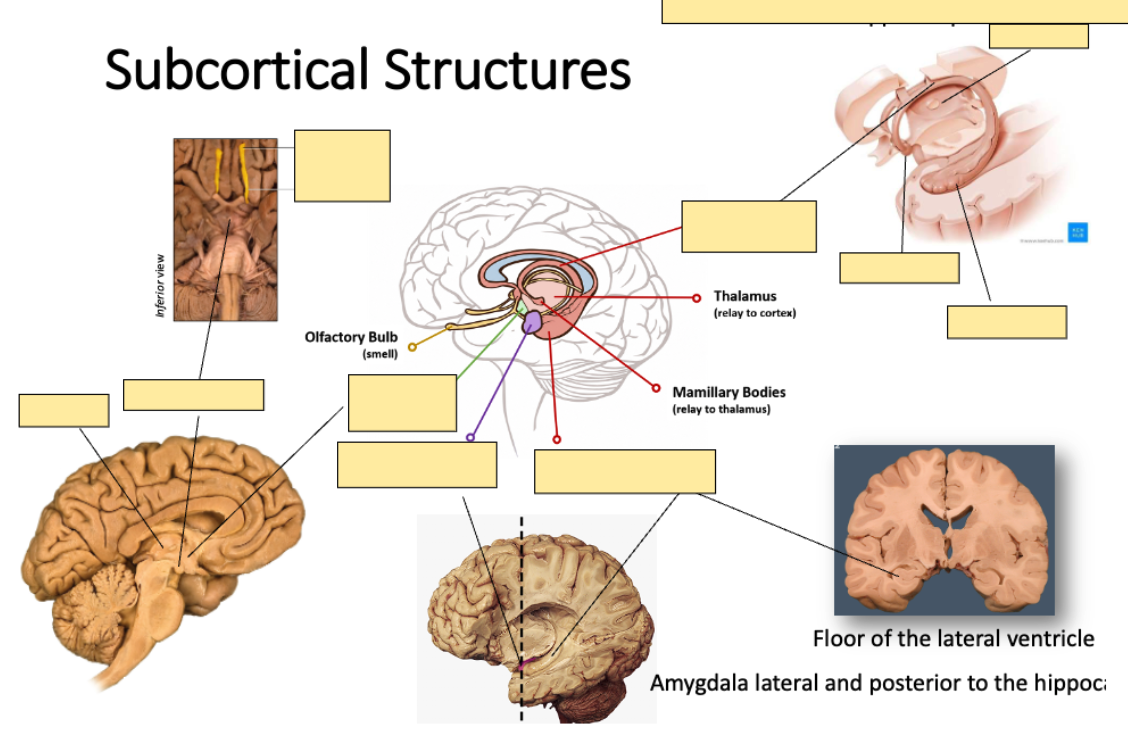
Specimens for subcortical structures [Image]?
[Image]

What does the fornix connect?
Hippocampus to mamillary bodies.
Describe where the hippocampus is located?
Floor of the lateral ventricle.
Describe where the hippocampus is located relative to the amygdala?
Lateral and posterior to the amygdala.
What is the cingulate gyrus?
Superficial grey matter spanning all lobes.
What is the uncus?
Overlies amygdala
What is the parahippocampal gyrus?
Entorhinal cortex.

Diagram of cortical structures [Image]?
[Image]

What is limbic white matter?
Internal loop = subcortical structures. External loop = cortical structures.
Describe the Loop of Papez?
Cingulate cortex pulls in information from senses (smell, touch, vision), sending to entorhinal cortex to the hippocampus. Info is sent through the fornix, in an internal loop to mamillary bodies. Through mammilothalamic tract, info sent to anterior thalamic nuclei. If we want to remember the info, sent back to the cingulate cortex. Cingulate cortex sends to prefrontal cortex to affect decision-making.

Picture of the loop of Papez [Image]?
[Image]

What functions is the amygdala critical for?
Learning through reward + punishment. Social communication (detecting emotion in others). Threat detection and assessment (appropriate response when fearful) - Trigger autonomic NS (sympathetic).
What does damage to the amygdala cause?
Disinhibition, impaired emotional memories, panic, anxiety
What do connections between amygdala and hypothalamus enable?
An autonomic response to govern: (1) Emotional responses via pituitary gland. (2) Feeding (hypothalamic nuclei associated with hunger and satiety), sexual function (increases oxytocin from posterior pituitary), motivation (increases dopamine secretion outside of hypothalamus).
What is the sympathetic autonomic nervous system for?
Fight, flight, fright
What is the parasympathetic autonomic nervous system for?
Rest, relaxation, rumination, or SLUDD (Salivation, lacrimation, urination, digestion, defecation)
What is the ANS controlled by?
Hypothalamus.
What are the homeostatic stages required for the ANS?
Monitoring: Sensory receptors. Integration: Nuclei within brainstem. Response: Via ANS motor; Muscle (smooth + cardiac), glands
Describe the somatic motor nervous system?
Somatic motor neuron come out of front of the spinal cord. Myelinated. One neuron. Effector: Skeleton muscle.
Describe the autonomic motor nervous system?
Preganglionic neuron comes out of front of the spinal cord (myelinated). Autonomic ganglion (collection of nuclei in periphery). Postganglionic neuron extends to the effector (unmyelinated). Effector: Glands, cardiac muscle, smooth muscle.
What are the neurotransmitters for the somatic motor nervous system vs autonomic motor nervous system?
Somatic: ACh. Autonomic: ACh, E, or NE.
Compare PSNS vs SNS neuron anatomy.
SNS: Short preganglionic neuron; E or N for post-ganglionic neuron. PSNS: Long preganglionic neuron; ACh for post-ganglionic neuron.
What is the origin of PSNS?
T1 - L2 (thoracolumbar).
What is the origin of SNS?
CN’s III, VII, IX, X. S2-S4. (craniosacral).
Describe the distribution of nerves in the body?
12 pairs of cranial nerves. 8 pairs of cervical nerves. 12 pairs of thoracic nerves. 5 pairs of lumbar nerves. 5 pairs of sacral nerves.
What is the SNS and PNS input for the heart?
SNS = speed up HR (tachycardia) + contraction force (positive inotropy). PNS = slow HR (bradycardia), - contraction force (negative inotropy)
What proportion of organs have both SNS + PSNS input?
Most
What is the SNS and PNS input for the GI?
SNS = relaxation of system, re-routing of blood to MSK. PNS = increase digestion.
What are organs which only have sympathetic input?
Sweat glands, visceral arterioles (contraction), radial muscle of the iris (pupil dilation - mydriasis)
What are organs which only have parasympathetic input?
Iris sphincter muscle (pupil constriction - miosis)
What is the process for parasympathetic nervous system signalling?
Pre-ganglionic PSNS signals travel through anterior root, into spinal nerve and out through peripheral nerves to reach effector organ. Synapse with post-ganglionic neuron is at ganglion within, or very near-by effector.
How many preganglionic nerve per target for parasympathetic nerve?
1 preganglionic nerve = 1 target.
What does the sympathetic nervous system signal to?
(1) Sympathetic chain next to the spinal cord, information travels up and down. (2) Collateral ganglia (T + L) regions - innervate the gut. Celiac, Sup/Inf Mesenteric to GI via splanchnic nerves. (3) Adrenal gland (secrete NE into blood).
What is the process for sympathetic nervous system signalling?
Pre-ganglionic SNS signals travel through anterior root, into spinal cord and through the white ramus coommunicans into sympathetic chain. Signals travel up and down chain as required (especially in cervical and sacral regions) + branch. Synapses occur at the level where the post-ganglionic nerve exits via the gray ramus communicans (unmyelinated). SNS to viscera synapses @ collateral ganglia or Adrenal Medulla.

Image of sympathetic nervous system signalling [Image]?
[Image].

How many preganglionic nerve per target for sympathetic nerve?
1 preganglionic nerve = multiple targets.
What neurotransmitters do pre-ganglionic neurons release for SNS and PSNS neurons?
ACh.
What are SNS neuroanatomy consequences?
Short pre-ganglionic neuron = everything stimulated at once. 1 pre-ganglionic neuron synapses with many post-ganglionic neurons within the sympathetic chain or collateral ganglia.
What are PSNS neuroanatomy consequences?
Just because 1 part of the parasympathetic system is active doesn’t mean another one is. The ganglion is right inside the organ, so you can have really specific control.
What is the stress response tiered?
Limbic (Amygdala); perceives external threat, connects to hypothalamus to incite neural response. Autonomic (hypothalamus); senses internal/external disruption of homeostasis, efferent SNS/PSNS = fast short-term response. Endocrine (pituitary + adrenal); long-term perpetuation of stress response via hormones, chronic management.
What is the HPA axis?
CRH - ACTH - Cortisol. Involves hypothalamus, pituitary, and adrenal glands.


What does Alzheimer’s disease cause?
Inability to recall recent and past memories, lack of attention, disorientation, language problems, and lack of problem solving.