intro to arthrology
 Call Kai
 Learn
 Practice Test
 Spaced Repetition
 Match
 Flashcards
 Knowt Play
1/57

There's no tags or description
Looks like no tags are added yet.
58 Terms
what are the different types of joint tissue?
Fibrous, cartilaginous, synovial
fibrous means?
bones connected by fibrous tissue
cartilaginous means?
bones connected by cartilage
synovial means?
articulating surfaces enclosed within fluid filled joint capsule, freely movable, most common type
whats the degree of movement for fibrous joints
Synarthrosis
synarthrosis means
immovable (fibrous)
whats the degree of movement for cartilaginous joints?
amphiarthrosis
amphiarthrosis means
slightly moveable
whats the degree of movement for synovial joints?
diarthrosis
diarthrosis means
freely movable
fibrous joints require..
strength and stability over range of movement
fibrous joints are further classified into...
sutures (skull sutures)
gomphoses (articulations of the roots of the teeth
syndesmoses (inferior tibiofibular joint)
What are sutures?
immovable joints of the skull
linked by a thin layer of connective tissue called sutural ligament
important for birth so bones can overlap to pass through birth canal
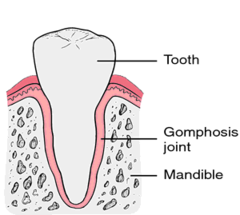
What are gomphoses?
joints that connect teeth to the maxilla or mandible (synarthroses)
immovable joints
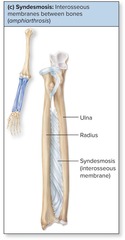
What are syndesmoses?
bones connected by ligaments
slightly movable
found in inferior tibiofibular joint and its the interosseous membrane joining the radius and ulna
whats the primary cartilaginous joint?
synchondroses
synchondroses
2 ossification centres in a developing bone that remain separated by a layer of cartilage to allow bone growth
growth plate between the head and shaft of developing bone (eventually becomes completely ossified)
whats the secondary cartilaginous joint?
symphysis
whats symphysis?
2 bones interconnected by cartilage, like in the pubic symphysis between the two pelvic bones and intervertebral discs between vertebrae.
what are the characteristics of synovial joints?
bones are separated by a narrow articular cavity
layer of cartilage (usually hyaline) covers articular surfaces, gap in x-ray (cartilage isnt shown in it)
has a joint capsule with membranes
there are some other structures inside the capsule such as articular discs, fat pads and tendons (common but not universal)
joint capsule has what?
fibrous membrane and inner synovial membrane
fibrous membrane is formed by?
what does it do?
formed by dense connective tissue
surrounds and stabilizes the joint- parts of it may thicken to form ligaments outside the capsule for more support
synovial membrane attaches to what?
attaches to the margins of the joint surfaces at the interface between the cartilage and bone and encloses the joint cavity

synovial membrane:
Highly vascular and produces synovial fluid into the articular cavity (Nutrition,
lubrication, shock absorption)
∙ Closed sacs of synovial membrane also occur outside joints to form synovial
bursae or tendon sheaths.
types of synovial joints
based on shape, based on movement
synovial joints based on shape of articular surfaces are
plane (flat), hinge, pivot, bicondylar (2 sets of contact points, condylar (ellipsoid), saddle, and ball and socket
synovial joints that are based on movement are
uniaxial (movement in one plane), biaxial (movement in 2 planes), and multiaxial (movement in 3 planes)
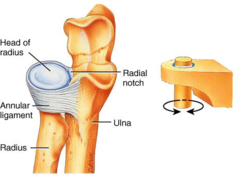
pivot joints
allow movement around one axis that passes longitudinally along the shaft of the bone; permit rotation

hinge joints
allow movement around one axis that passes transversely through the joint; permit flexion and extension, eg elbow

saddle joints
allow movement around two axes that are at right angles to each other, articular surfaces are saddle shaped; permit flexion, extension, abduction, adduction, and circumduction. eg, carpometacarpal joint of thumb

ball and socket joints
allow movement around multiple axes; permit flexion, extension, abduction, adduction, circumduction and rotation. eg hip joint
condylar (ellipsoid) joints
allow movement around 2 axes that are at right angles to each other; permit flexion, extension, abduction, adduction, and circumduction (limited)
eg wrist joint

Plane joints
allow sliding or gliding movements when one bone moves across the surface of another
eg between tarsal bones

bicondylar joints
allow movement mostly in one axis with limited rotation around a second axis; formed by two convex condyles that articulate with concave or flat surfaces
eg; knee joint
2 types of nerves in joints
autonomic and sensory
what are autonomic nerves?
These control the widening (dilation) and narrowing (constriction) of blood vessels (vasomotor function).
what are sensory nerves?
These give you proprioception (the subconscious sense of where your body parts are in space) and free nerve endings convey pain. Pain from joints is usually "diffuse and poorly localized" (it's hard to point to exactly where it hurts)
does articular cartilage have nerve supply?
no, so no pain in cartilage
whats hiltons law
The nerve that supplies a joint also supplies the muscles that move that joint, and the skin over that joint. This is why a joint injury can cause referred pain (the skin over the joint hurts, even though the injury is deep inside).
how do joints get blood?
Joints get blood from articular arteries that form a web-like network (anastomoses) around the joint. This ensures blood can get to the joint no matter how it is bent.
Blood vessels enter the synovial membrane to feed it.
is articular cartilage vascular or avascular
avascular, The articular cartilage has no blood vessels (avascular). It relies entirely on the synovial fluid to bring it nutrients.
where are the veins and what are they doing in the joint?
Veins bring the used, deoxygenated blood away from the joint. Venae comitantes means "accompanying veins"—they run right alongside the arteries, like a buddy system. Just like the arteries, these veins are mostly found tucked inside the synovial membrane.
lymphatic vessels in a joint?
Lymphatic vessels are like the body's drainage system (they carry away excess fluid and immune cells). Every joint has tiny lymphatic vessels, and they simply drain into the same paths as the tissues surrounding the joint.
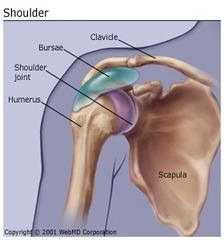
what is Bursae?
A tiny, fluid-filled sac lined by synovial membrane. (Think of it like a tiny water balloon).
where are bursae?
Between tendons and bones, or skin and bone. in synovial joints
what do bursae do?
Reduce friction and act as a cushion so muscles/tendons can glide smoothly over bones.
whats bursitis?
Inflammation of the bursa. Symptoms include localized pain and restricted movement.
Overt inflammation may not be present upon physical exam or imaging
what factors make a joint stable?
1. shape/size of the bones
2. ligaments
3. muscle tone
how does shape/size make joint stable?
If the bones fit together snugly, the joint is stable. (The hip socket deeply wraps around the thigh bone = very stable. The shoulder socket is shallow = unstable but has a huge range of motion).
how do ligaments make joint stable?
The more ligaments a joint has, and the tighter they are, the more stable it is.
how does muscle tone make joint stable?
the strength and tightness of the muscles surrounding the joint.
whats osteoarthritis (OA)?
"Wear-and-tear" arthritis. The cartilage wears away over time. Eventually, bone rubs on bone, causing pain and stiffness.
whats rheumatoid arthritis (RA)?
An autoimmune disease. The body's immune system mistakenly attacks the synovial membrane (joint capsule), causing chronic inflammation.
whats gouty arthritis (Gout)?
Caused by too much uric acid in the blood. The acid forms tiny, sharp crystals that get stuck in the joint (often the big toe), causing extreme pain and swelling.
the knee has...
Cruciate Ligaments (ACL & PCL)
Collateral Ligaments (MCL & LCL)
Menisci
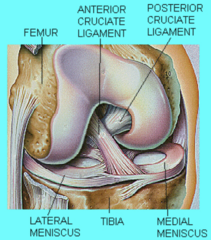
Cruciate Ligaments (ACL & PCL)?
Inside the joint, crossing each other to prevent the shin bone from sliding too far forward or backward.

Collateral Ligaments (MCL & LCL)?
On the sides, preventing the knee from bending sideways.

menisci?
C-shaped pads of cartilage that act as shock absorbers between the femur and tibia.